Ecuador and the Galapagos Part 5: Fernandina and Isabela Islands

Wednesday, March 18, 2015


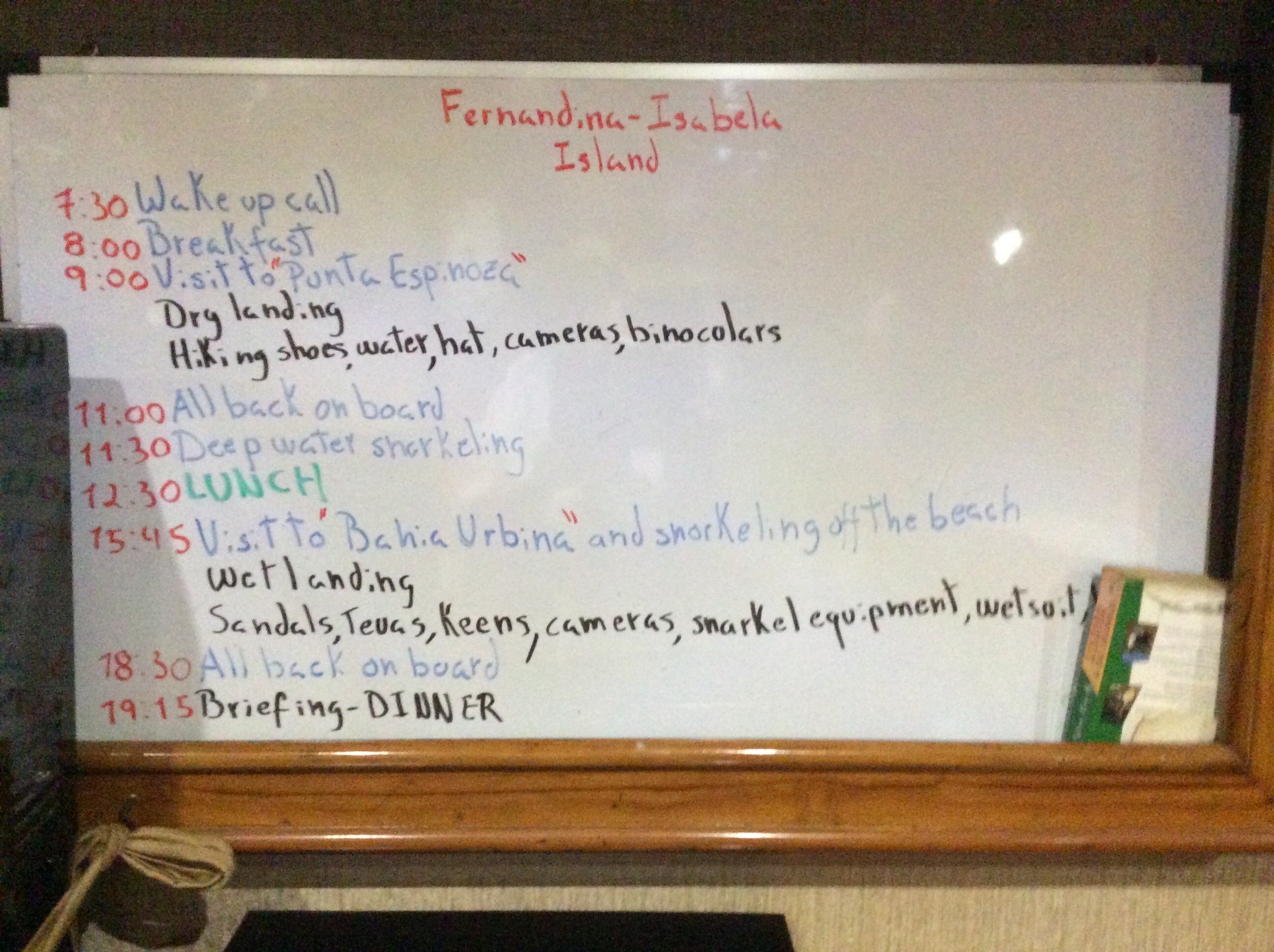
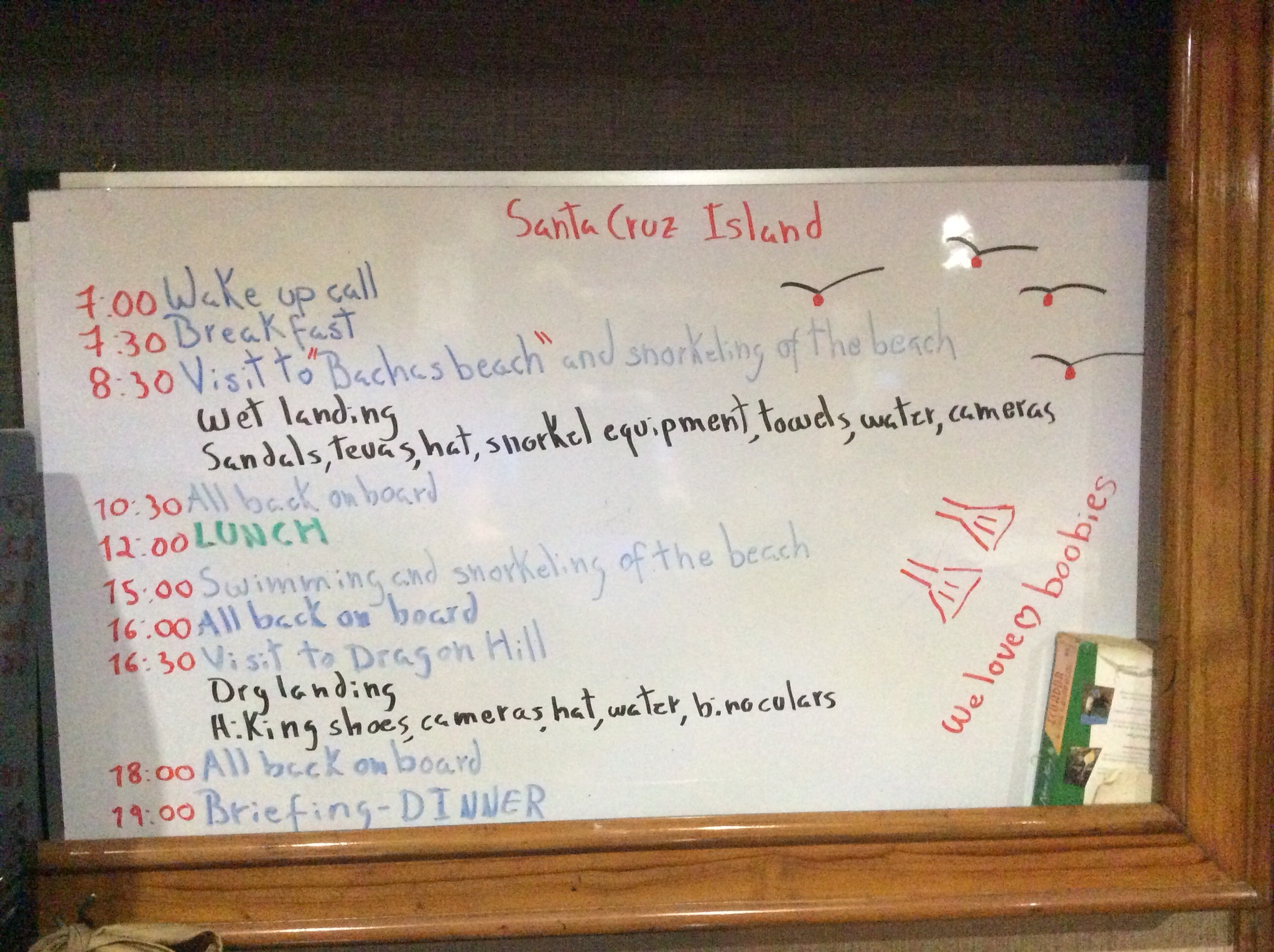
The white board:

We got to sleep in until 7:30 this morning because of the long transit time between yesterday’s stop on Santa Cruz Island and today’s activities on Fernandina and Isabela Islands. Fernandina and Isabela are the westerly islands in the Galapagos archipelago, and as such, they are the “young” islands. The volcanos are still active, and our guides told us that some visitors have been “lucky” enough to see an eruption.

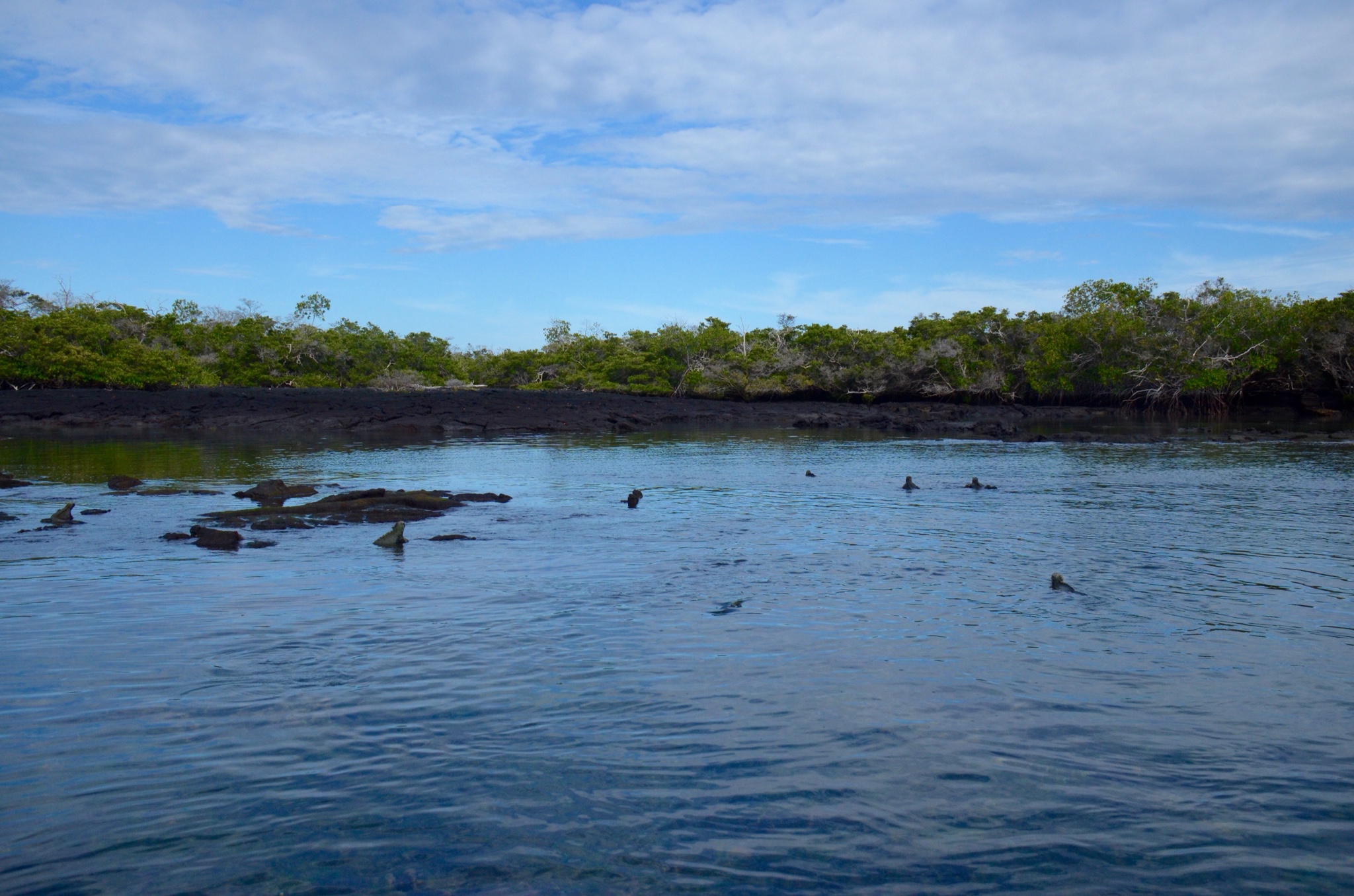
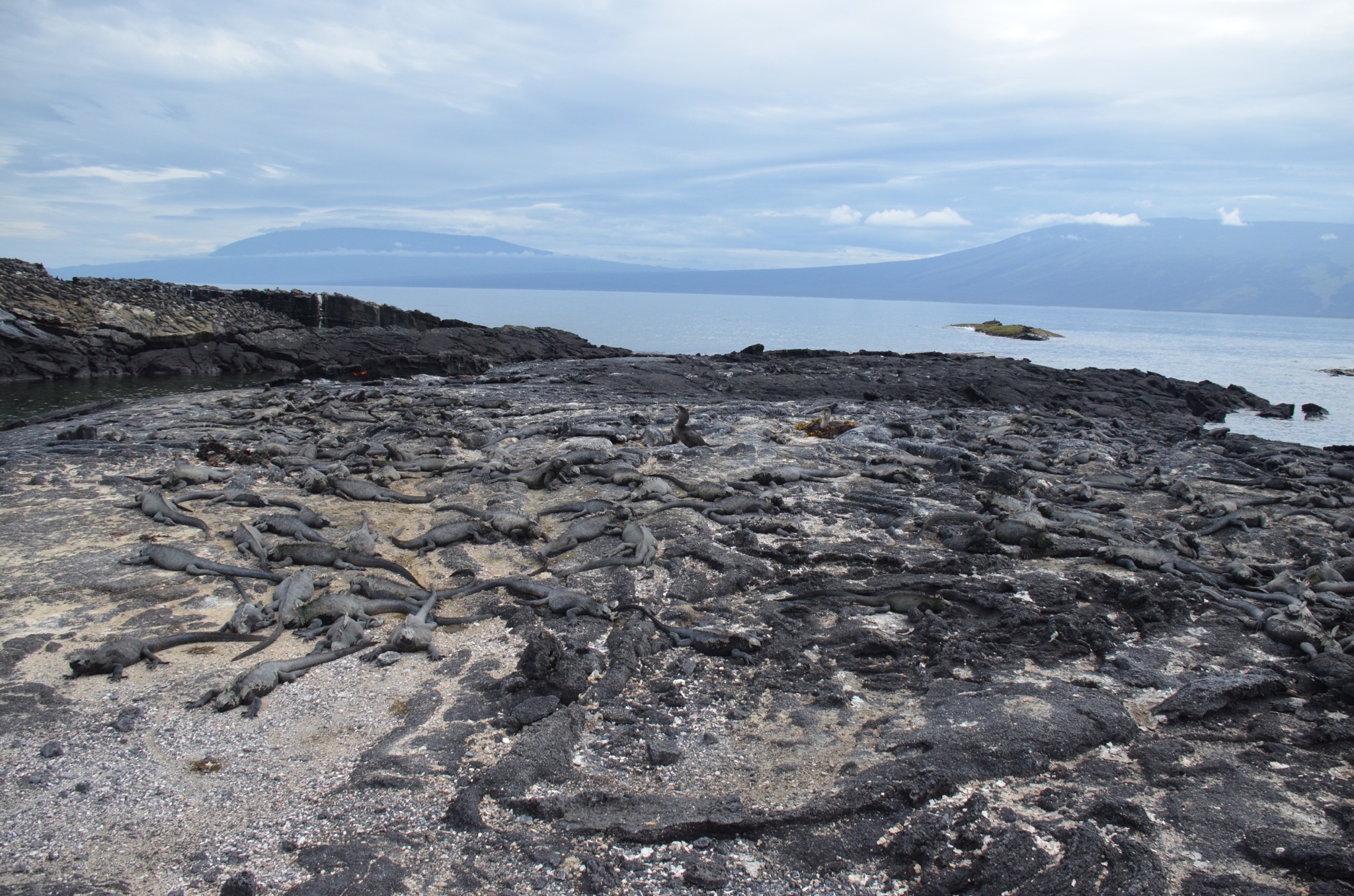
We had a dry landing at Punta Espinoza at Fernandina, and we knew it was going to be something special before we even got off the pangas. The water in the bay was filled with marine iguanas. On our previous days’ tours, we had certainly seen marine iguanas here and there, but this was something on a different scale. Their heads were sticking out of the water everywhere.

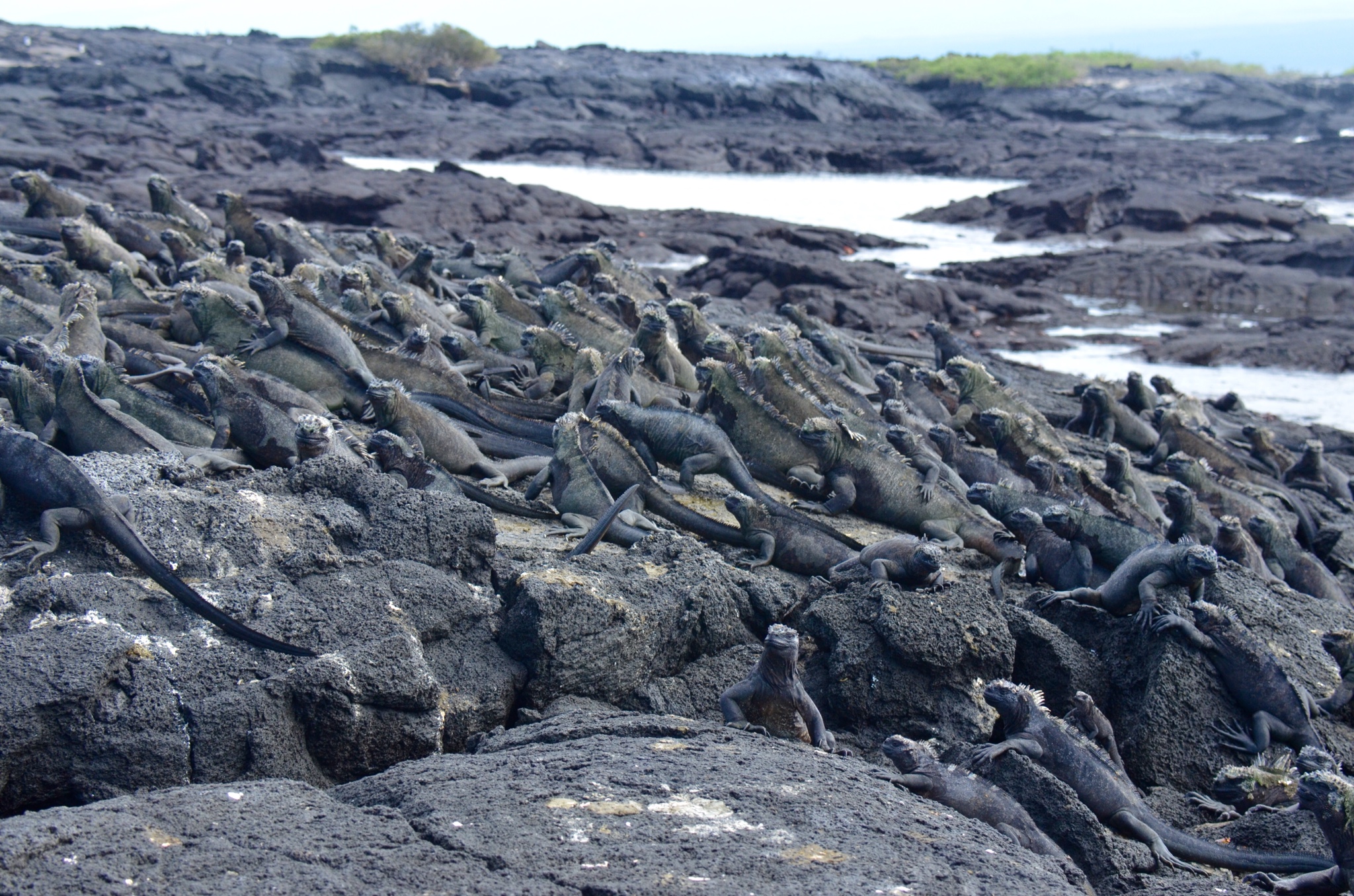
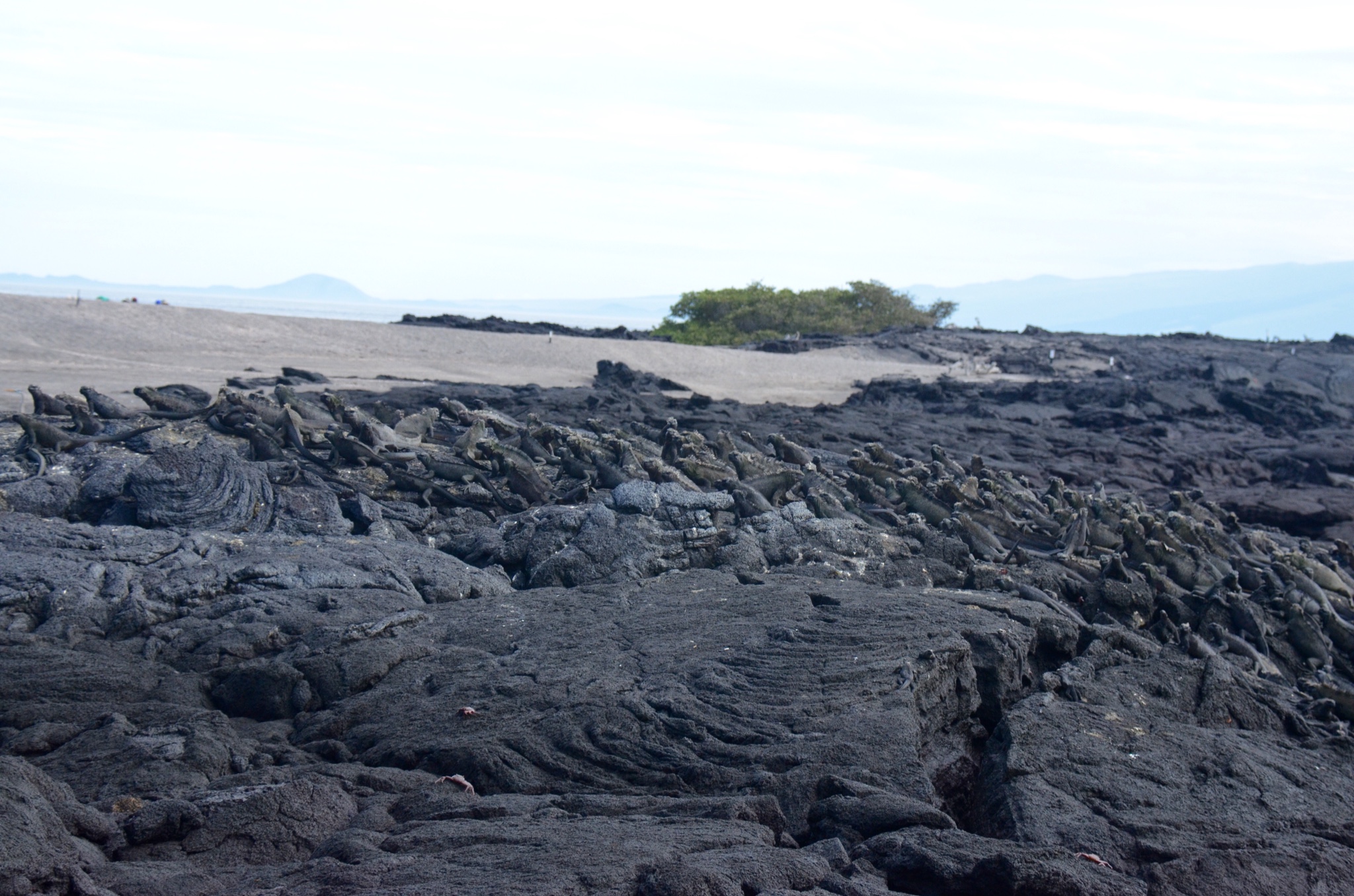
When we got ashore, it was a little difficult for our minds to accept what our eyes were seeing. At first glance, it looked like a black volcanic lava shore. Closer inspection revealed more.
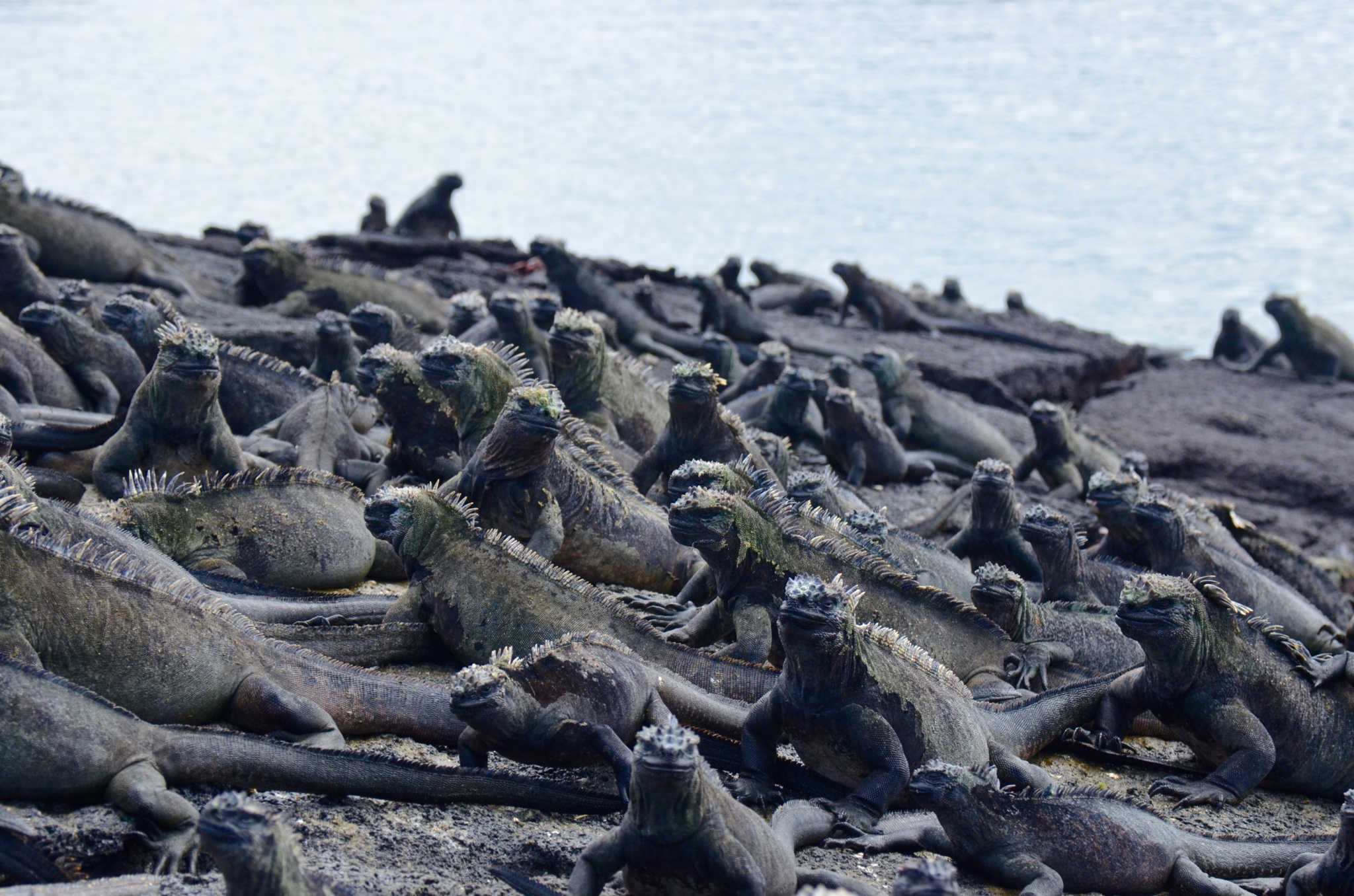
Marine iguanas everywhere.
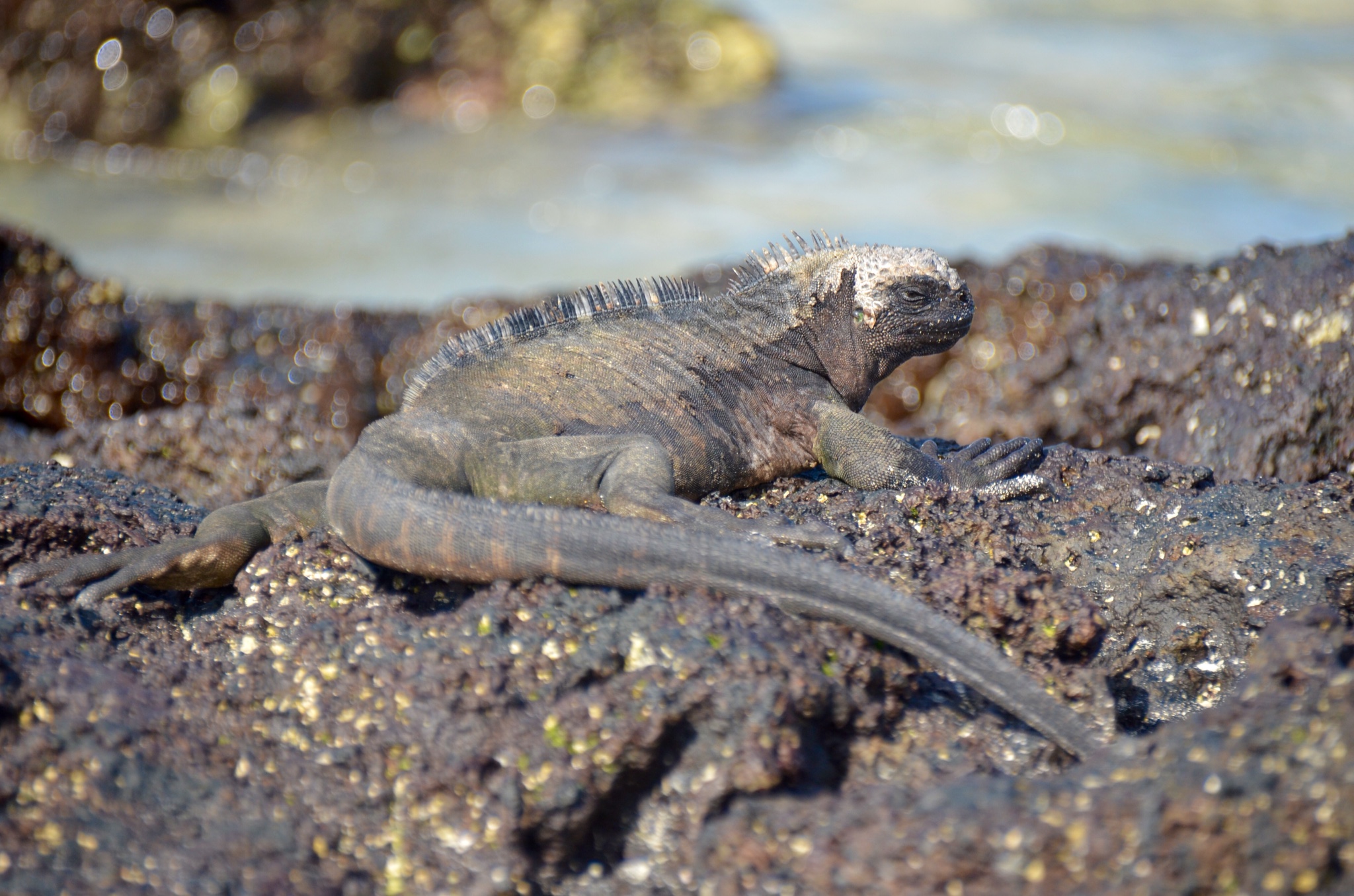
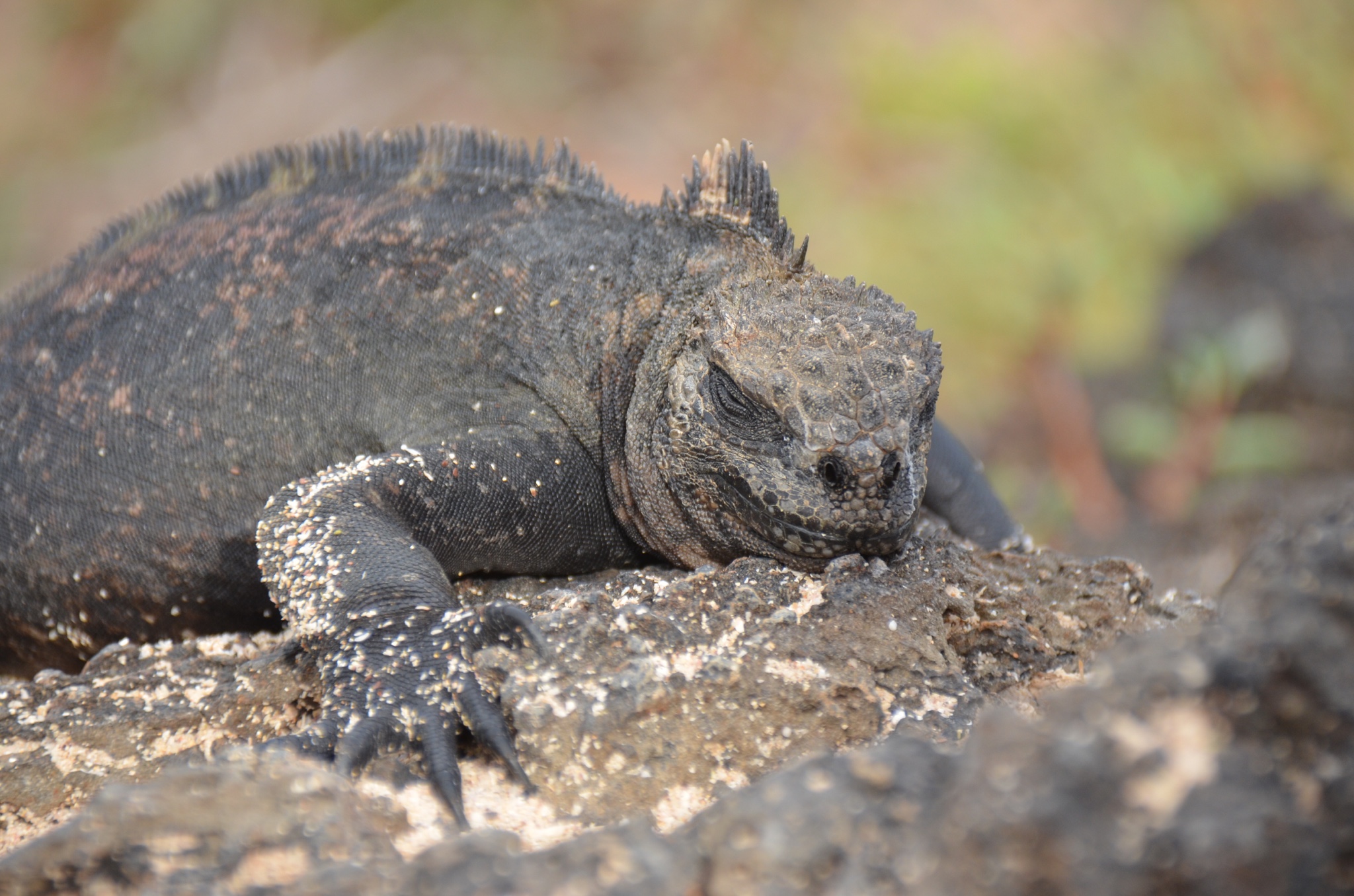
Marine iguanas are cold-blooded, and so they must absorb the heat of the sun before and after diving into the cold waters to search for algae. To avoid overheating, they vary their position in relation to the sun. Sometimes they face the sun directly to reduce their exposure to it. The colony segregates itself. These are the males.
As we watched, a sea lion grabbed the tail of a swimming iguana. Our guides said that the sea lions are “playing” with the iguanas.
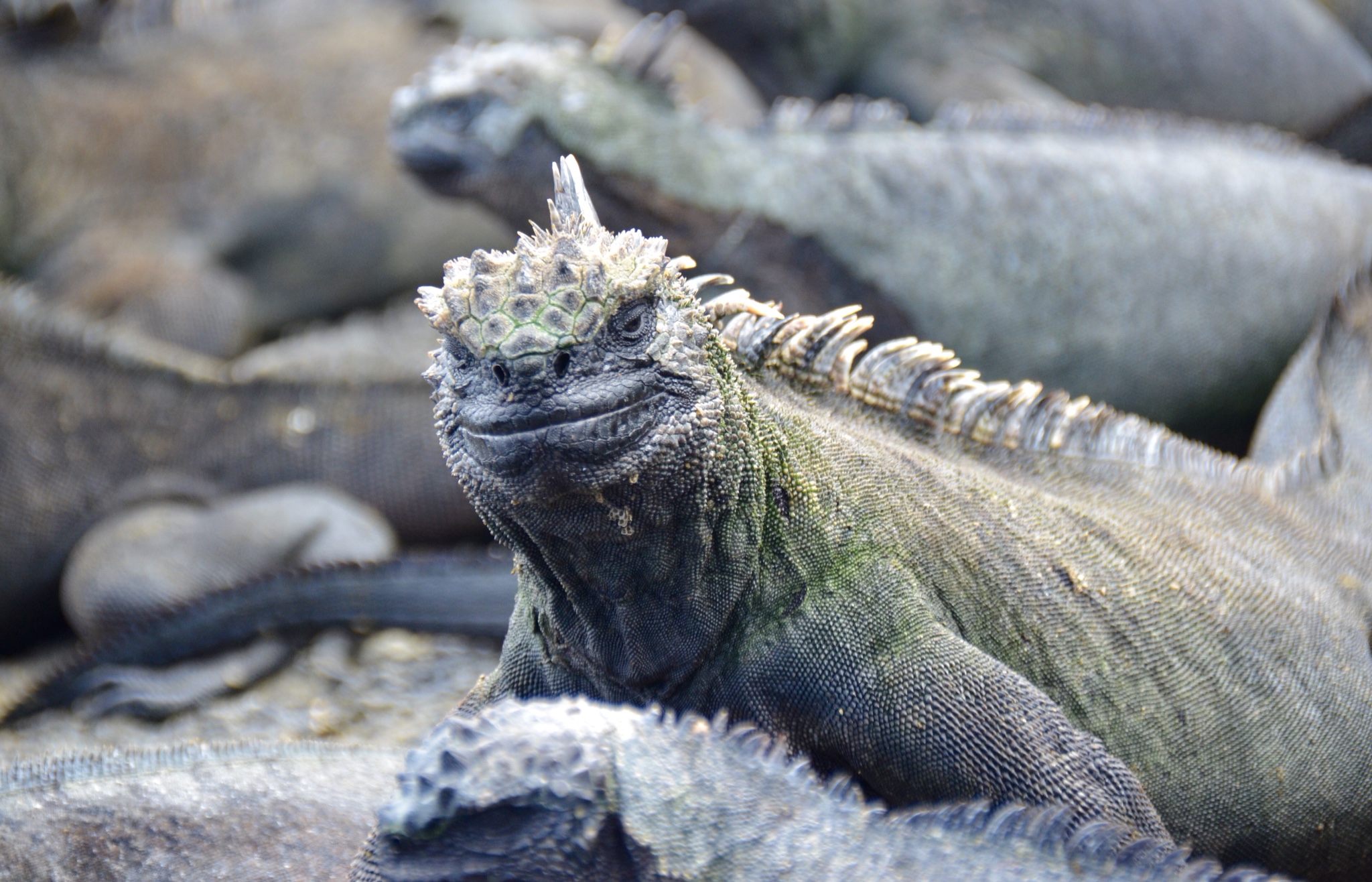
Smile for the camera!
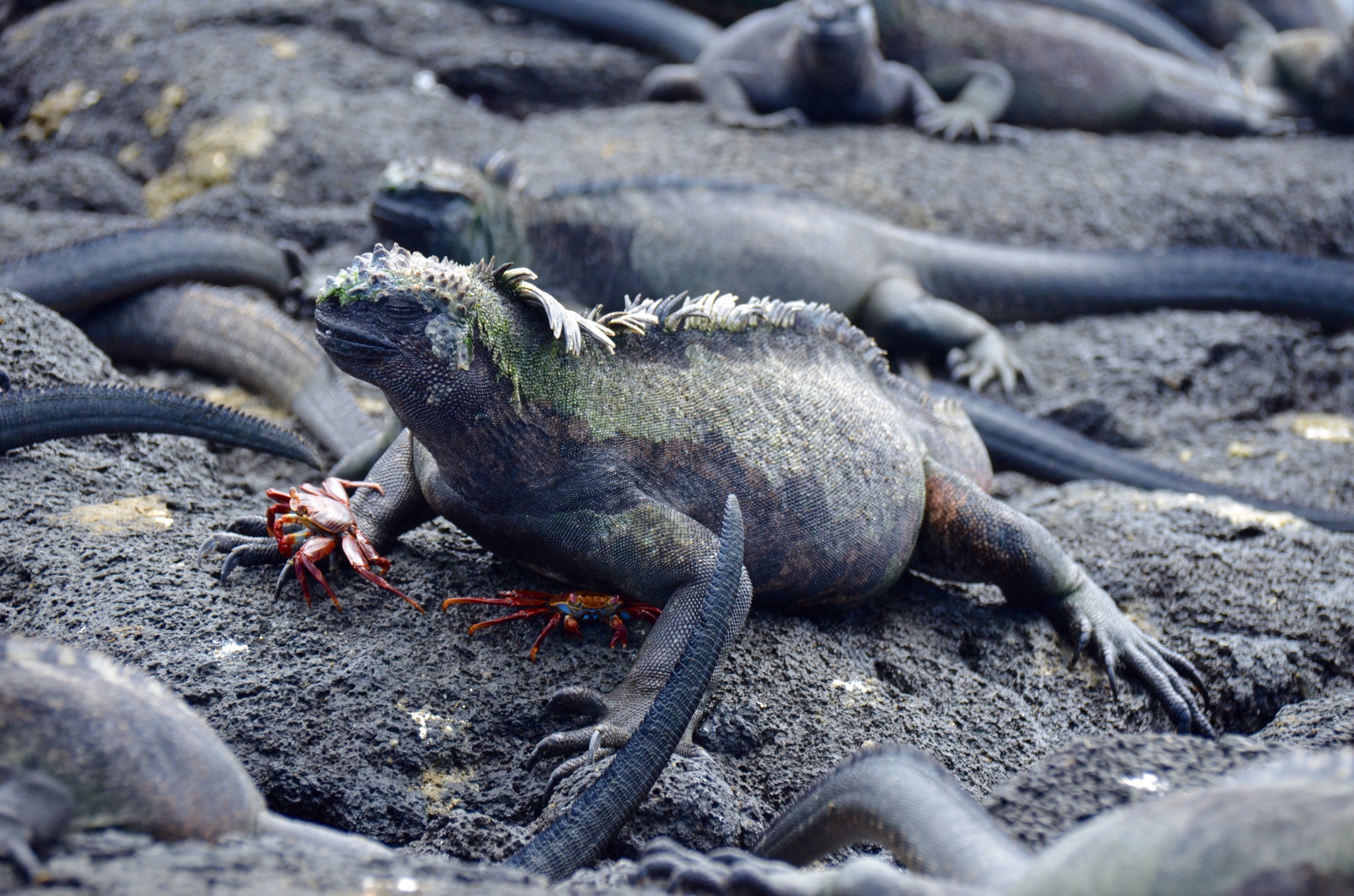
The Sally Lightfoot crabs clean the scales and parasites off of the iguanas.
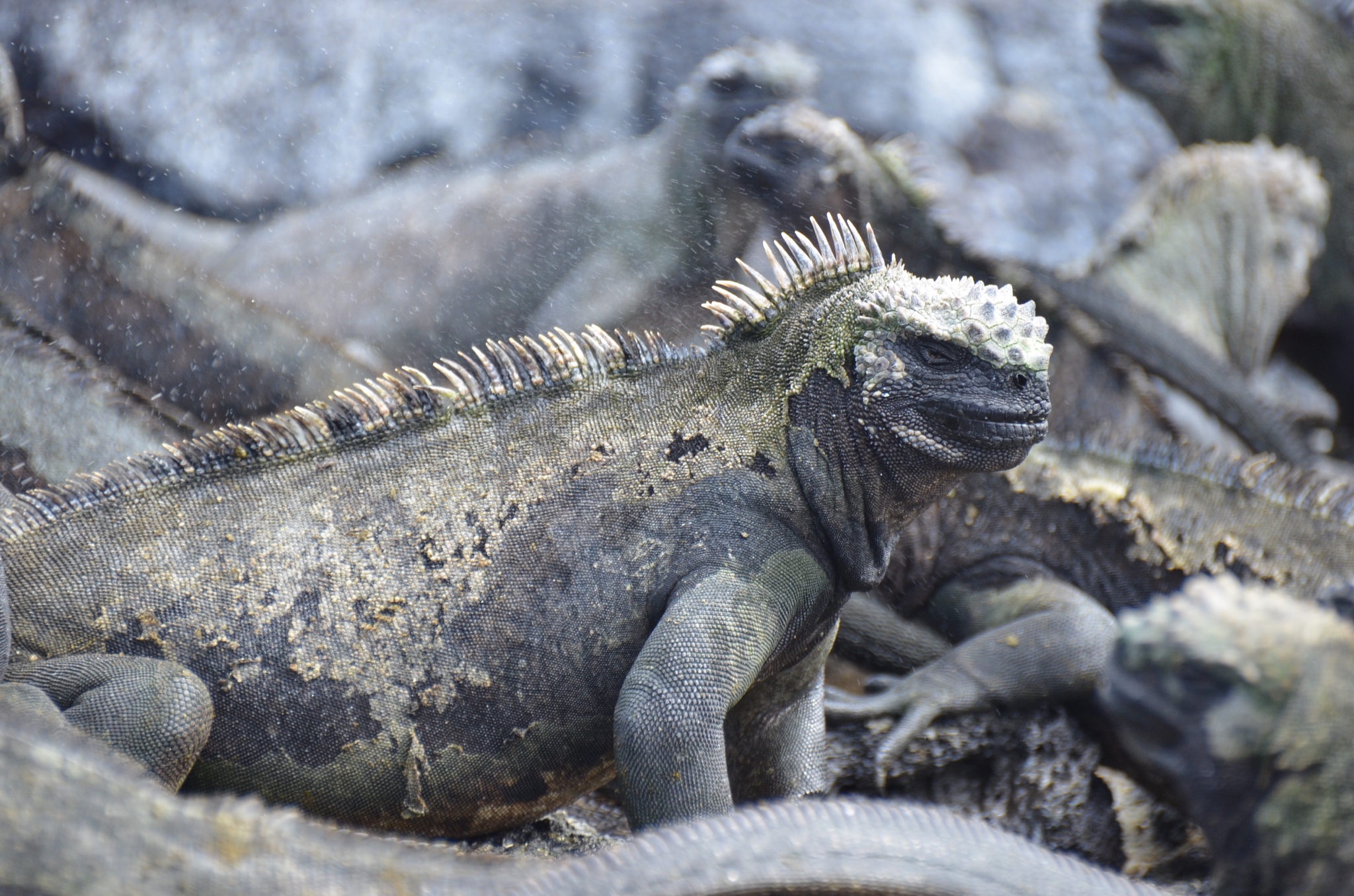
The marine iguana can stay under the water for up to 10 minutes. When they return to land, they forcefully expel the salt from their nostrils. As we stared at this pile of iguanas, every few seconds a spray of white snot would go up. One of them hit the girls with the snot-rocket. I trained my camera on the group and snapped away, hoping to catch one in the act. It seemed like an easy thing to do, as the sound of the nose-clearing was almost constant. The problem was that I could never figure out when any given iguana was going to clear his nose, and so I never got the shot. I got lots of good close-ups anyway.
This guy didn’t make it. An adult marine iguana does not have many enemies. Most of them die by being crushed against the lava rocks in a storm.
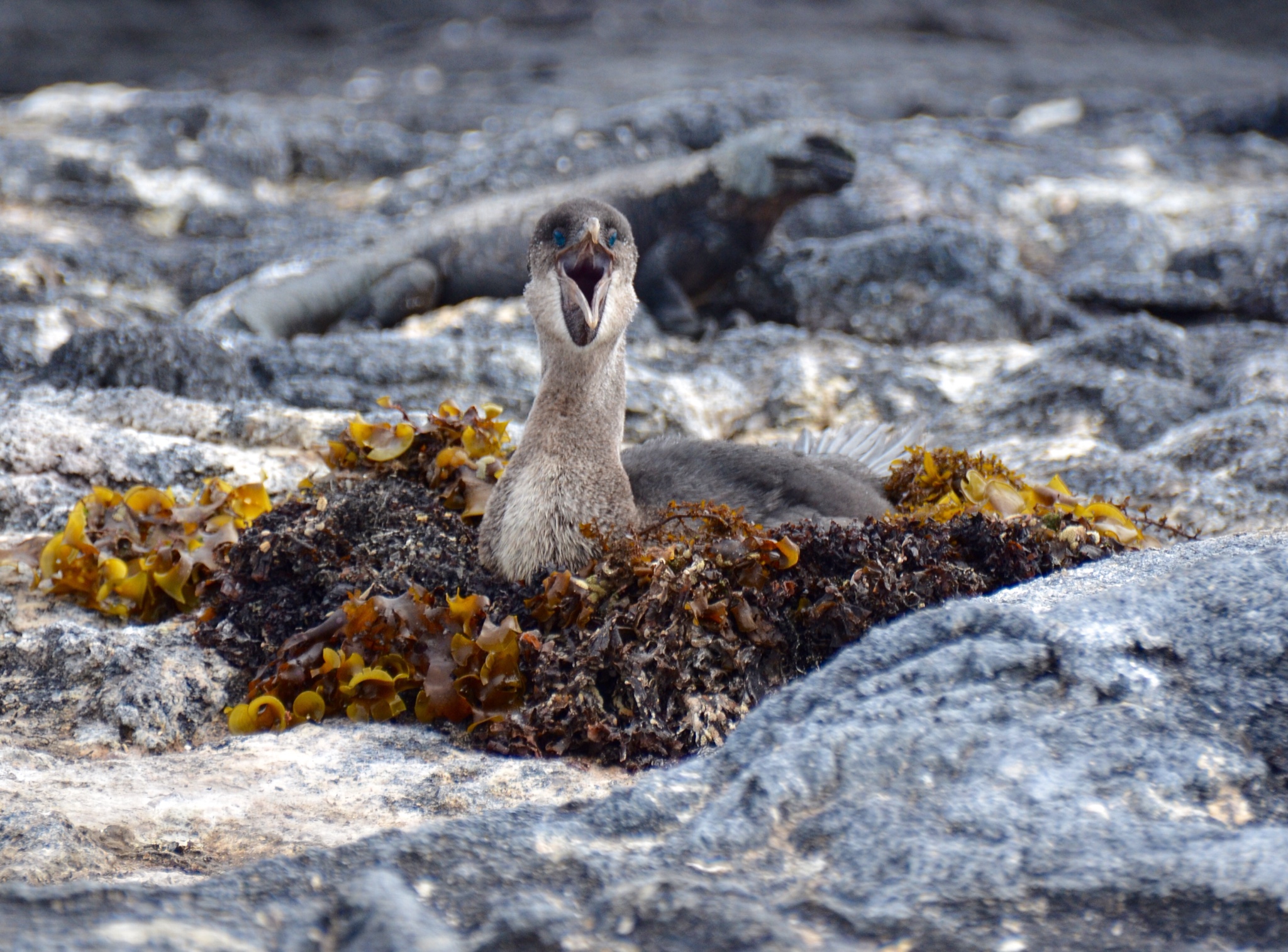
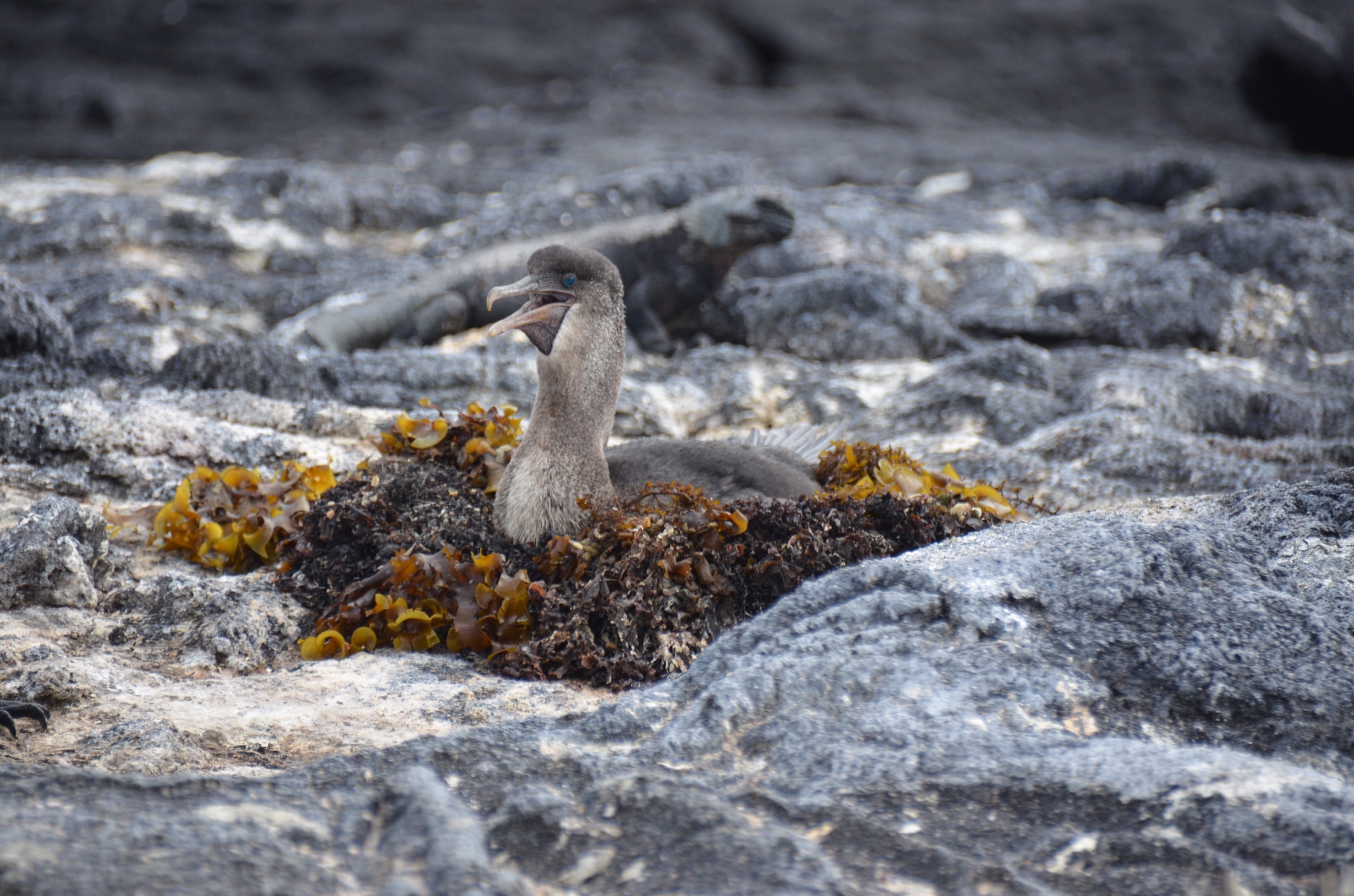
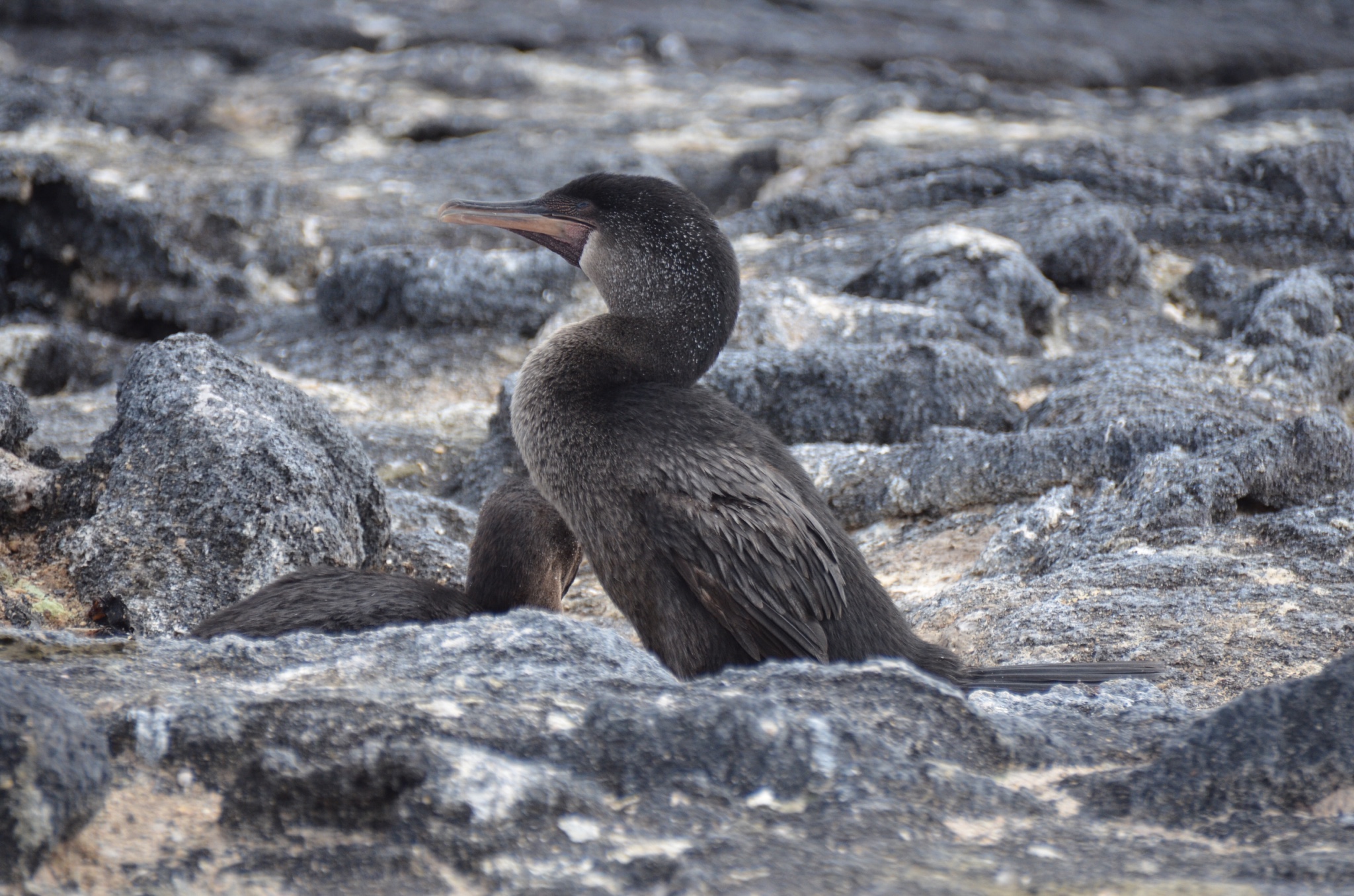
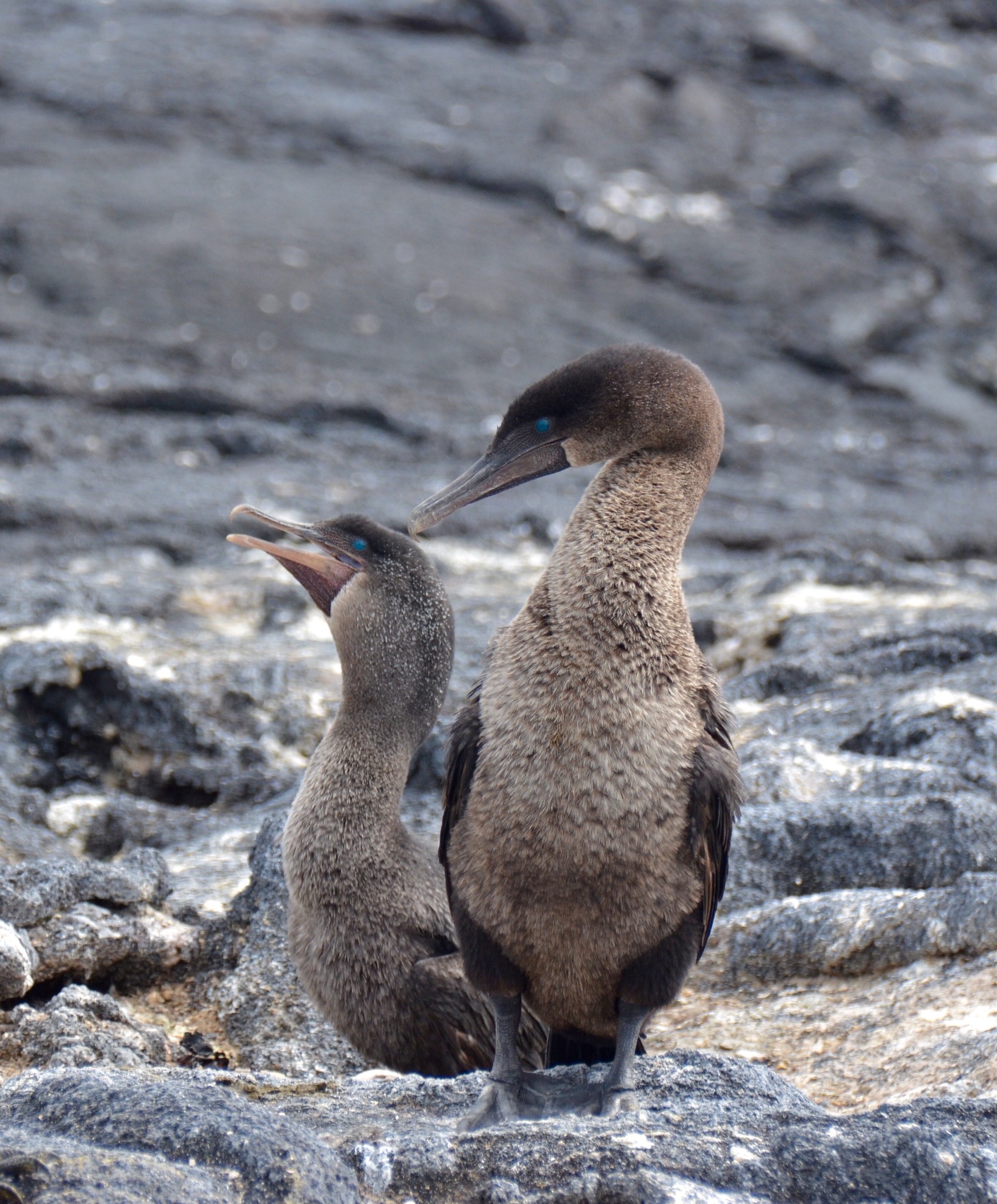
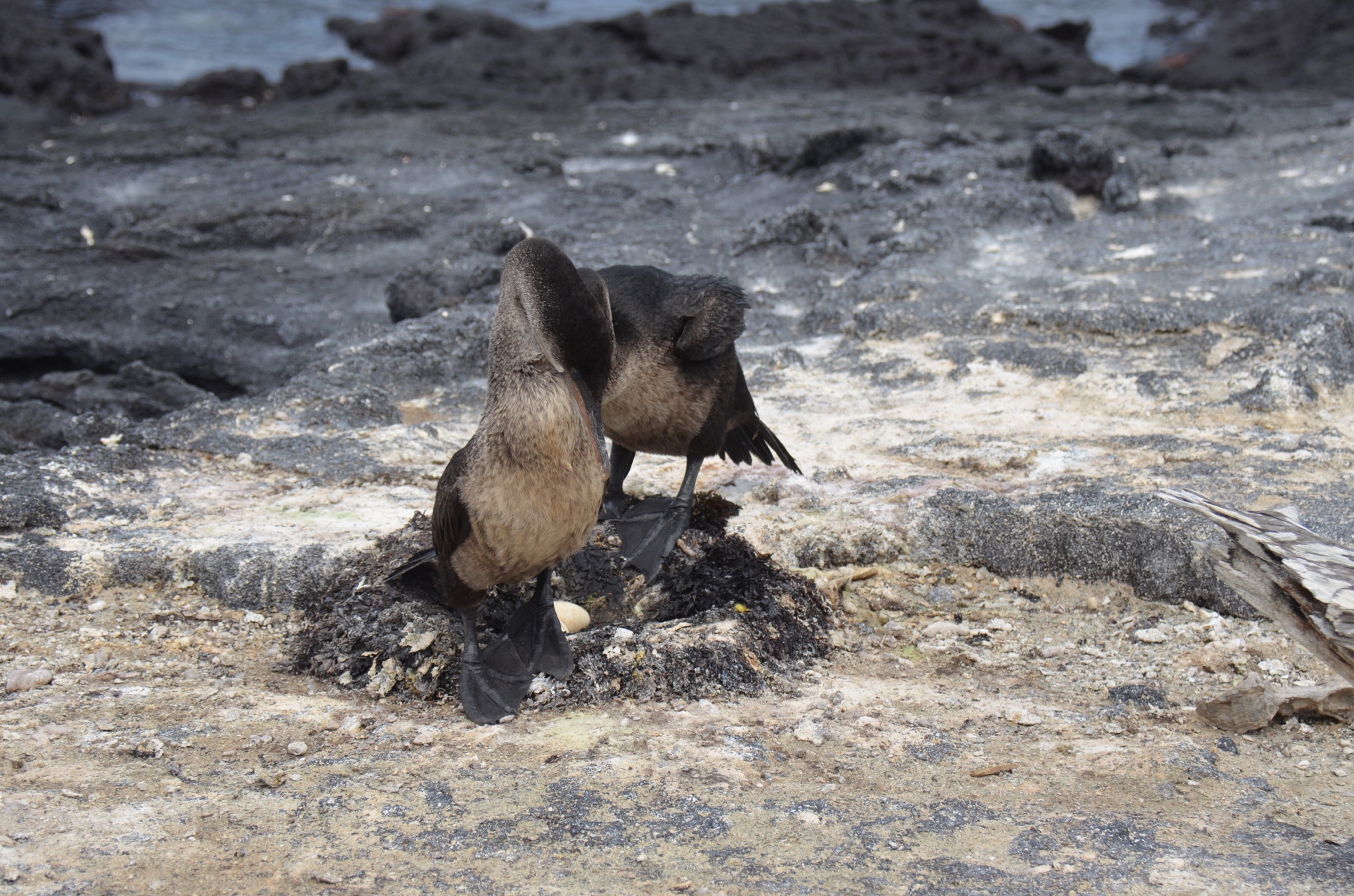
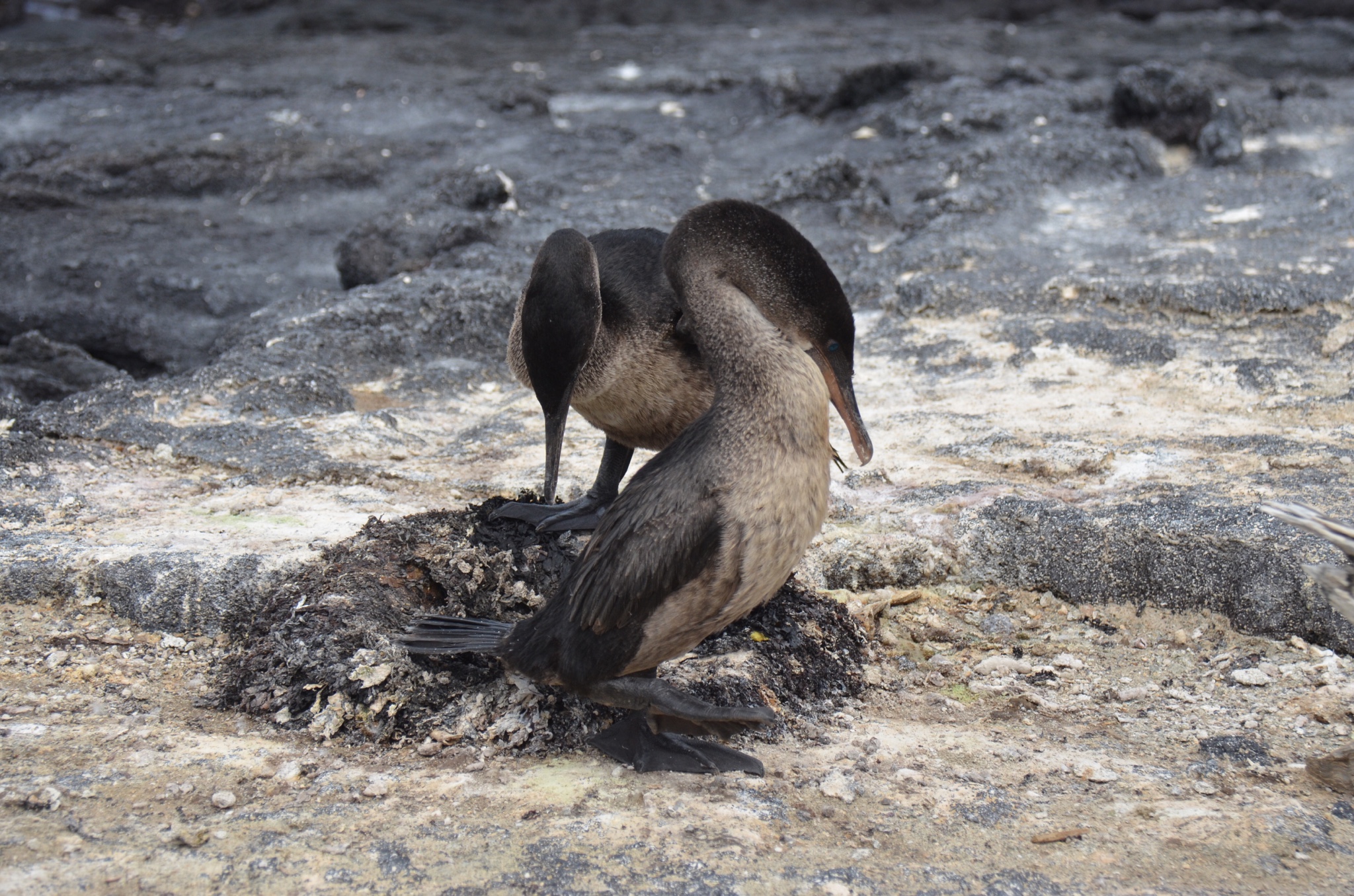
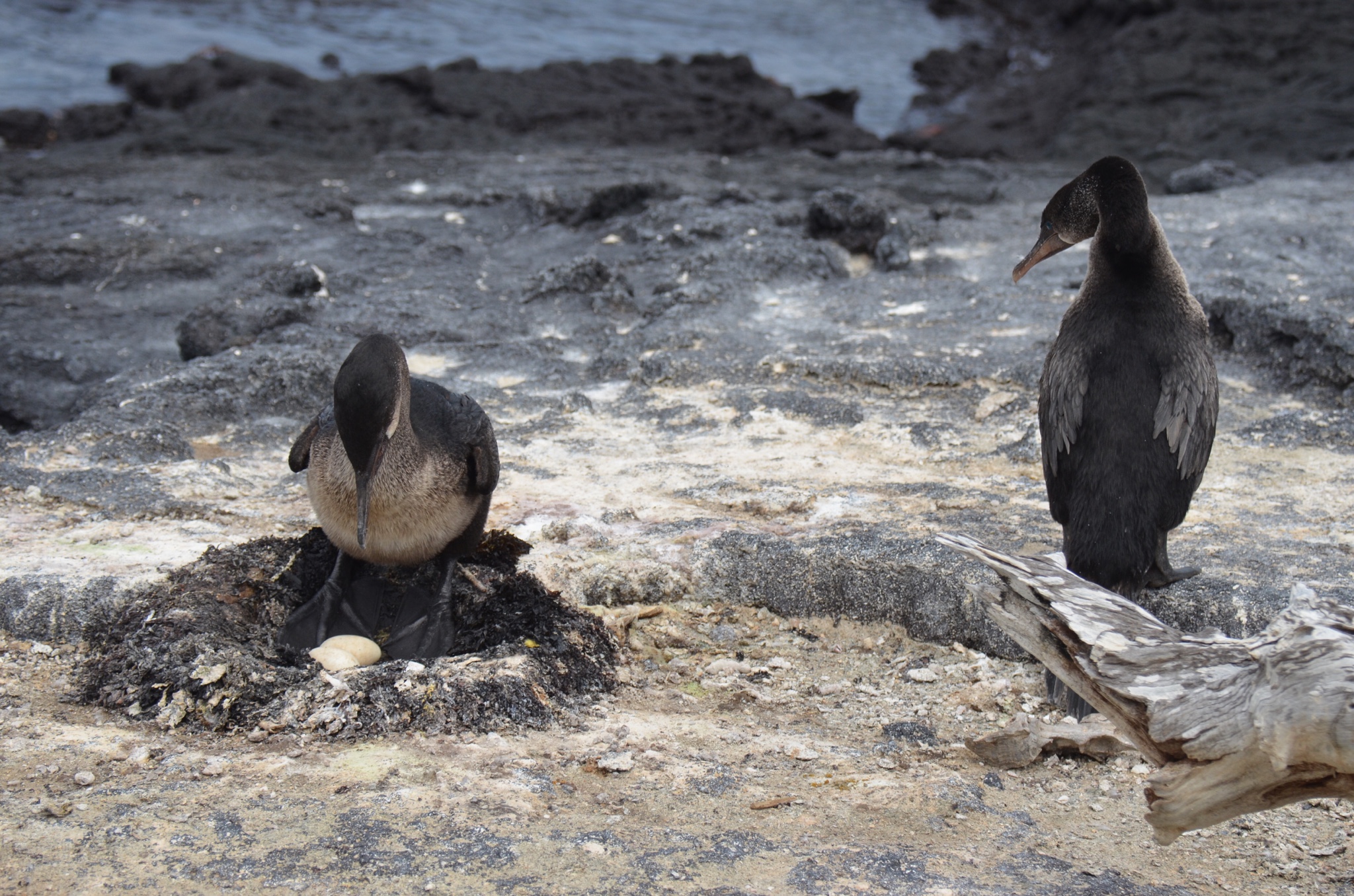
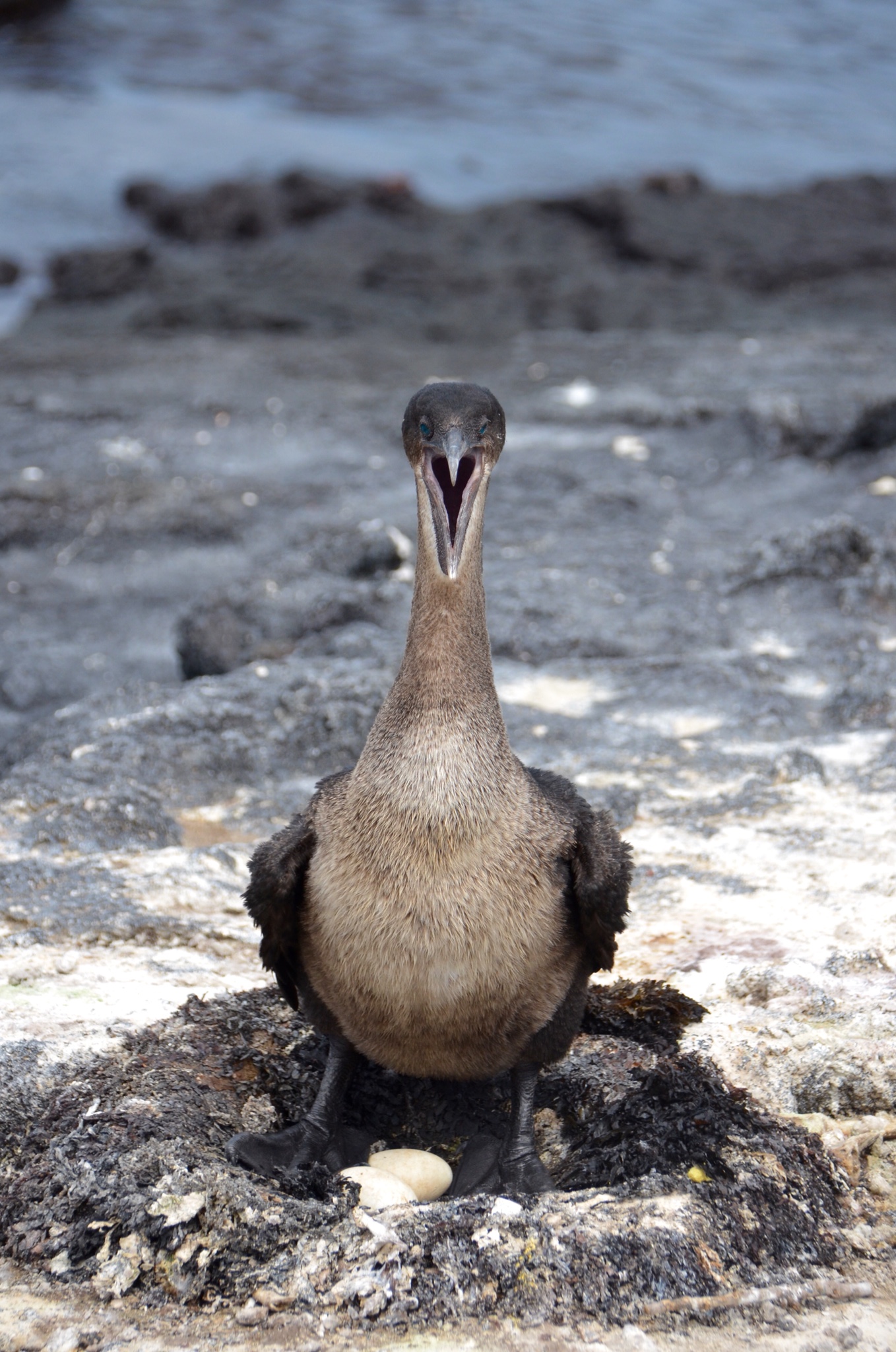
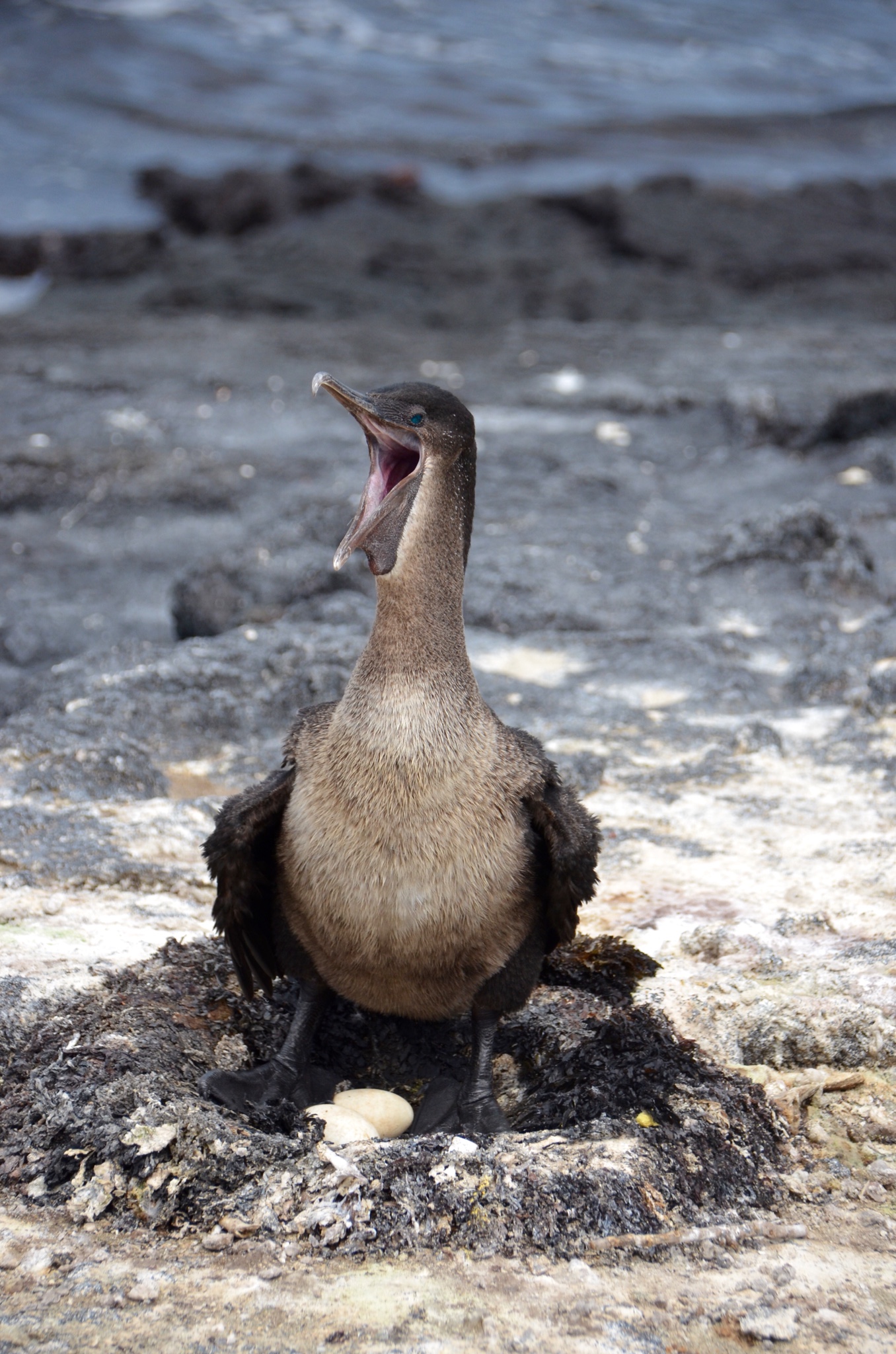
As we walked along the beach, we came upon a flightless cormorant on the nest. The cormorant has useless vestigial wings. They swim with powerful webbed feet. Our guides told us that if we could come back in a millenium, the wings will have transformed into flippers, like a penguin. They build nests on the rocky shore with seaweed.
Near the bird on the nest, we saw another fellow come inland.
He passed by the nesting bird, and she gave a squawk.
He headed straight for a lady-friend, and right there in front of the children, they began getting it on. James said they were “doing the coochie-coochie.” The iguana in the foreground is unimpressed.
Landscape interlude….
Was it good for you?
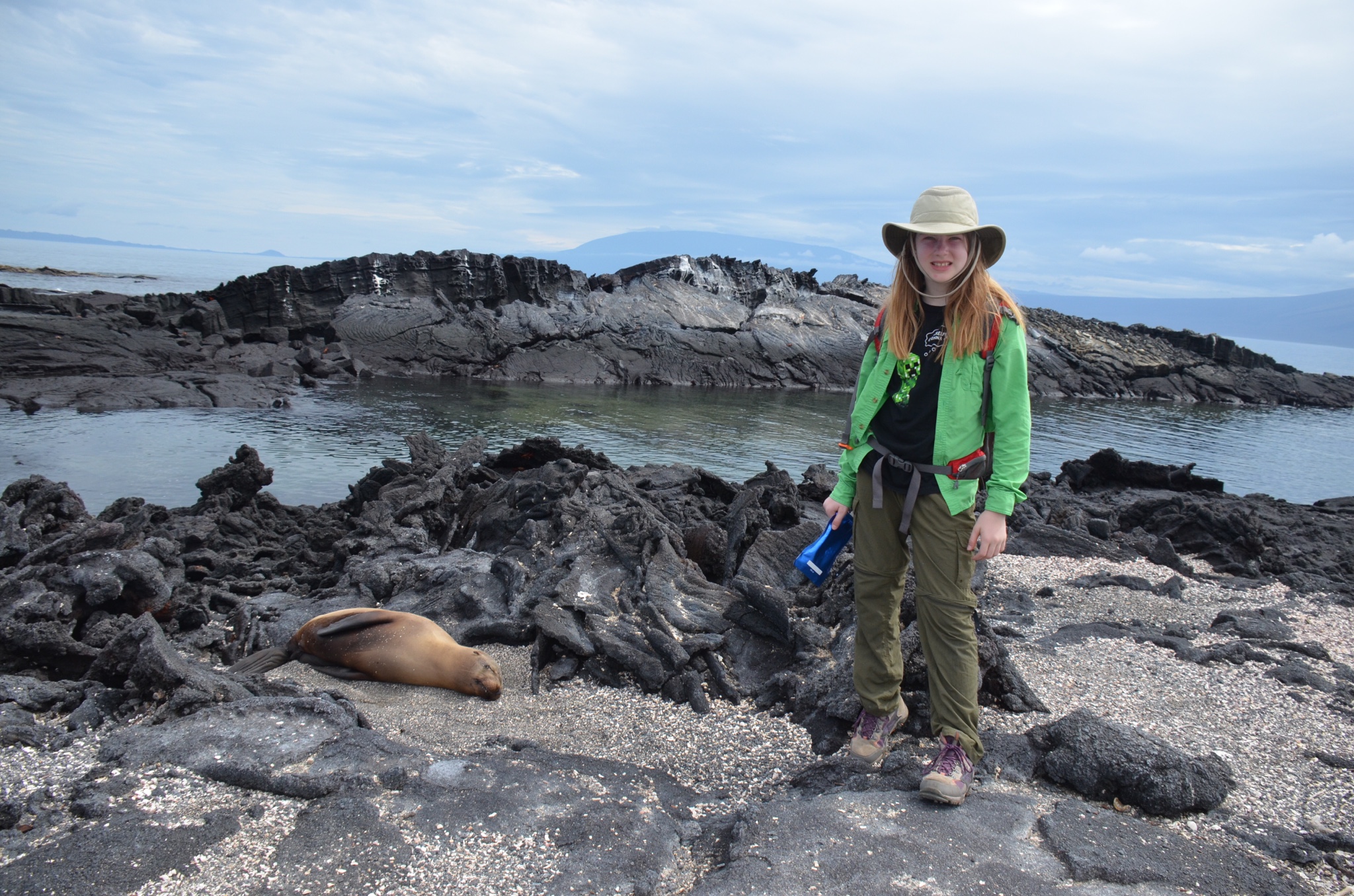
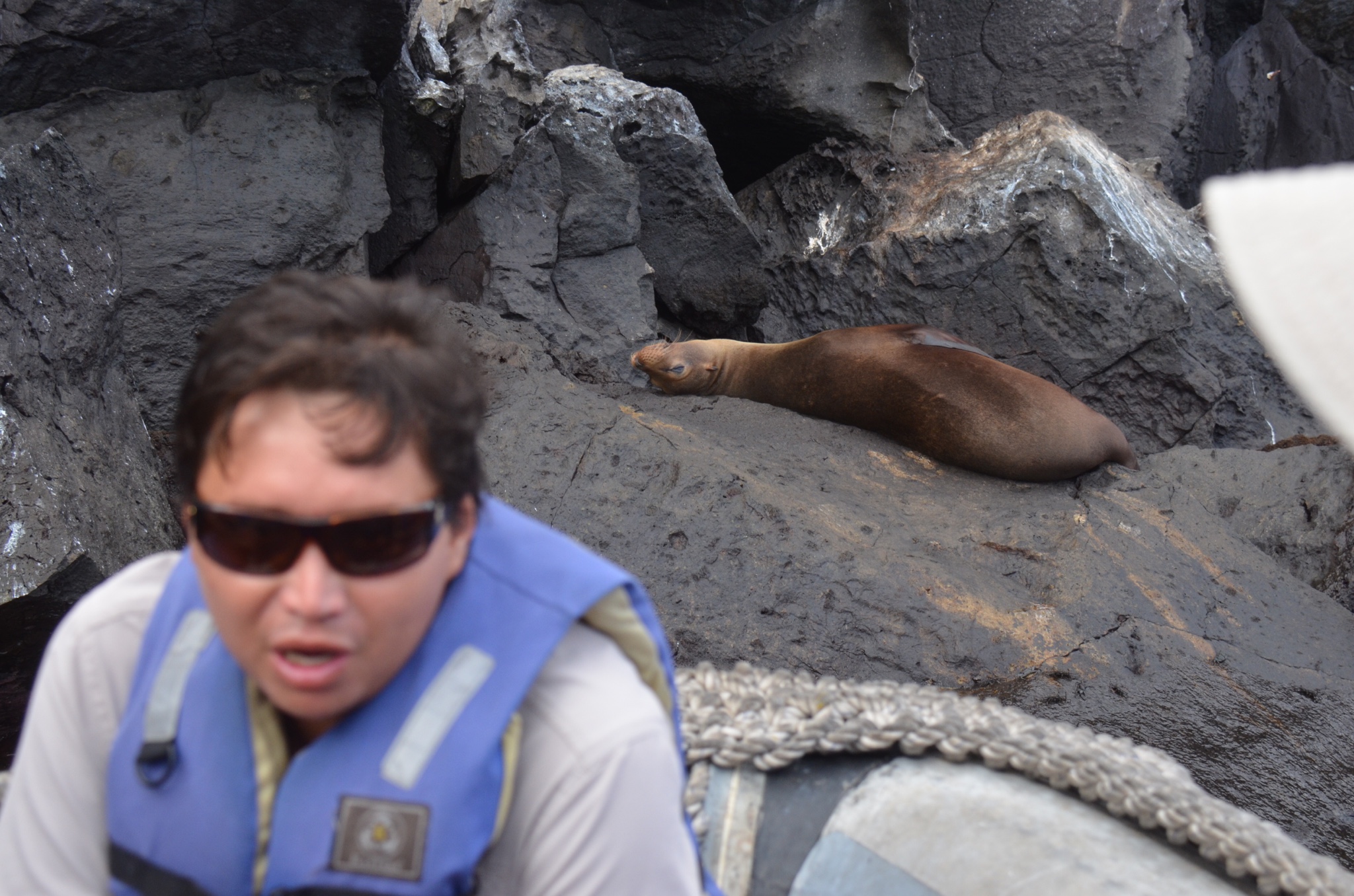
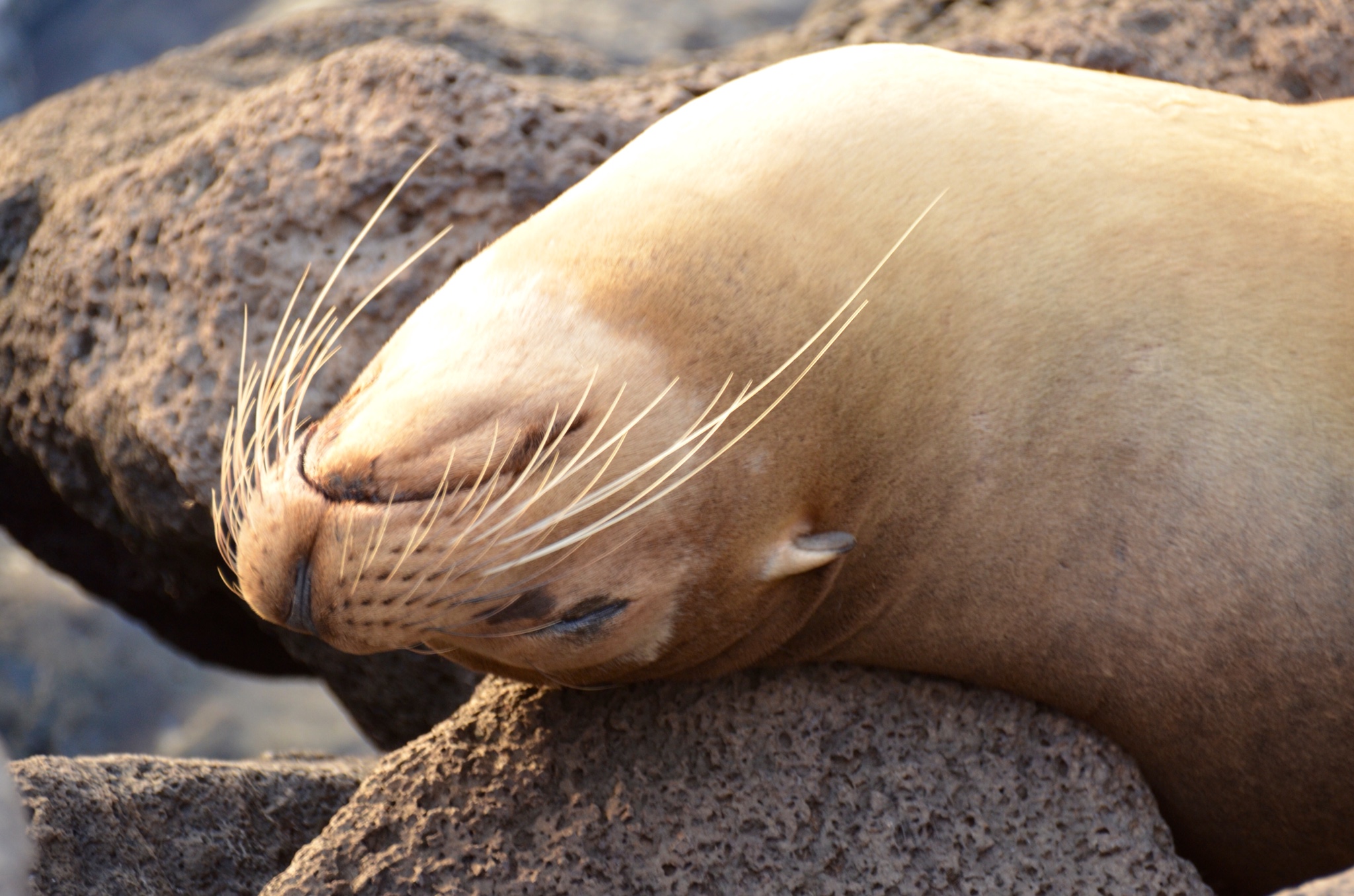
Sea lions basked in the sun.
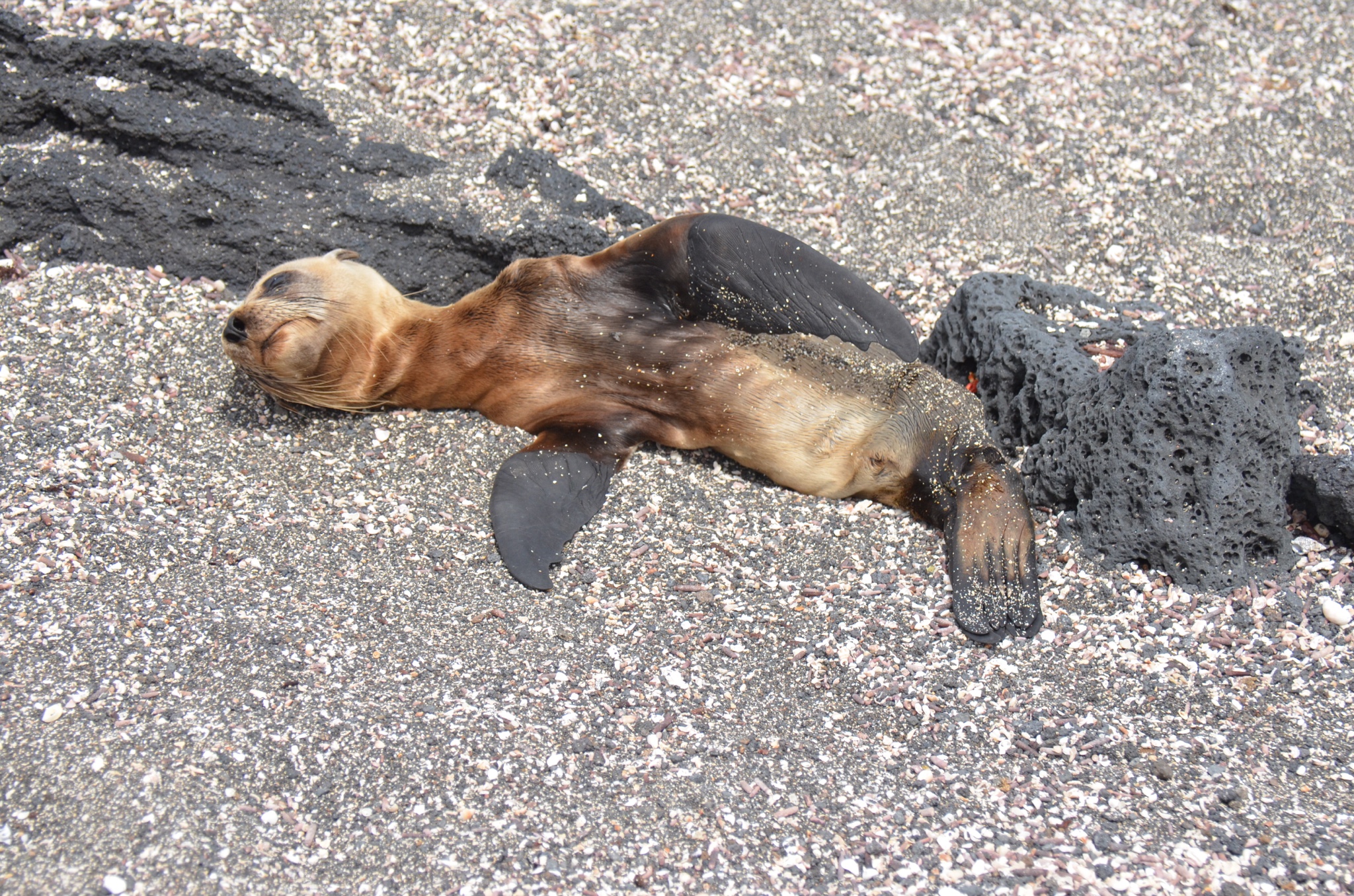
The next photo is a little disturbing. We first spotted this little guy from afar, and our guides said, “Oh look. A baby!” As we got closer, it became clear that this baby was dying. Our guides explained that he had probably lost his mother to a predator, a whale perhaps. The other sea lions will not adopt an orphan and so the baby slowly starves. The kids gathered close, and they were all disturbed. Oddly enough, the baby was purring. I did not even know that sea lions could purr. The girls all wanted to take the baby home with them, but our guides explained that this could not happen. The guides are not allowed to intervene in nature’s cruelty. In a little while, this little fellow will perish, and the Sally Lightfoot crabs will pick his bones clean.
A close-up view of the cormorant’s useless wing and his very useful foot:
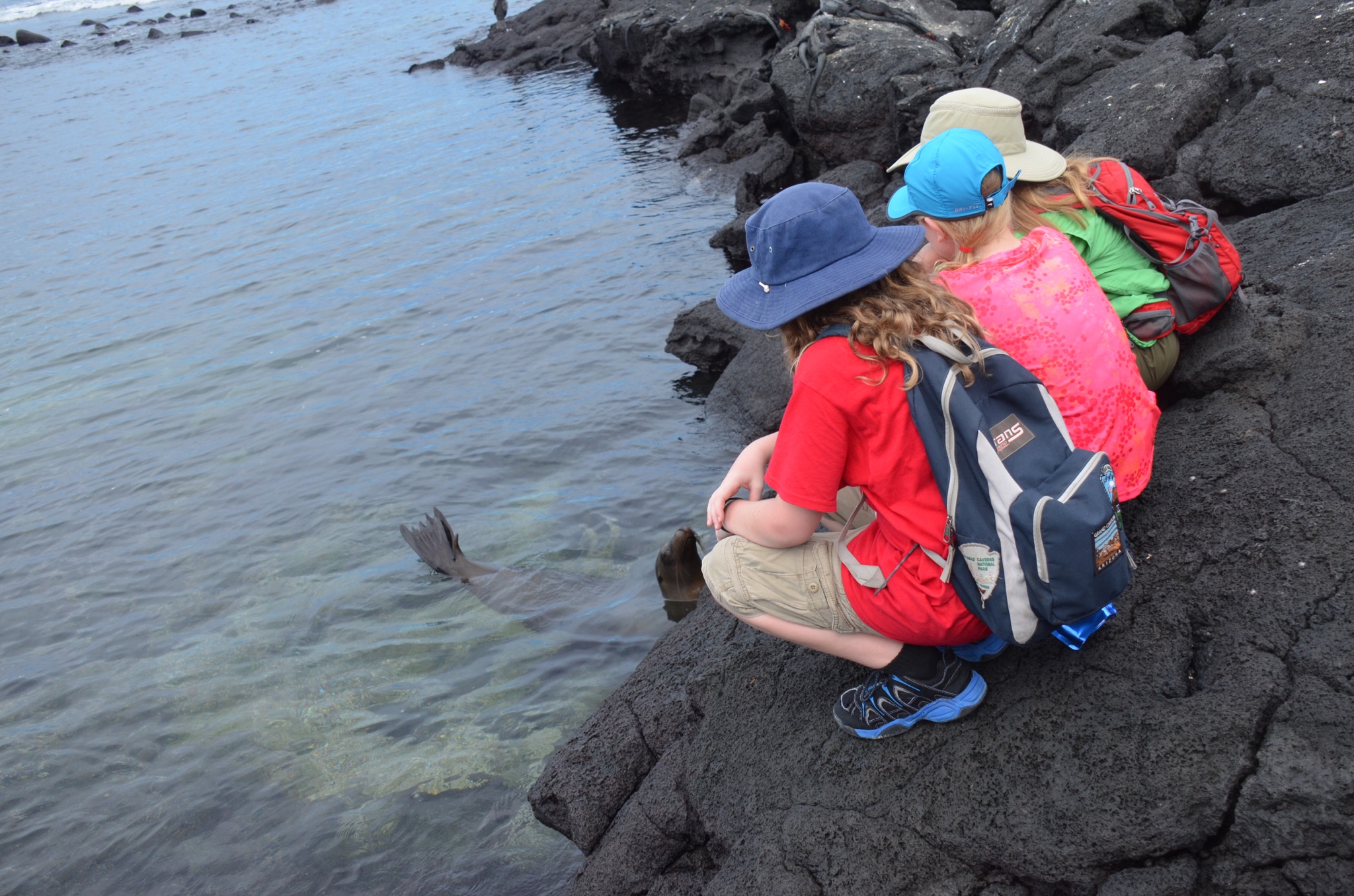
The kids look at the sea lion, and the sea lion looks at the kids. Wonder if either of them liked what they saw?
Another colony of marine iguanas. I think these are the females.
Offshore, a group of penguins fished.
A close-up of the pale blue eye of the flightless cormorant:
We got to watch the changing of the guard. Both male and female cormorant incubate the eggs.
My turn:
Go grab a bite!
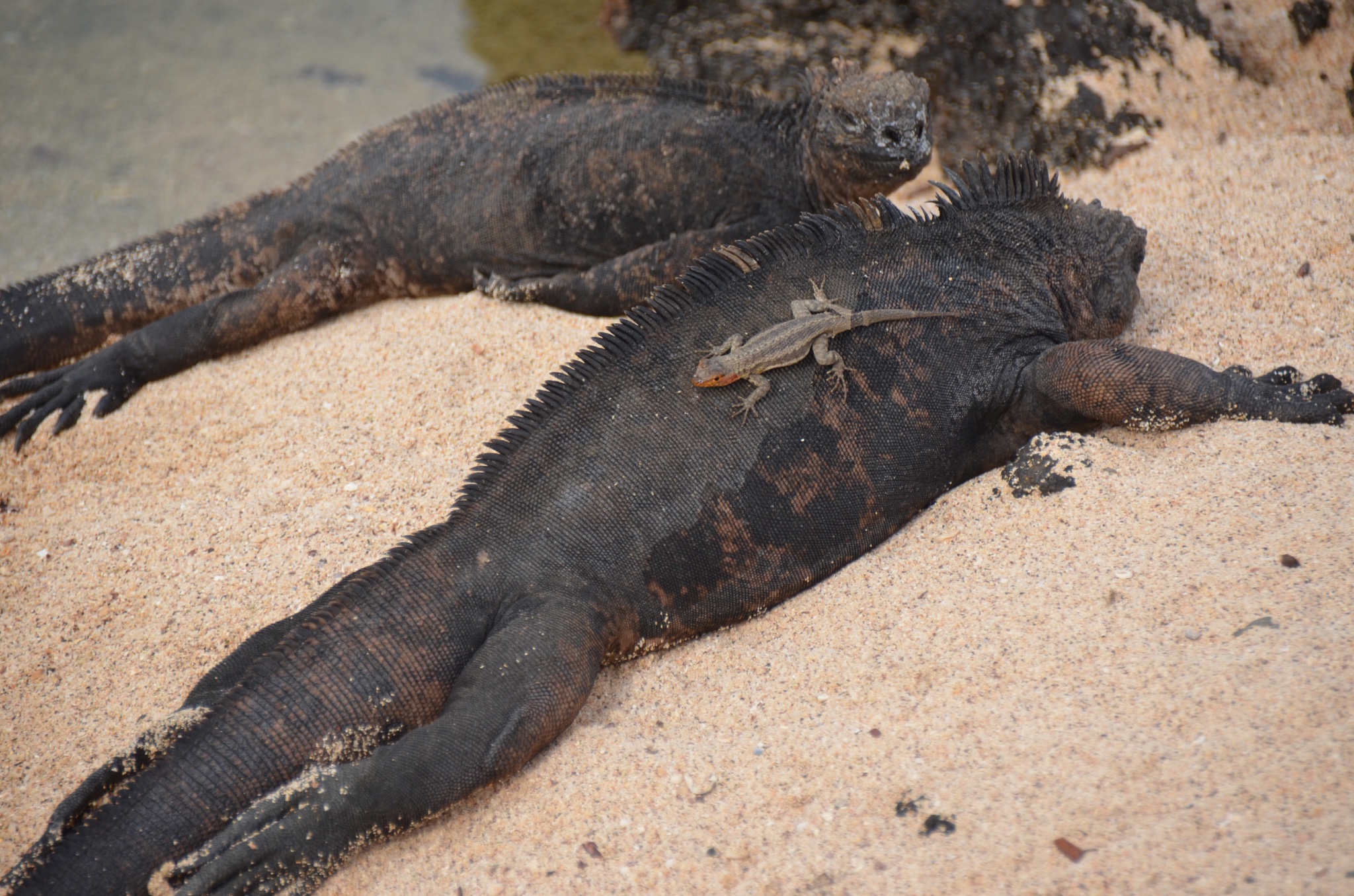
A marine iguana with a lava lizard hat.
This is what I felt like most days after lunch.
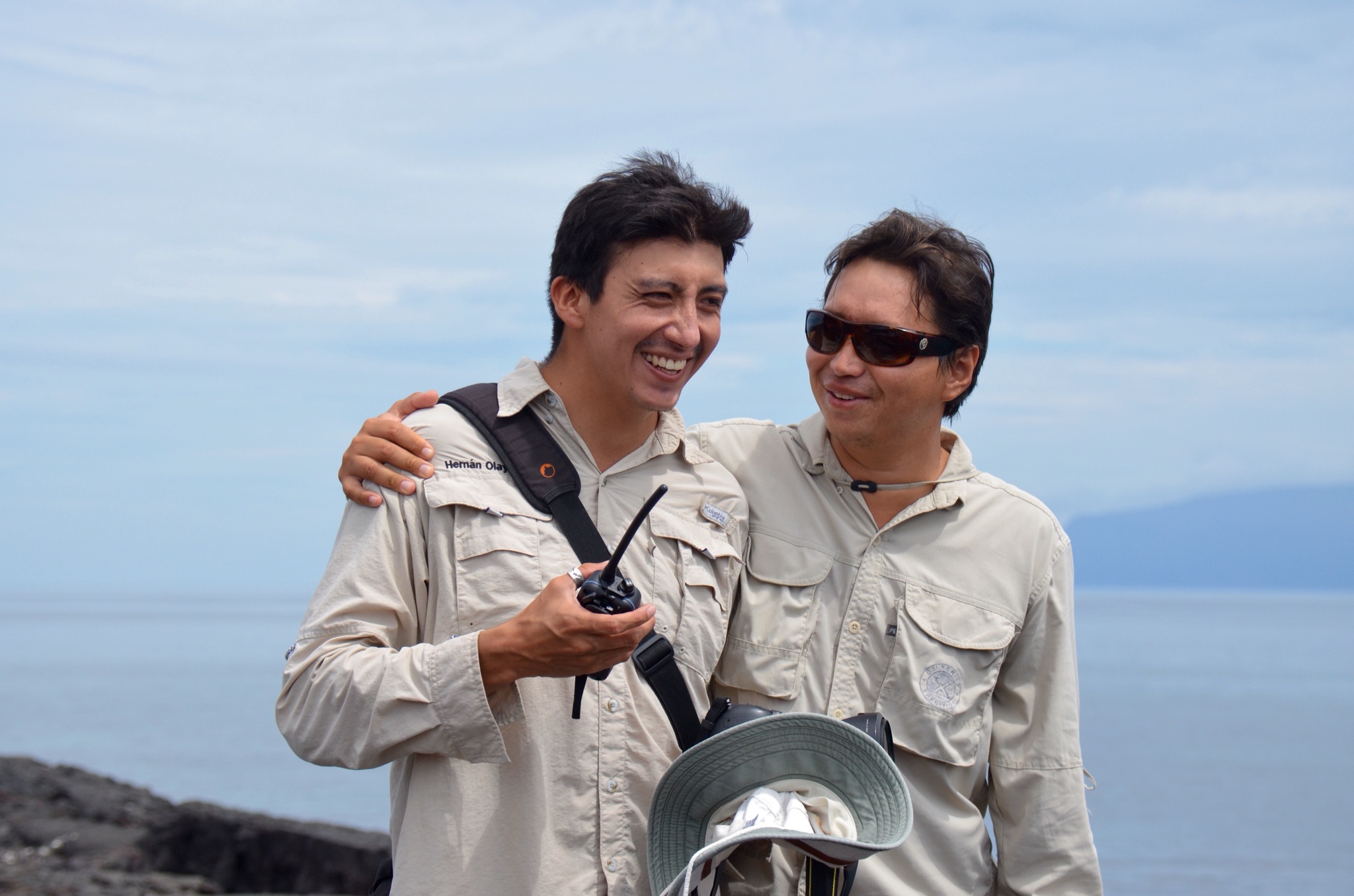
Our guides Hernan and James decided to strike a pose for us.
They clearly shared a great working relationship and a strong bond. Hernan was from San Cristobal and claimed that was the “best” island. James was as strong in his belief that his home island of Santa Cruz was “No. 1.” We were never asked to choose our favorite island or guide, and it would have been impossible.
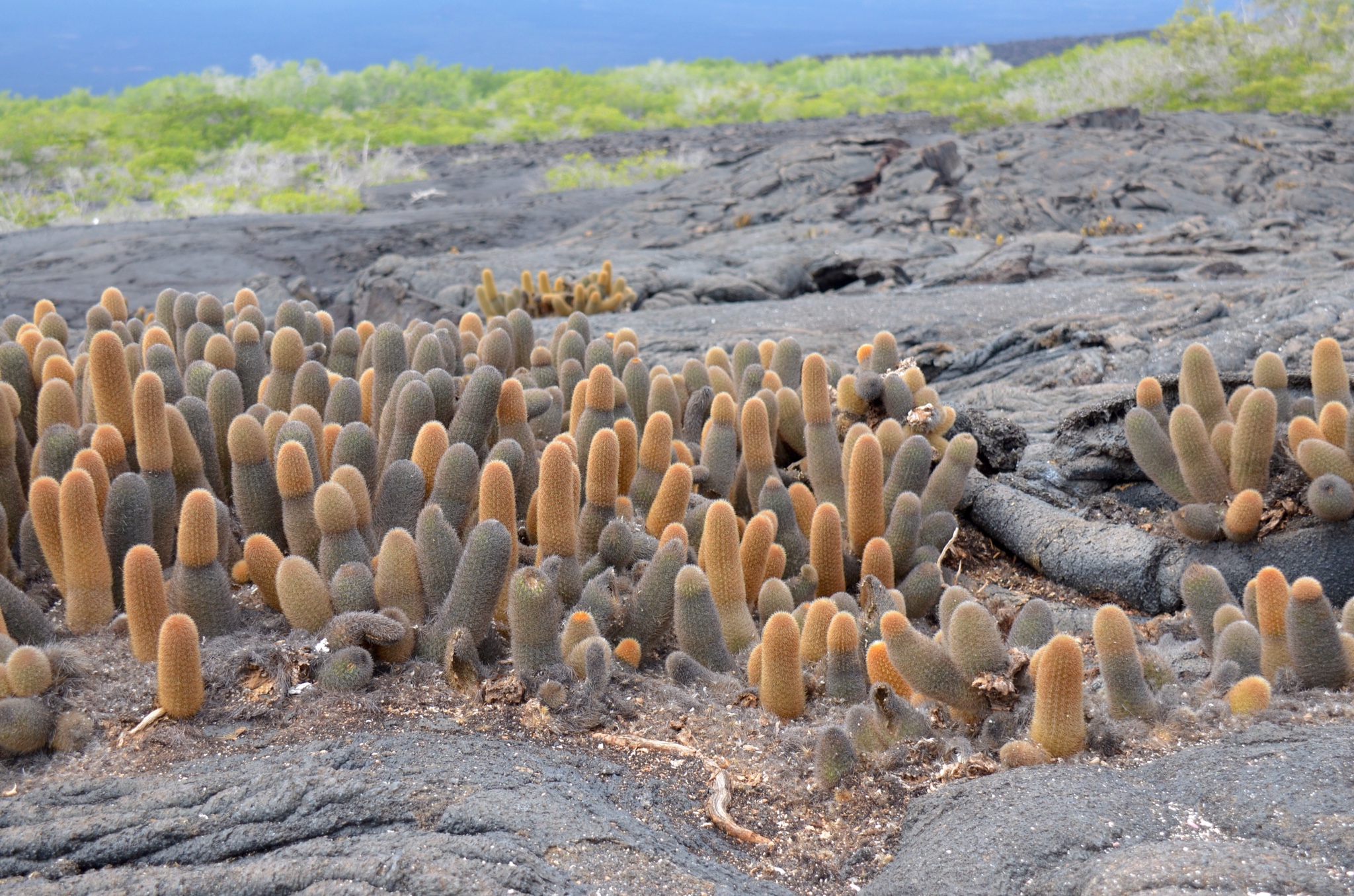
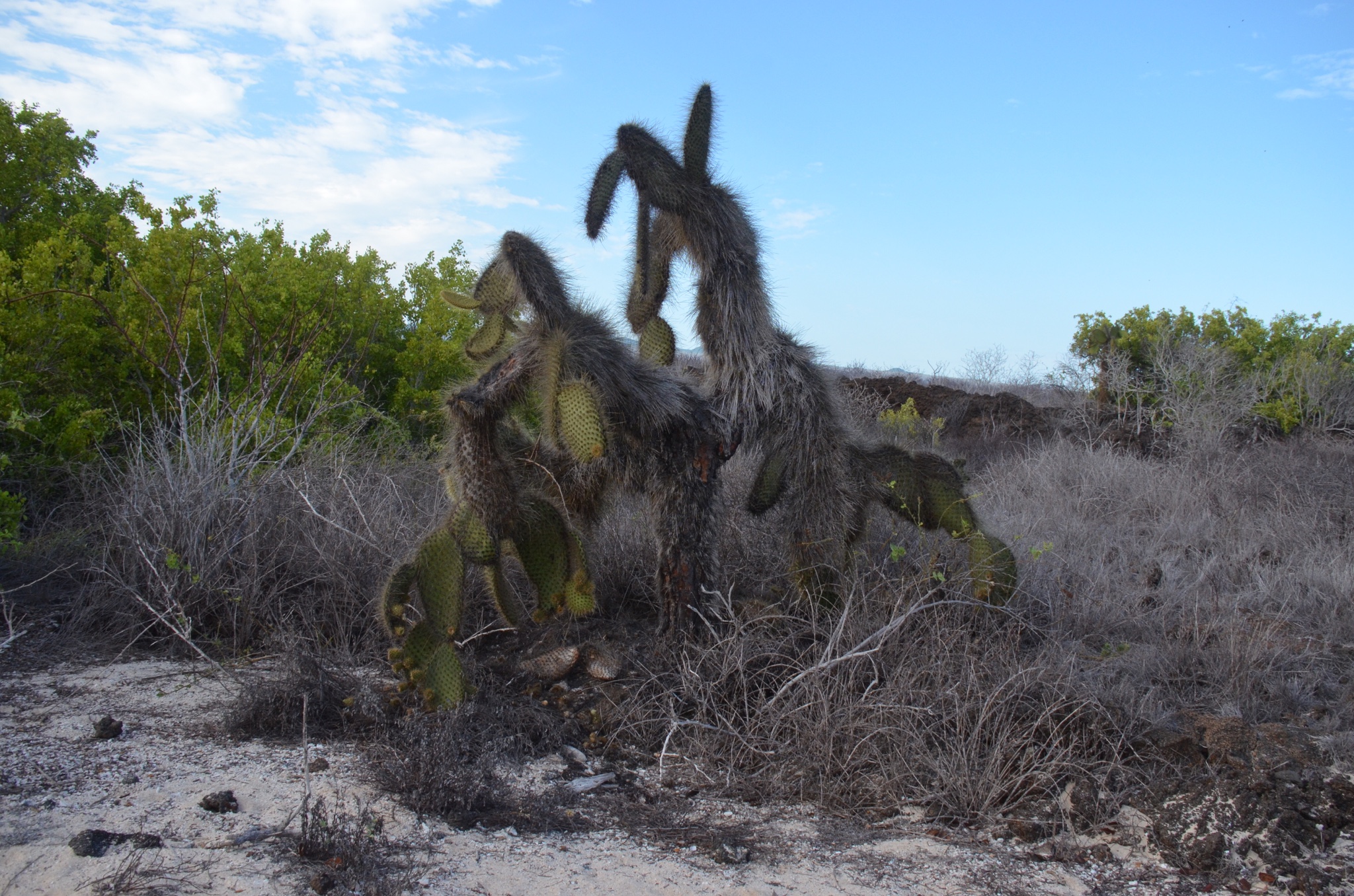
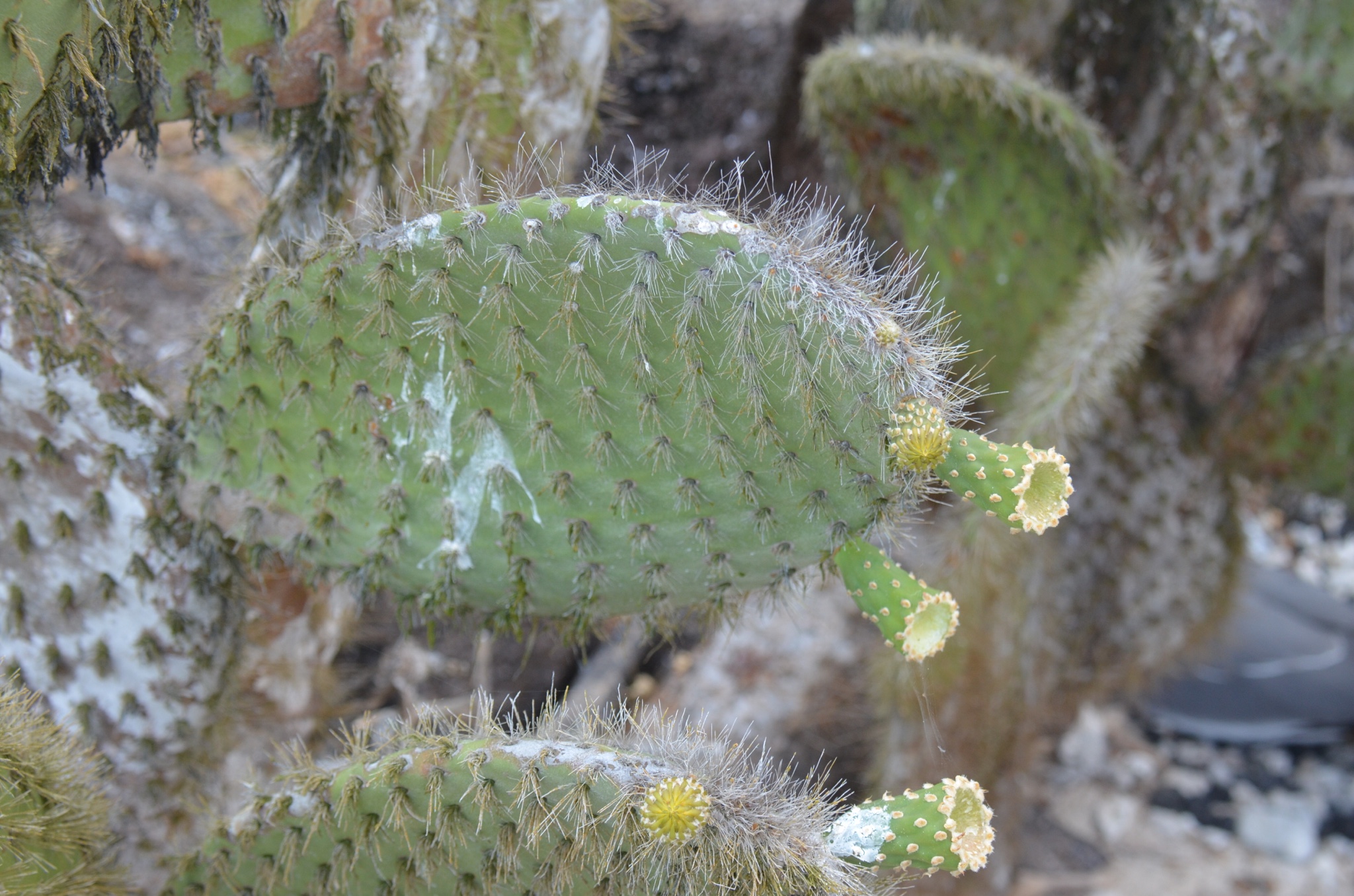
Cactus grow from the lava rocks.
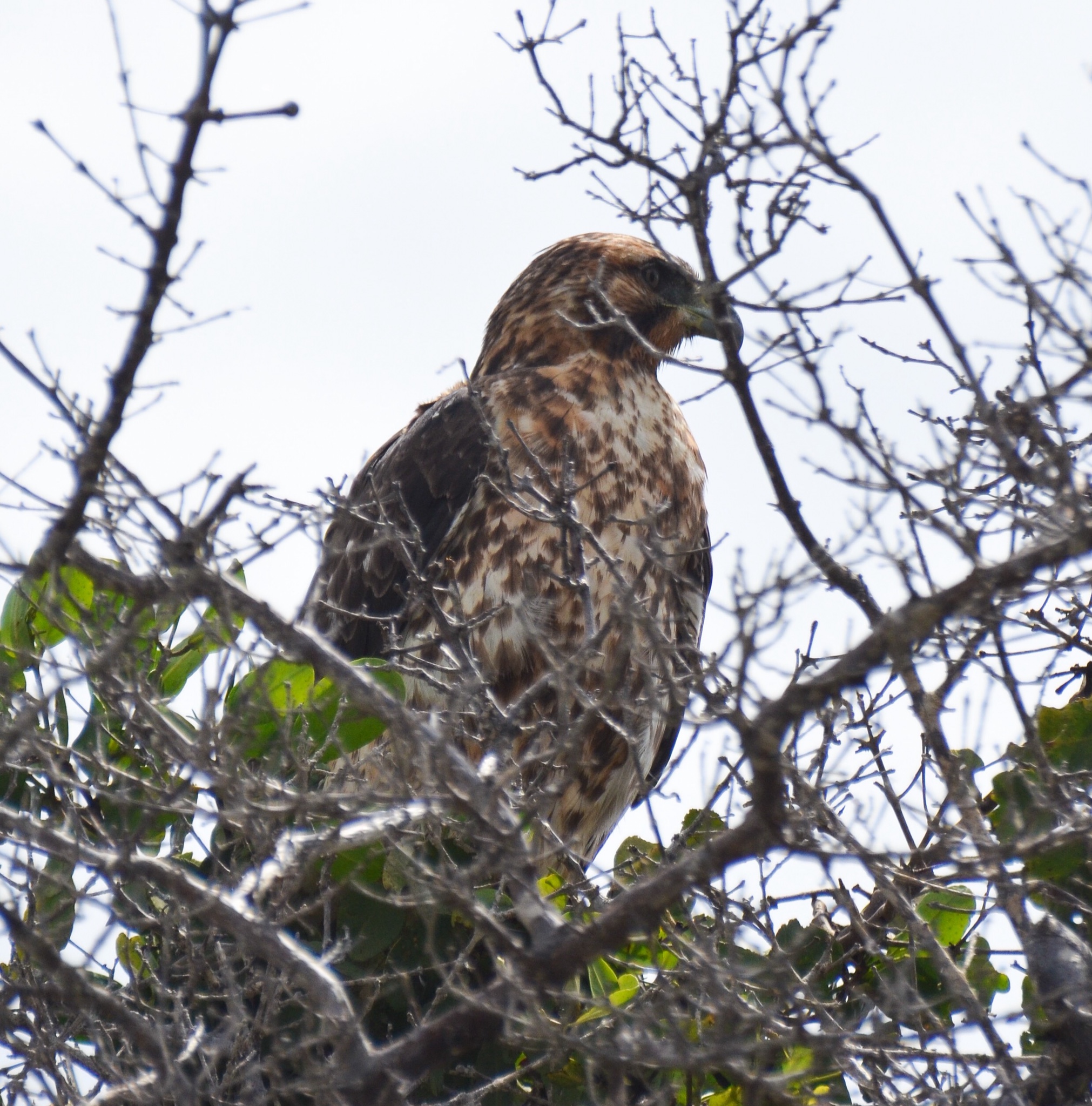
A Galapagos hawk perched atop a tree. James joked that if you do not know the name of an animal in the Galapagos, a good guess is simply to start with one of these words: Galapagos, Darwin or lava.
We took a short walk to a mangrove inlet, where we saw sea turtles skimming the surface.
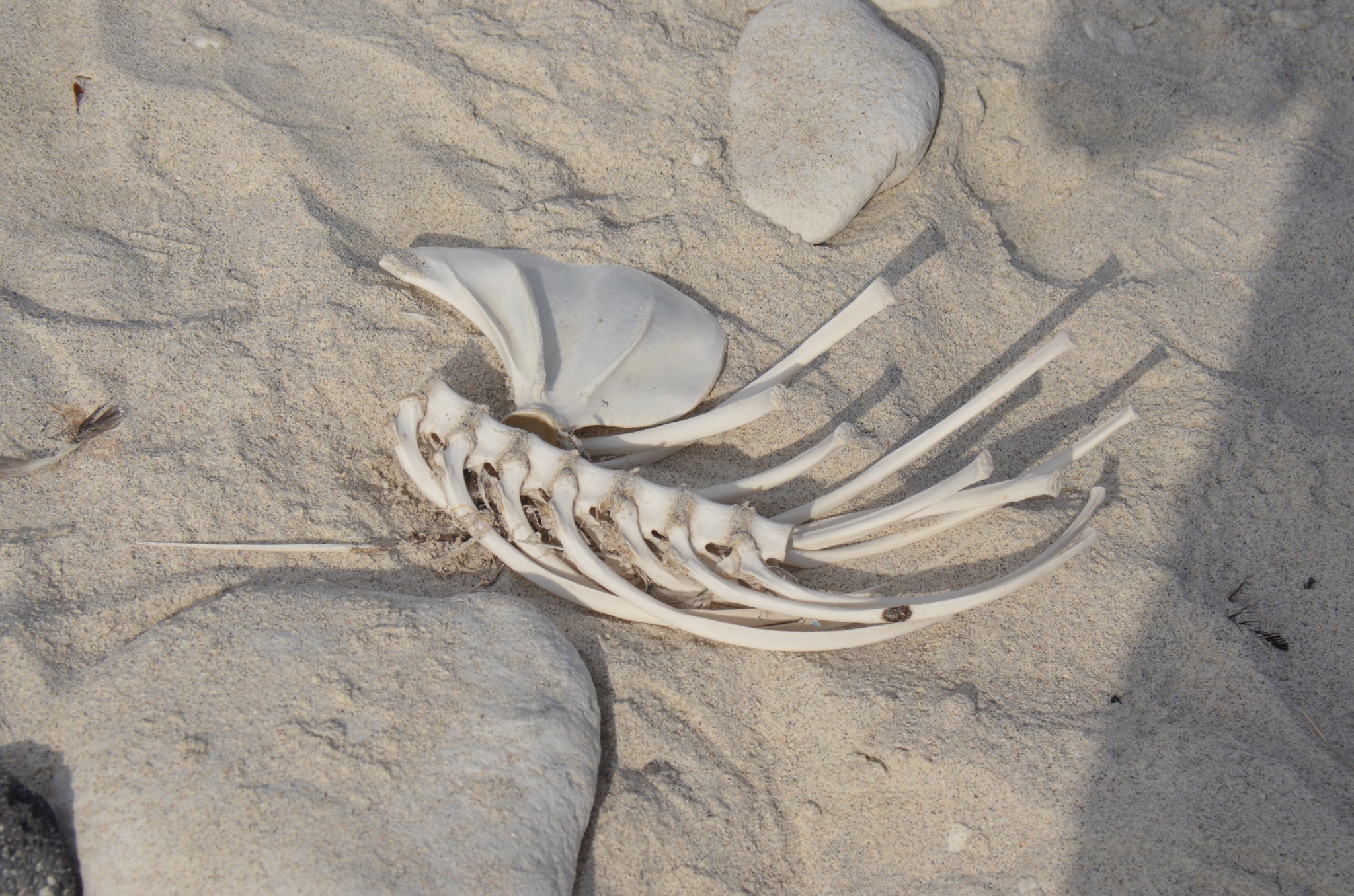
In 2007, several pilot whales beached on neighboring Isabela Island. Through the efforts of bystanders, some were saved but others perished. The National Park preserved the bones and relocated them to this beach to provide educational opportunities for visitors.


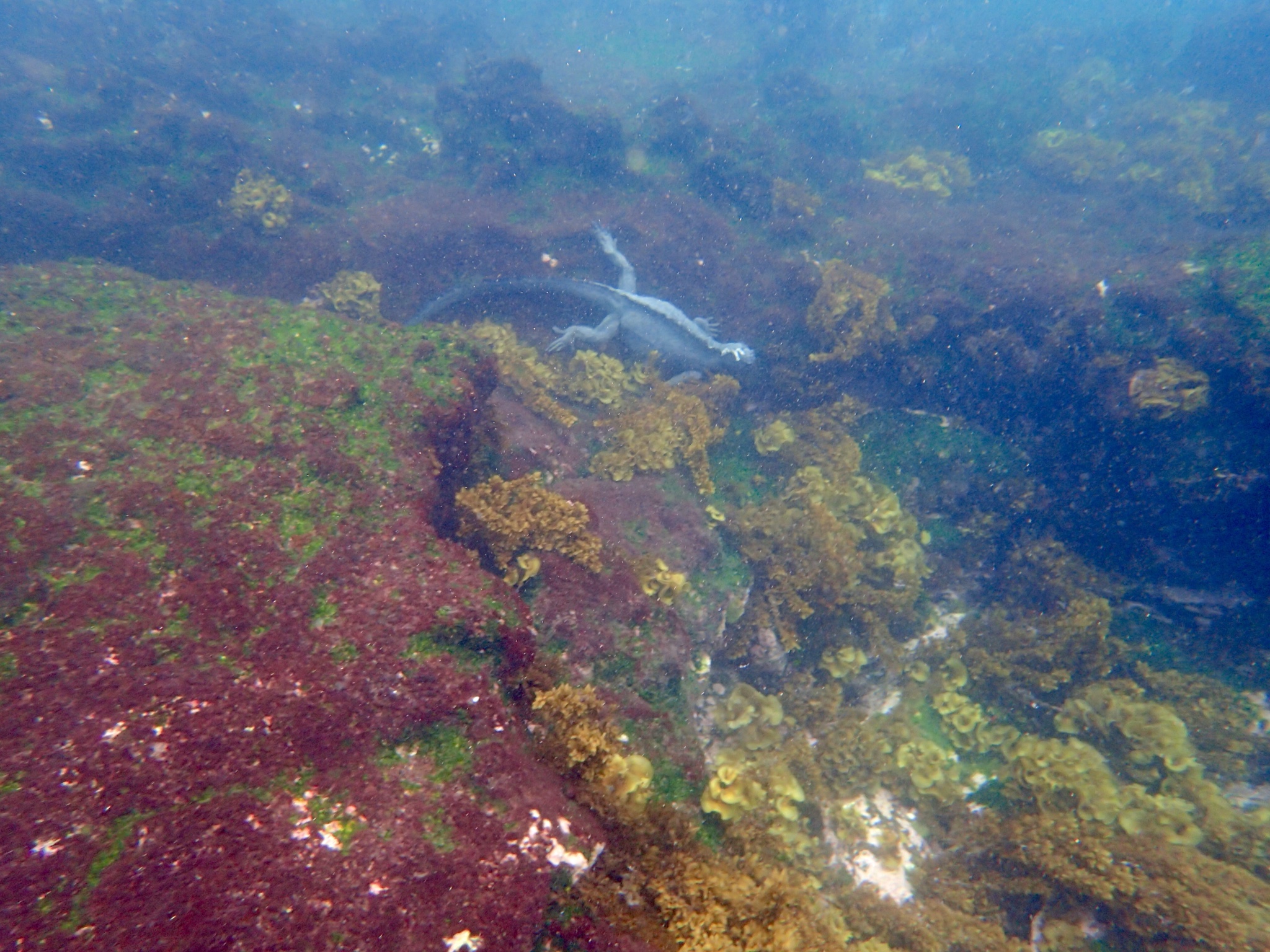
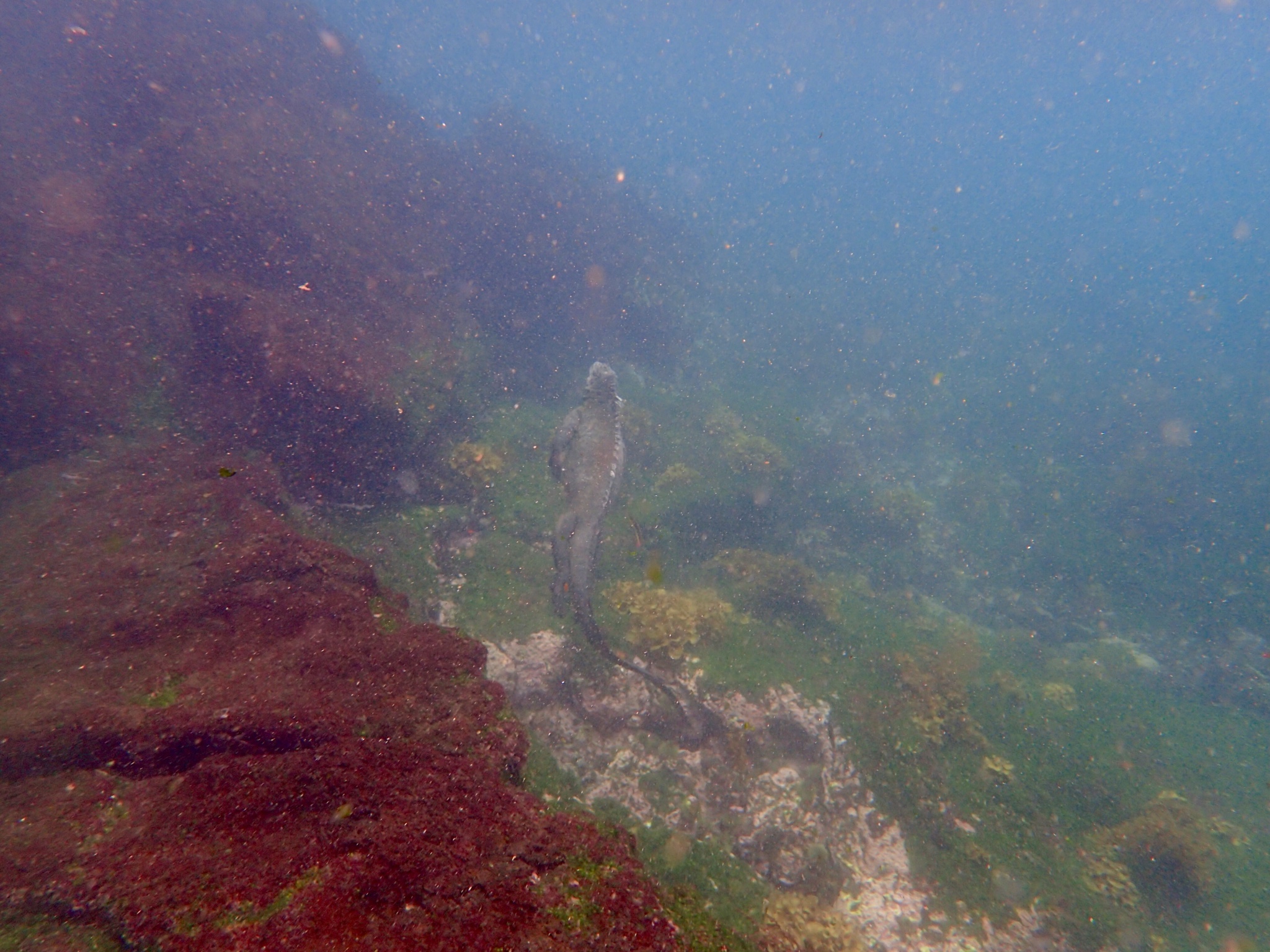
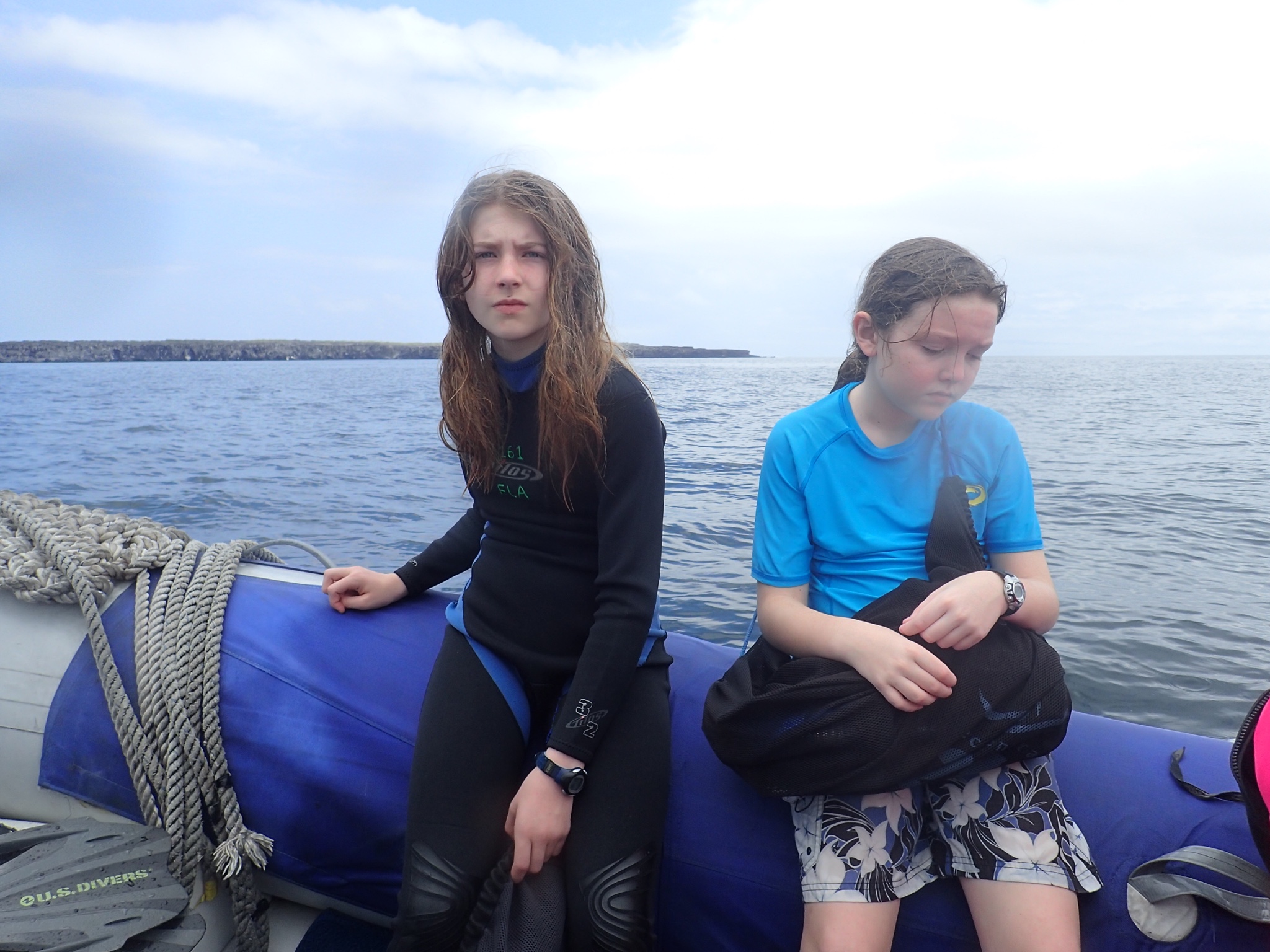
After our walk, we went for a very short snorkel. Due to prevailing currents, the water off the shore of the western islands is much colder than the eastern islands where we started our cruise. Wetsuits were a must. We saw amazing things in the water. Right off the bat, we saw a marine iguana eating seaweed. Talk about feeling like you have stepped back in time. It was the closest thing to Jurassic Park that I expect to ever see.

I’m trying to upload my first youtube video to this blog. Let’s see if this works:
 
 
Genene watched the iguana swim away.
I cannot really describe how bizarre it is to see a lizard swimming gracefully in the sea.
I hope this video of the swimming iguana turns out:
 
 
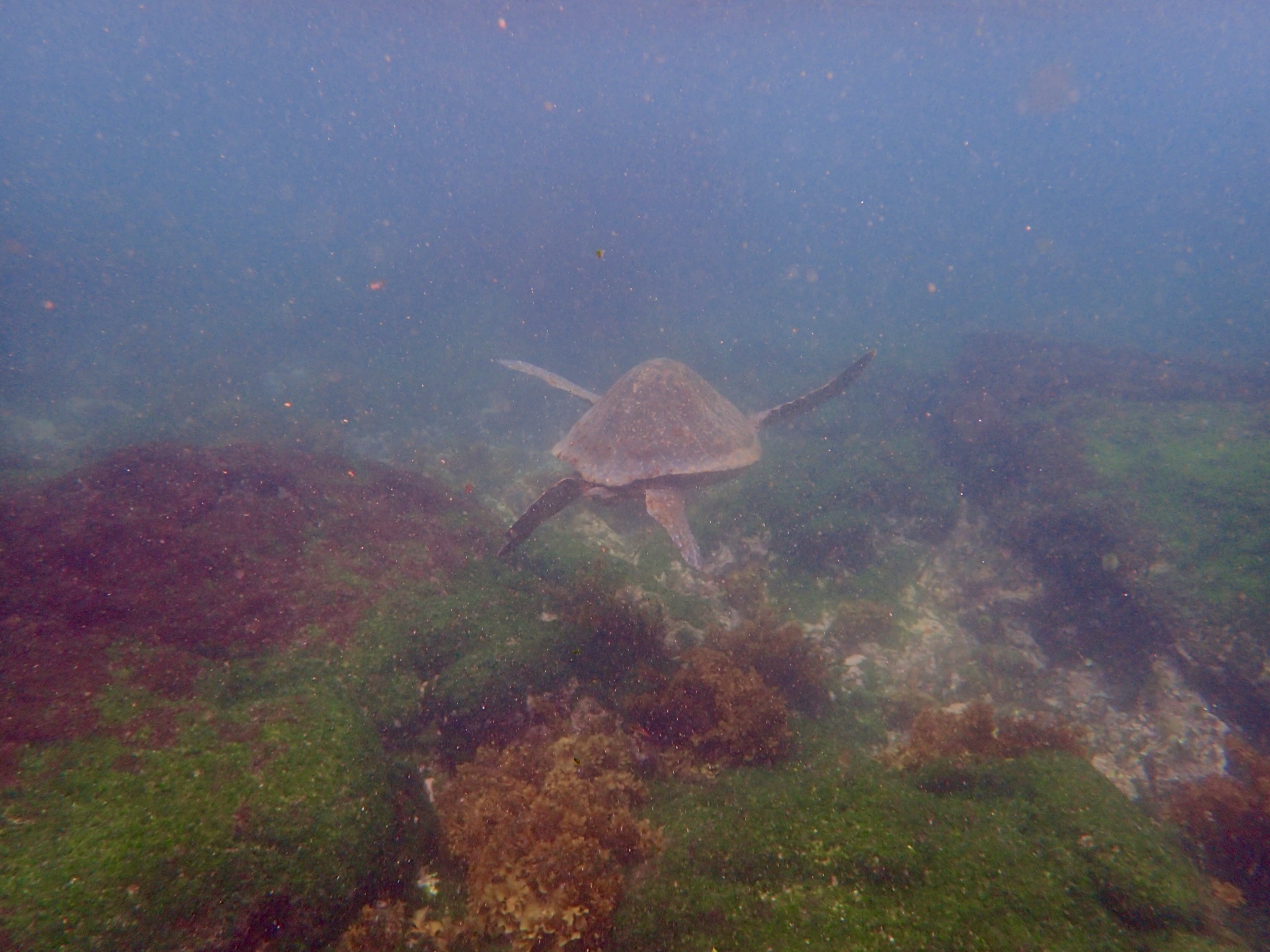
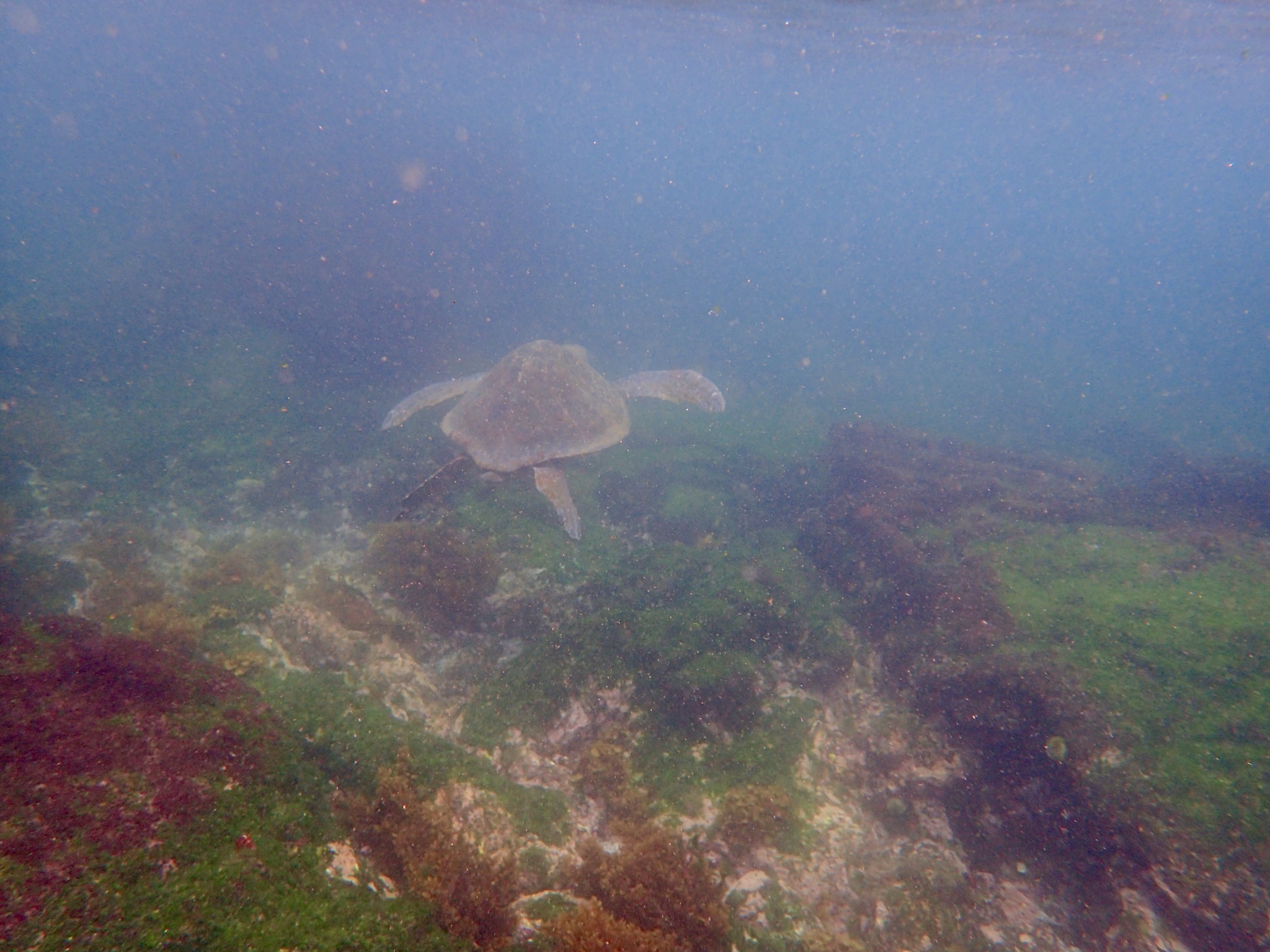
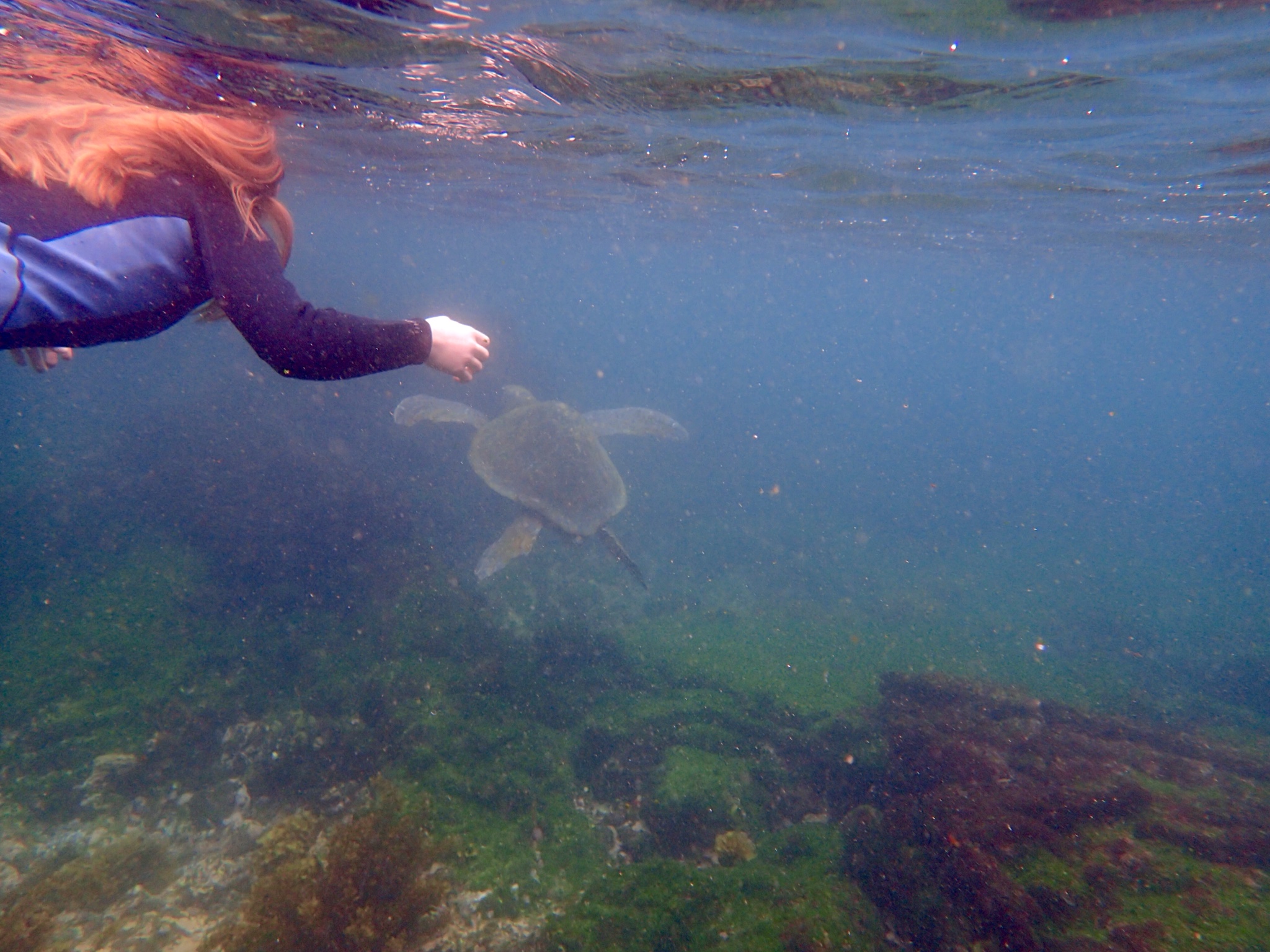
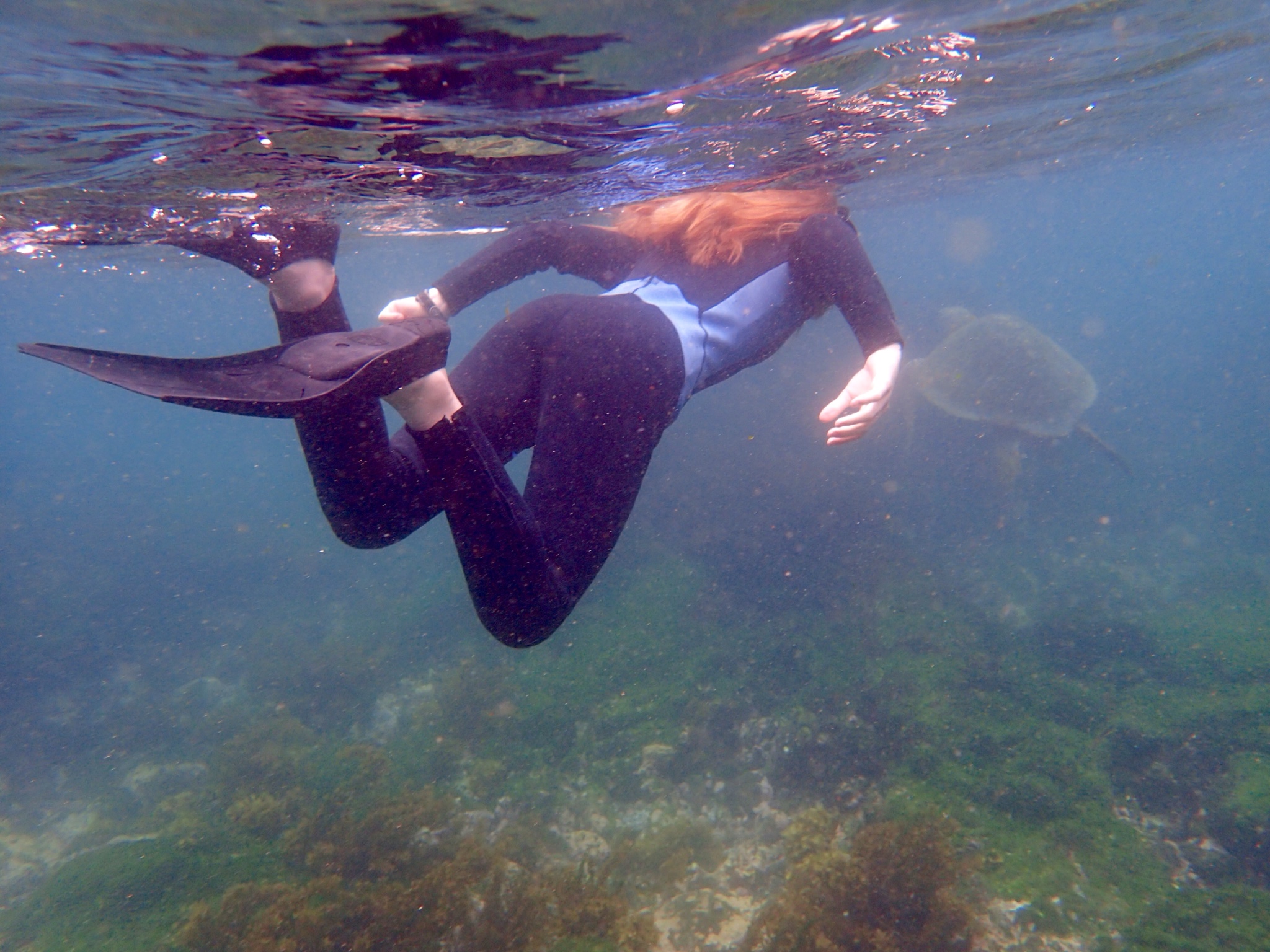
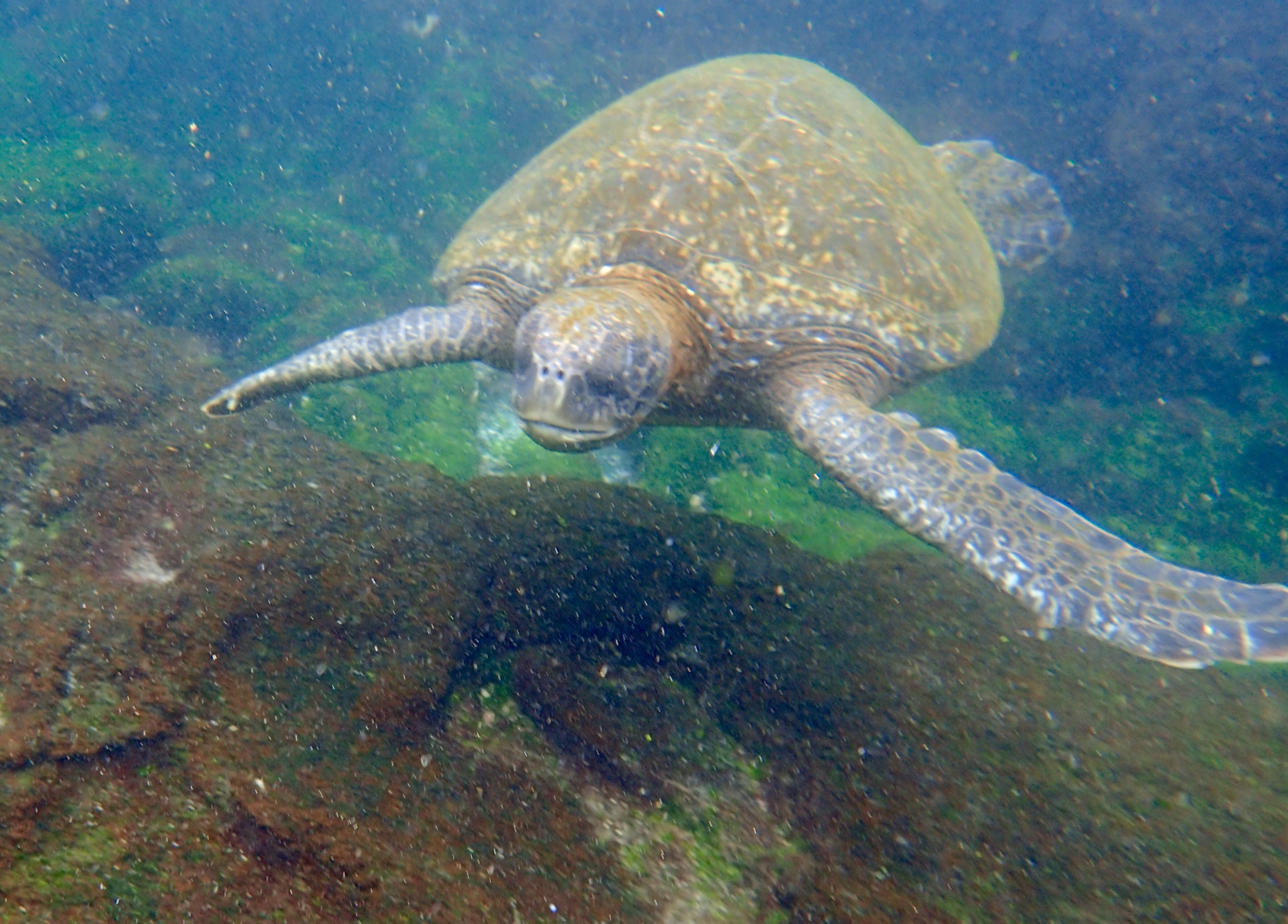
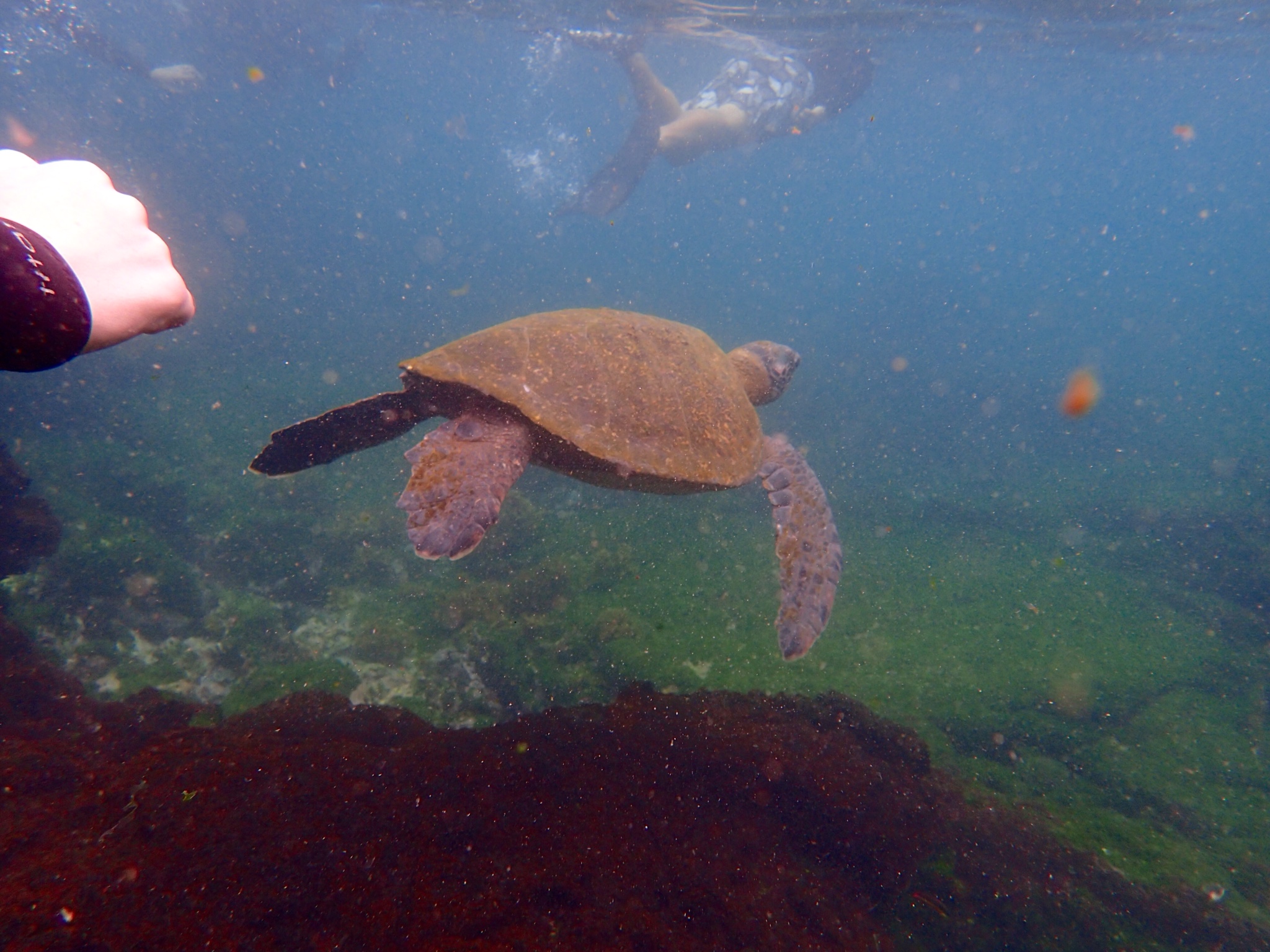
No sooner did the marine iguana make his exit than the sea turtle floated into view.
Genene followed, trying to maintain the six foot rule.
This guy turned right toward me, and I was a six-foot violator in a moment’s notice. He went right under me and all I could do was simply be still and let him pass.
See you later!
 
We came back aboard the boat for lunch and a siesta.

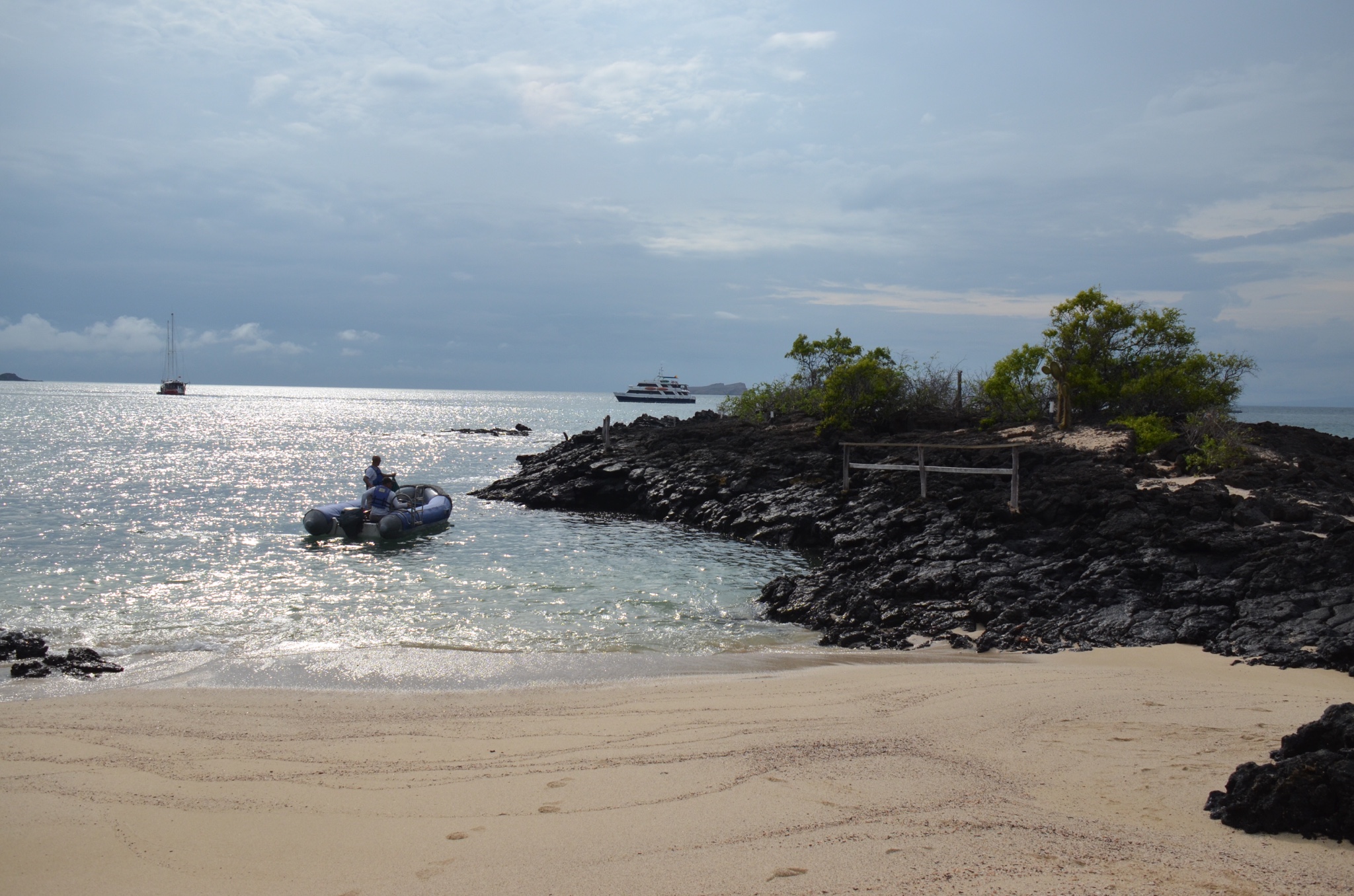
In the late afternoon, we made our first trip to Isabela Island (Isabela and Fernandina are within sight of each other). We had a wet landing at Bahia Urbina.

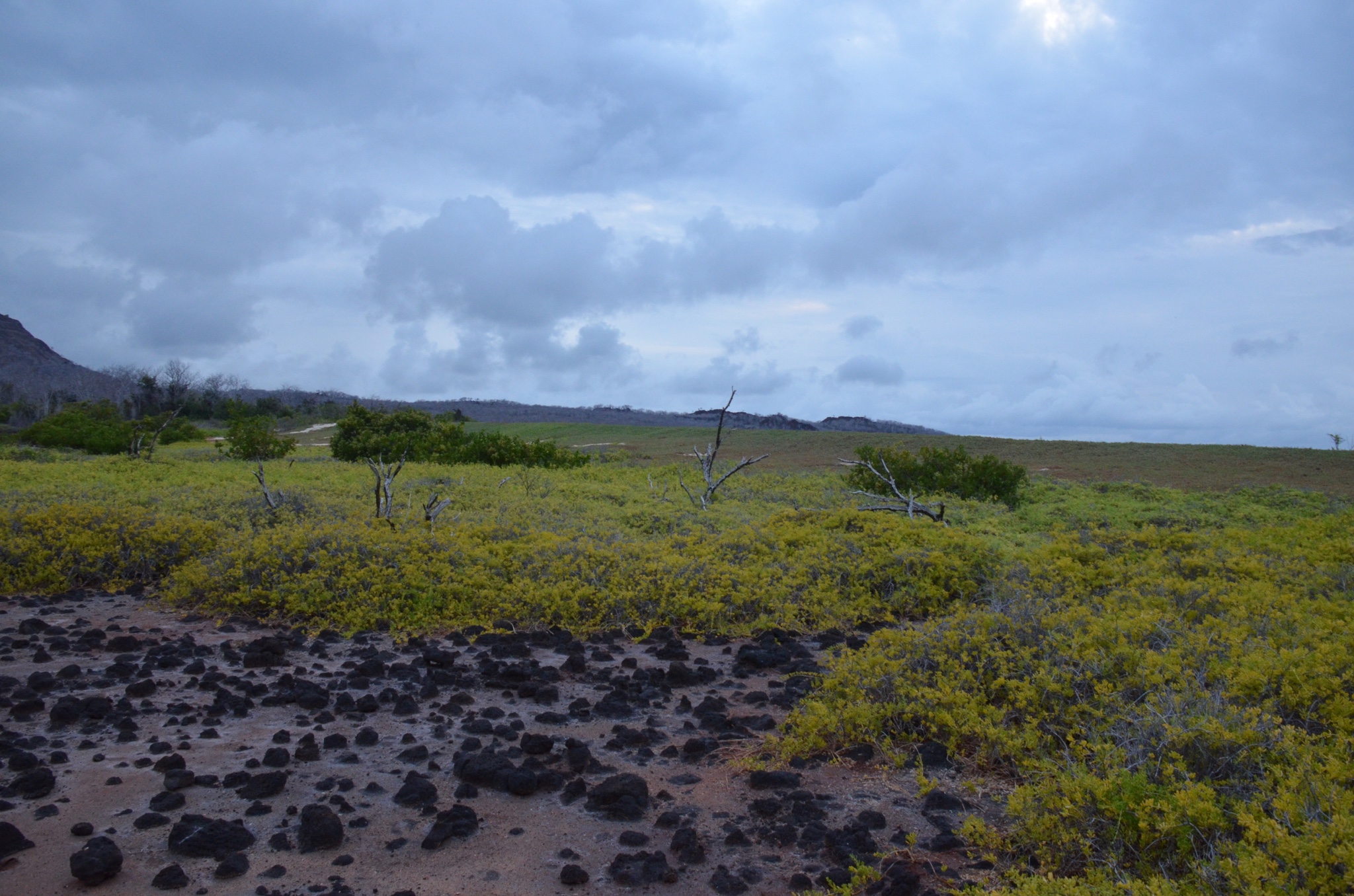
The island was grassy and green.

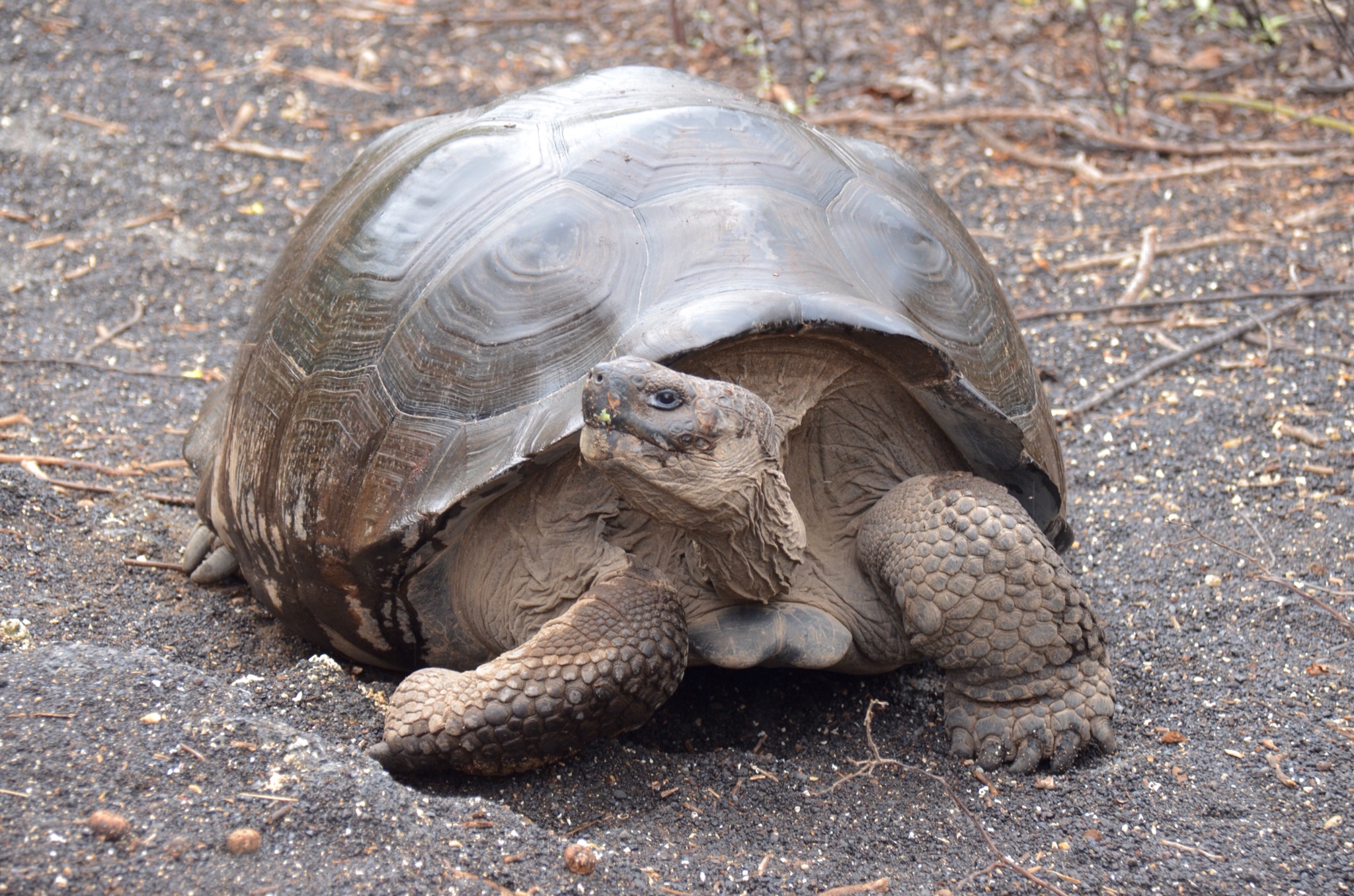
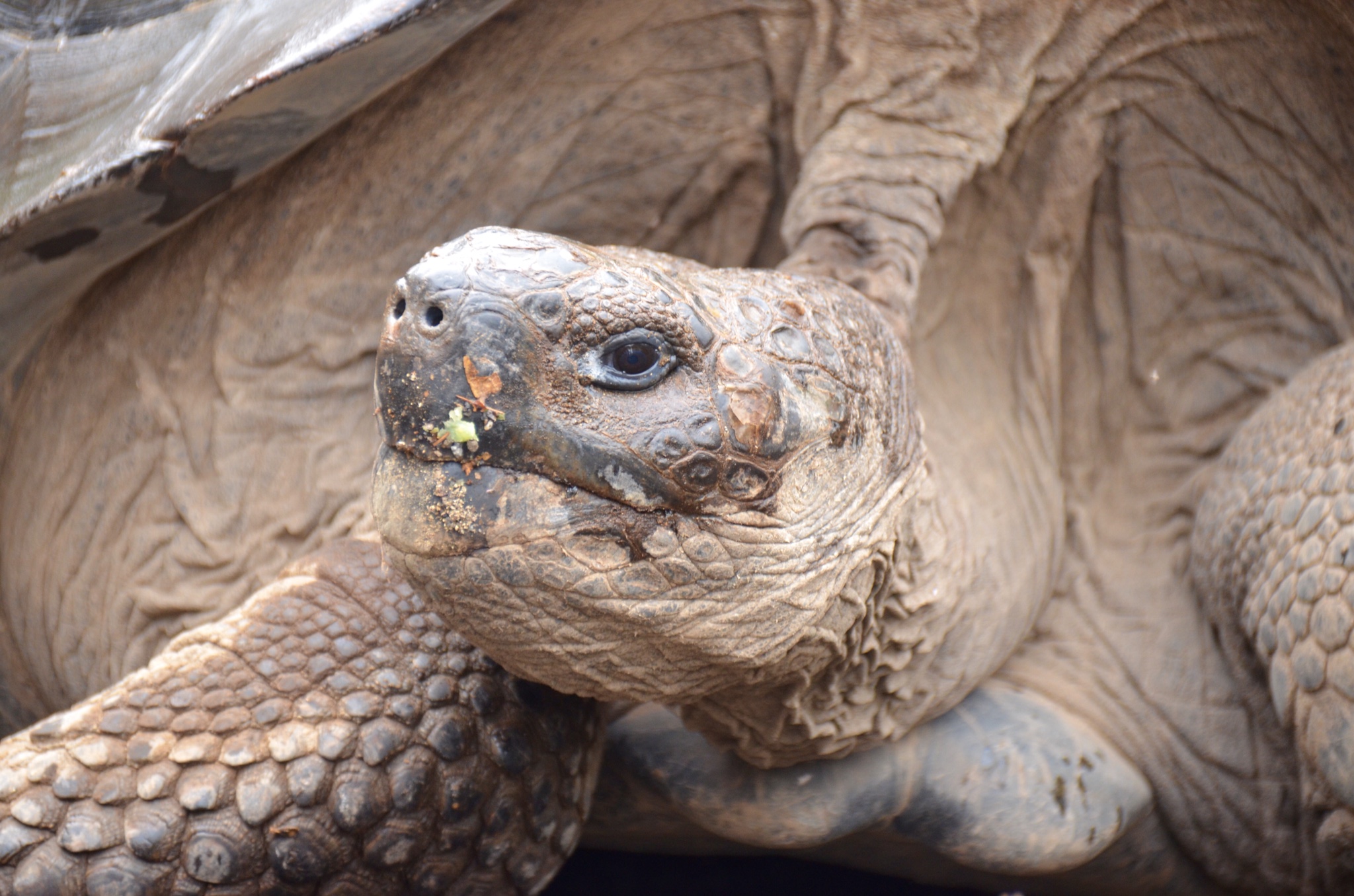
As we walked the trails, we got our first glimpse of the land tortoises. There are several species of tortoise, but they can be roughly divided into two groups: dome shaped and saddlebacks. Isabela’s tortoises are dome shaped. Dome shaped tortoises evolved on the larger islands with more extensive moist area and vegetation. The saddlebacks live on the low islands. Their saddlebacks evolved because the tortoises much reach high into the vegetation to feed.
The tortoise is one of the few animals of the Galapagos with a fear of man. Pirates who landed on the islands valued the tortoise as food. They can live up to a year on their backs with no food and water, making them ideal meat for hungry sailors. Sailors to the islands would fill the holds of their ships with the big beasts (tossing out the goats that they were sick of eating) and have fresh meat for their voyage. The tortoises take over 25 years to reach sexual maturity and live to be over 100. At maturity, they weigh several hundred pounds.
Speaking of goats, their invasive introduction by sailors became a huge problem for the islands. The goats destroyed the habitat of the tortoises and competed for natural resources. The Galapagos government undertook a massive goat eradication program, shooting the goats from helicopters. There is a wonderful hourlong “Radiolab” program on the Galapagos that discusses this issue in some detail. I commend it to your listening pleasure.
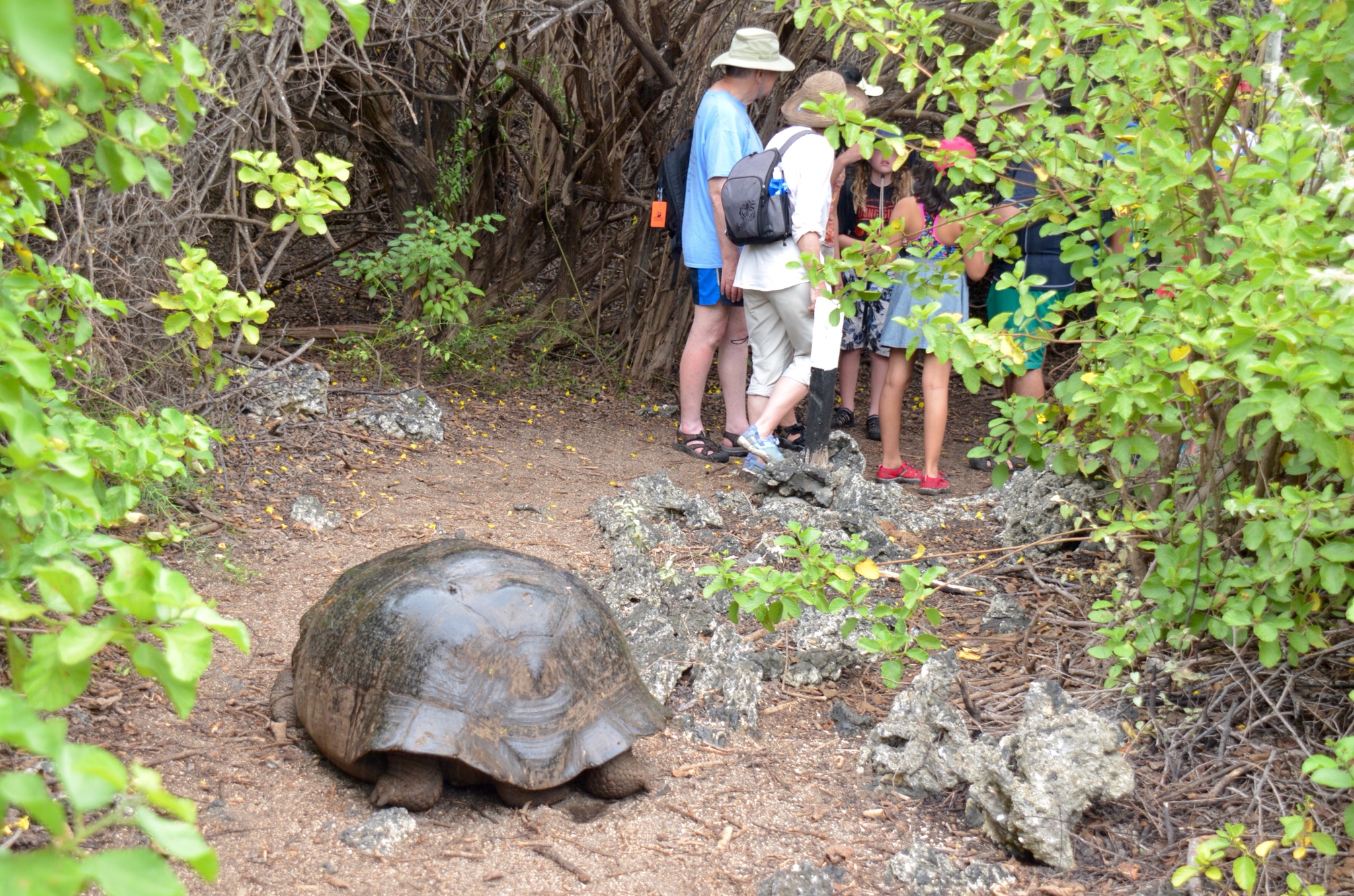
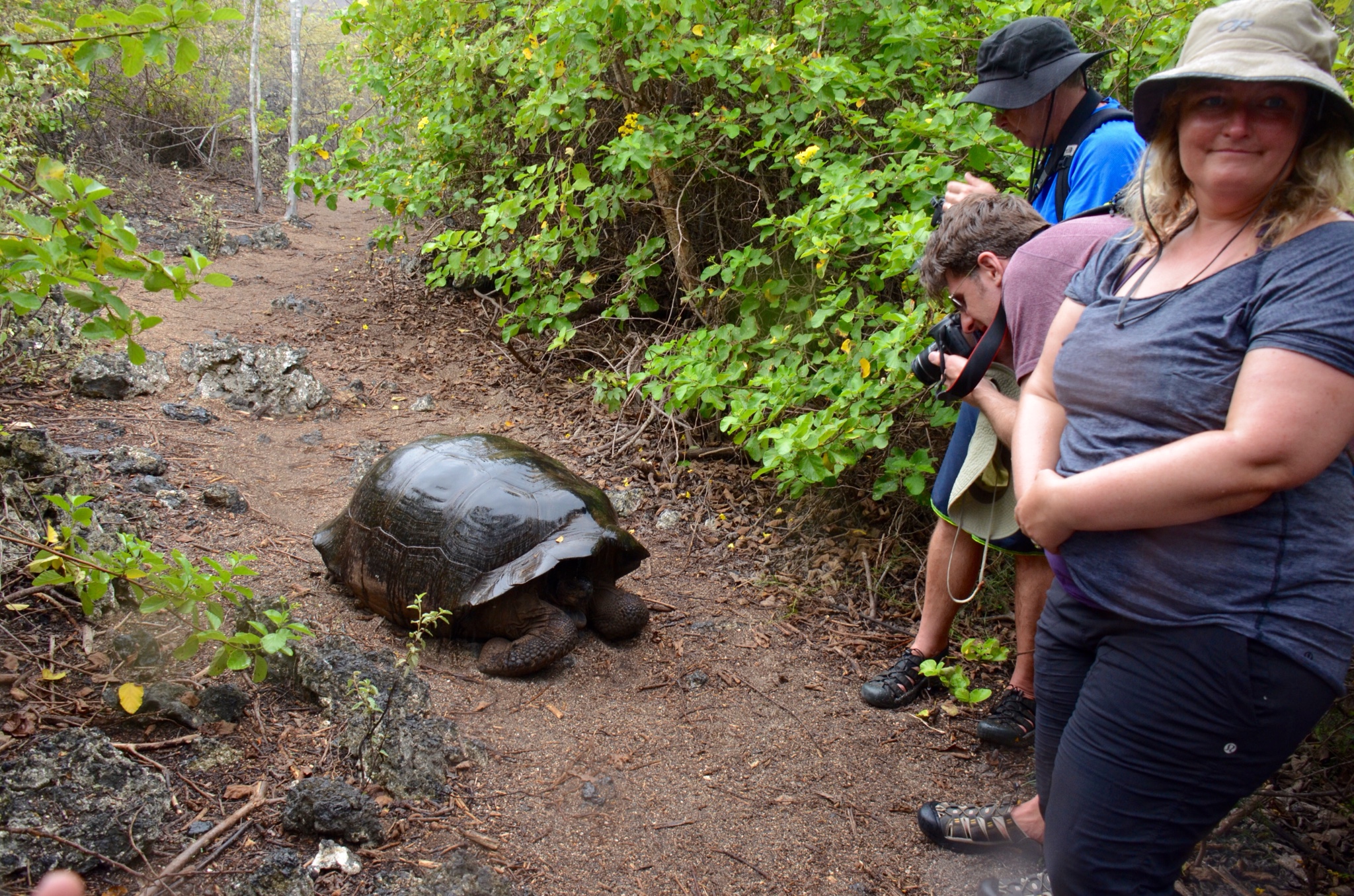
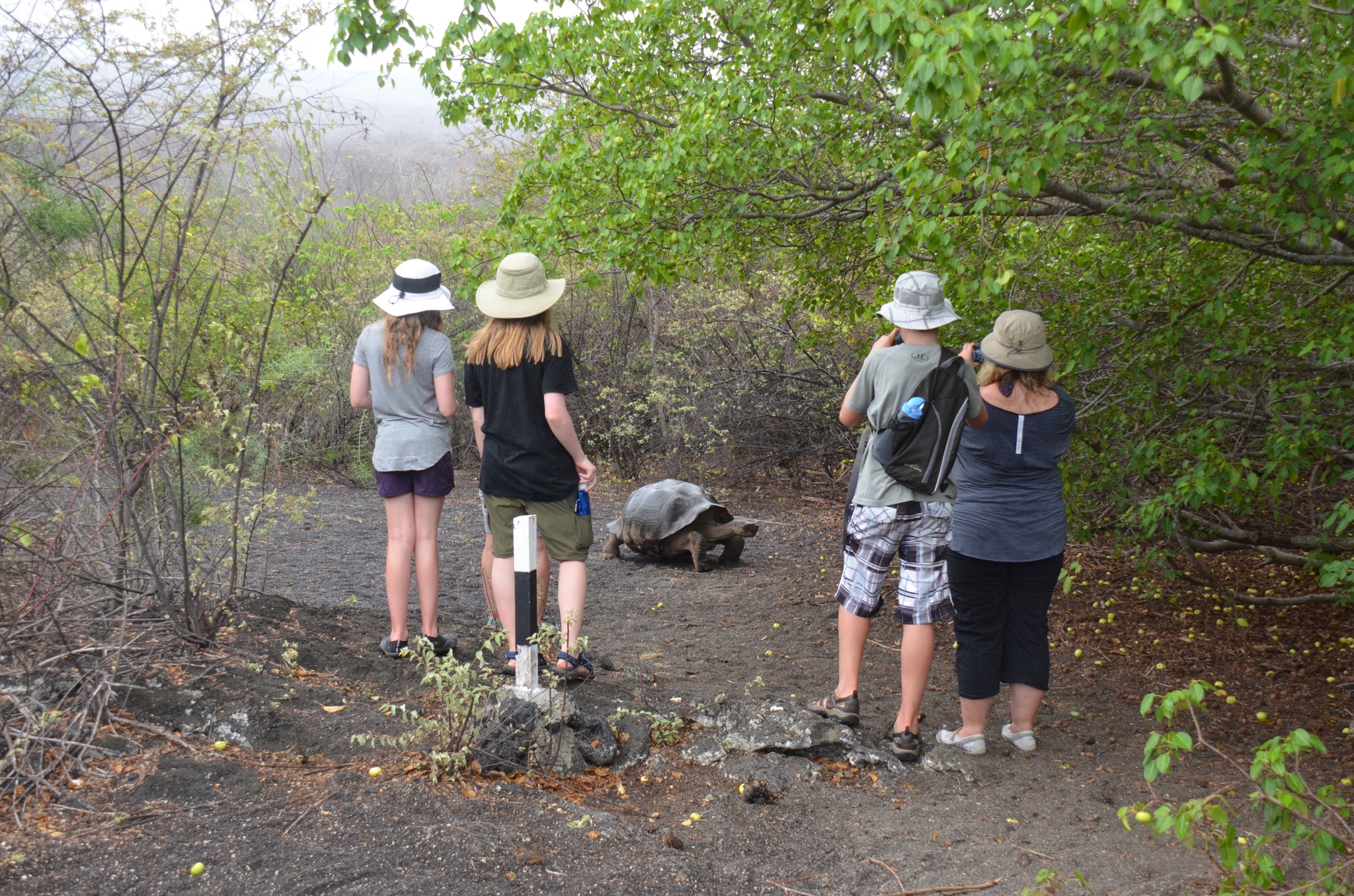
We got our first glimpse of the tortoise. He was not hard to find, sitting in the middle of the trail.
This fellow was naturally shy. Don’t worry. We won’t toss you into the boat.
The turtles are deaf but can feel the vibrations of people walking.
This fellow ate a poison apple as we watched. Their digestive systems are adapted to it, but James explained that this fruit will make a human very sick. Even the leaves of the tree are poisonous to people.
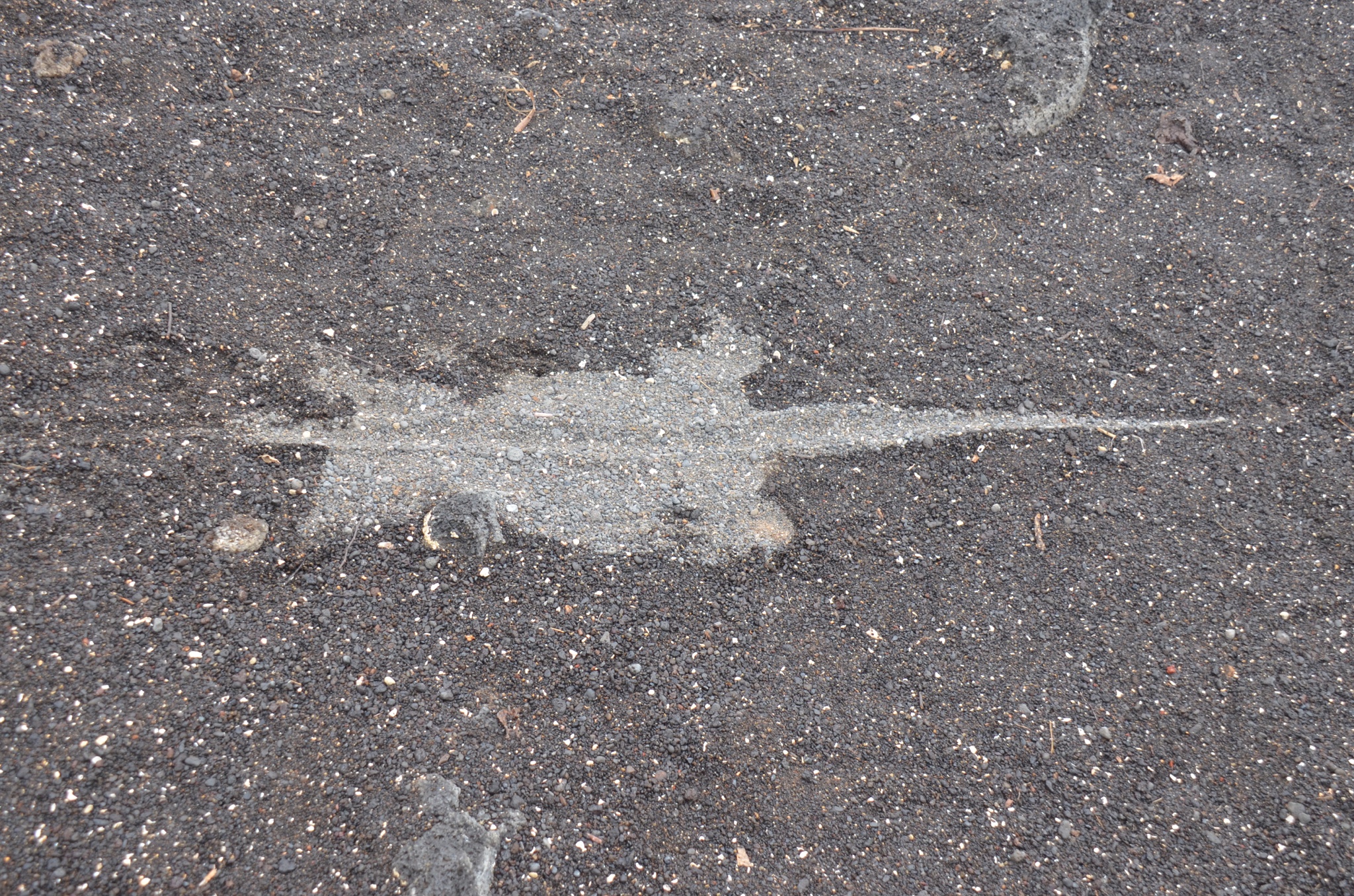
It came a drenching afternoon shower as we toured the island, and this outline showed us where the land iguana had been laying. It looks a bit like a police outline, doesn’t it?
Look at the big feet and tail.
We came upon this fellow strolling down the walk as we toured the island. To mind the six-foot rule, we all had to push to the edge of the trail and give the right-of-way.

Our guides told us that the early sailors called the Galapagos the Enchanted Islands. They were frequently covered by the mists and clouds, and the sailors thought that the islands moved. Staring across at Fernandina from Isabela, I could understand their point.

After our walk, we snorkeled from the beach. I didn’t see anything new, and the cloud cover made for lower visibility. Some people saw a sea turtle. Genene simply enjoyed letting the waves push her in and out on the shore.


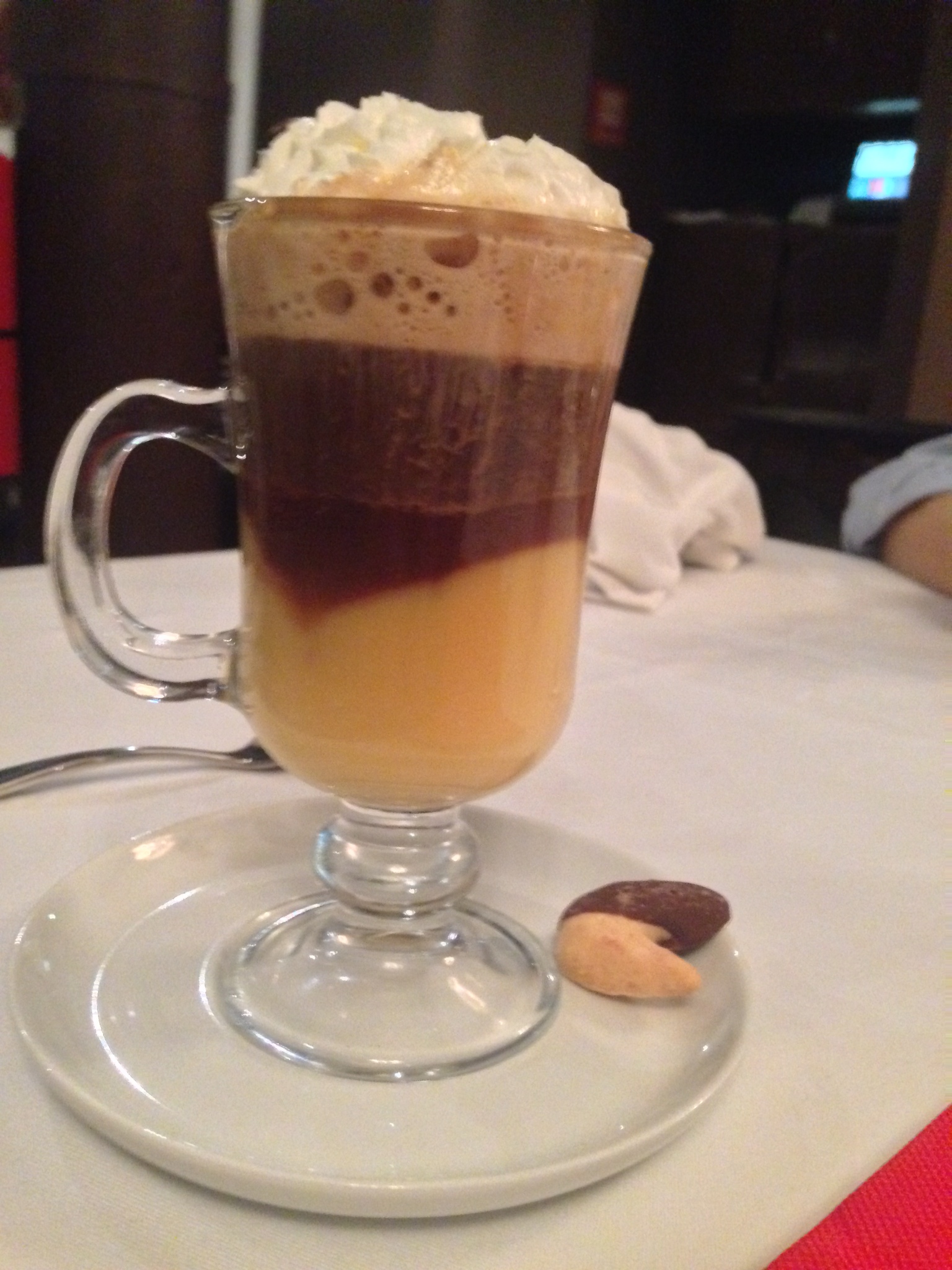
We went back to the boat, where snacks of ice tea, chicken salad sandwiches, PBJ, cantaloupe-prosciuttto and black olives awaited, along with the ever-smiling Abel. He was not about to let us get hungry. We all had time to take a shower before the briefing on tomorrow’s activities and supper. Tonight we ate cucumber appetizer, chicken consommé, with entree choices of beef and salmon, and for dessert bananas foster. The chef was a genius. Every course was delightful.

After dinner, we got a special treat. The crew put on a musical show for us. Tomorrow, we will spend the day on Isabela Island. Because the crew only had to move the boat for 3 hours, we were at anchor after dinner. There was time for everyone to relax, including the crew. Even the captain joined in the festivities. He bought us all a beer, and the entire crew sang songs for us. They had a guitar, and the captain played bongo drums with his hands. Even Abel joined in, banging on an empty wine bottle with a spoon. Soon, they were all dancing. The captain gestured to me (at least that’s the way I saw it; That’s the way I wanted to see it!) I jumped off the couch in a moment and danced with him. (Did I mention that he was very handsome?) At some point, I looked over, and Genene had her face covered with her hands. Oh well. I don’t care if she was embarrassed. When will I get another chance to cavort on the high seas with a swarthy young boat captain? Several of the other ladies took a turn, and the boat was filled with laughter and song.

They asked if any of us wanted to sing, and young Alec took the guitar. He did an absolutely stunning rendition of “Hey Soul Sister.” I reached out to his mother, and we shared a little moment. I felt her pride for her son, and it welled up inside of me. We were bursting with emotion….or was it the wine?

After Alec wowed everyone, one of the fathers, Matt from Vancouver, picked up the guitar. He played and sang Neil Young’s “Old Man Take a Look at My Life.” His acoustic guitar and vocals were astonishingly beautiful. We teased his wife Laura, asking her if this is how he had courted her. It was on this night that I began to suspect we had something really special going on. What were the chances that we would have two phenomenally talented musicians on board? Several of the girls take piano lessons, including Genene, but they were all beginning to see the utility in learning to play a portable instrument like the guitar. If only I had brought my clarinet!

It was just an amazing night. Perhaps the coolest part of all is that after Alec and Matt sang their one song each, no one sang anything else. Too often, an amateur musical night can devolve into hours of one-upmanship, but this was not the case. The crew, Alec and Matt performed their best, put down the guitar and left us wanting for more. Their best was fabulous, all of it.

We stayed a while and laughed and talked. The kids, bonded like glue, played their own games.

At anchor, until tomorrow…..


Ecuador and the Galapagos Part 4: Santa Cruz Island

Tuesday, March 17, 2015

I slept very well on the boat, which is surprising. I normally have a lot of trouble staying asleep but I think they just wore me out. Genene and I hit the rack before 10PM last night, and I did not wake up until 3:30 AM when the boat stopped. You can definitely tell when we are motoring on the high seas. The boat rocks, and the sound of the engine is quite loud. All of it lulls me to sleep.

The white board:


This morning’s wake-up was at 7:00 AM. The “call” each morning came in the form of some music being piped in over the PA system. The first morning we were all slightly amused because it was an instrumental version of “Hotel California.” Was it a threat or a promise? (You can check out any time you like but…you can never leave!)

Anyway, after a minute-long musical interlude of some sort, the guide announced, “Buenos Dias, Good morning! This is your wakeup call. Breakfast will be served in 30 minutes. Please get ready for the day. Wake up! Wake up!”

I stepped out the door and took in the sunrise.

Genene was harder to wake up:
 

We splashed water on our faces and took the few short steps from our cabin to the main dining room. Another great breakfast awaited. We had cereals (including the ever-popular chocolate puffs, which were attacked by the kids), fresh fruit, fruit juices, meats and cheeses, hot coffee, and some kind of omelette. We must be fortified for our adventures lest we become famished.

At 8:30, we climbed into the pangas and headed for a wet beach landing on Bachas Beach. Our guide explained that the beach was named because during World War II, US troops had a presence in the Galapagos. On Santa Cruz, barges were loaded and unloaded. The local Spanish-speakers could not say “barges,” and so the beach became Bachas.

The kids took a close-up look at the Sally Lightfoot crabs:

Peekaboo!
The crabs were all over the rocks.
The cactus trees grow tall on Santa Cruz.

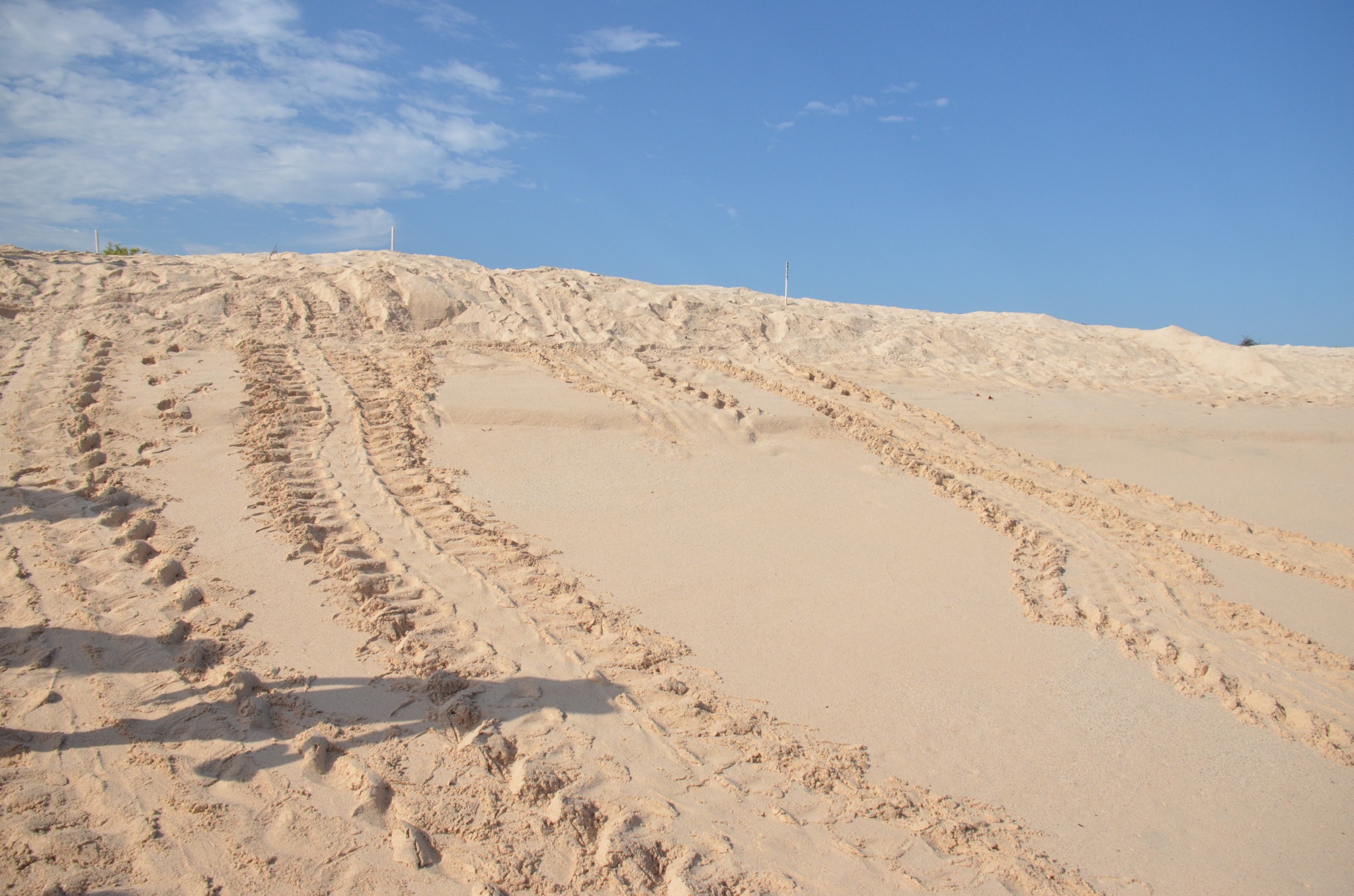
We walked a short distance to the beach area to see the sea turtle nests and their tracks. We saw one swimming in the water.

The babies make these small tracks as they try to reach the sea after they hatch:

The female sea turtle cuts a larger track, first up the dune to lay her eggs and then back down to the water. Our guides can tell from the way the sand is pushed up whether the turtle was inbound or outbound. The tracks look as large as an ATV track, don’t they?

Our ship strikes a pose in the turquoise water.
The Flamingo frequently attracted a following of birds:
I think this is a striated heron but it could be a lava heron.
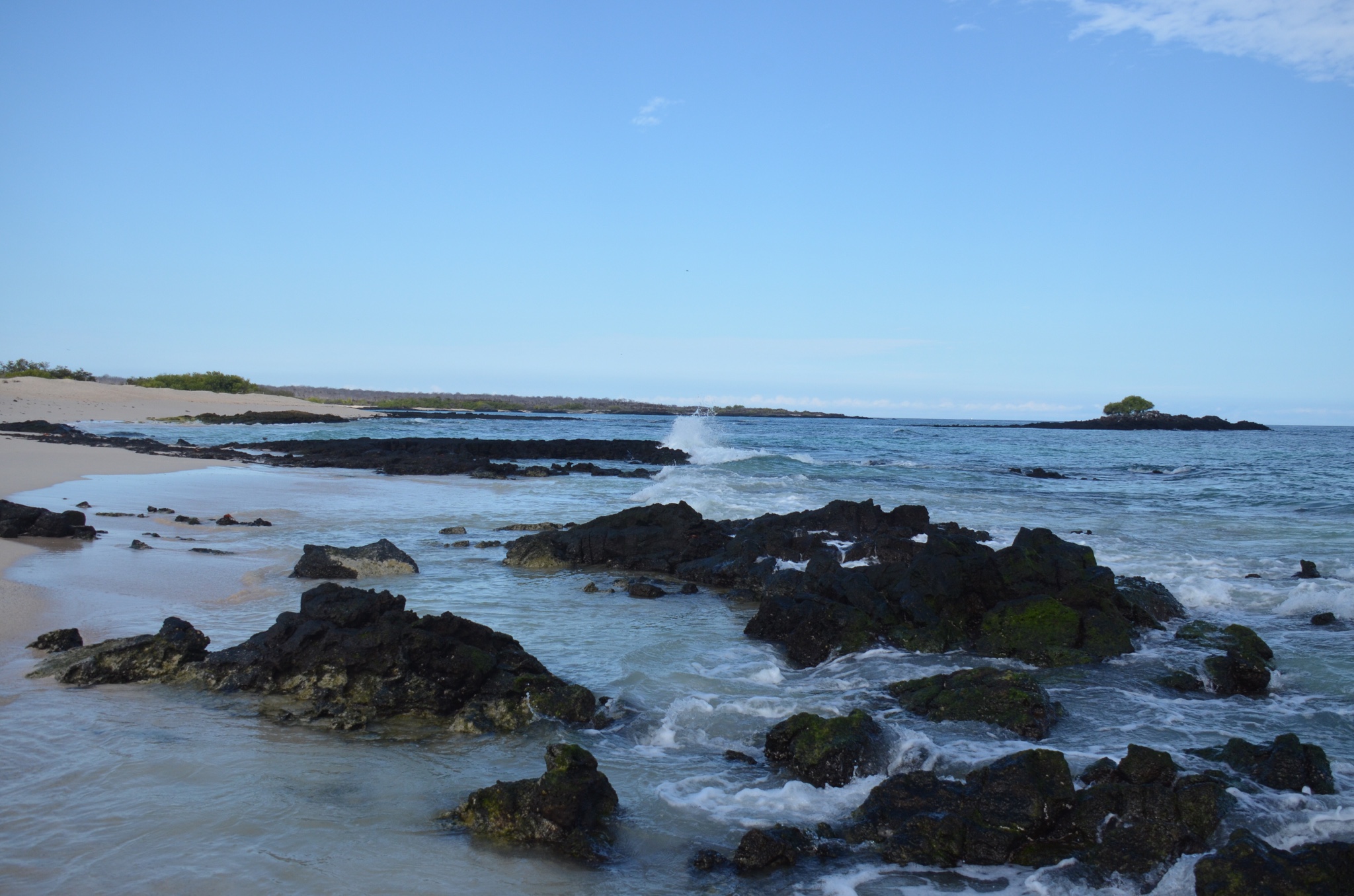
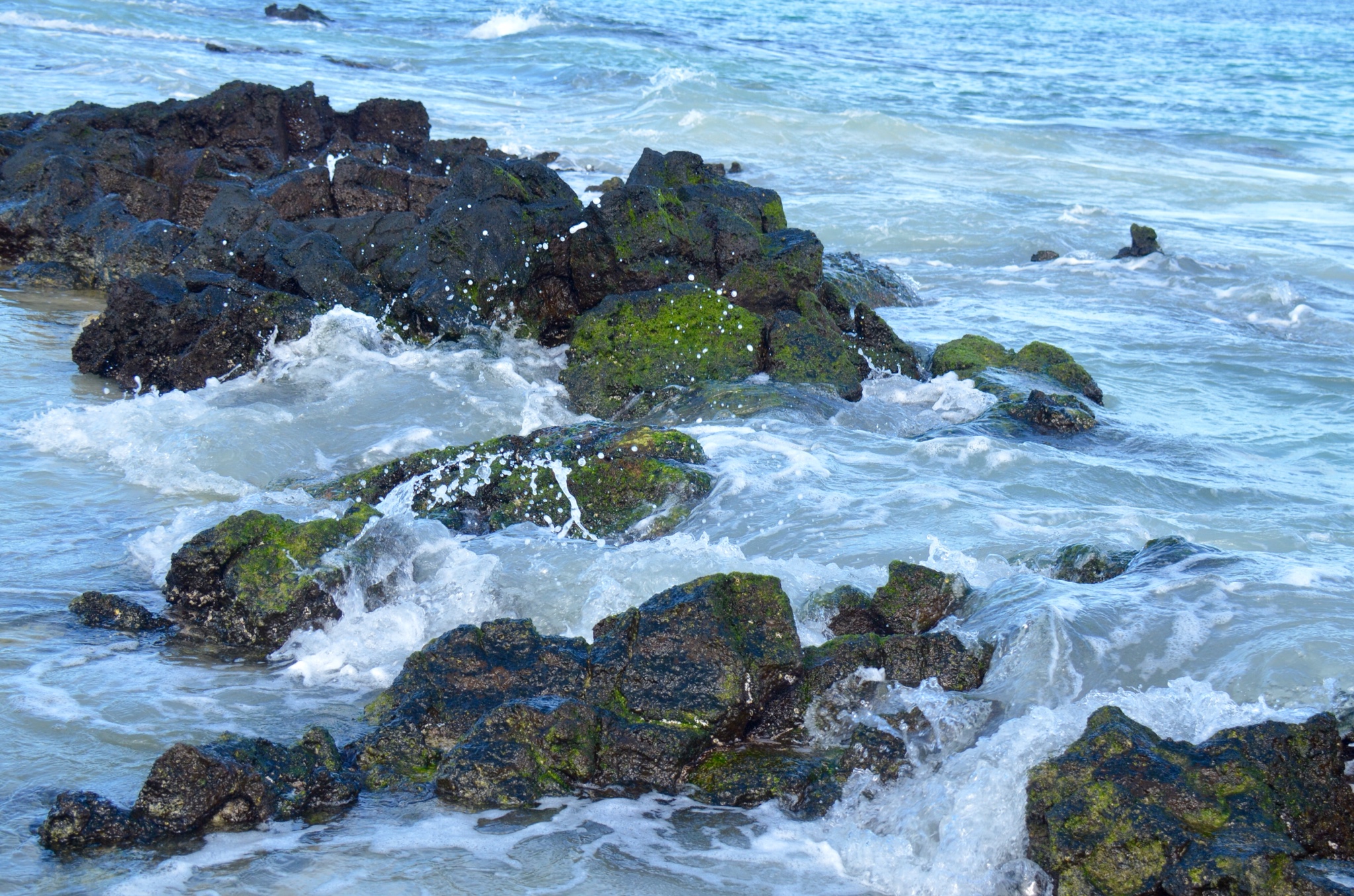
The black lava rocks and the white sea foam contrast beautifully.
The kids enjoyed looking for crabs.
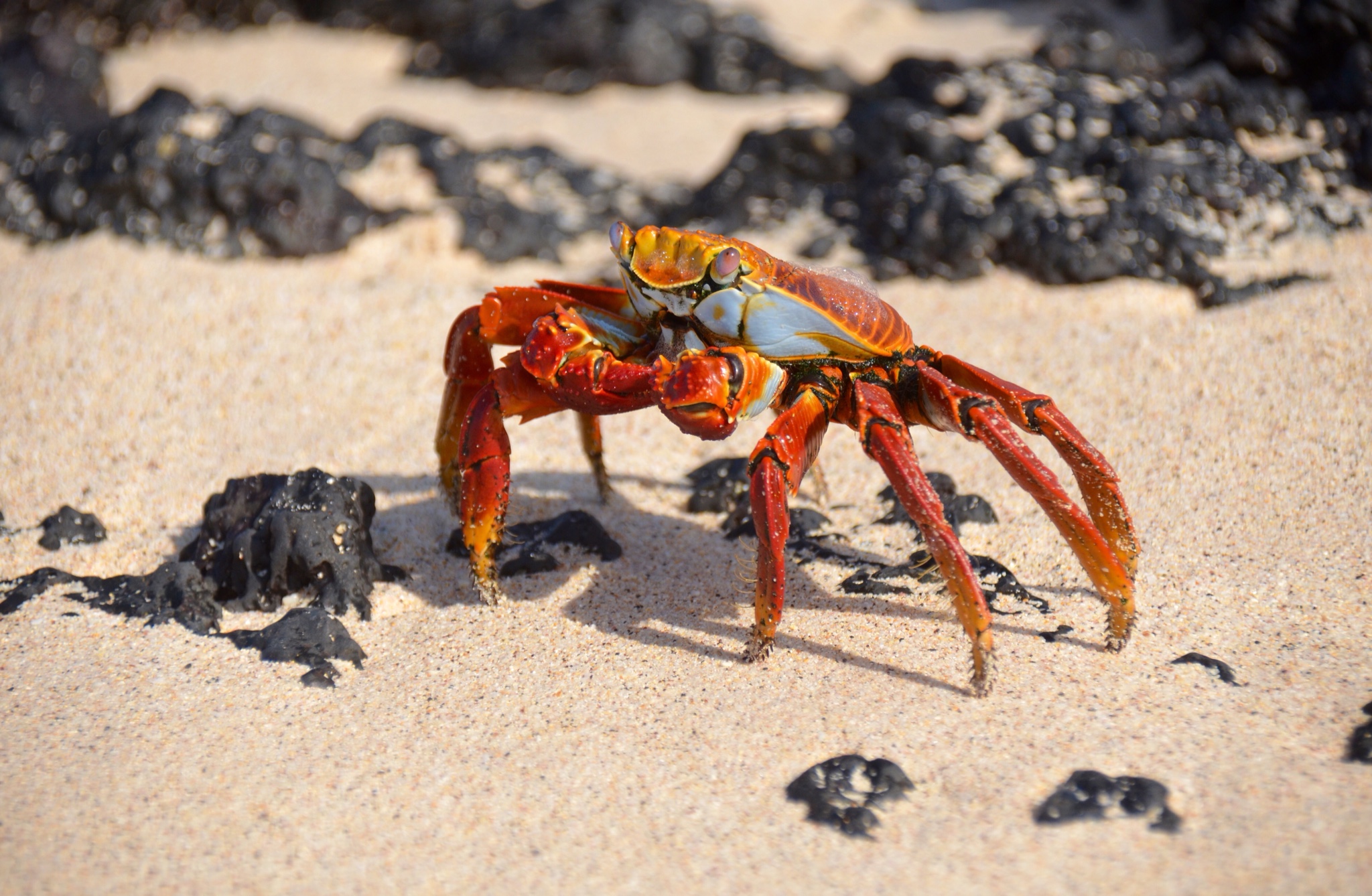
The Sally Lightfoot crab can be seen everywhere. Our guides told us that they used to be commonly eaten and were “delicious.” Even though they are common and not in any way endangered, it is forbidden to eat them now. They serve a valuable purpose in the Galapagos ecosystem. They are the “cleaners” and have symbiotic relationships with other creatures on the island. They pick the scales and parasites off the marine iguanas and sea lions. Nevertheless, James says his mouth still waters when he thinks of how they taste.
A marine iguana sits on the lava rocks:

A flamingo searches for food in a brackish pool. Our guides explained that the flamingos send scouts. The rest of the flock remains behind on another island while a few brave souls go looking for food. If they find good eats, they go back and get the rest of their troop.

The white cheeked pintail is quite clearly a duck, not so different from the green head mallards of Stuttgart, Arkansas.
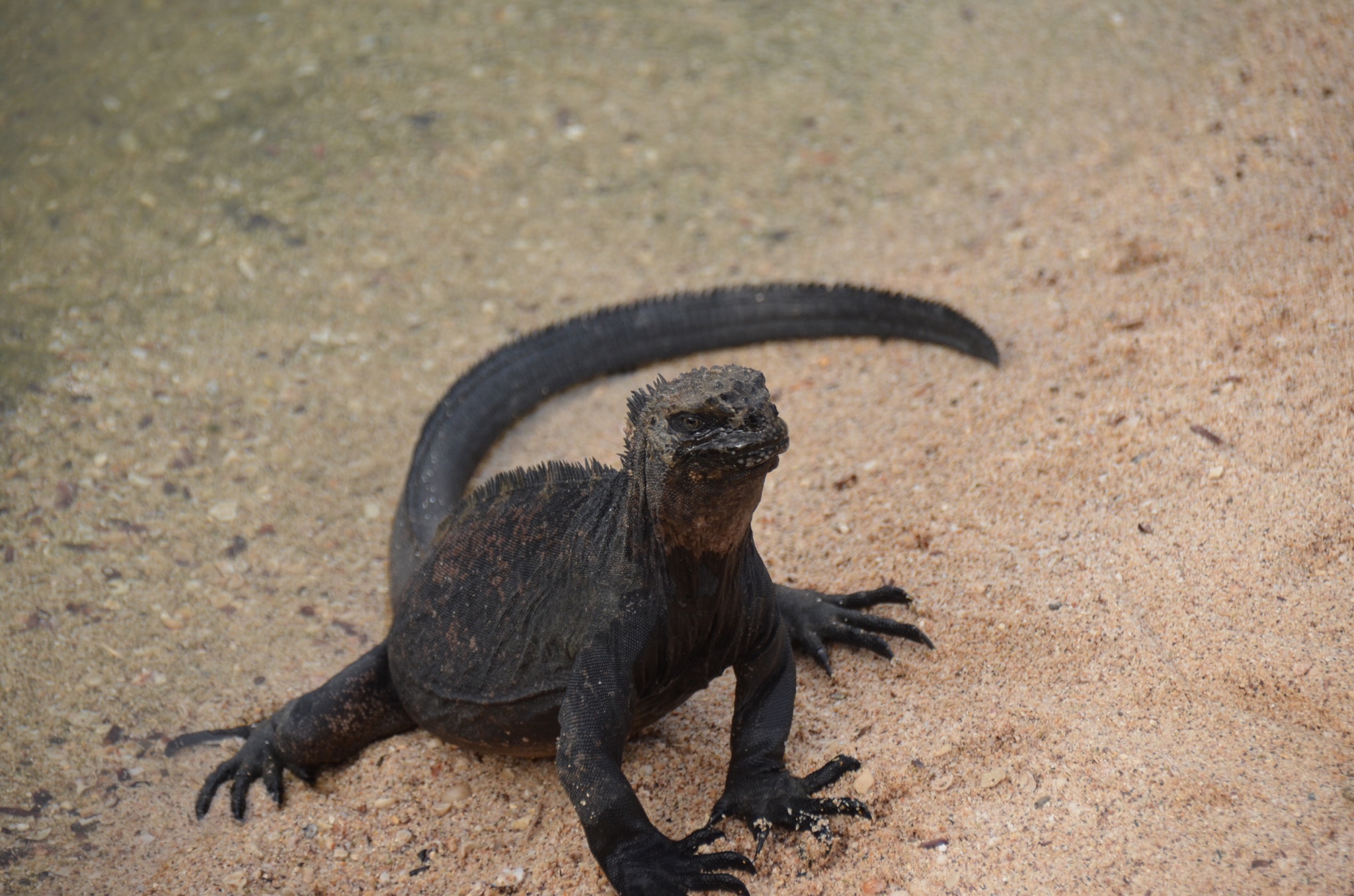
The marine iguanas look like Godzilla to me.
Eons ago, when the iguana arrived in the Galapagos, probably floating on a log or debris, it was a land creature. They evolved to eat the algae and can dive up to 10 meters. They can hold their breath underwater for up to 10 minutes. The iguanas propel themselves with a side-to-side motion of the tail. They are very other-worldly looking to me.
The brackish pond. Can you see the two scout flamingos?

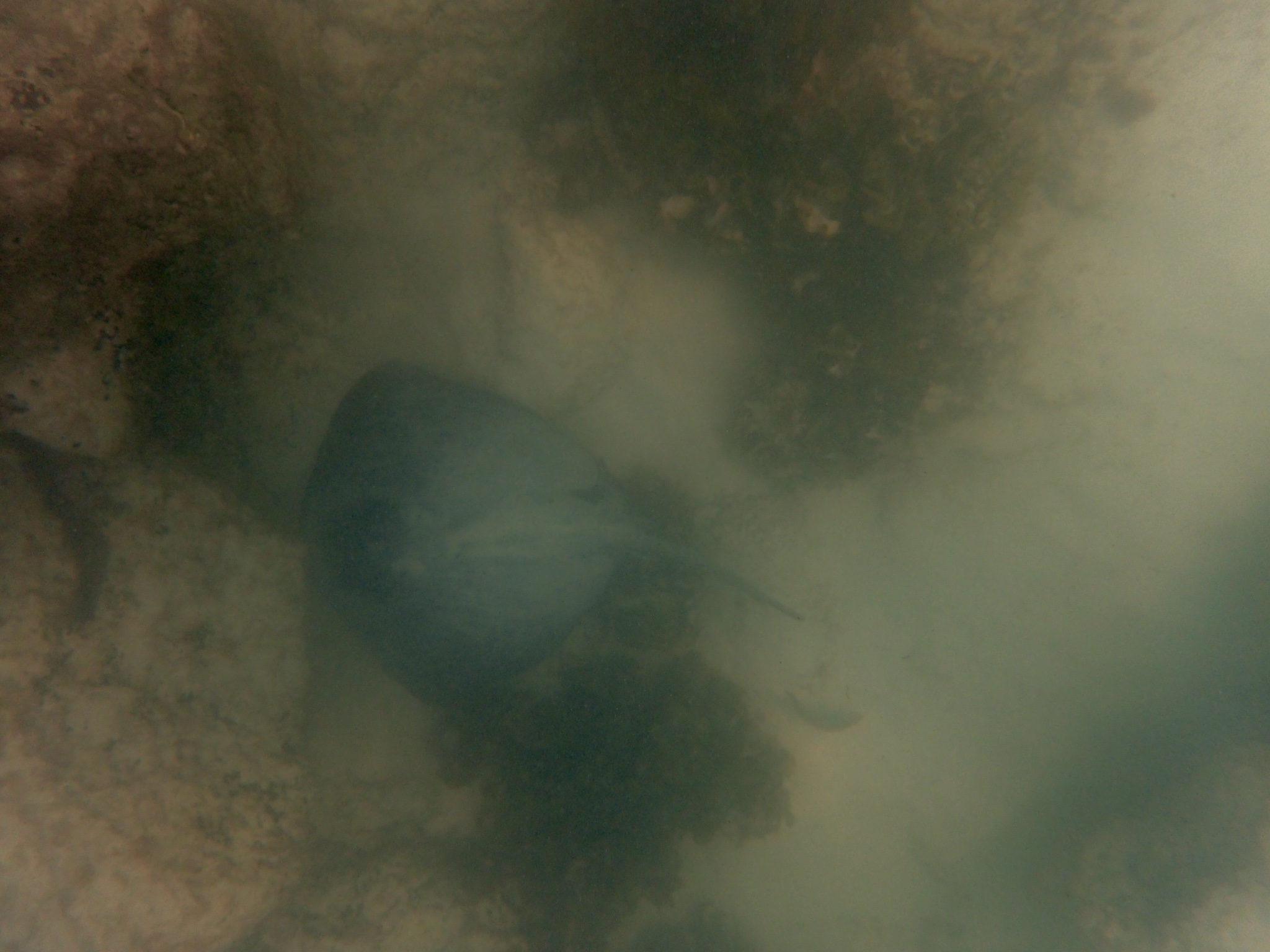
After walking on the beach for about an hour, our guides released us to snorkel off the beach for another hour. I saw a ray, puffer fish and lots of fish whose names I do not know. The kids all elected to stay on the beach and swim without their snorkels.

One of the panga drivers let them get on board the panga, and he took them out into the deeper water so that they could jump over the side. It was fun to snorkel off the shore and listen to their squeals of delight close by. The kids got along famously and so did the adults. I was amazed by the group we were traveling with. Every single person was smart, fascinating and fun. It even seemed as if we parented our kids in the same style. It was a joy to share the adventure with them.

A few shots from our snorkel interlude.

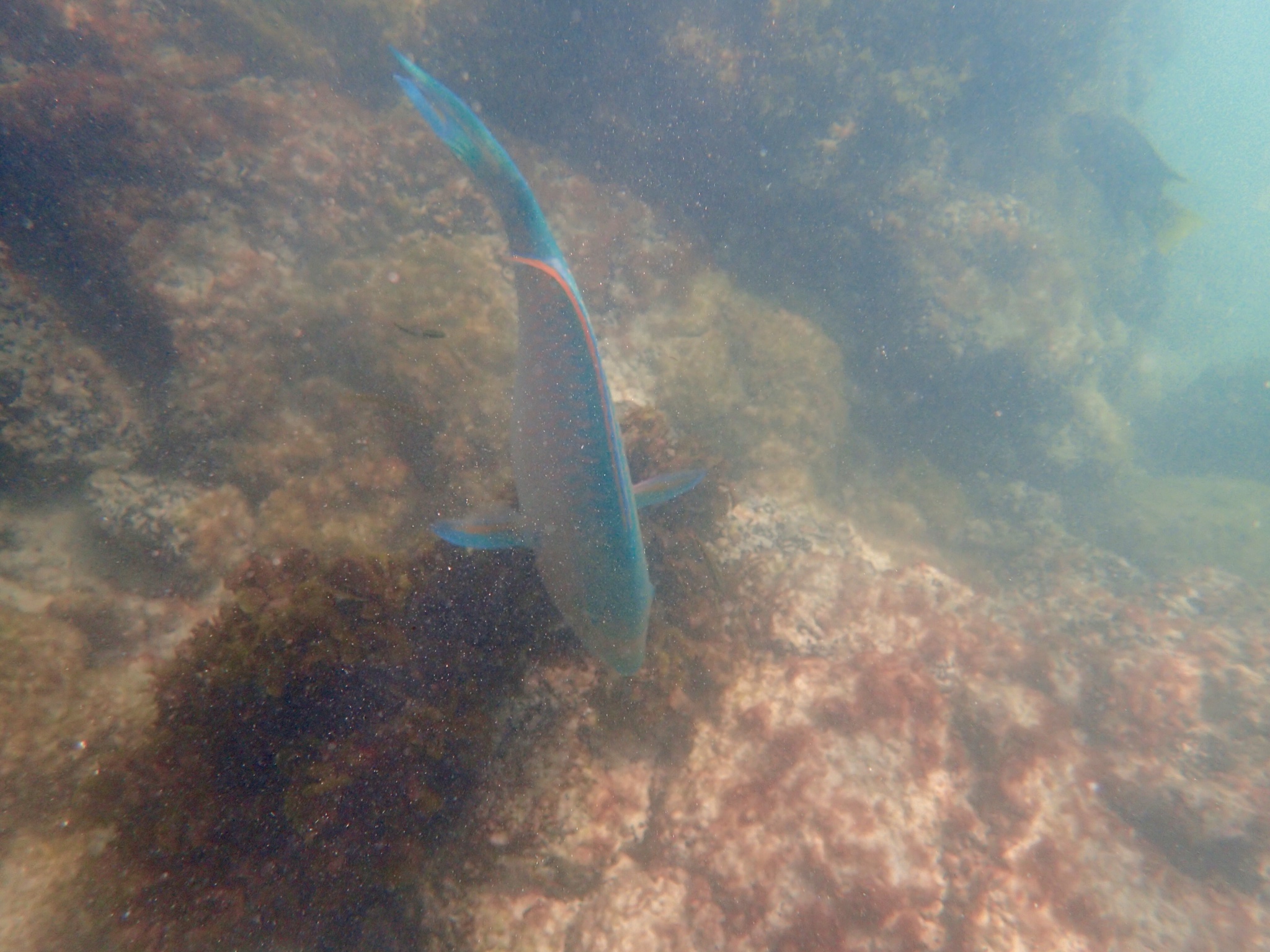
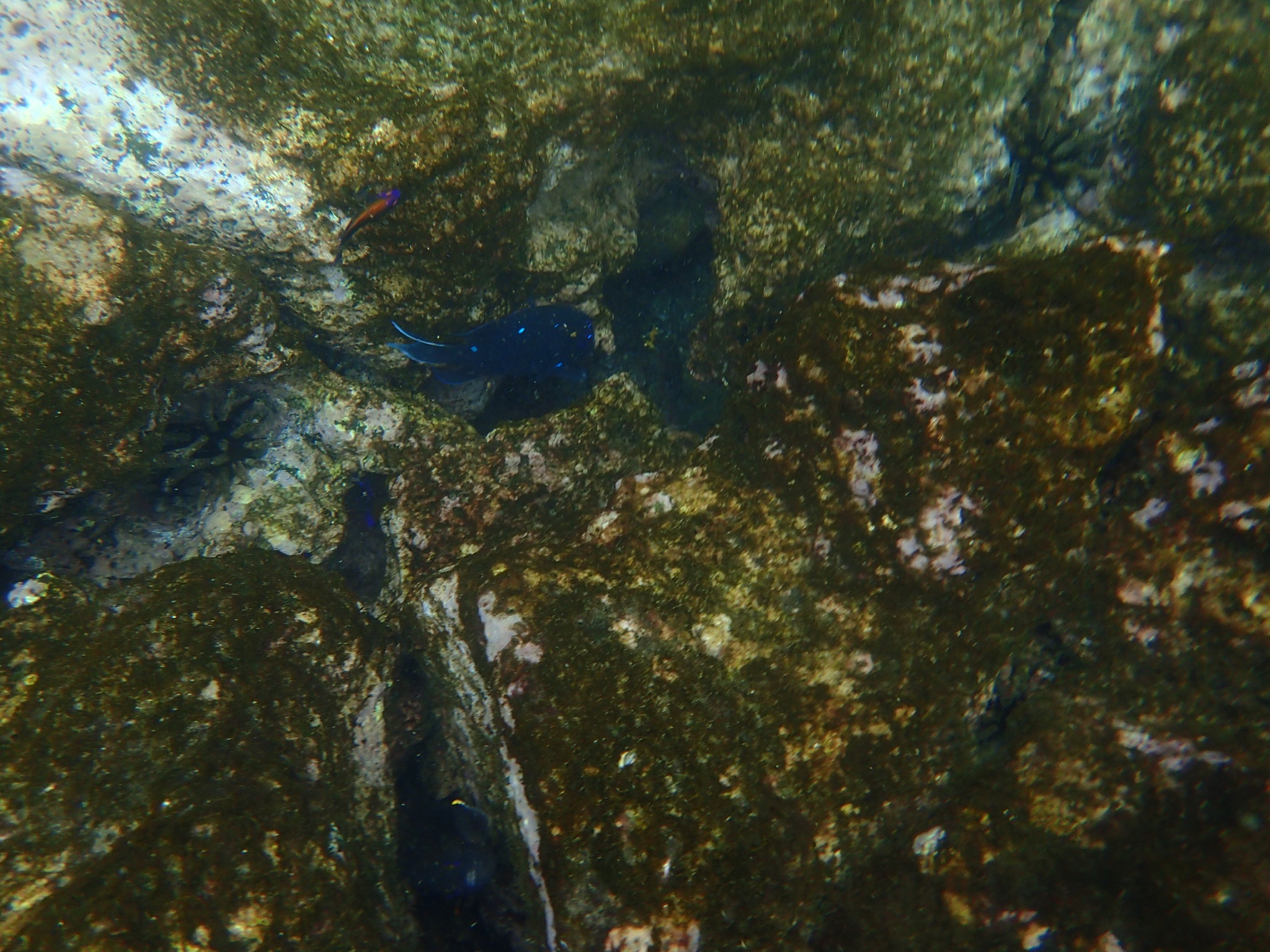
Colorful fish:

A ray!
Greg enjoyed the snorkeling most of all. He is very comfortable in the water and just loves looking at everything. I’m an Arkansas land-lubber and so I regard the sea with much more suspicion and trepidation. I was glad when Genene did not join us for snorkeling because I did not have to worry about her. Greg worried about nothing and frequently ditched us all to do his own exploring.
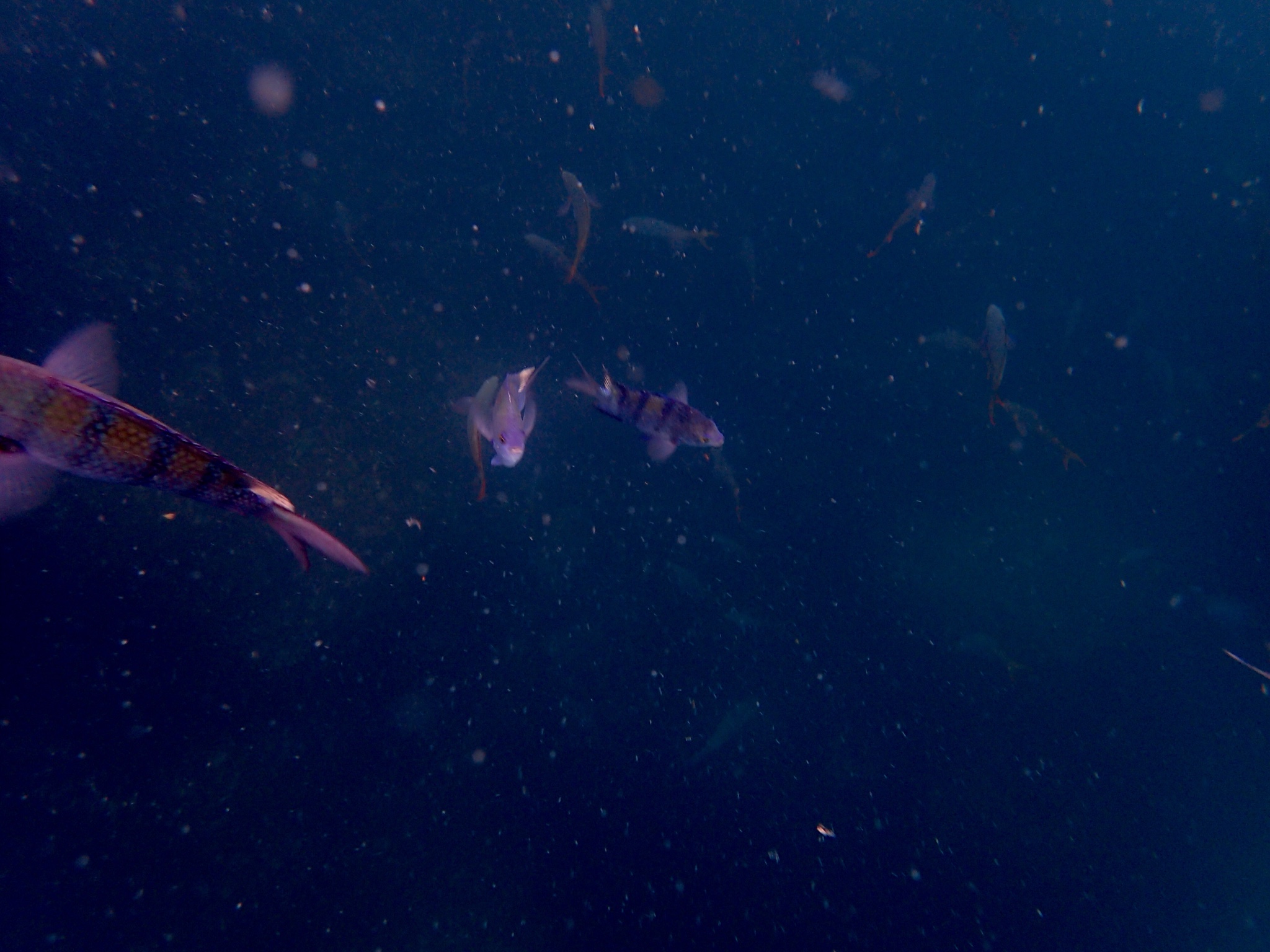
The water in the Galapagos is teeming with life.

After the morning snorkel, we returned to the boat and had lunch at noon. Between noon and 3:00 PM, the boat moved to another landing on Santa Cruz, Cerro Dragon (Dragon Hill). Most people took a siesta or sat on the top deck reading a book.

At 3:00 PM, we went swimming and snorkeling off the beach, where we saw schools and schools of fish. Genene snorkeled without a wetsuit or life vest. She is so confident with her swimming. I am proud of her. In this regard, she takes after her dad.

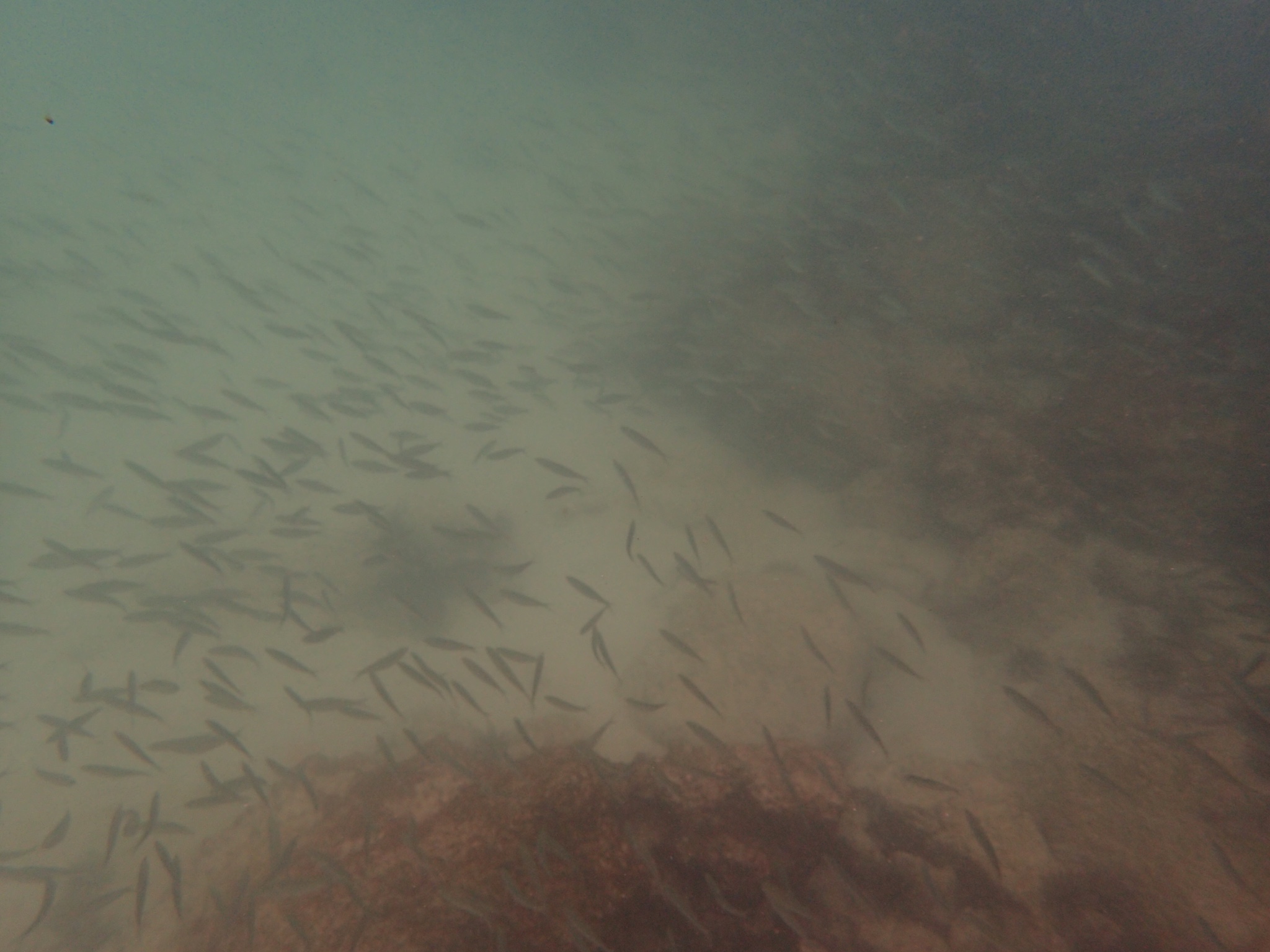
As I said before, the water is teeming with life. Food is easy to come by in the Galapagos.
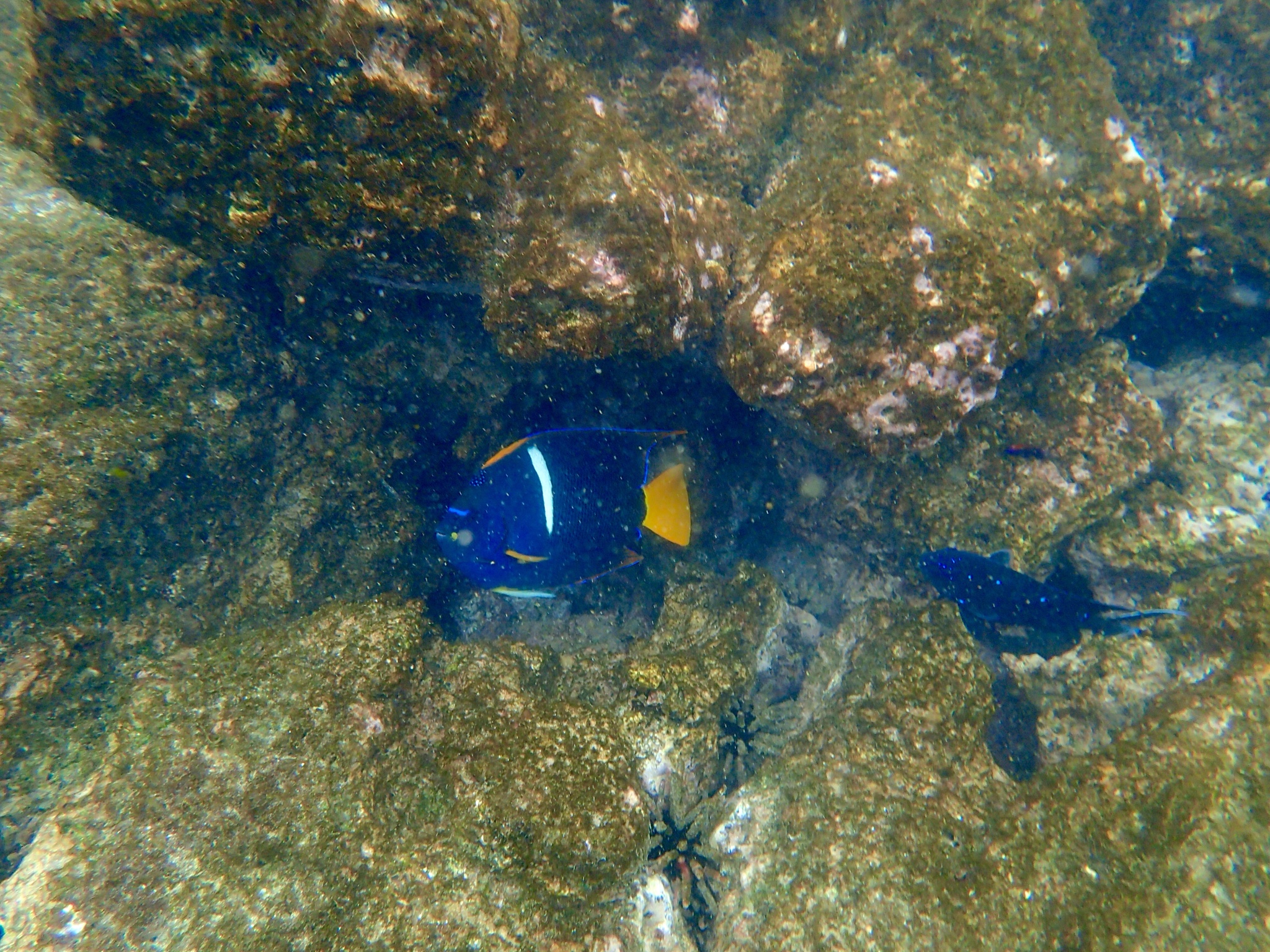
I wish the photo did justice to the one fish with the spots on it. In real life, it looked like the fish had glowing polka dots on it. Bizarre looking!
Can I say “teeming” one more time?
At the end of each beach outing, we got hosed down before boarding the ship. “No sand in the pangas! No sand on the boat.” In this photo, Genene has boarded the boat from the panga, and she’s getting the wash down before coming upstairs to take off her life jacket. After each outing, Abel, our waiter for all meals and snacks, waited at the muster area with snacks.


As soon as we got back on board after snorkeling, we changed into hiking shoes and went back to Cerro Dragon, Dragon Hill. The landing was dry but very slippery. We made our way gingerly across the algae-covered black lava rocks and went for a hike.

Our landing point:

A marine iguana soaks up the sun:
Most of the plants appear to be succulents of some sort.
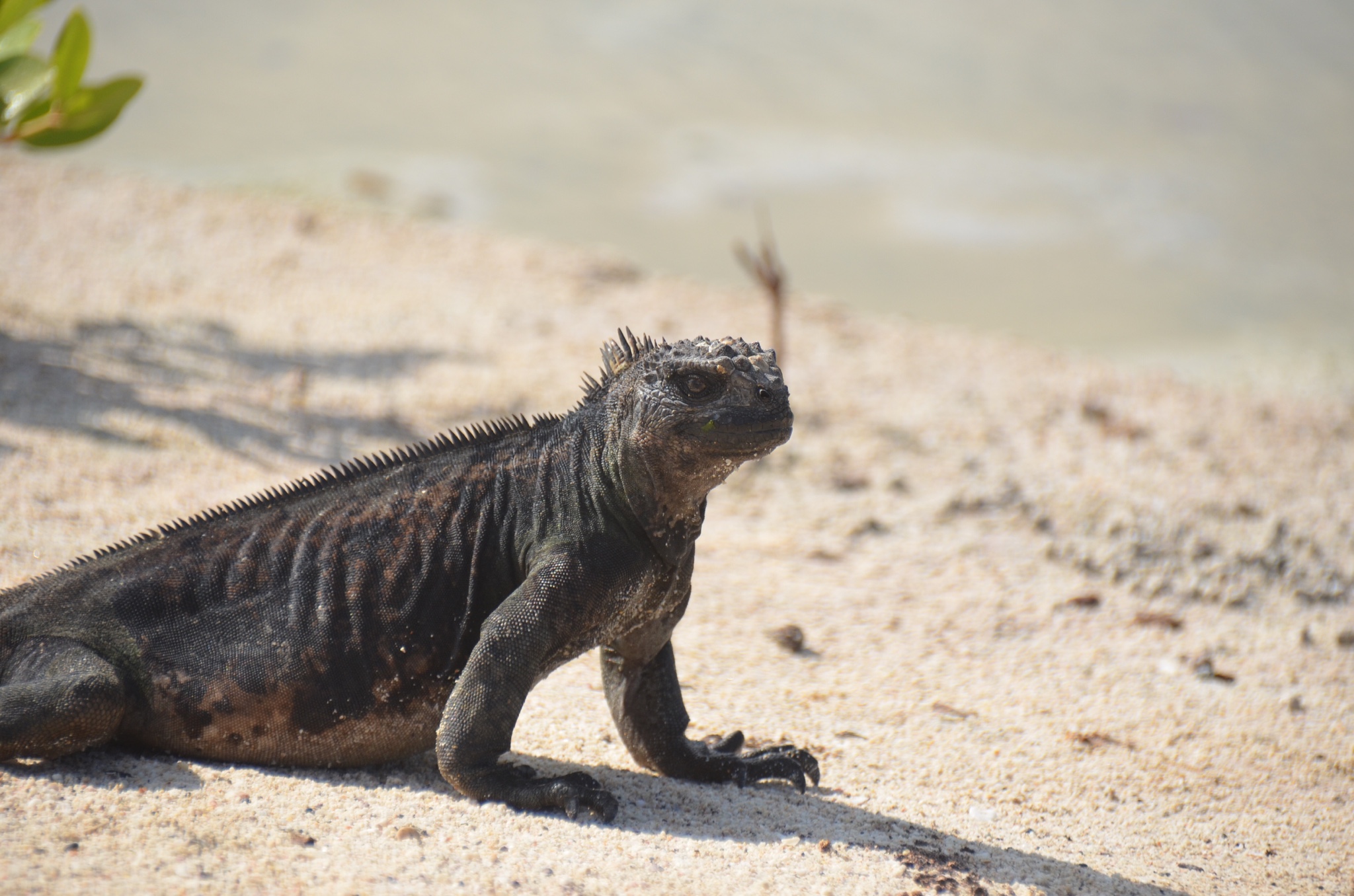
The marine iguana’s face sometimes appears white because it is encrusted with sea salt.
A lava lizard perches on a marine iguana:
A yellow warbler:
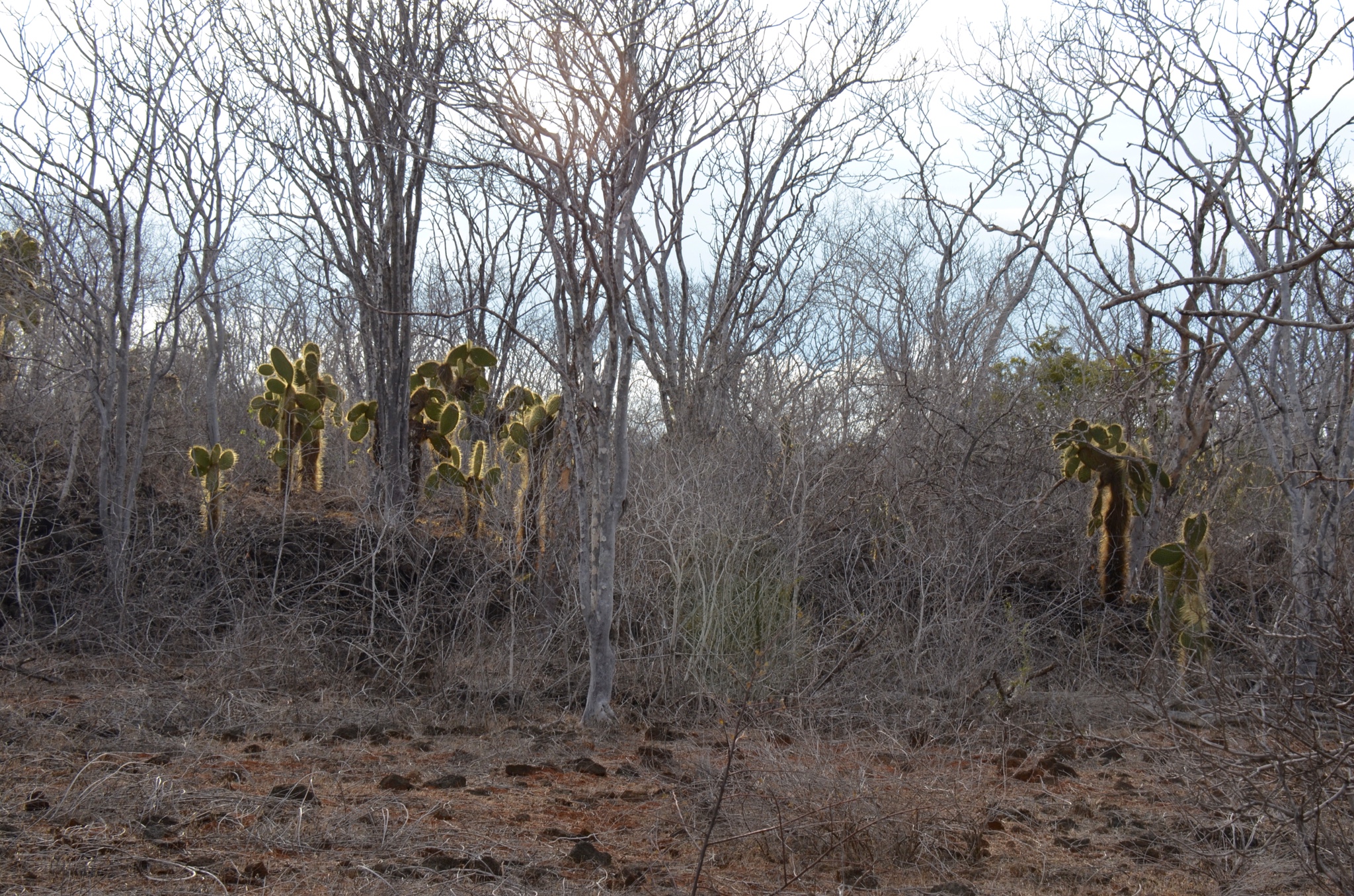
In the late afternoon, the light of the setting sun shone through the cactus trees, making them appear to glow.
As we strolled along, we looked for the land iguanas, which are much less common than the marine iguanas. Their habitat has declined because of competition from introduced goats and donkeys, and they also have suffered from introduced predators: rats, feral dogs, cats and pigs. Our safari eyes helped us on this part of the trip. It was fun to scan the brush and the hillsides for these huge lizards.
I think this is a Galapagos flycatcher.
A land iguana eating something:
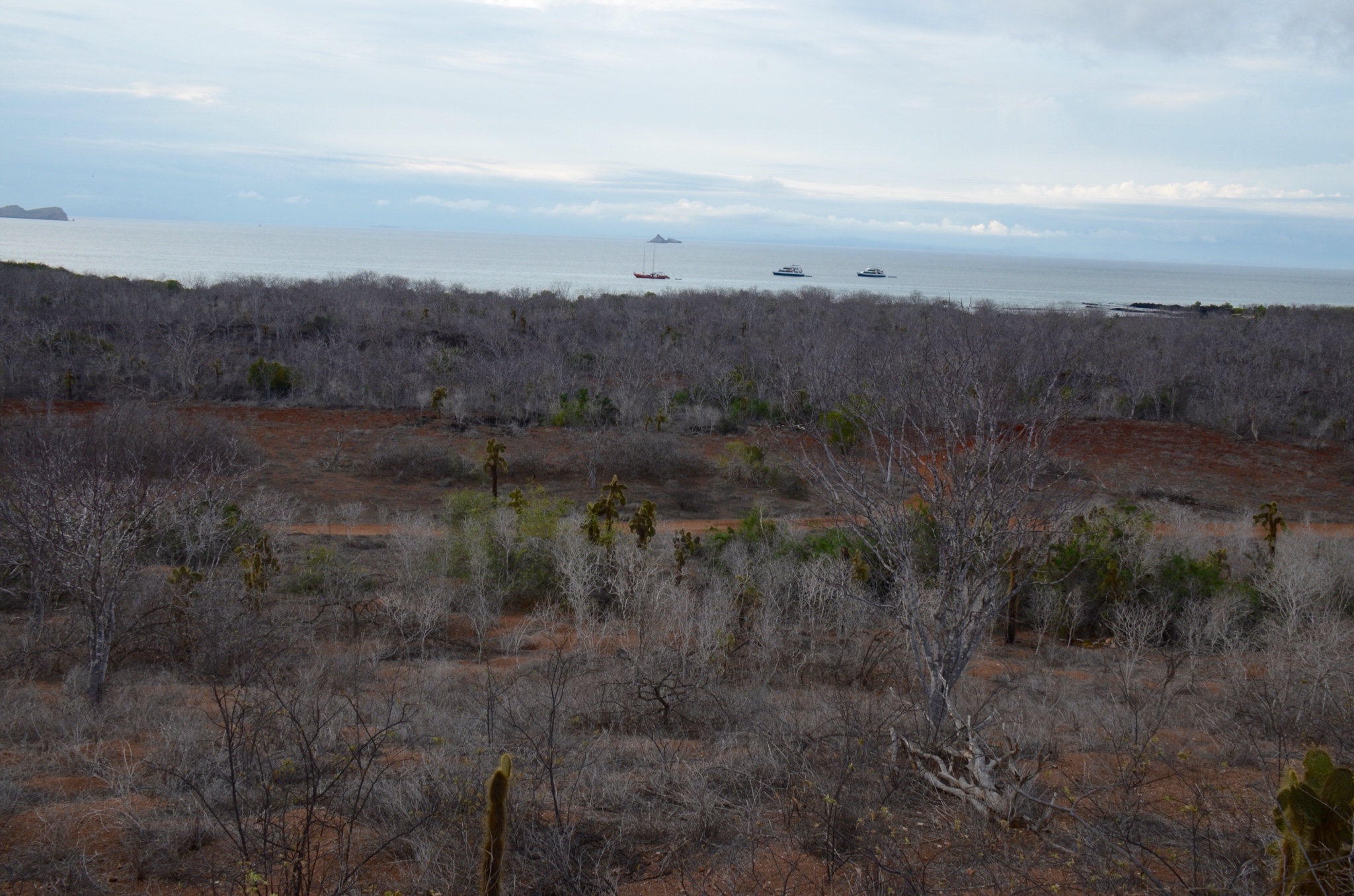
The view of the Ecoventura fleet from Dragon Hill:
A cactus tree:
A mockingbird (Harper Lee says, “Don’t shoot.” Lori says, “Get the bb gun.”)
Is it any wonder that the early sailors called these creatures dragons? I am sure those sailors must have thought that they stepped into a land that time forgot. I frequently thought of that old TV series that we watched as kids, “Land of the Lost.” The premise was that a man and his two kids went on a rafting trip, somehow fell through a crack in the earth, and ended up in some kind of bizarro dinosaur world. The special effects were hopelessly cheesy, and the bad guys were upright man-lizards called “Sleestaks” that moved at glacial speed and hissed ominously. I’m sure Genene would not be impressed with what passed for high entertainment in my youth. Anyway, these lizards must have been a bit unnerving to the first sailors who visited these islands.
It’s a little hard to get perspective with the six foot rule, but these creatures are about a yard long and can weigh about 28 pounds.
As we walked the trail, we saw a lot of donkey poop. The donkeys were, of course, introduced to the islands and were originally domesticated. They have become feral and are a problem on the island, as they compete for habitat with the land iguanas. The guides never used the word “invasive” as we might have done to describe the introduced species. Instead they would say that the donkeys “are part of the human history of the Galapagos.” That’s a nice way of putting it.
One last look at Cerro Dragon.


We returned to the boat at 7 pm and had a beer while the guides presented their powerpoint presentation and prepped us for the next day’s activities. They had to “shush” us several times because all of us–parents, grandparents and children–have become quite friendly and consequently are boisterous and talkative. There were laughs all around as we tried to sing the various national anthems–Star Spangled Banner, God Save the Queen, and O Canada. The kids all love to play with one another, and they taught each other pattycake games, card games, dumb jokes and riddles, and so on. Our guides finally had to say, “We are so glad you are such a good group and are getting along so well, but we do need you to listen for a few moments.” And so we quieted down and got our orders. And then came the favorite line of the Gordons: “And now, dinner is served.”

We tried to sit with someone different every night, and it was fun to get to know all of them. It was as if we had ordered these people from central casting. Each person brought a different set of fascinating stories to the table. Everyone has been on great adventures, and it is fun to hear about them all. The kids all rushed to their own table. Abel poured wine generously during all the meals. We shared the day’s adventures and our excitement about what tomorrow might bring. What will we see next?

The ship got underway just as soon as the last person set foot on board, and we were traveling at a good clip throughout the briefing, the dinner and onward into the night. Our guides told us that we would have a good 13 hours of speedy travel to get to the next island by morning light.

Ecuador and the Galapagos Part 3: Genovesa Island

Monday, March 16, 2015

It took most of the night for us to make our way from San Cristobal Island to Genovesa Island. It was easy to tell when we arrived, for the sound of the boat motor was quite loud from my cabin. It’s a white noise that is easy to sleep through, but the moment it stopped, I woke up for a few minutes and listened to the sounds of the crew securing the anchor. I was soon back asleep. Our wake-up call was at 7:00 AM, which I thought was very civilized. We were at anchor within sight of Genovesa.

Our tour operator, Ecoventura, has three yachts in their fleet. They travel together, although it appears that we stagger our arrival and departure times a bit to avoid running into each other.

Meet Flamingo’s “sisters”, Eric and Letty:


At 7:30, breakfast was served. Breakfast was a delicious buffet of all kinds of treats: fruit, cereals, prosciutto, salami, hot coffee, yogurt drinks, fresh squeezed fruit juices.

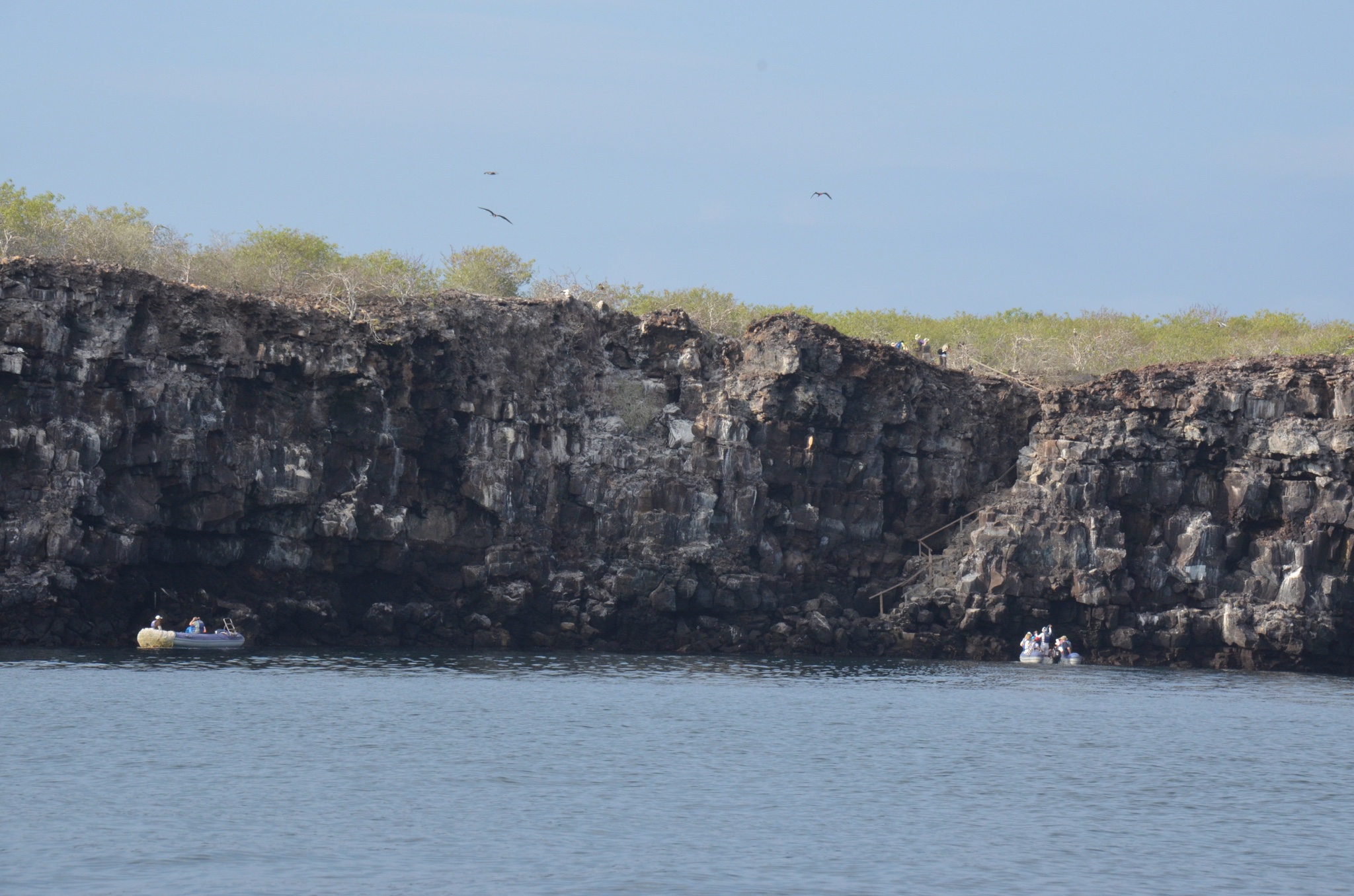
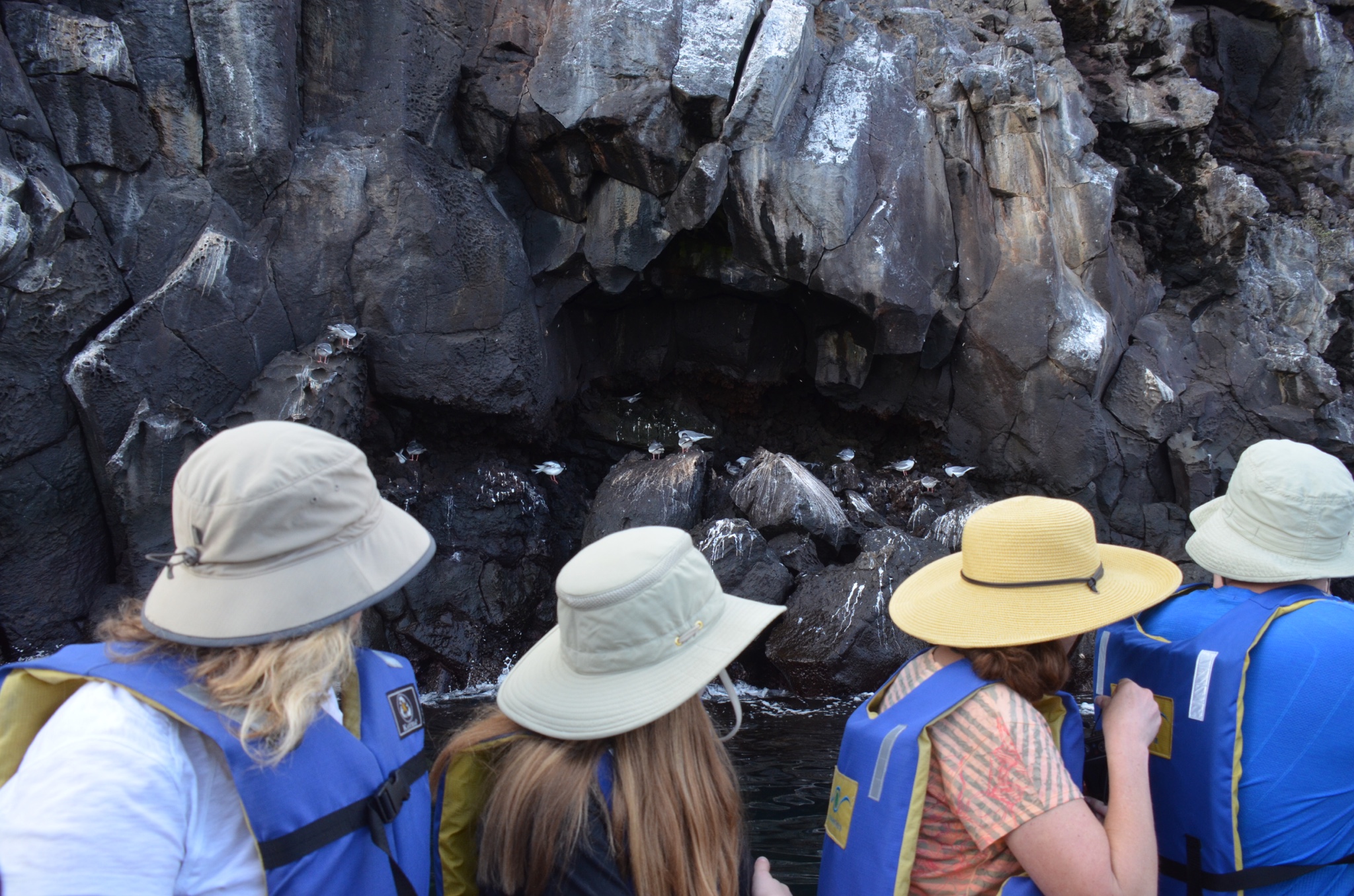
At 8:30, we loaded onto the pangas and motored over to Genovesa Island, a trip of less than 10 minutes. The panga pilots brought us along side the cliff wall, and birds, sea lions and fur seals were abundant.

Birds at the top of the cliff:
Birds in the cliff wall:
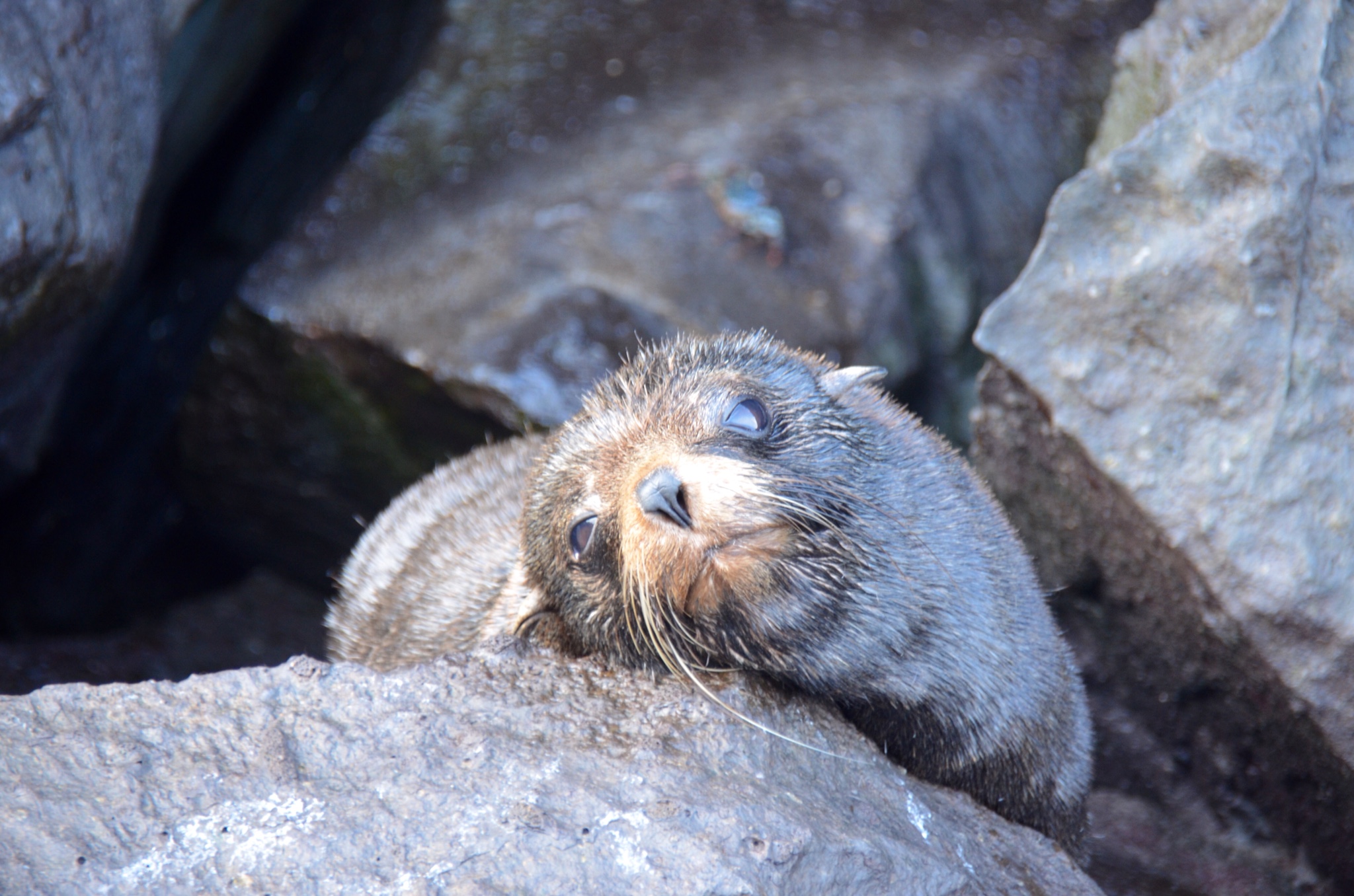
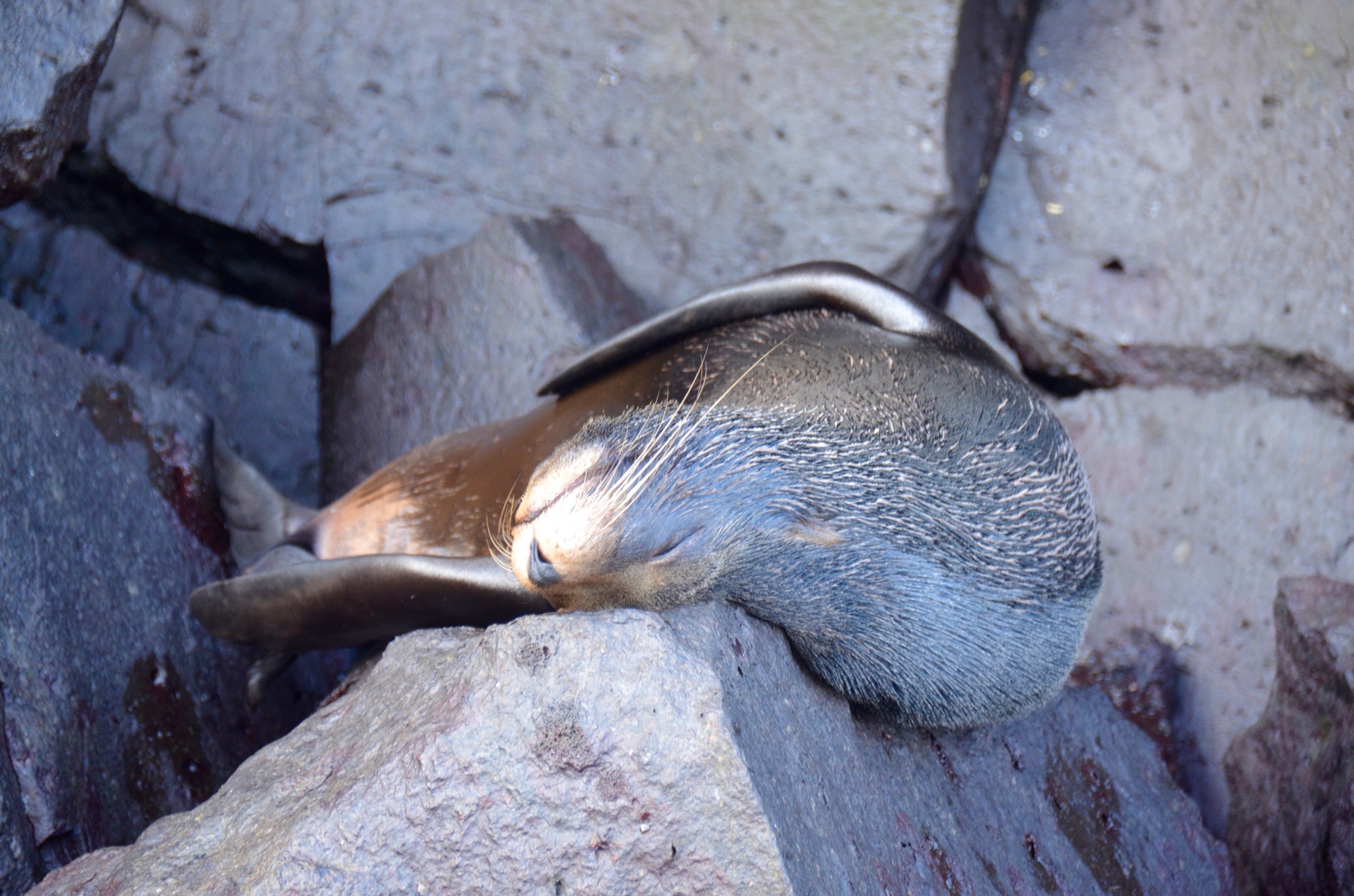
James and the fur seal:
The fur seal thinks it’s a runway model and poses for us, this way and that:
 

The fur seal is not actually a seal at all. It’s more like a “fur sea lion.” It is smaller than a sea lion with a shorter snout. You will not find it on sandy beaches, only rocky ones.

We were THIS close:
We had a dry landing, which means we could wear our hiking shoes. Wet landings call for Tevas sandals. We walked up Prince Philip steps, so named after the British prince paid Genovesa a visit on the royal yacht Brittania in the 1960s. I would love to see the inside of that boat! The steps are set into a cliff wall, and at the top was an unbelievable scene: birds were everywhere. They were flying through the air, walking across the ground, and sitting in the trees. Each and every one was completely oblivious to us. If it were not against the rules, you could easily reach out and pet them or wring their necks. (Sorry, I’m an old Arkansas girl, and I’ve seen that done. I’m sure hungry sailors thought the same thing.)


Galapagos dove:

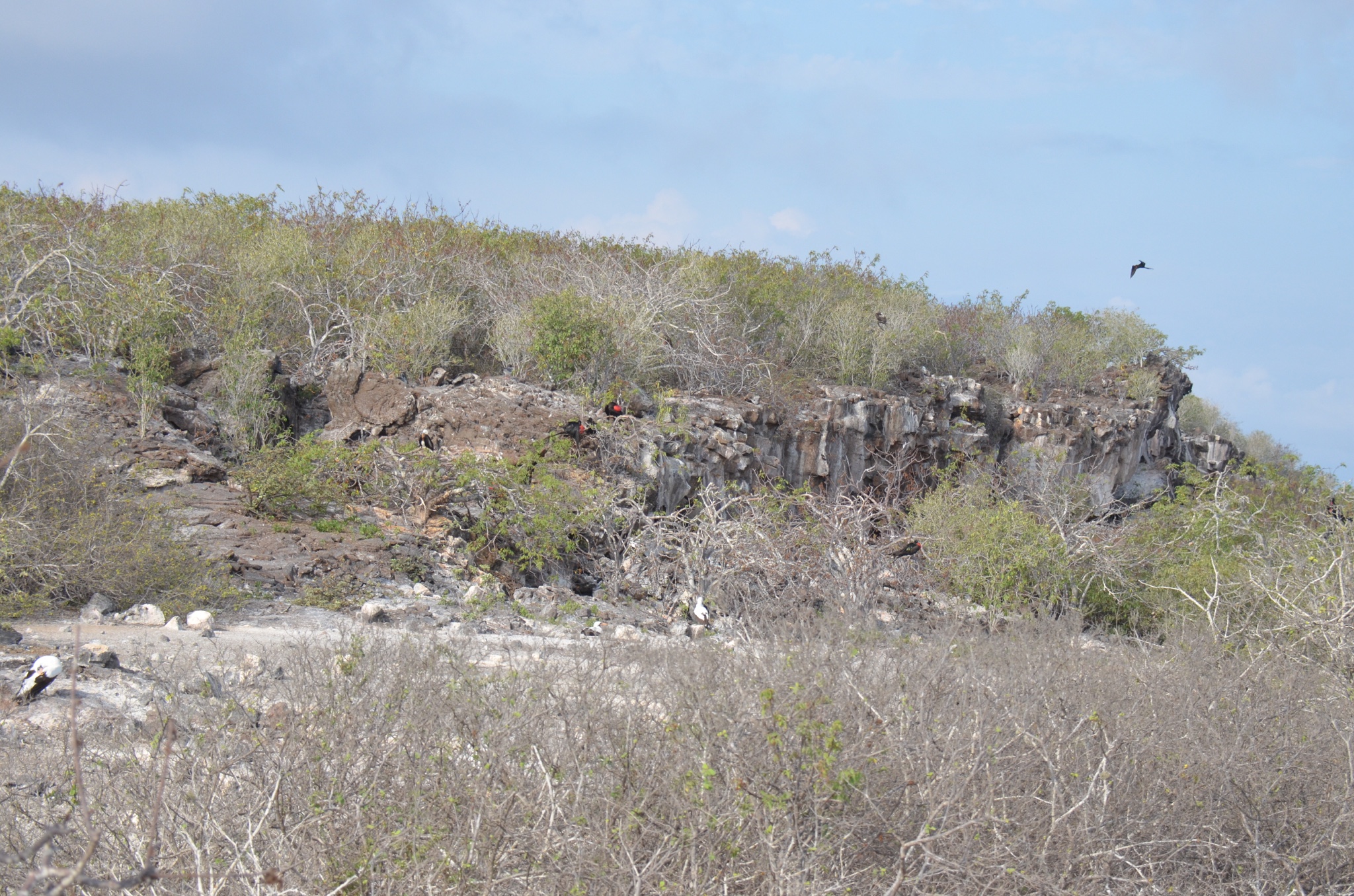
If you look closely at this photo, you will begin to see birds everywhere:

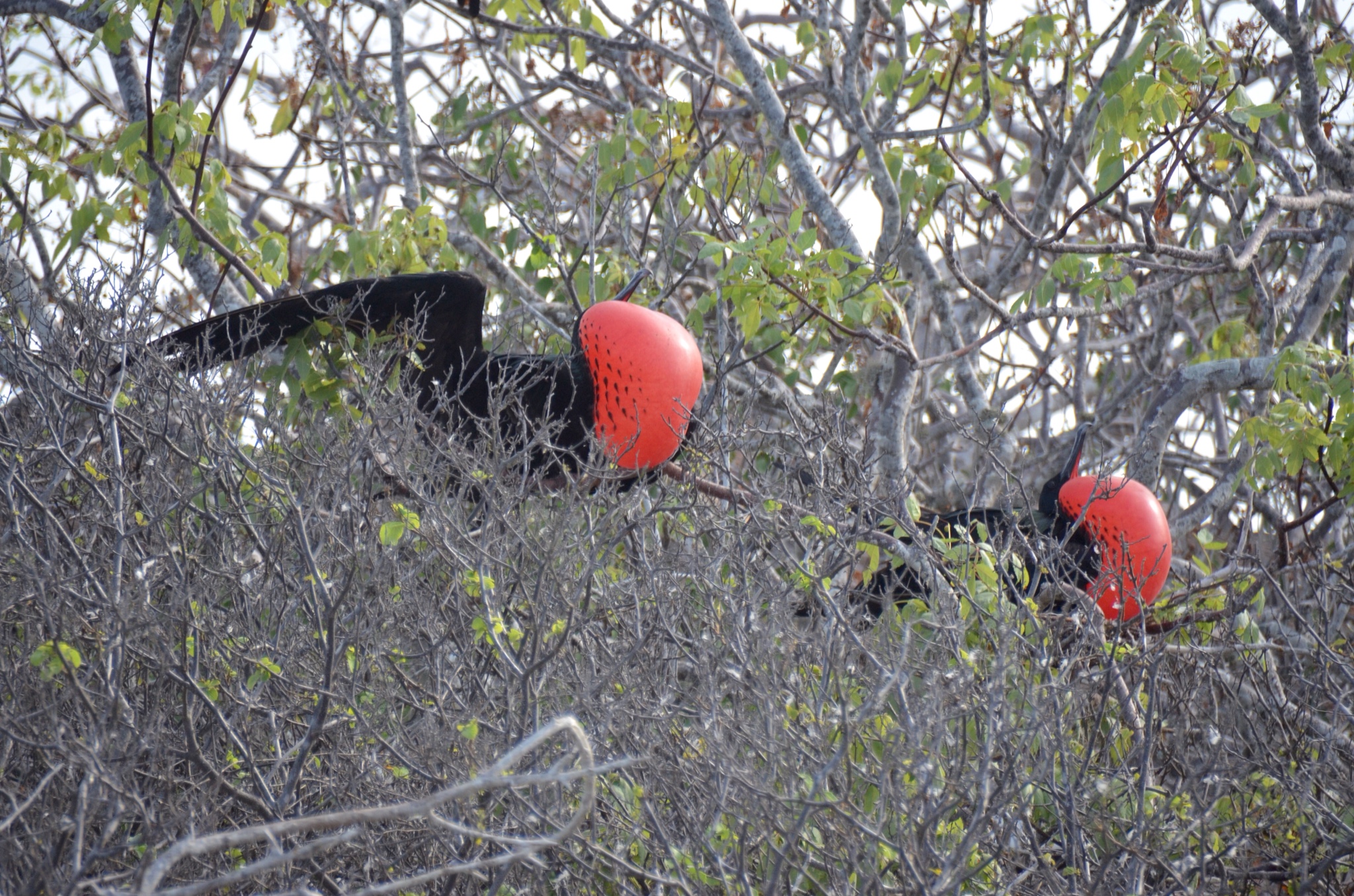
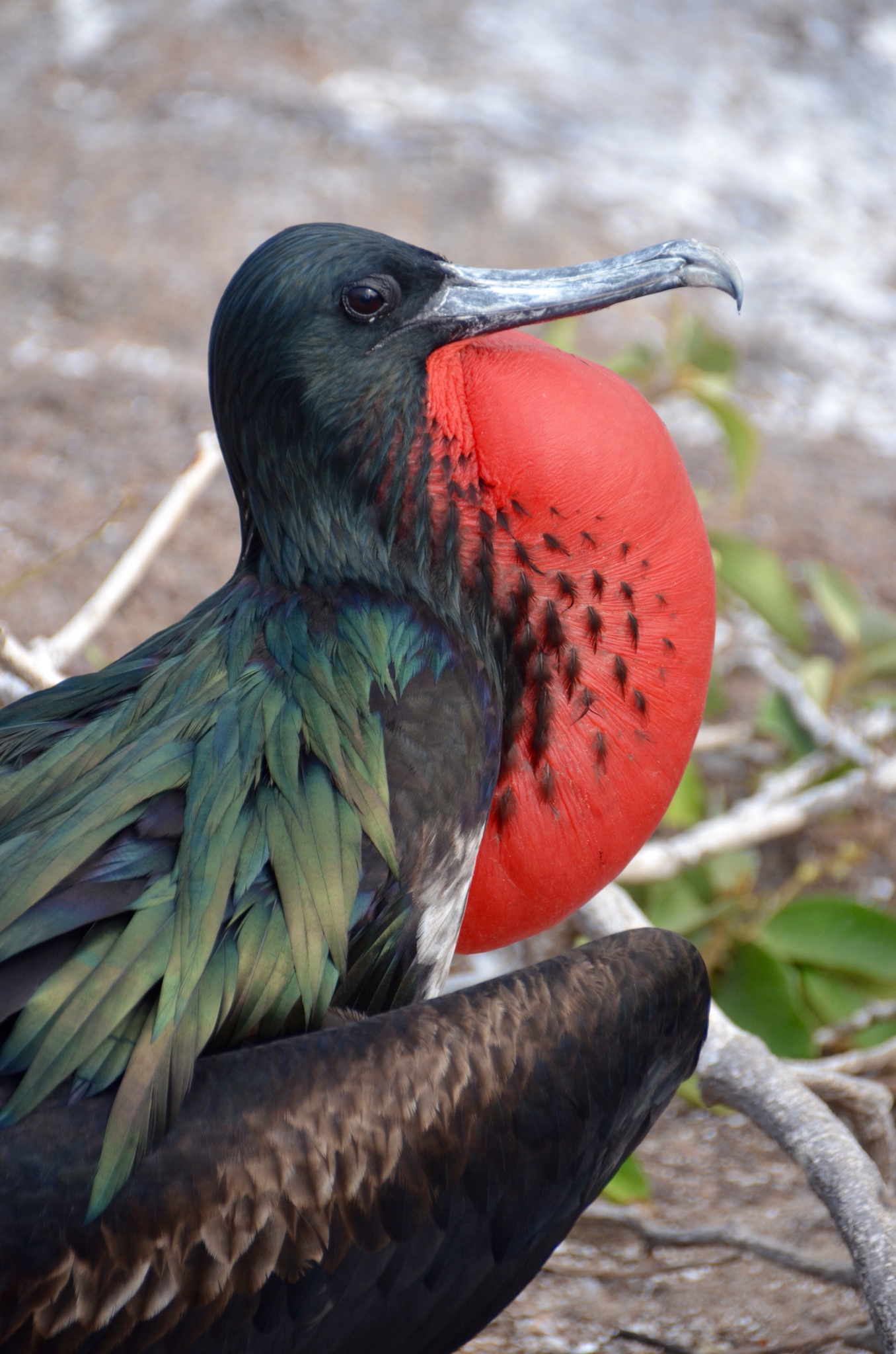
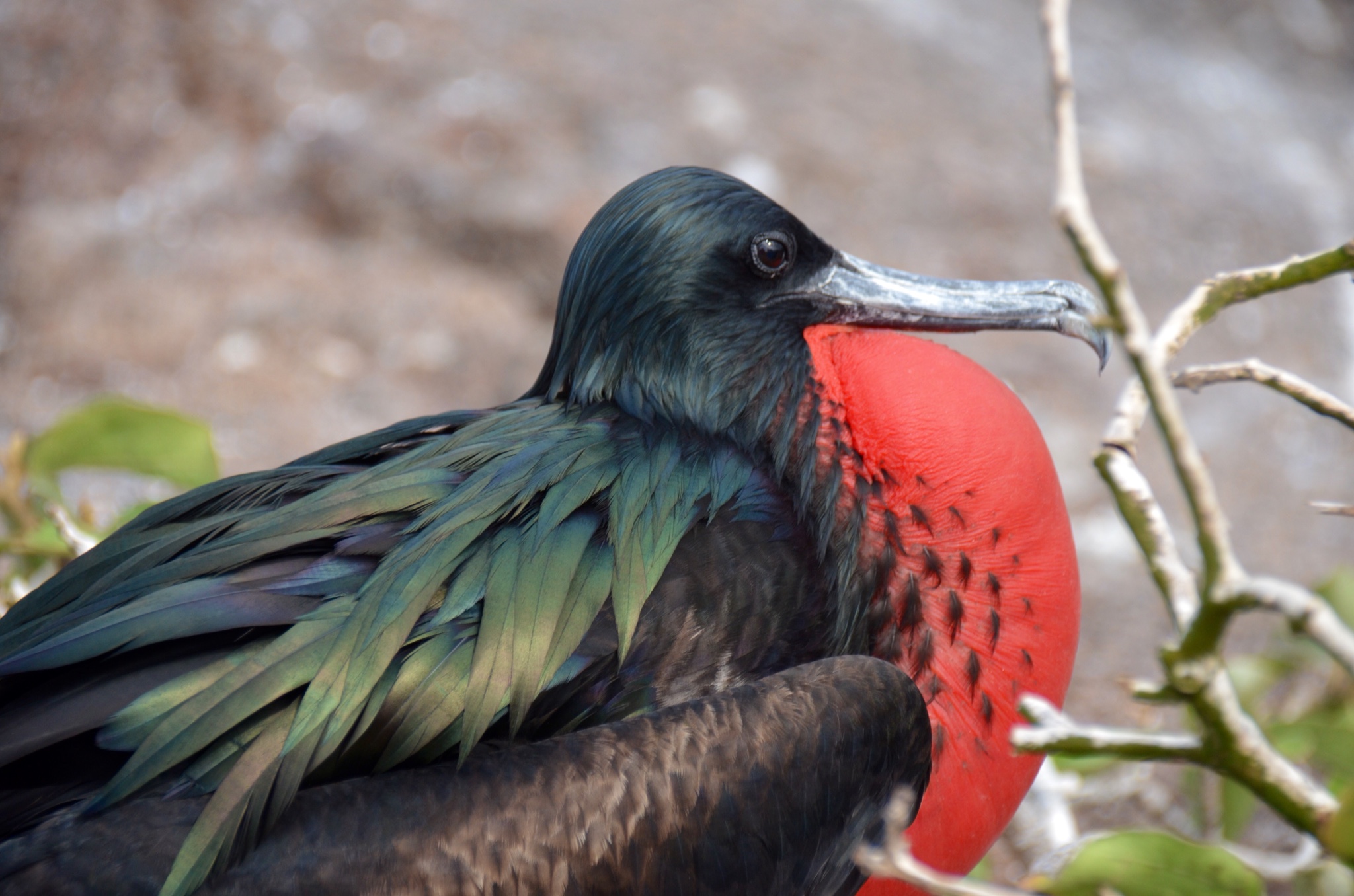
The great frigate bird is a spectacular creature. The male has a huge red gular pouch (I call it a throat balloon) that he inflates to attract a mate. The inflation and deflation of the pouch takes over half an hour. As our guide explained, he inflates the pouch to show the lady birds how virile he is. “Look at me. I have a Mercedes Benz.” Even after he has attracted a mate, he will keep the pouch inflated for 5 days, just to make sure the lady doesn’t better-deal him. The guides described the birds as “pirates,” because while they can fish directly from the sea by skimming, they cannot plunge into the water or their wings will weight them down and drown them. Instead they usually chase other birds, particularly the booby. The frigate uses its hooked beak to catch the booby by the tail-feathers, shaking and forcing it to disgorge the fish it has caught. The frigate then catches the dropped fish in midair.

Love is in the air:

Don’t look at him! Look at me!
He either got his girl or gave up trying.

When Spaniards first came to the Galapagos, they were unimpressed with some of the birds, which simply stared at them and did not run away. They called them “bobos” (stupid), and that became booby. The name is not accurate, for these birds are skilled fishermen.

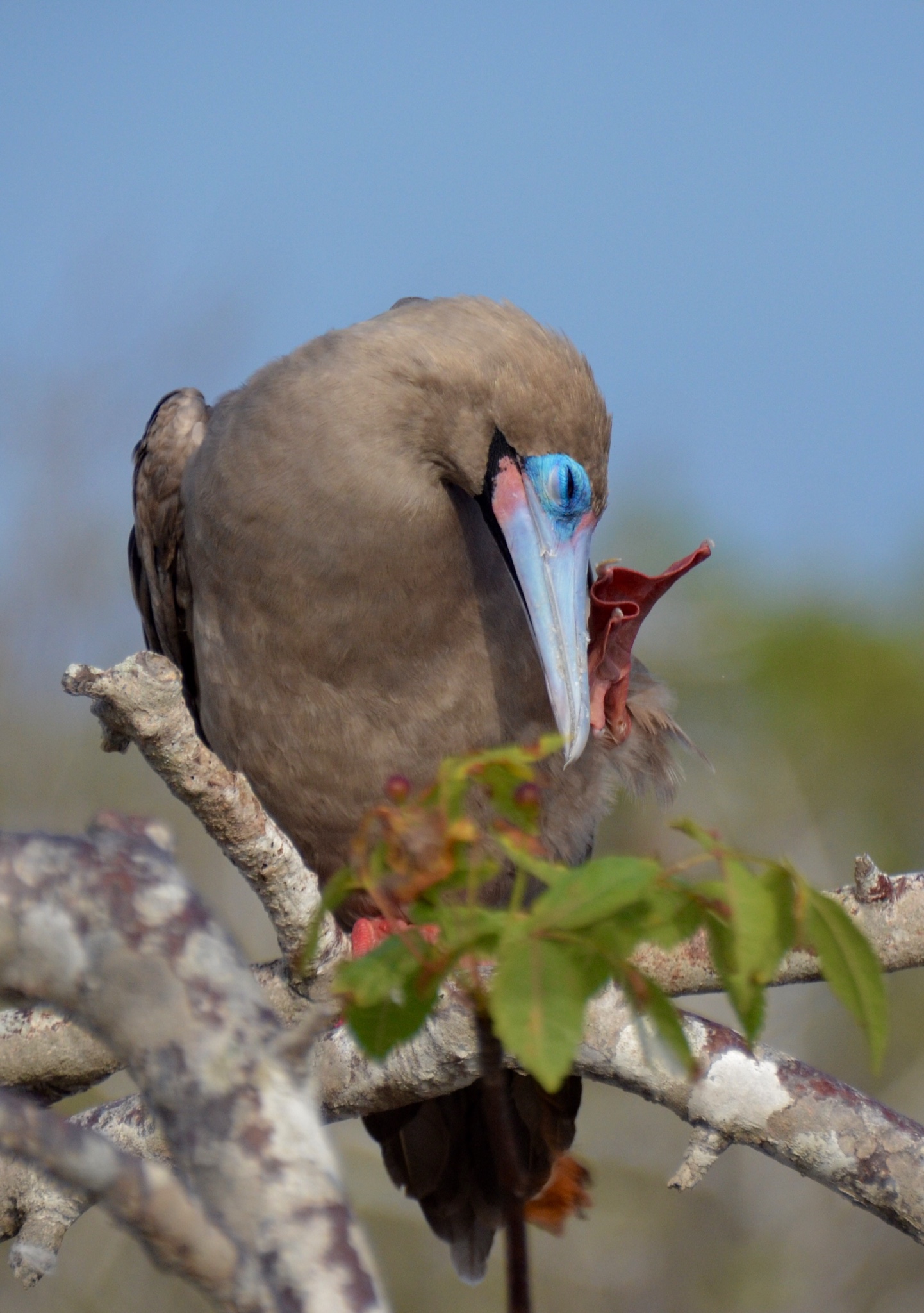
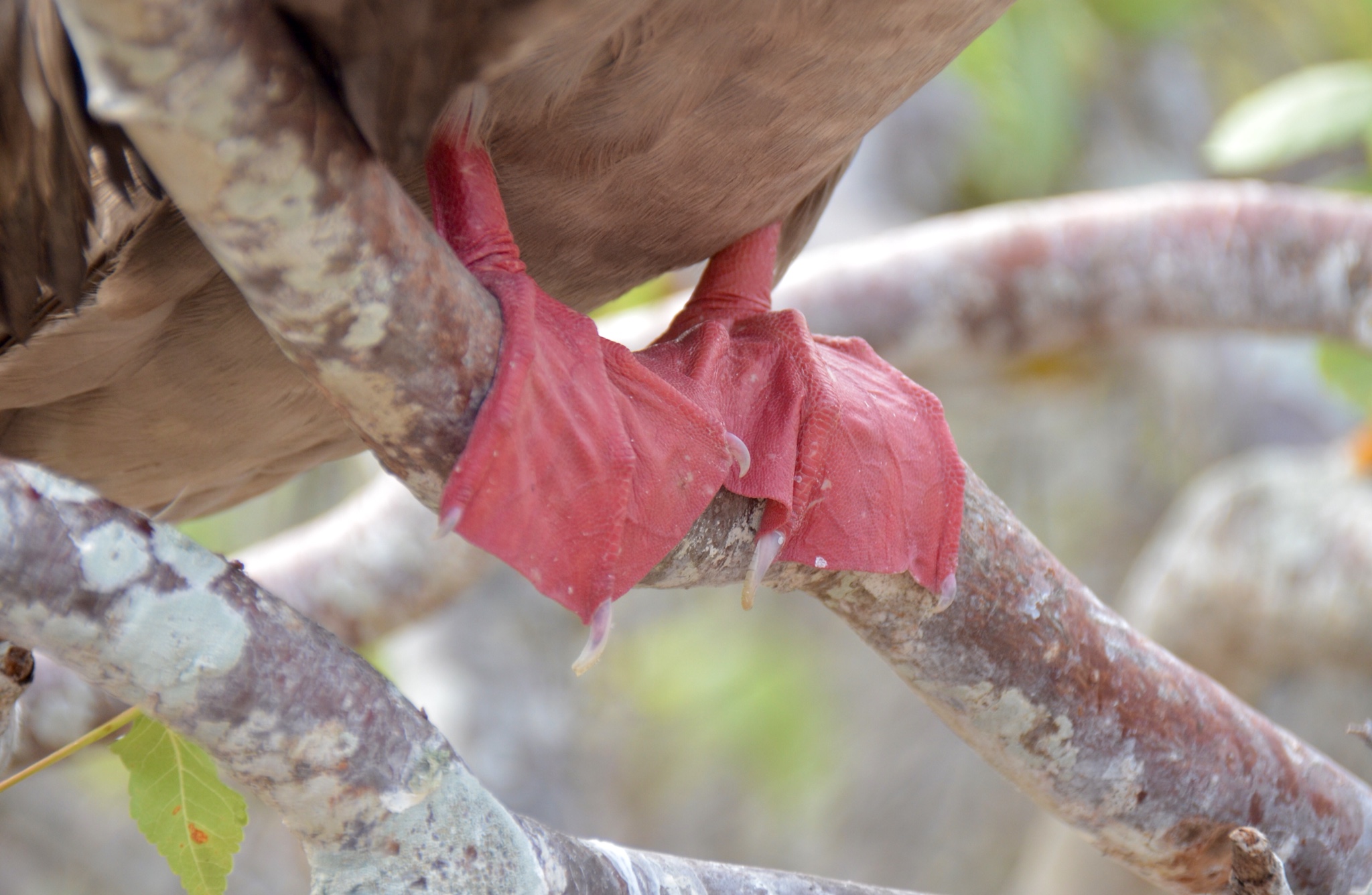
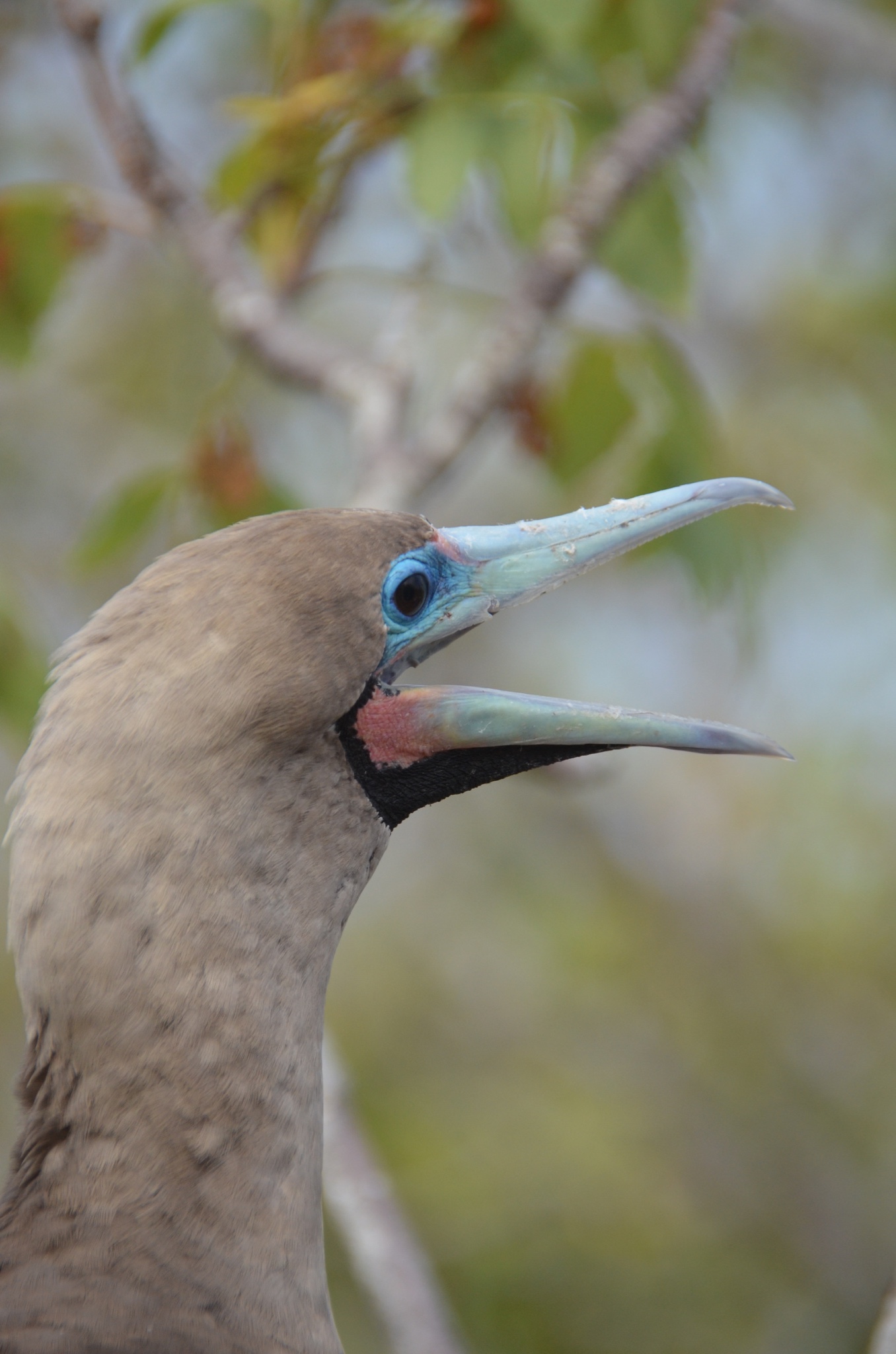
The red-footed booby is adept at fishing. With its long bill, it can pierce the water in a 25-meter dive and with its webbed feet, it can swim below the surface to catch fish.

The booby spends hours spreading oil on its feathers so that they can repel water:
 
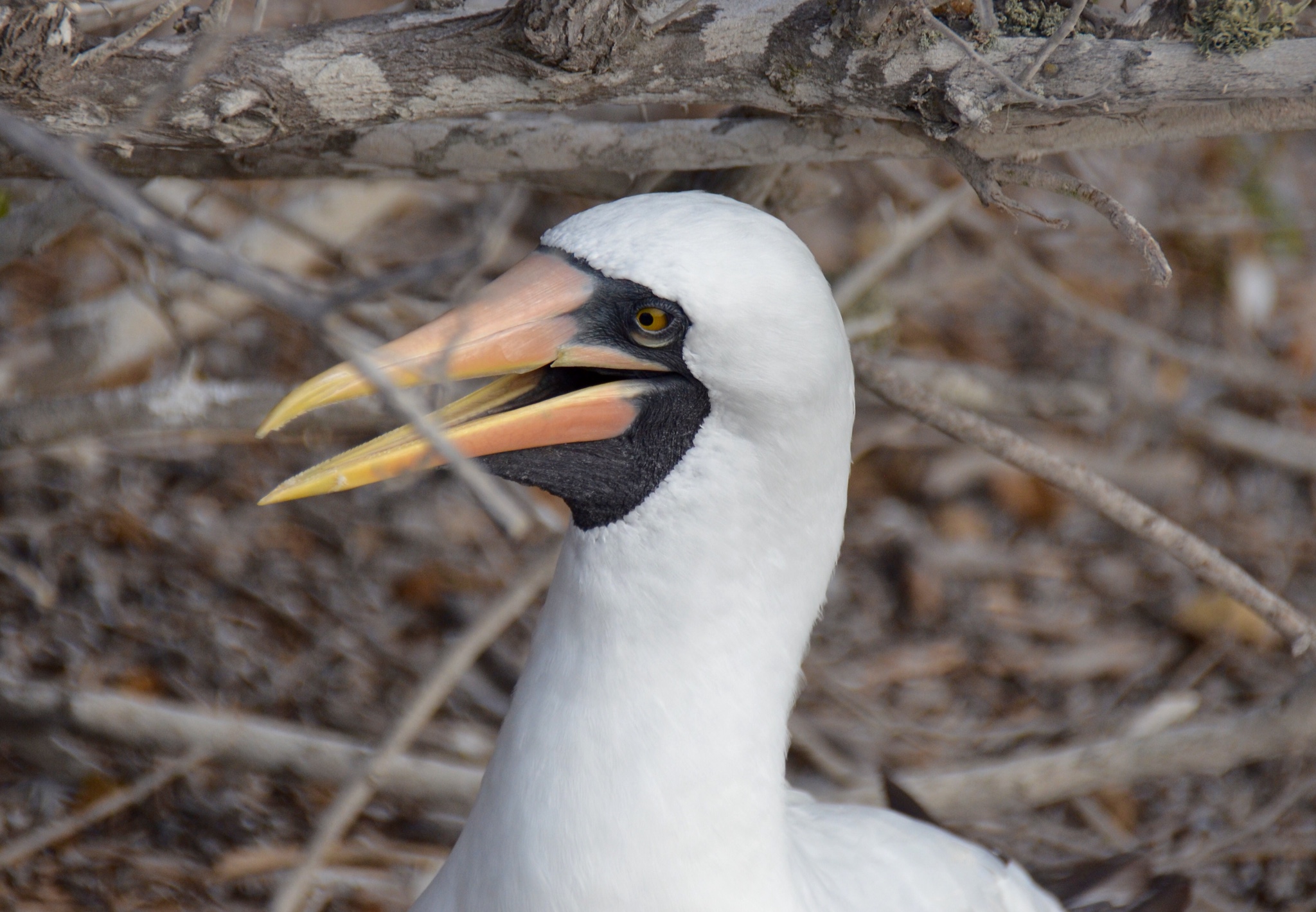
The Nazca booby (below) is white with a black masked face. I guess I can almost see the Spaniards’ point. This fellow looks a bit dopey:


The Nazca booby lays two eggs, but they are laid a few weeks apart. The Nazca booby can only raise one of the chicks. The stronger baby bird (usually but not always the firstborn) pushes the weak one out of the nest, and the one on the ground dies. I guess they are the Cain and Abel of the bird world. Our guide James says that he has seen this happen many times. He’s seen the bird on the ground crying to be fed, and the parents just ignore it and feed the one in the nest. Nature can seem awfully cruel sometimes.

A juvenile Nazca booby in the nest. I guess he killed his sibling a while back.

Spread your wings, Cain!
 
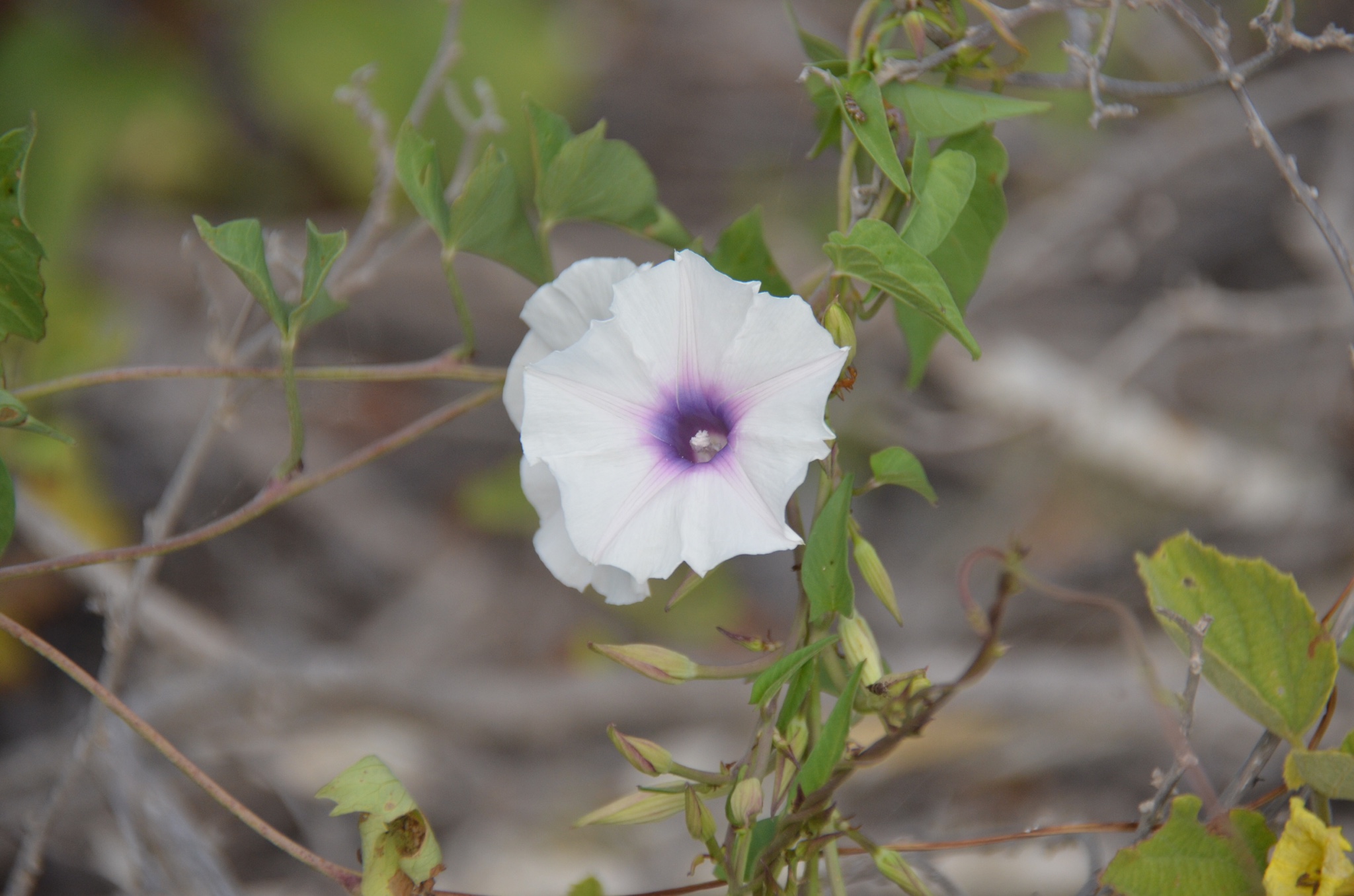
Morning glory:
 
Spanish moss:
 

As we continued our walk around the island, Genene became quite tired. She had eaten something that disagreed with her, and she was a bit dehydrated. She completed the walk, but it was an effort and she was not her normal cheerful self.

We got to an observation area with the coast in full view, and the birds were swarming like something out of a Hitchcock movie. There was literally a cloud of them.

 
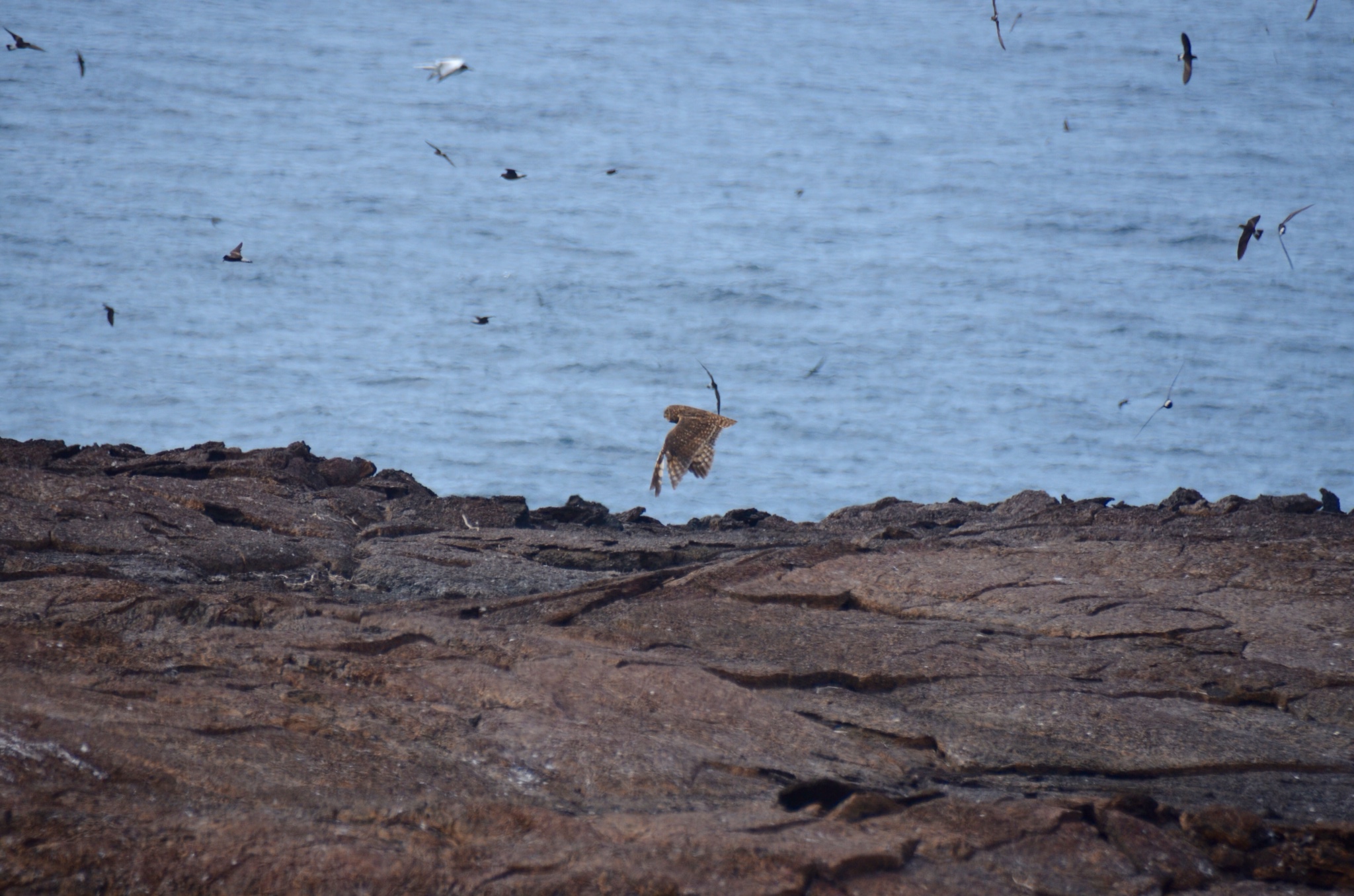
In the midst of the swarm was a short eared owl, which hunts in daylight. He’s flying just left of center below:
 
In this photo, you can see him perched at the cliff edge:
And here he is in flight:
 
As we continued our walk, we found another owl hiding out in a small grotto. Look at his strong talons!
While trying to capture the owl, I really wanted my 500 mm lens. I used my 18-300mm exclusively on this trip, and most of the time it was up to the task.
Circling back, we continued to encounter more birds on the ground and in trees all around us.
Ladies (yeah!) Ladies (yeah!)
 
You wanna ride in my Mercedes (Yeah!)
 
Why don’t you shut up?
 
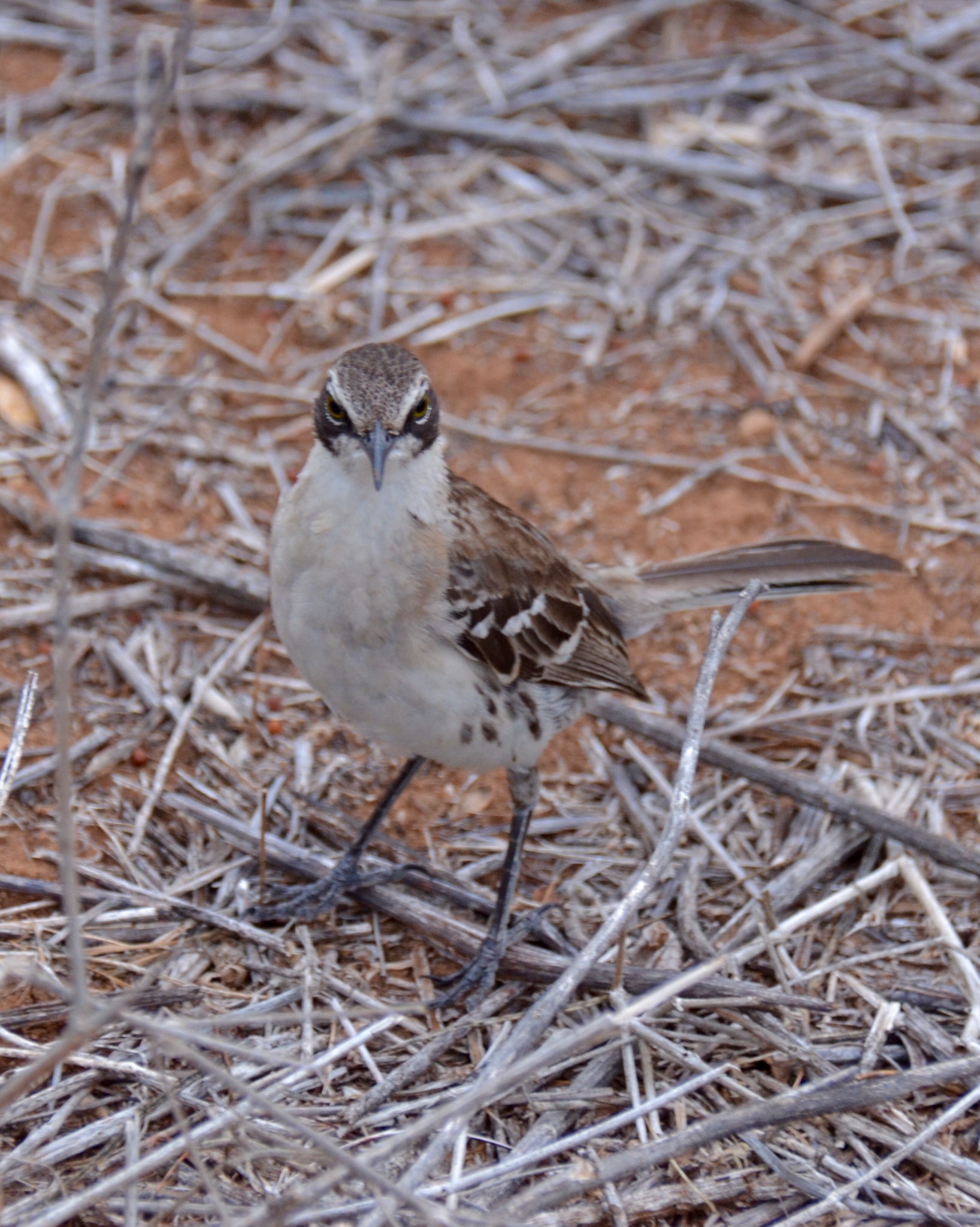
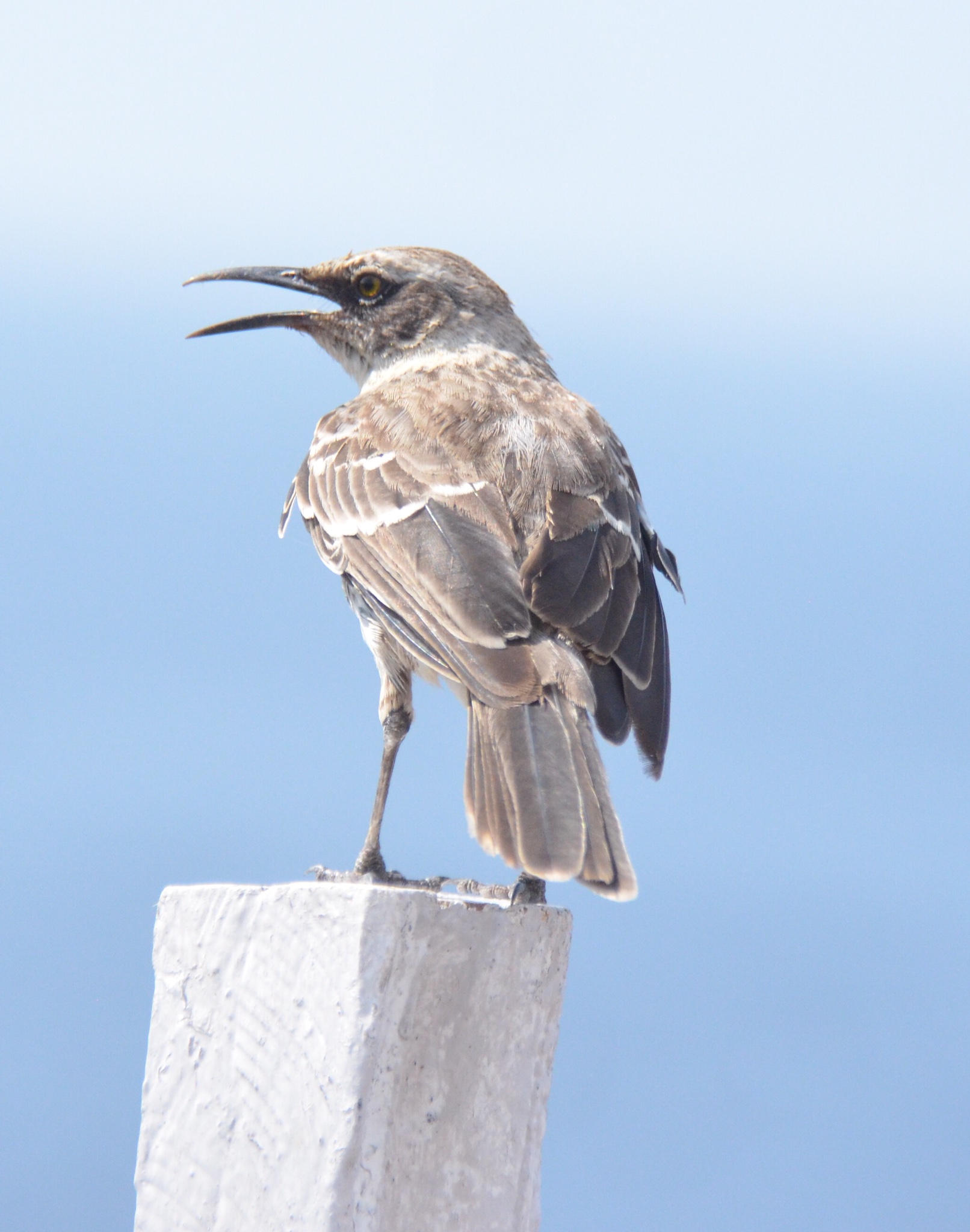
The mockingbird was one of the easier birds for me to identify. They look much like ours at home in Texas and Arkansas. Don’t tell Harper Lee, but we used to shoot them all the time because they are noisy.
 
Hernan, our guide and sometimes Nat Geo photographer, goes all out for the Nazca booby shot:
 
Back down Prince Philip’s Steps:


Our walk around the island lasted about 90 minutes, and we came back to the boat and prepared to snorkel. Some people wore wetsuits, but I elected not to make the effort to squeeze into the thing. (Five pounds of lard into a three pound sack.) I should have done that or worn a life jacket, because it was the first time I had been snorkeling in many years, and I was a little uncomfortable at first. Eventually I relaxed enough to understand that I was pretty buoyant (fat) and was not going to sink like a stone. There is another world down there! Genene saw a ray and I saw a hammerhead shark! My breath quickened a bit, and of course, the theme to “Jaws” came instantly into my head. I only saw him for a few seconds, and I did not get a photo.

There were all kinds of other colorful fish, whose names I do not know. No wonder all the animals have an easy living on the Galapagos. Food is plentiful just under the surface of the water.

The kids were tired!


We snorkeled for less than an hour and came back to the boat for snacks, followed by a delightful lunch.

Some people chose to sea kayak in the afternoon. There are not enough kayaks for everyone to go, and so we elected to stay on the boat and take a nap and relax. We will be entitled to priority the next time that kayaking is offered, so that everyone will eventually get a turn. Genene seemed to be feeling better and played hide-and-seek with all her new-found friends for hours on the top deck. I guess that was too much for her. She began feeling low again and chose to skip the late afternoon excursion. She felt bad about it because she was afraid that she might miss her chance to swim with the sea lions, but she was just too exhausted. She wanted to stay in bed, and we knew that meant that she should rest. The guides assured us that she would be very safe on the boat as the crew was still aboard. Greg and I left her to sleep and went back to a different landing point on Genovesa, Darwin Beach.

The sea lions sunbathed on the beach:

Close enough for the kids to touch, but they honored the six foot rule:
The beach:
This fellow patrolled the beach:
Dead sea lions are picked clean in a matter of days:
 

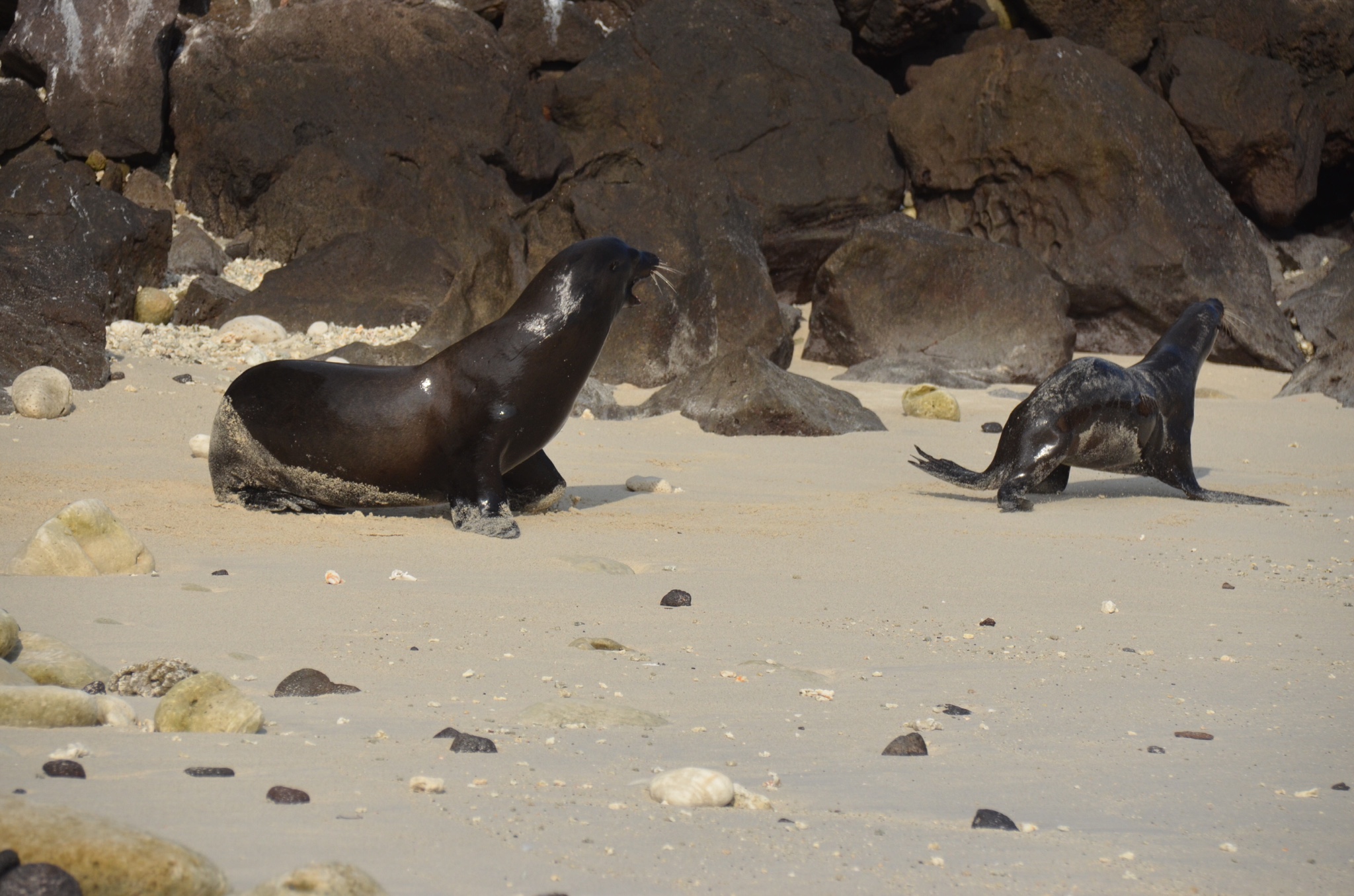
We got to see a sea lion fight. The alpha male ran off a young pest.

Get out!
And stay out!
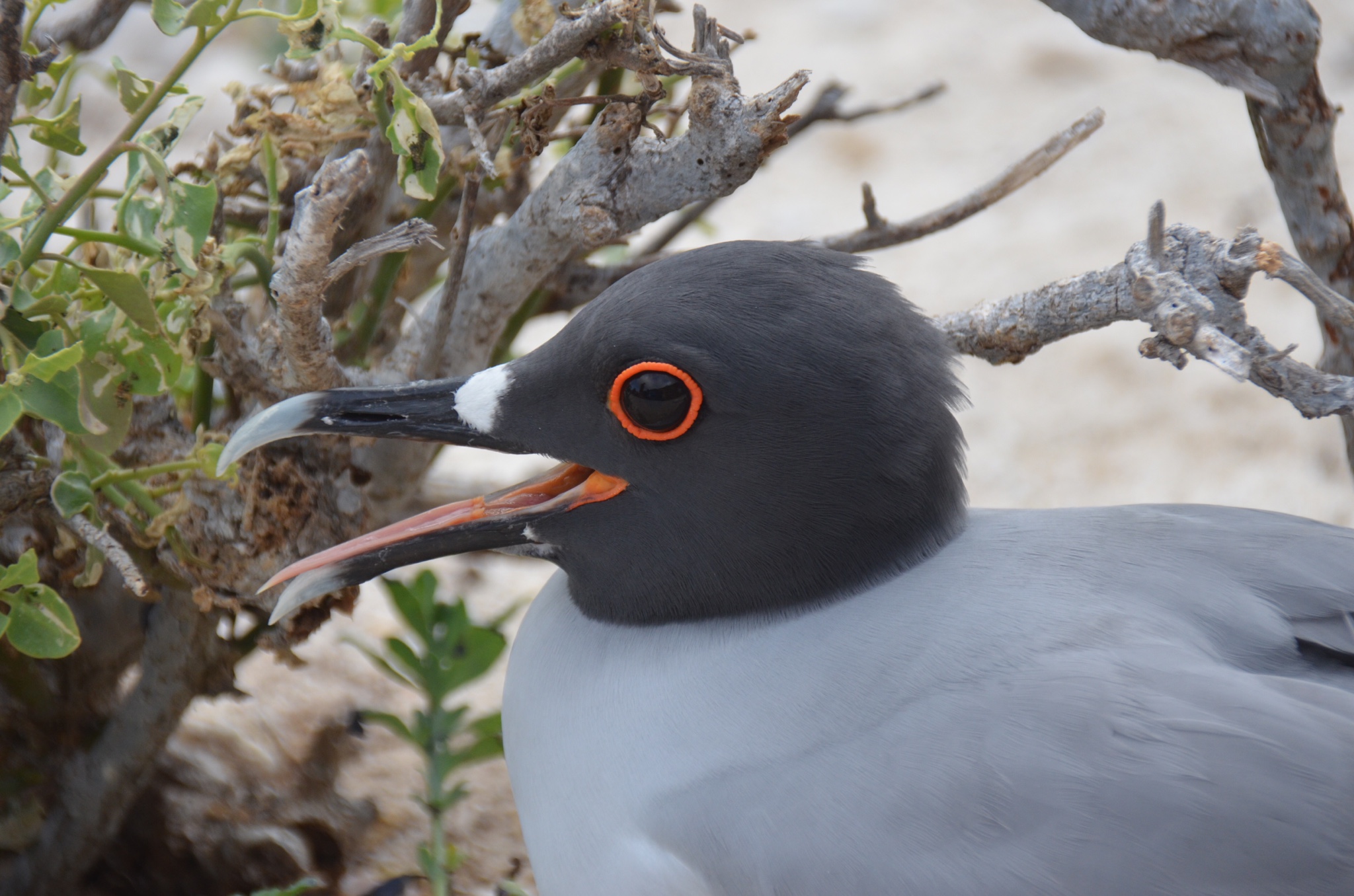
The swallow tailed gull lays a single egg, which is incubated by both parents. We got a good look at the spotted egg:
The nest sits on the ground among the cactus plants:


Another frigate bird looking for a lady:

Another red footed booby:

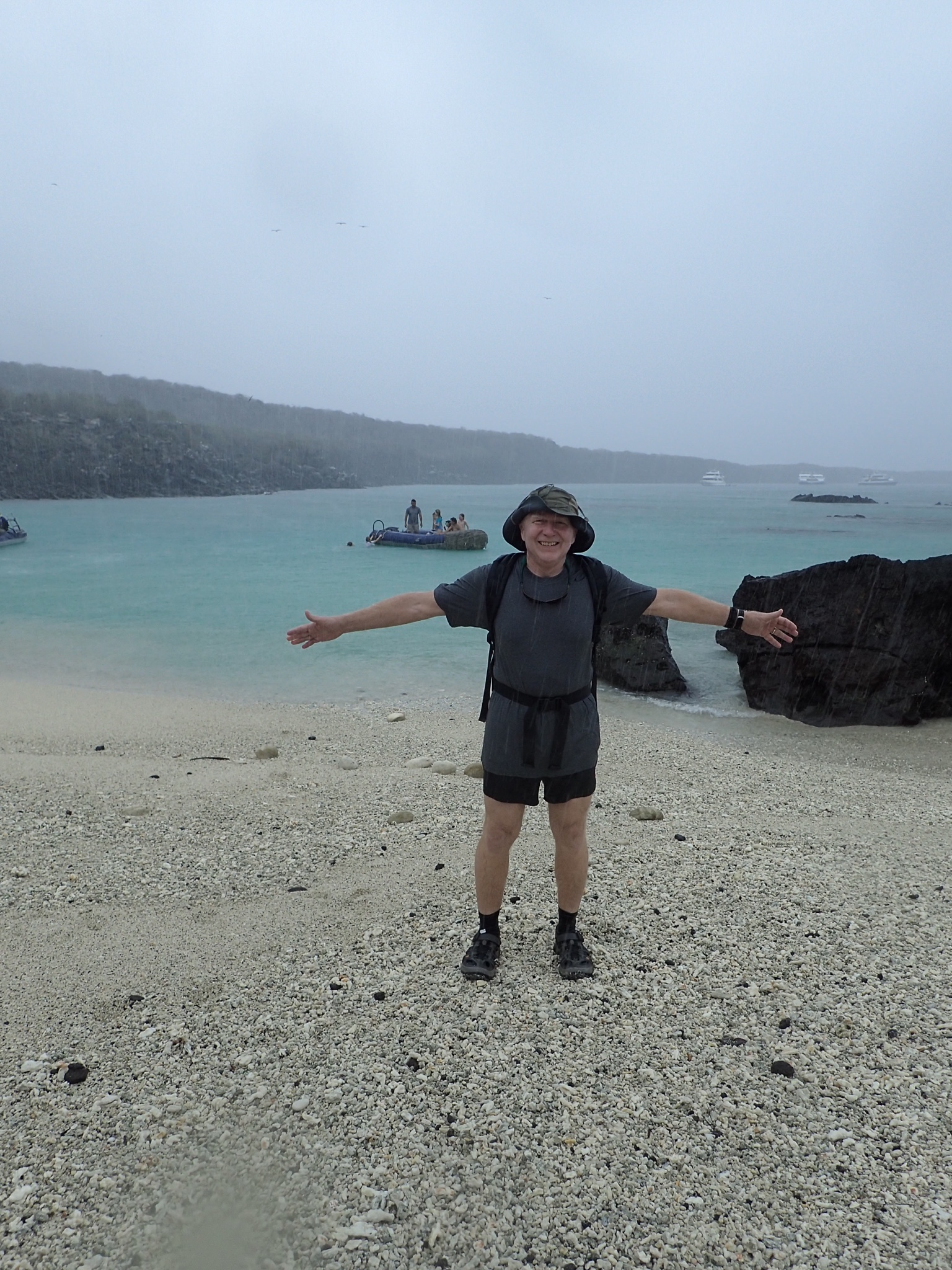
As we strolled around, it came a torrential downpour, and I was glad that Genene had elected to stay in the boat. The beach was beautiful, but we really were not seeing any new animals or birds. With hindsight, I might have stayed in the cabin and avoided the drenching too.

Monsoon!

Greg and I were thoroughly soaked, but I don’t know that I have seen him look happier.
Let’s panga home!


Genene was asleep in her room when we came back. She seemed no worse for the wear, and we assured her that she had not missed getting to swim with the sea lions.

At 7:00 PM, the guides gave us the briefing about the following day’s events, and dinner followed directly thereafter. Genene had perked up sufficiently to ditch us for friends of her own age. Greg and I had dinner with two other fathers. This was OUR kind of trip with our kind of people. Everyone we have met wants their kids to experience new places, customs and people. Most of our boatmates are world travelers, and we were getting many ideas for future trips. The red and white wine was flowing, as was the laughter and bonhomie. We enjoyed pumpkin soup, sea bass in peanut sauce, creme brûlée, and friendship. We felt lucky to be among such nice people, and it was good to hear the squeals of laughter coming from the kids’ table. I was pleased that my seasickness patch was doing its job perfectly, and frankly it was a surprise. I have always been prone to motion sickness, and every childhood summertime car trip involved my mom packing a wastebasket that she called the “puke basket”, and more often than not, it got used. I felt like a sailor and for the first time was able to enjoy riding on a boat. Our bellies were full and our faces were sore from laughter, and so we teetered off to bed. Genene came in and racked out before 10:00 PM, and Greg and I were right behind her. Being on vacation is hard work!


Ecuador and the Galapagos Part 2: To the Islands!


Sunday, March 15, 2015

Our day started early at 5:30 AM. We were to meet our cab at 6:50 to take us back to the airport, so naturally Prontosaurus (Greg) wanted to get up at the butt-crack of dawn. For once, we got ourselves going in an orderly fashion. We even had time to sit down and have a cup of coffee and continental breakfast before our cabbie showed up.

We checked out of Patio Andaluz (we barely knew you!) and put Quito in the rear view mirror. The drive to the airport was a little scary, because there was a very dense fog. Our cabbie navigated it flawlessly and put us out at the terminal well early of our required check-in. Our tour operator was waiting for us at the door and escorted us to the SICGAL, the System for Inspection and Quarantine in the Galapagos (the acronym makes sense in Spanish). The Galapagos is a national park in Ecuador, and they take its protection very seriously. All persons headed for the Galapagos must undergo a thorough inspection of bags to avoid the introduction of any invasive plants or animals. All of our bags were xrayed, and the checked bags were fastened shut with plastic lock-ties. We were given a declaration to complete and give to the inspector upon arrival at the Galapagos Islands. The tour operator met us again after the inspection and gave us our boarding passes, boat tickets and final instructions. I went into the airport bathroom and put on the seasickness patch. I’m taking no chances!

Our flight was on time. The flight to Guayaquil was about 30 minutes in the air, and in that time the crew managed to deliver a free muffin and a hot cup of coffee. Avianca 1, United 0. The same plane was taking us on to the islands, so we were told to stay in our seats. I was surprised that the plane was so large. Somehow I had in my mind that we would be taking a puddle-jumper to the islands, but this was an Airbus 330 with over 100 passengers.

The flight from Guayaquil to San Cristobal in the Galapagos was about 1 1/2 hours. Everyone on the plane was full of excitement, and the atmosphere was electric. The people in the row ahead of us are going to be on the same boat as we are, and one of their children is Genene’s age. Perhaps Genene will find a friend, which will make her parents happy but lonely. We got a cup of coffee, a small hot sandwich and a diet coke, all free. Avianca 2, United 0.

About 15 minutes prior to landing on San Cristobal Island, the crew passed through the cabin and opened all the overhead bins. All planes headed for the Galapagos are treated to protect the fragile ecosystem of the islands from damaging non-native plants and animals, even microscopic ones. The flight attendants (who are all beautiful women, by the way, wearing bright red dresses with the make-up to match) opened all of the overhead storage bins and sprayed an aerosol in the the bins and on each bag. I could smell the bug killer.

The plane landed smoothly, but we all chuckled because the pilot took up every inch of the runway. The plane began its taxi with a sharp turn, and we could all see the drop-off to the ocean. There was no margin for error. Most tours begin and end on San Cristobal because it is one of the few islands with an airport.

We deplaned onto the tarmac and went inside and through the control area to the national park. Our carryon bags were opened and checked by hand to make sure that we were not carrying seeds or food on any other contraband that could damage the ecosystem of the islands.

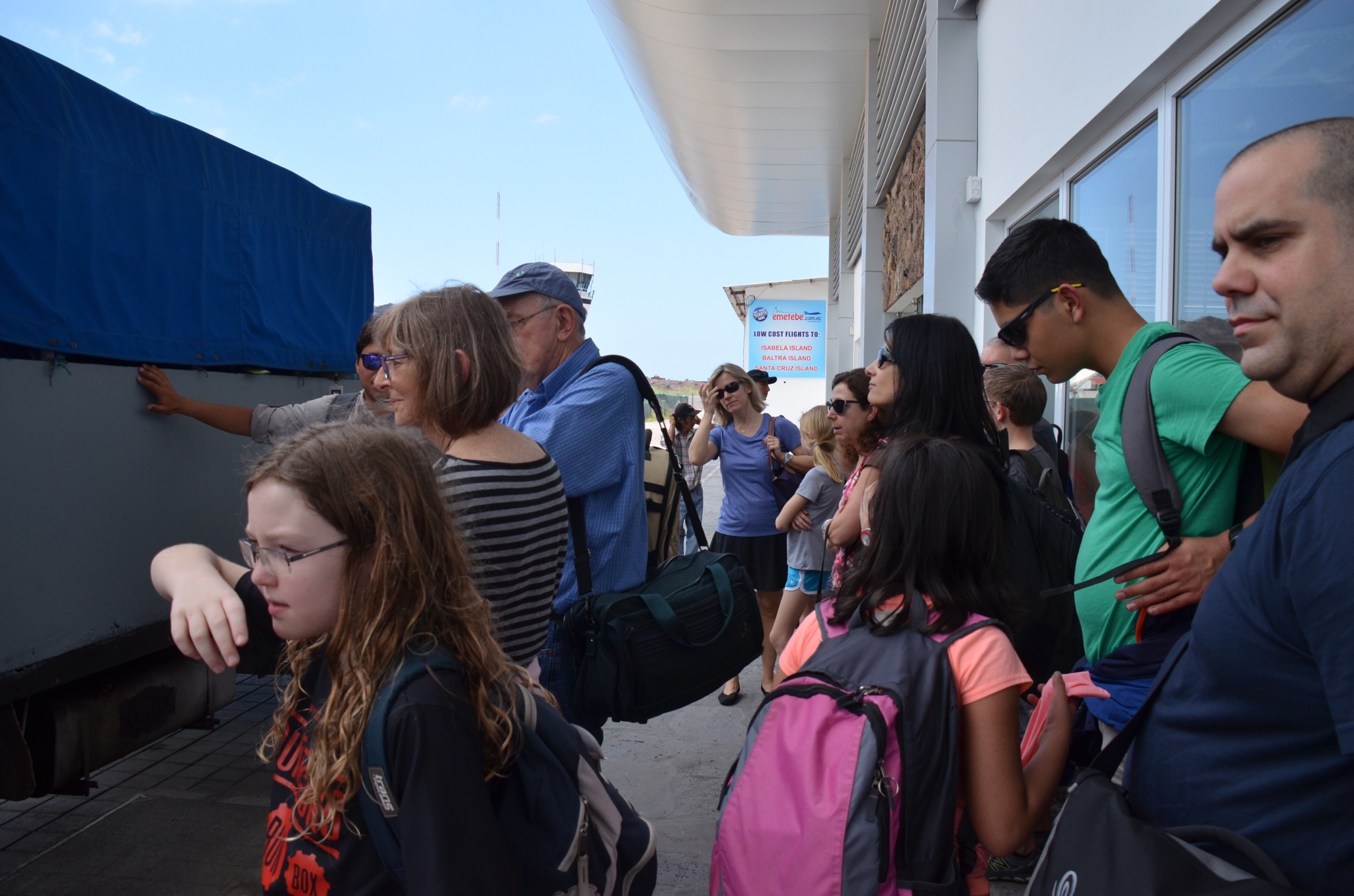
We gathered our duffel bags from the baggage carousel, found our Ecoventura guide and boat mates, and waited outside for the bus to carry us to the boat. It was hot and steamy.

Are we there yet?

Various dive groups and tour operators lined this area:

The passengers of the Flamingo:
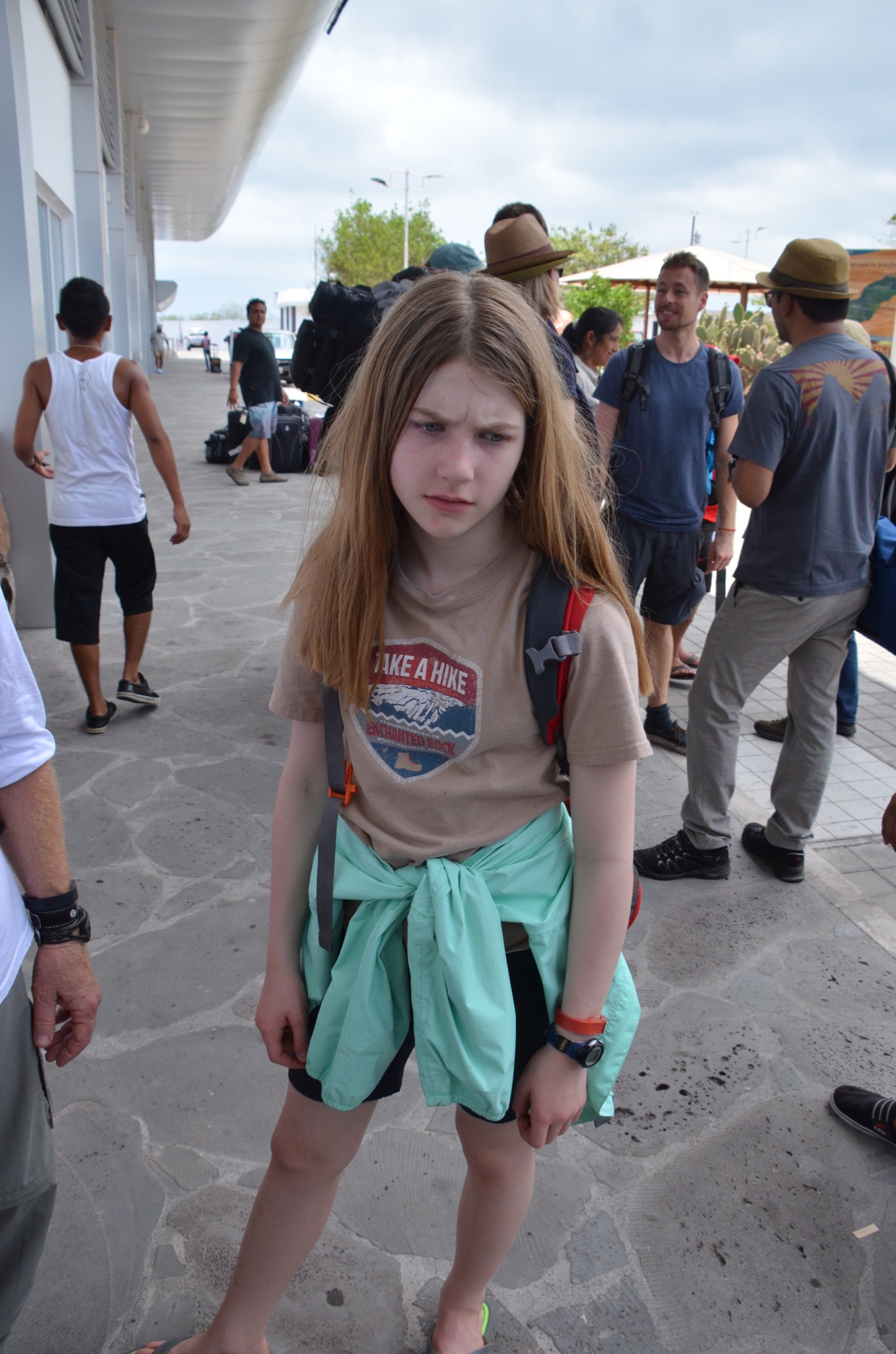
I’m hot and tired!


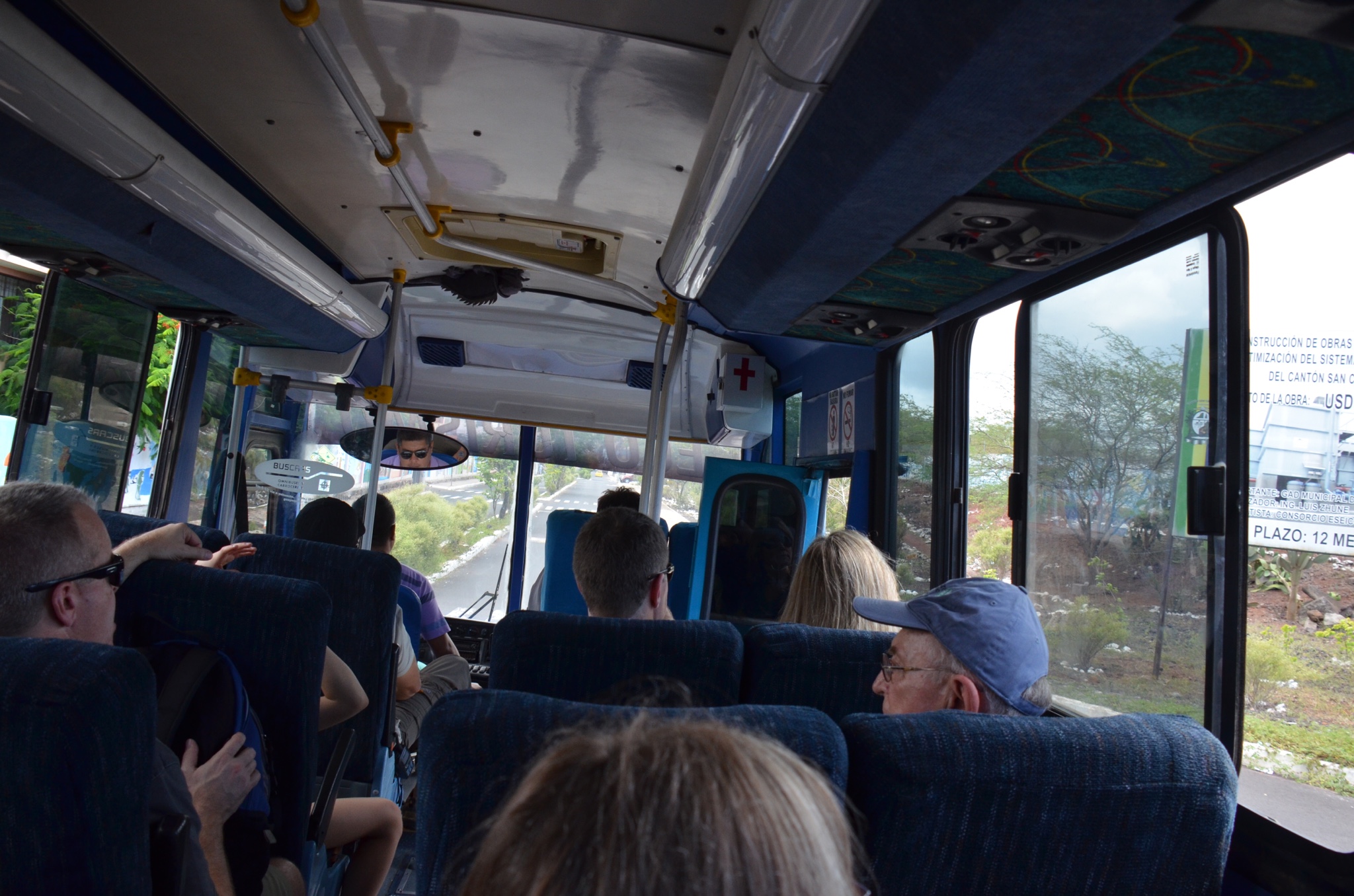
The bus ride to boat was short.

Are we there yet?

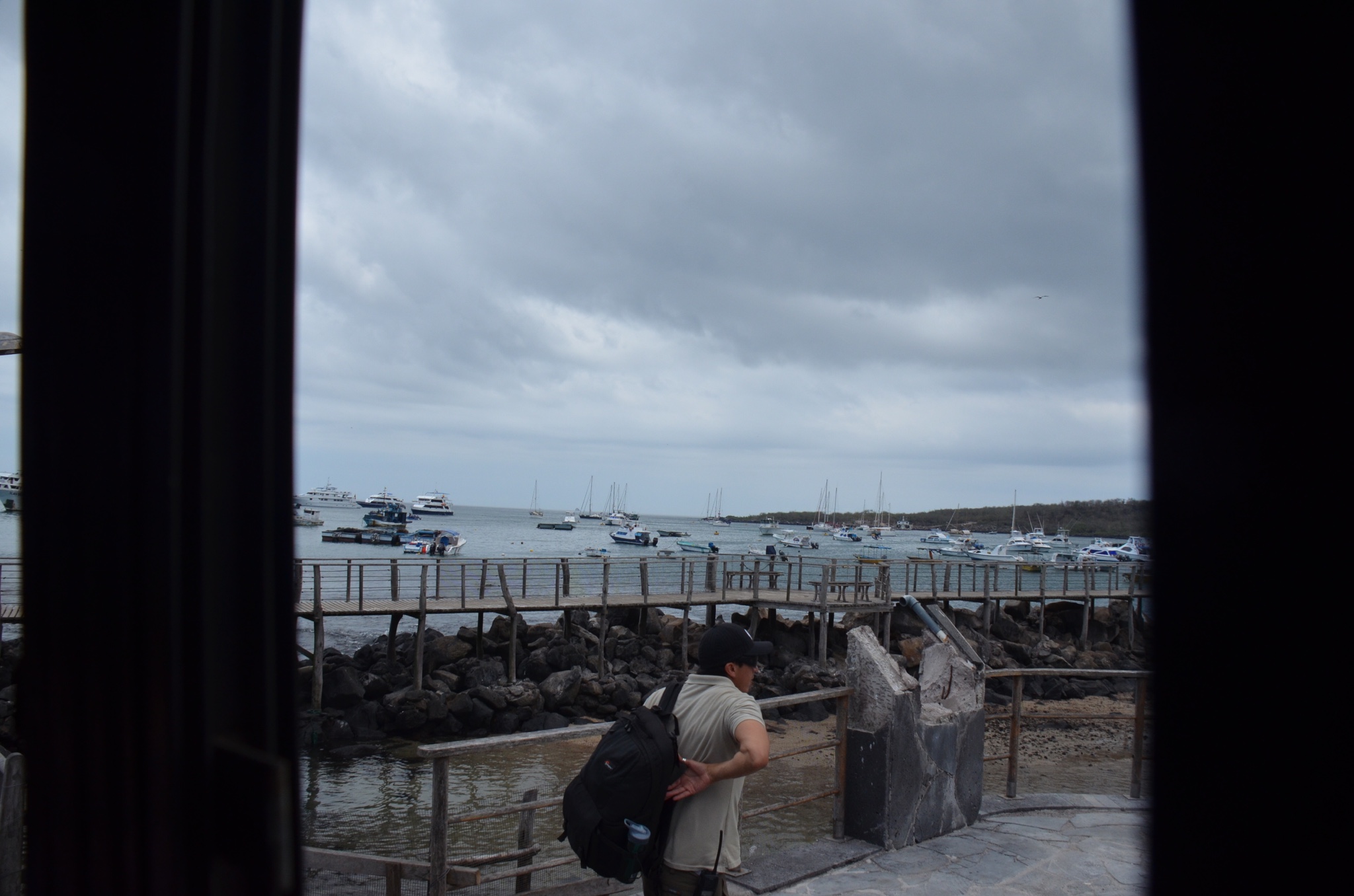
First glimpse of the harbor through the bus window:

These guys were lounging around all over the docks.
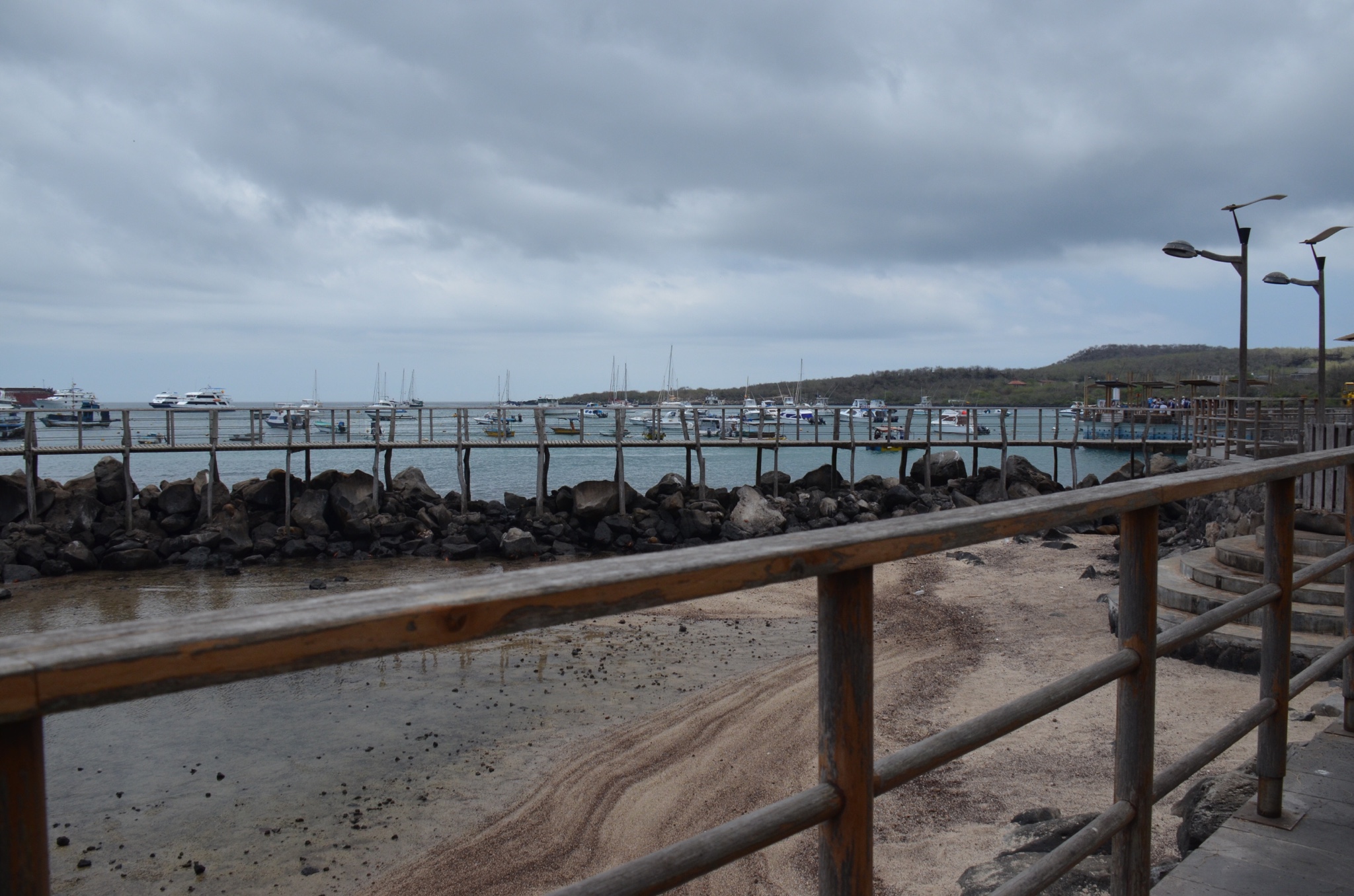
The pier:
The sea lions have no fear of people and lay around all over the steps, piers, and sidewalks:
Crabs are plentiful:
Another view of the pier:
Try going down these steps:
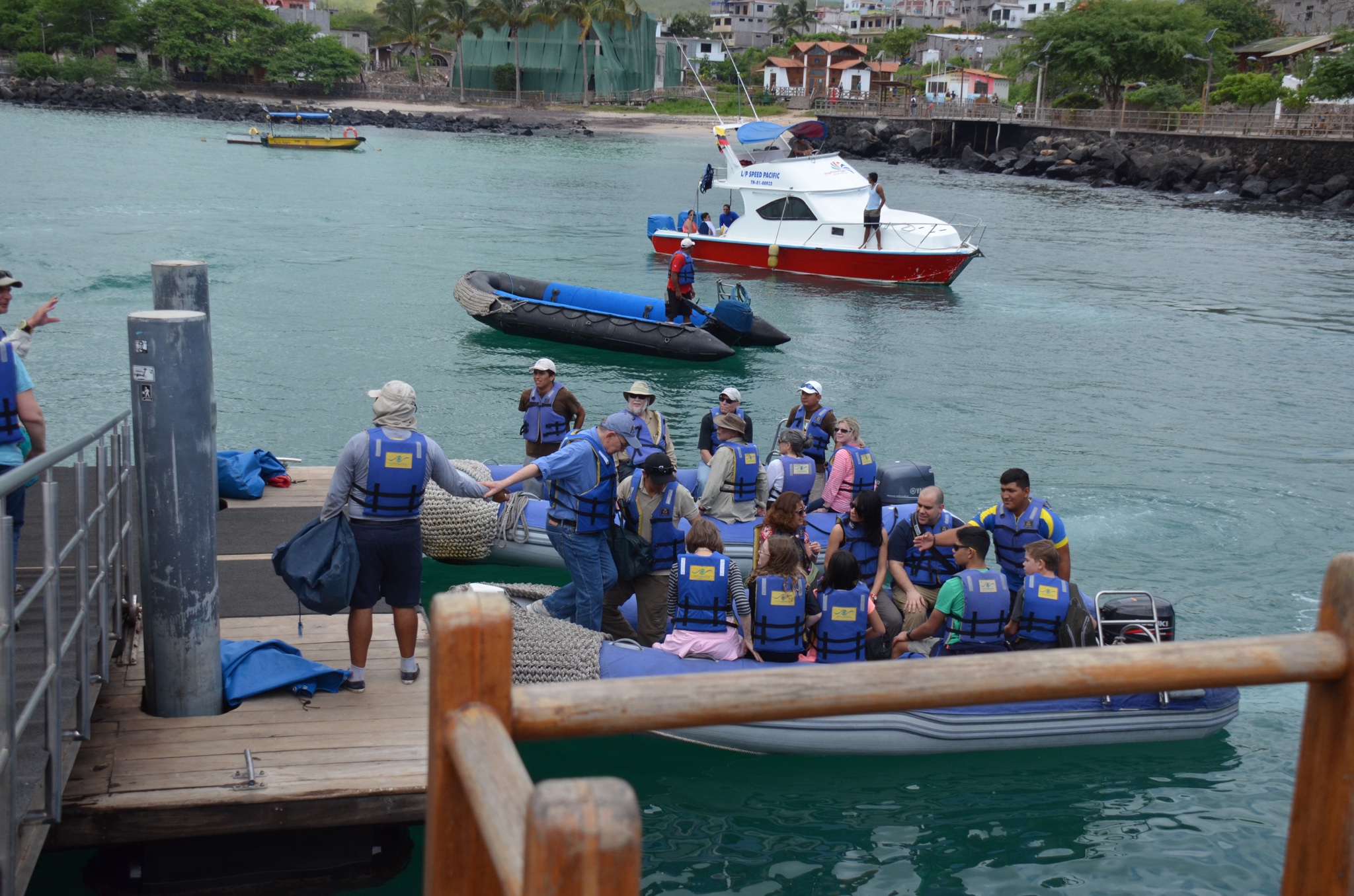
We were met at the pier by our guides, who passed out life jackets to everyone. We loaded into two pangas (zodiaks) for the ride through the harbor to our boat:

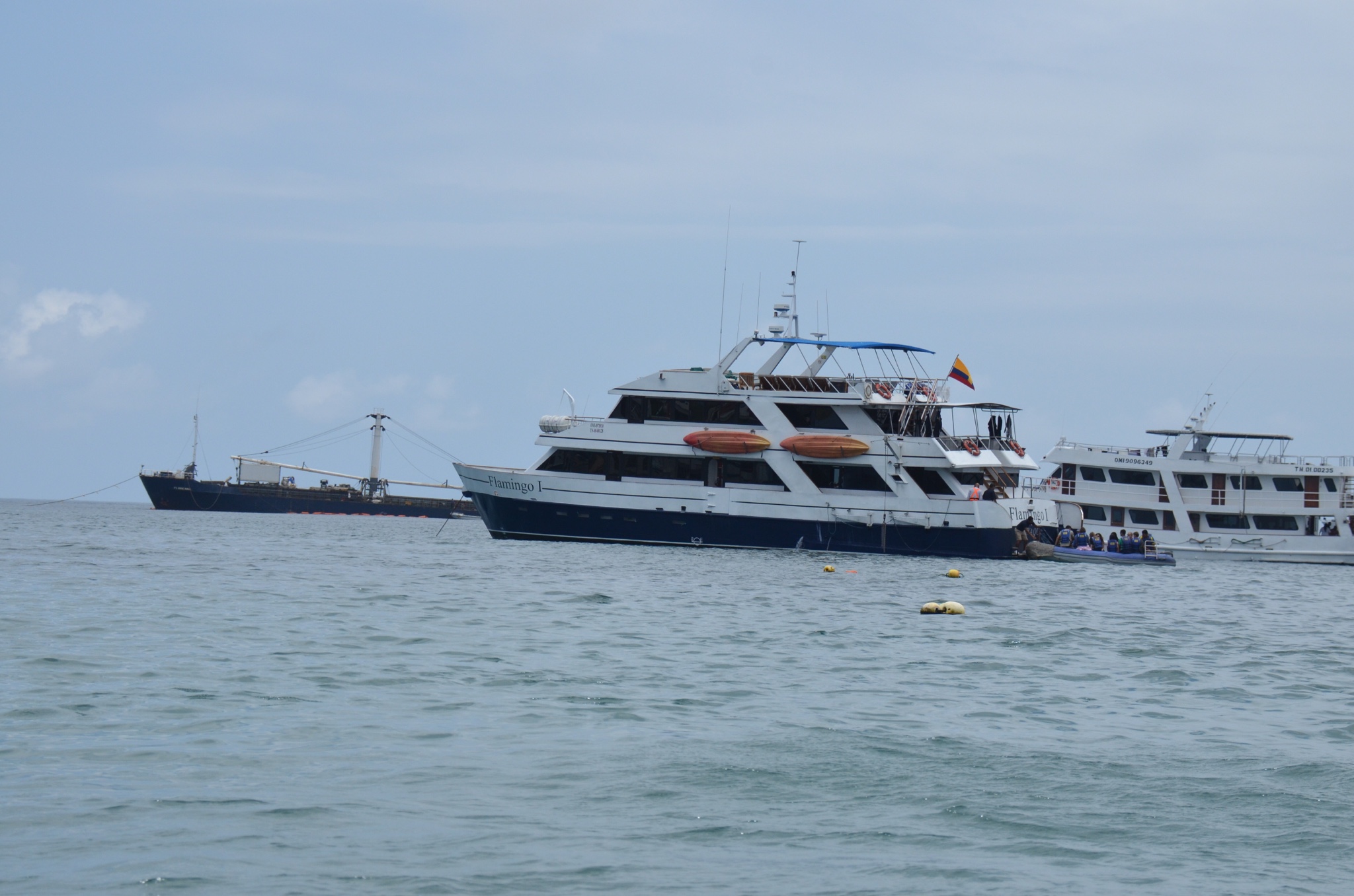
It was a short panga ride to our home for the week, the Flamingo I.

First glimpse of the Flamingo:

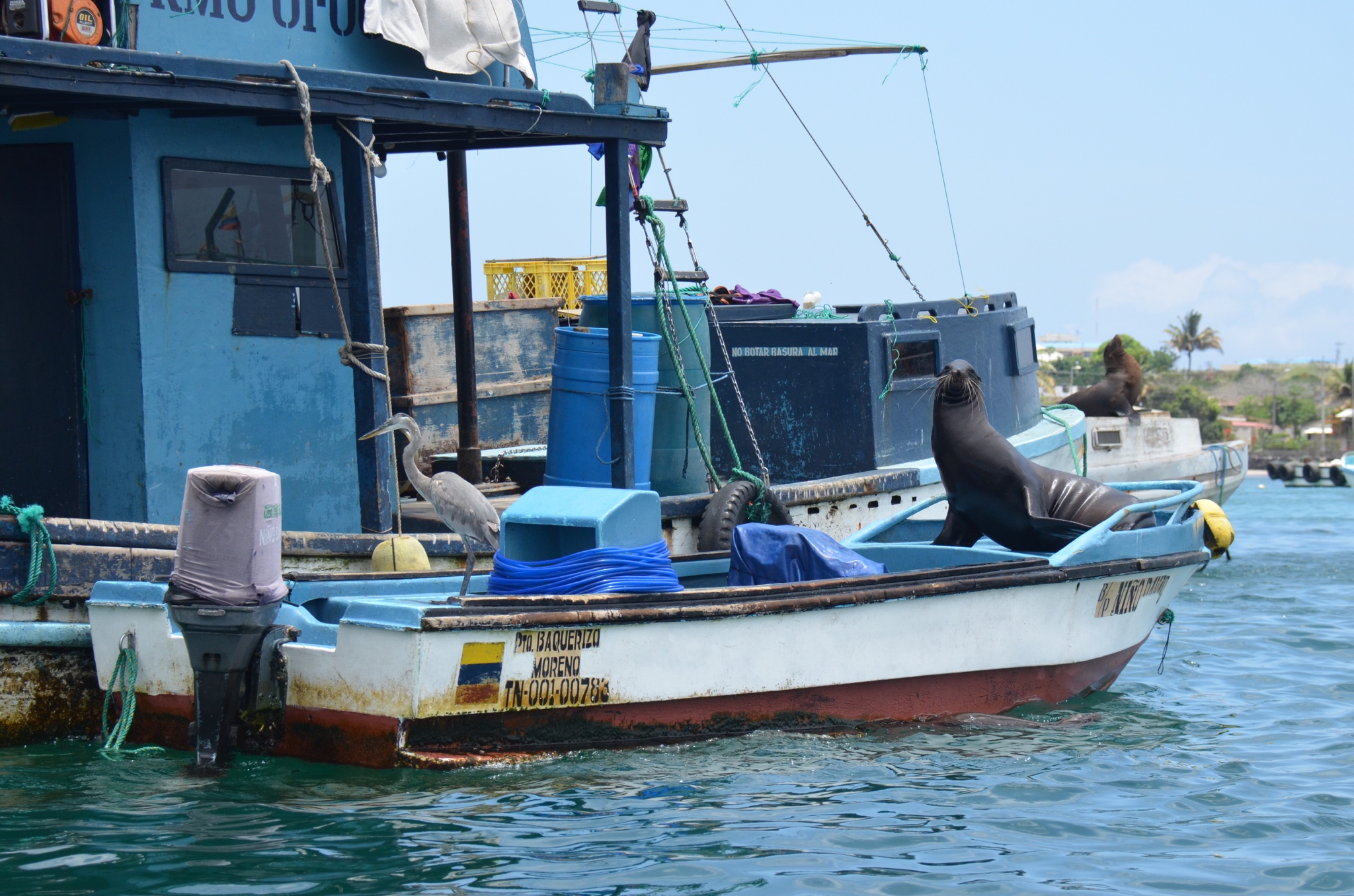
A sea lion and a heron hang out on a boat:
I’m king of this boat!
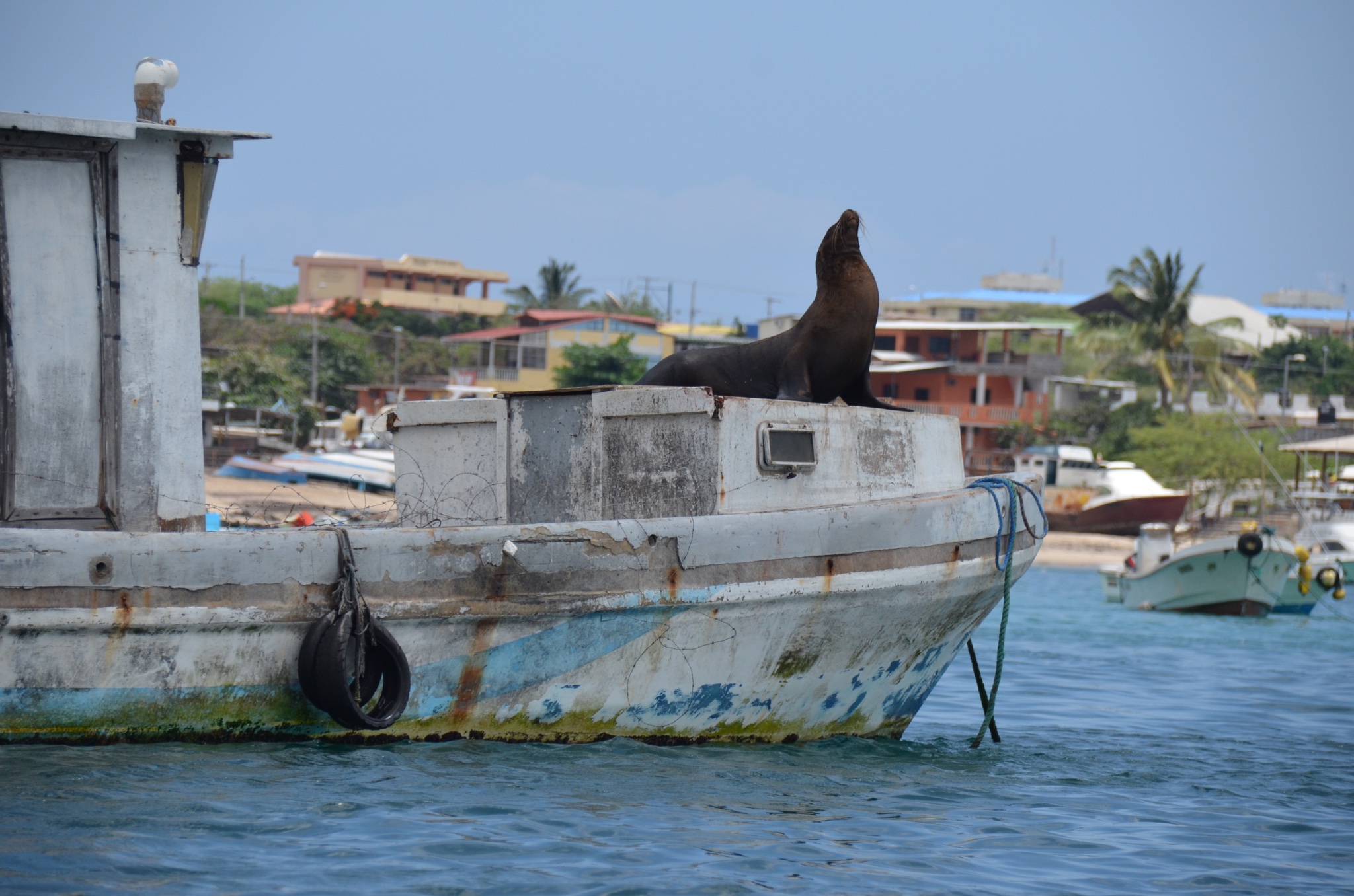
Our guides told us that the sea lions can be a menace in the port. Sometimes a large male will sit atop a boat and call to his mates. They sometimes swarm on a smaller boat and sink it.
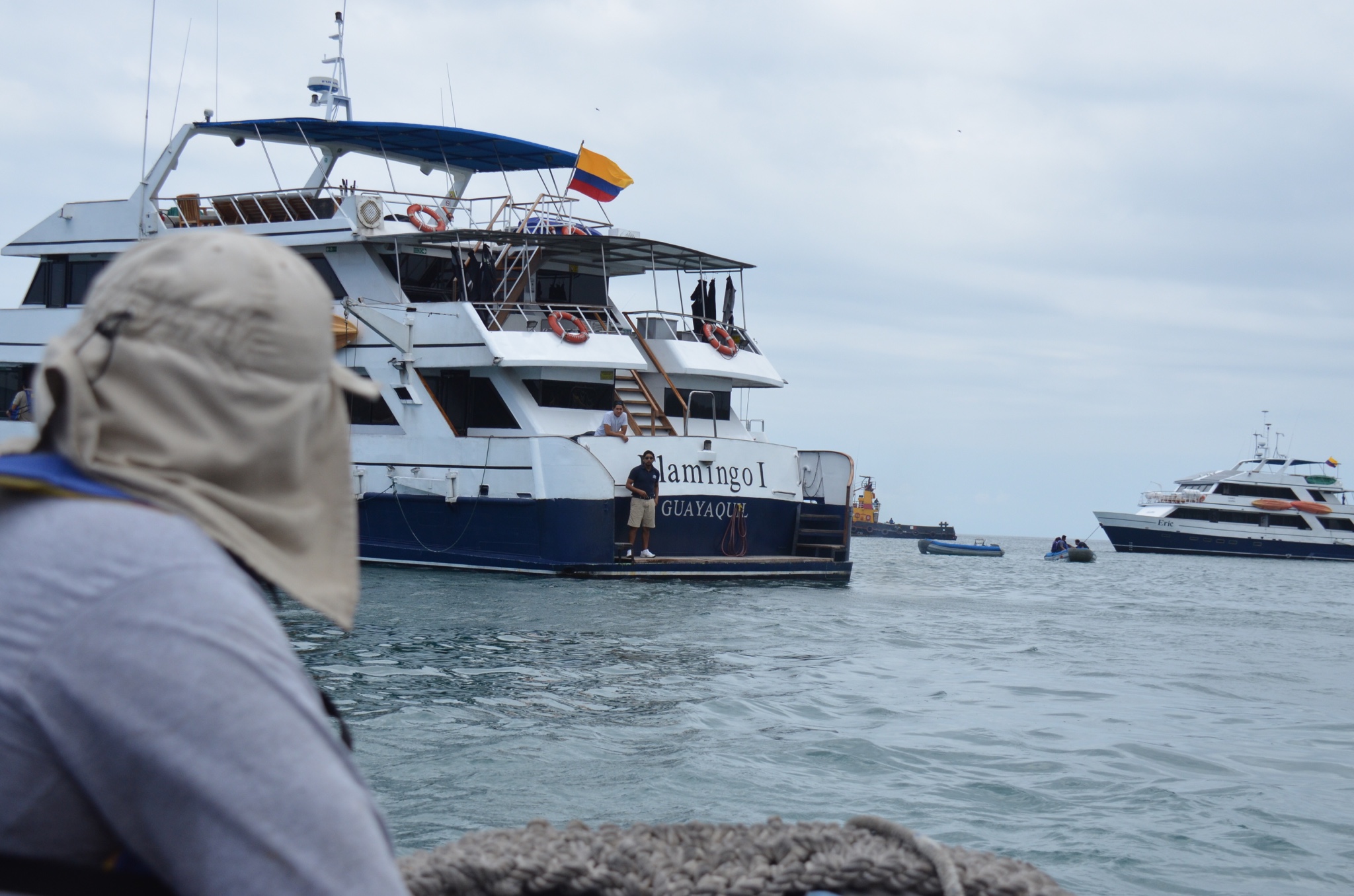
A closer view of the Flamingo:
The panga drivers pulled up to the rear of the boat, and we unloaded one by one. We alternated sides when unloading to keep the panga balanced. Hands are slippery with sunscreen, so we were told to grasp wrist to wrist as we step off the panga to the boat.

We had a buffet lunch and initial briefing. We met the 17 people who were sharing this adventure with us: a couple from Austin (originally from Great Britain) with their 11 year old grandson; a couple from Boston with two girls,11 and 10; a couple from Vancouver with their 11 year old daughter; a couple from Portland, Oregon with their 14 year old son and 11 year old daughter; another couple from Boston (but who formerly lived in Dallas) with their 12 year old son. I was so excited to see all the kids of similar ages and interests. It did not take the kids long to start talking to one another and forming their own pack.

We met our guides for the week, James and Hernan. They gave us some of the ground rules for dealing with the animals. We are supposed to keep a 6-foot separation from us and any animal. We must watch where we put our feet to avoid stepping on any creatures or plant life. If the animals come too close to us, we are to “do the Michael Jackson walk” and move back away from them. It’s hard to imagine that the animals will be this close. We are also to take nothing from the island. If we pick something up, we are to put it back down exactly where we found it. We are to avoid stepping on any vegetation. The guides apologized in advance and told us that they were going to be “quite bossy” in enforcing the park rules.

After lunch, we were given some time to unpack. The cabins were small but nice. Genene and I shared one cabin, and Greg is around the back side of the boat in the other. Our cabins are side by side, and they are the only cabins that open to the outside. We had originally thought that the doors to the room would open from the inside, but that was not to be the case. We can knock on the wall if we need anything.

The crew put us all through a safety drill and showed us where our life preservers were in our rooms, where to muster, and what the alarm would sound like. They told there would only be this one drill, and if we heard that alarm again, it would be a real emergency.

At 4:00 PM, we took a panga ride back to shore and rode a bus for a short distance to a local swimming hole.

The black lava rocks are beautiful:

Vegetation grows right up through the rocks:

This little lava lizard posed for me:


Sea lions were lounging on the black lava rocks and swimming in the water with the locals:

A view of my intrepid traveler at the local swimming hole:
The sea lion played peekaboo with the kids:


Birds stroll close to us:

A “mom” sea lion and her baby lumbered by and settled down for some family time:

“Mom” laid on the shore nursing her little one, and they were both completely oblivious to humans. They do not regard us as predators, and we could get close enough to hear the suckling sounds. The kids enjoyed watching the sea lions in the water and getting their feet wet.

Slurp, slurp:
Can you see the two sea lions that the girls are watching? They blend into the lava rocks quite well:
Watching the nursing sea lion:
These two look as if they are sharing a joke: “This sea lion walked into a bar….”
Covered in sand:
Our guide told us that the sea lion mothers go out to hunt for several hours a day, leaving their babies on the shore. When they come in, the pups line up, and each mom identifies her pup based on smell. This is one reason it is important not to touch the babies:
Can you see the little hermit crab strolling across the beach? Also, take note of the incredible number of shells. It was tempting to pick up a pocketful, but I did not want to end up in jail so I resisted the urge.

On the walk back to the bus, we ran into a marine iguana. I would say he was about 2 feet long, head to tail.

I’m ready for my close-up, Mr. DeMille:


We rode the bus back into town and spent a couple of minutes souvenir shopping. Genene had her eye on a little leather wallet, and Greg and I each got a cold beer and sat out on the park benches in the shade.

More sea lions hanging out:
Beach bum:
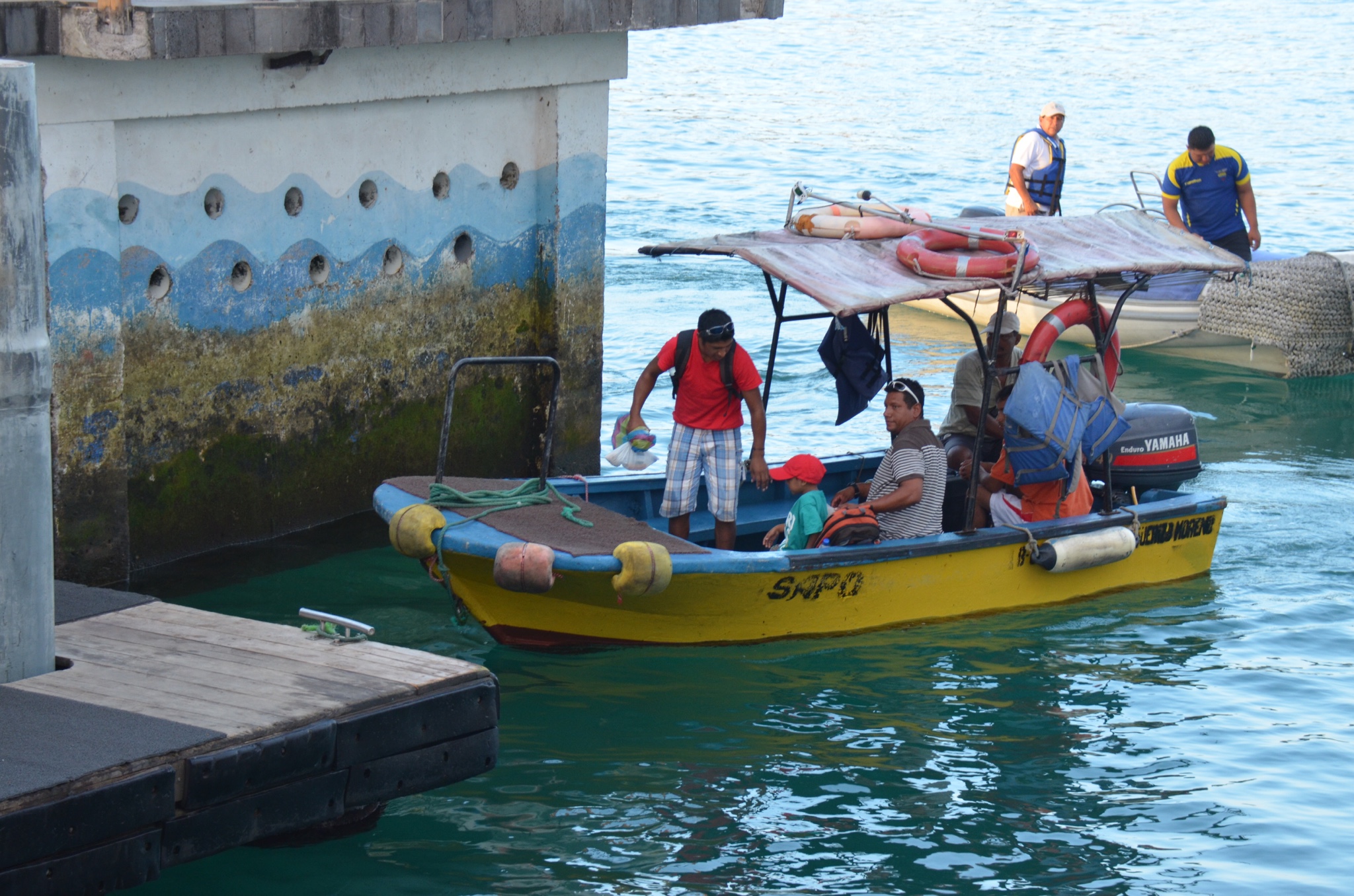
I like to imagine the lives of the people I see along the way. I wonder what these folks do and how they make their living with this small boat?
On the panga headed back to the boat:
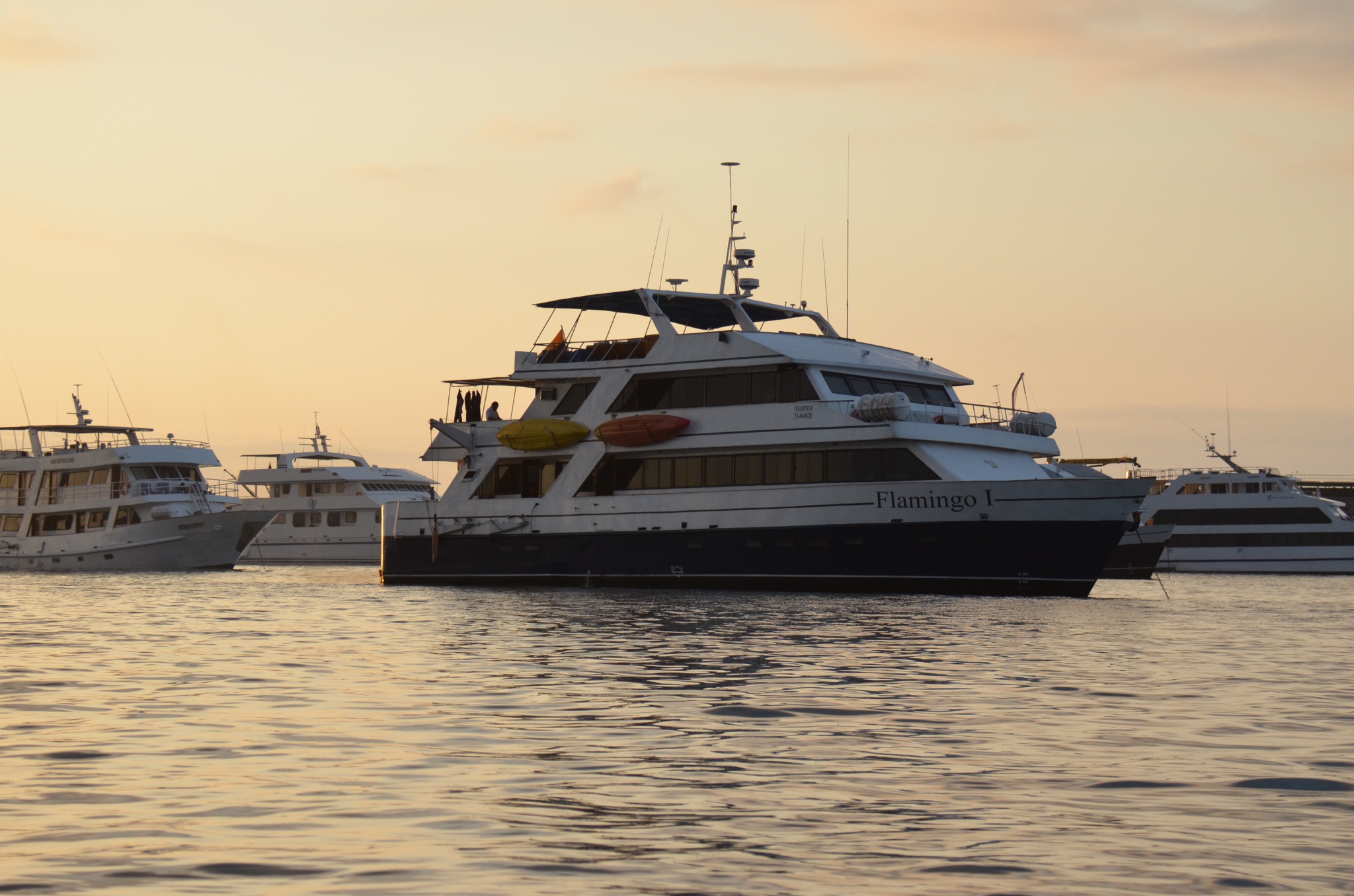
Sunset and the Flamingo:


We rode the pangas back to boat and splashed water on our faces and went to the lounge area for the captain’s welcome.

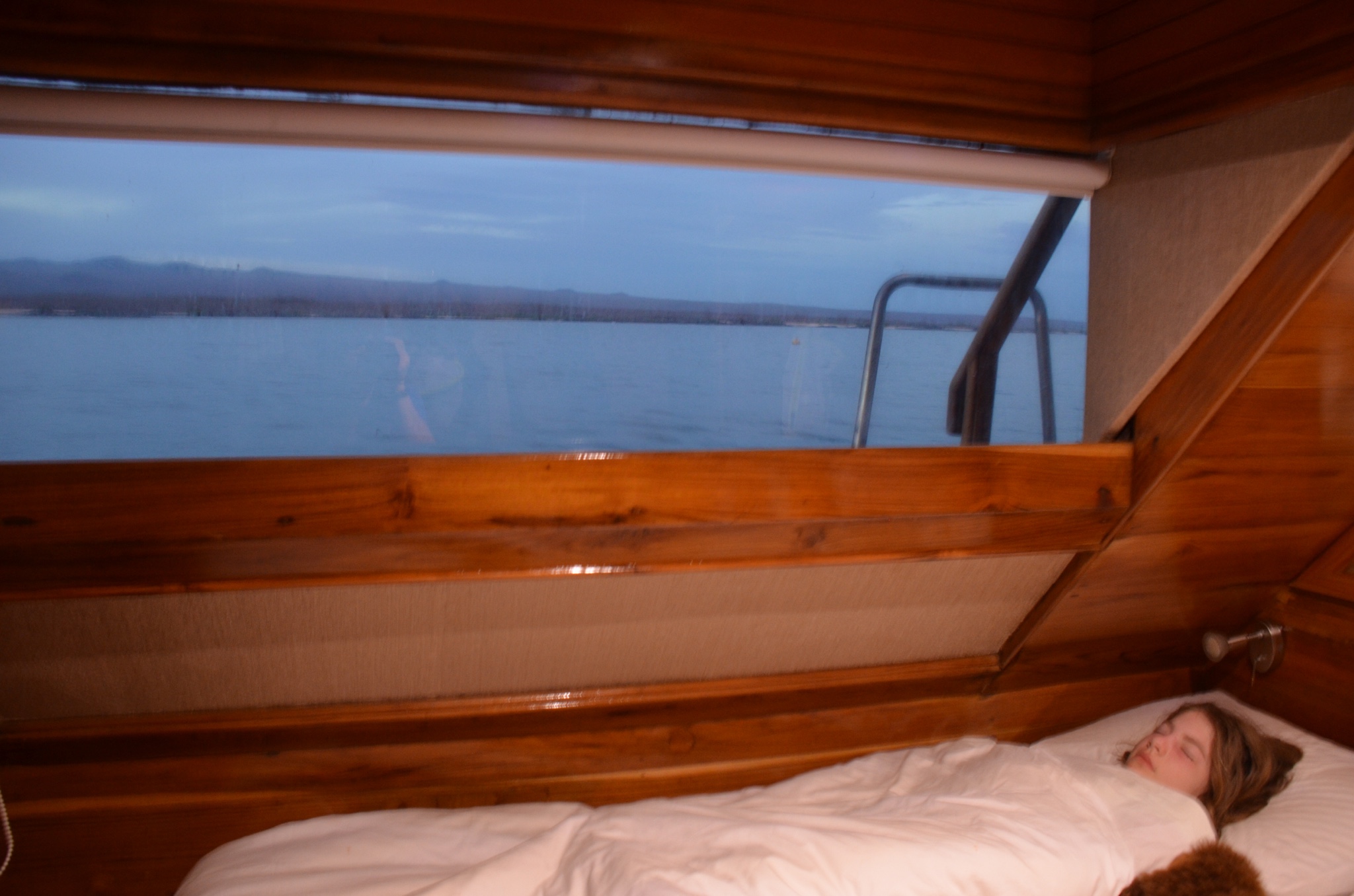
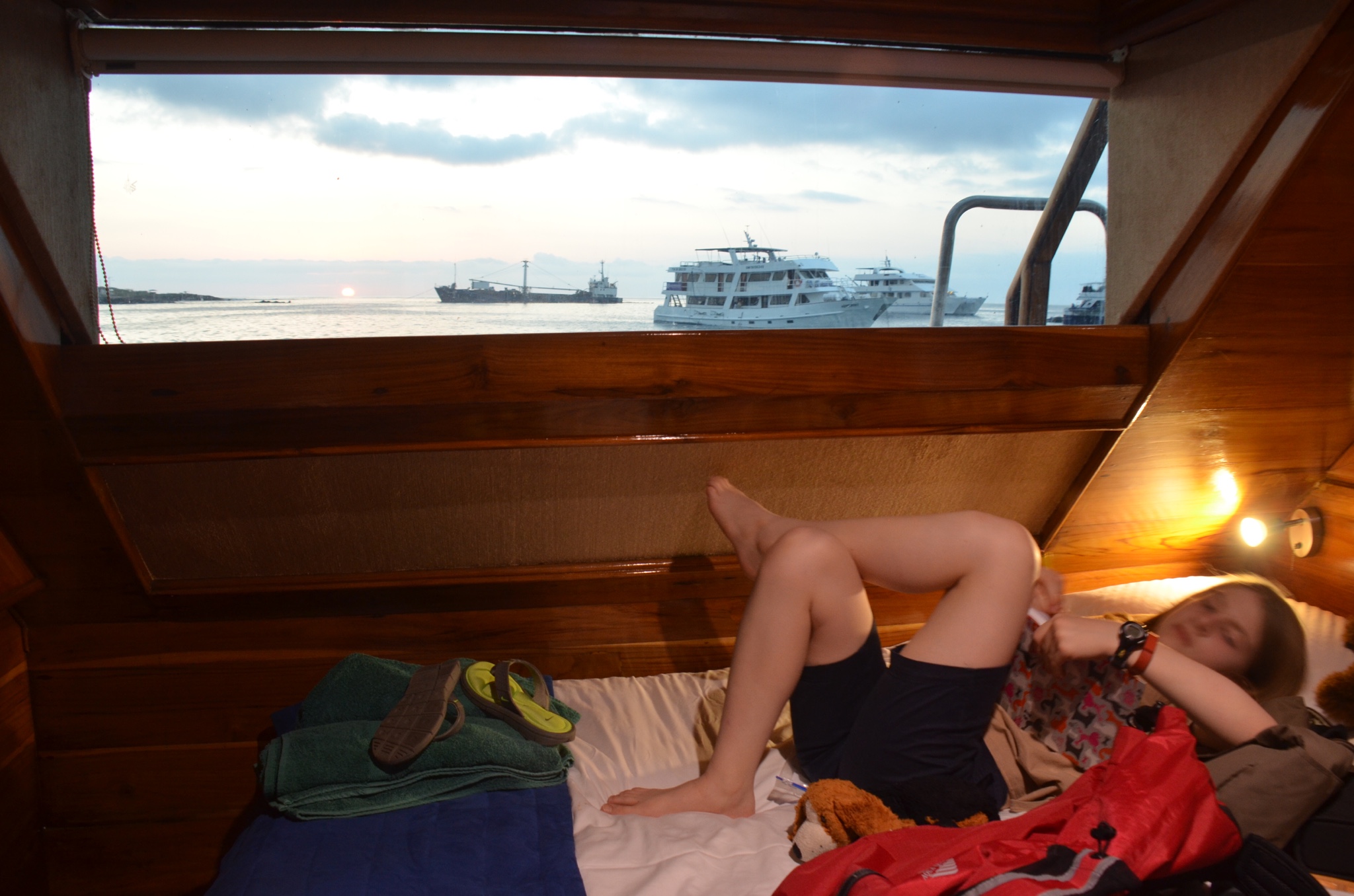
Genene took an opportunity to relax for a moment in the cabin. What a view from our window!


In the lounge, our guides James and Hernan were waiting to tell us about tomorrow’s activities. The lounge area has two large flat screen televisions, onto which the guides project a powerpoint presentation. They showed a map of our sailing route, photographs of things we should expect to see, an itinerary of events, and a description of things we should bring for each trip. They told us whether each landing will be wet or dry and what kind of shoes to wear. After the presentation, the main itinerary is written on a white board. The guides encouraged us to take a photo of the board each day so that we could refer to it. Everyone has an iPad or iPhone, and there are some nice cameras hanging off of necks all around. In fact, our guide Hernan takes photographs for National Geographic. How cool is that?

We are headed to Genovesa Island, which is a voyage of several hours.

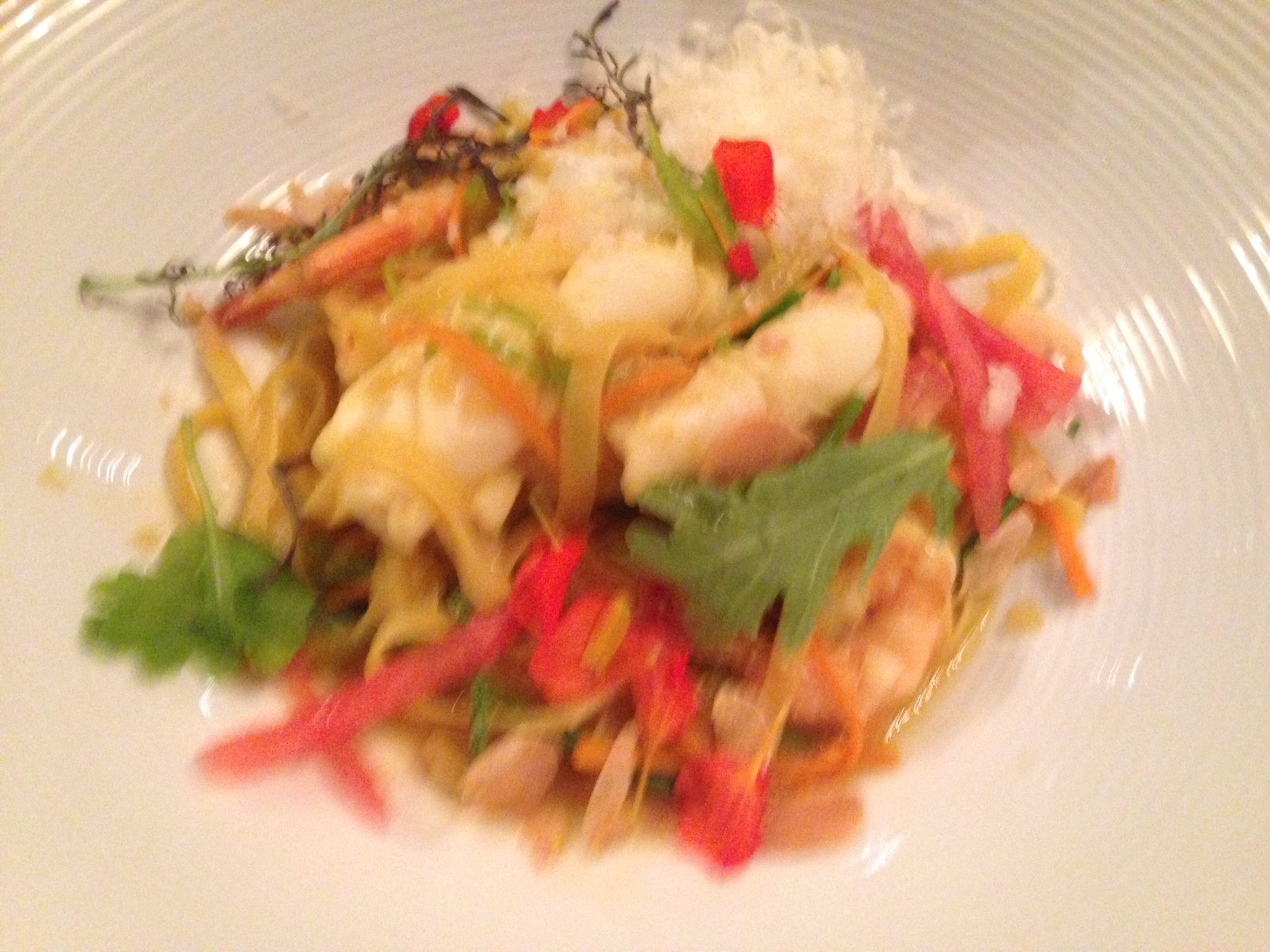
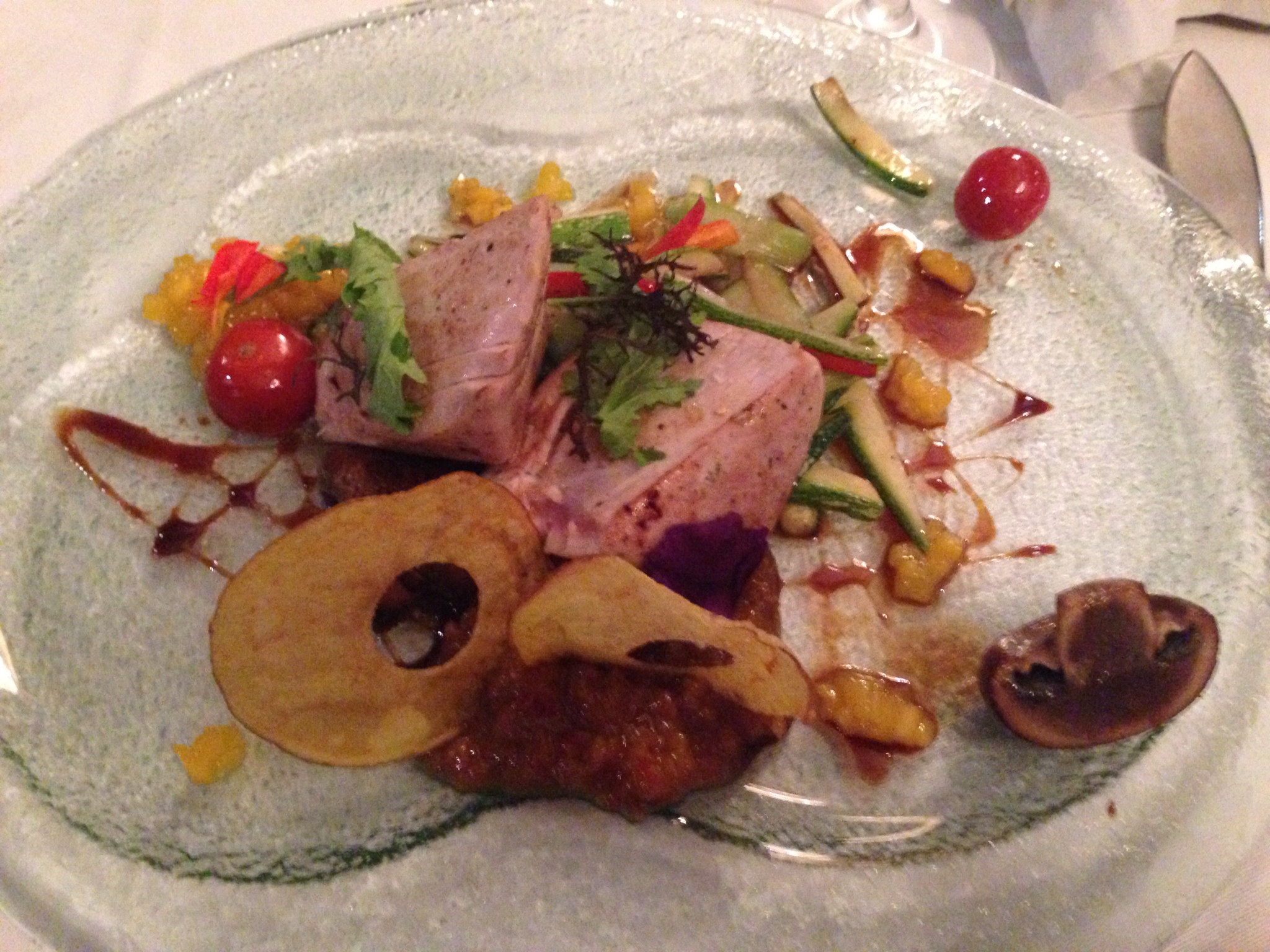
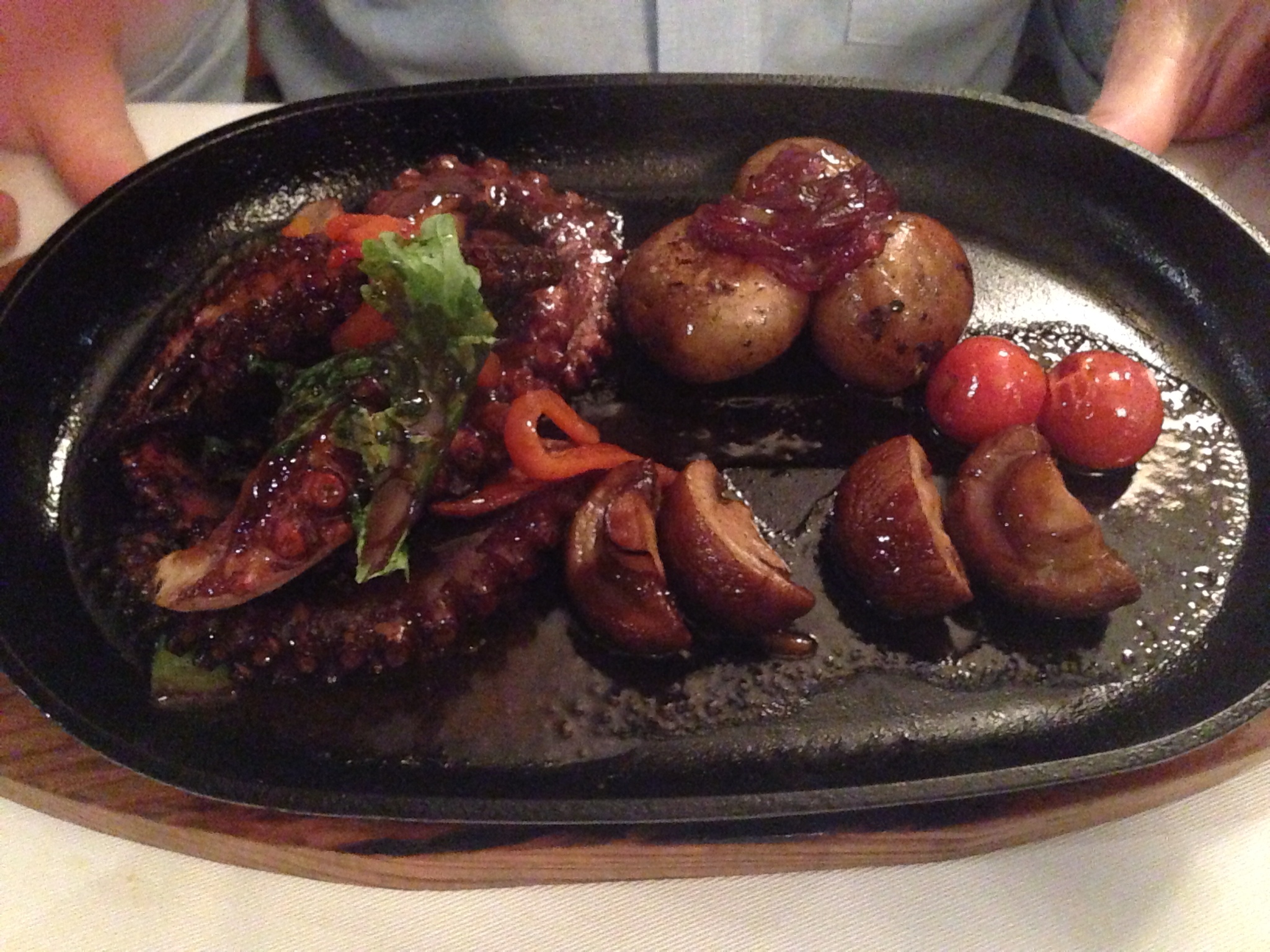
The captain made his entry, and he is a handsome fellow and much younger than I would have imagined. He thanked us for coming aboard and told us that the Flamingo was to be our home for the week, and we were to all be friends sharing the adventure together. I do not think that will be hard. He introduced us to his crew, and there was a pink champagne toast (for adults) and orange/cherry juice for the kids. Directly after the toast, a delicious dinner was served: mozzarella and tomato appetizer, a choice of octopus or filet mignon for the main course, and a warm Chocolate ganache dessert to die for. The Gordons are in heaven!

We are awestruck at how nice and interesting all of the passengers are. The dinner tables are 4-tops, and there are just enough tables to seat everyone aboard. That means that the families who are “threesomes” have to mix it up. We have been sitting as a family, but we will need to change that. I am sure the kids will start wanting to sit together, and that will leave us some opportunities to sit with adults and visit.

After supper, the kids played hide-and-seek on the top of the boat. We let them go. After all, how far lost can you get on a boat? The Flamingo pulled up anchor, and we were underway!

It was completely dark with open water all around. The stars were amazing. Genene came in tired and ready for bed. The hum of the boat motor lulled Genene to sleep, and I followed close behind.

Ecuador and the Galapagos Part 1: Getting to Quito

Friday, March 13, 2015

Today has been a day of roller coaster emotions. We were excited to be going to the Galapagos for spring break, but my excitement has been tempered by sadness. As we were finishing our packing, we got word that one of my dear co-workers lost her husband today. His fight with cancer was short, and the odds were mercilessly stacked against him from the start. Nevertheless, the news was sad. God rest his soul. I wish I could be there for my friend, and I am torn about getting on a plane to have a vacation while she has experienced this terrible loss. Please keep her in your prayers, as our family does.

********

I finished my last work meeting of the week last night and went back to the office for a few minutes to drop off files and settle all those last minute details. I was home by 10 PM. Greg was so excited that he could hardly stand himself. This trip has captured his imagination like none other in my memory. I am excited too. Genene, the world traveler, is taking it all in stride. Will it be better than Universal Studios, where one of her classmates is spending spring break?

This morning we got Genene off to school so that the real packing could begin in earnest. Before I had even gotten in the shower, the power went off in the entire house. The day was overcast, so the whole house was dark. Have you ever tried to pack duffel bags in the dark? It’s not easy. Luckily we had some headlamps left over from our ill-fated Inca Trail expedition, so I put one on and went around the house looking like some kind of half-assed coal miner. The power came back on after a couple of hours, and we got it all done in time to pick Genene up from school. We took her out an hour early, figuring that a little island education would be as good as that last hour of math class on the Friday before spring break.

Action Limos took us to the airport, and I am continuing to LOVE the Global Entry. Today, the regular line to go through security and screening was miles long, and there was NO ONE in the TSA pre-check line. We were finished with all the xrays and bag checks in a jiffy and had time to eat dinner in the airport.

The flight was uneventful. I watched “Wild,” which I thought was passable. Reese Witherspoon’s performance was inspired, but her character was not very likeable. I have a hard time investing two hours in a movie if I do not like the characters. I also had trouble accepting that Laura Dern was Reese Witherspoon’s mother. They look more like drinking buddies. Genene watched “Big Hero 6” and thought it was really good. Greg watched “The Good Lie” and liked it.

We did make a rookie mistake on the flight. United offered to SELL us some food as the flight first began. We had just stuffed ourselves and so declined the offer. I was under the mistaken impression that they would pass through the cabin again and offer to sell us a snack. They did not. In fact, the crew only passed through the cabin and offered water two times during a 5 1/2 hour flight. I thought that was pretty sorry. We were parched by the flight’s end.

By the time we got on the ground in Quito at 11:00 PM and through customs and immigration, we were starving. We had hired a driver to meet us. I know that taxis are cheaper, but at 11:00 PM, who wants to take a chance? It’s very comforting to see a friendly face holding the “GORDON FAMILY” sign among the throng. It took less than an hour to get to the hotel, and we begged the concierge to have the kitchen make us something–anything! They obliged with a white bread sandwich and some potato chips and we devoured it like a pack of ravenous wolves and hit the sack.

Saturday, March 14, 2015

We had no plans, so we set no alarms. I love days like this. We drowsed until 8:30 or so and strolled down for breakfast in our lobby. The coffee was delicious, and we enjoyed fresh fruits and scrambled eggs. Everyone had a healthy appetite. Quito is at about 9,350 feet above sea level and is the highest capital city in the world. I have been a little worried about a repeat of last summer’s altitude sickness drama with Greg. I didn’t want another endoscopy without benefit of anesthesia, so I have been watching him like a hawk. He is taking a bigger dose of altitude medicine and does not seem affected as he was in Peru last summer. Perhaps that bleeding ulcer he had then was the bigger part of his problem.

Genene having breakfast:

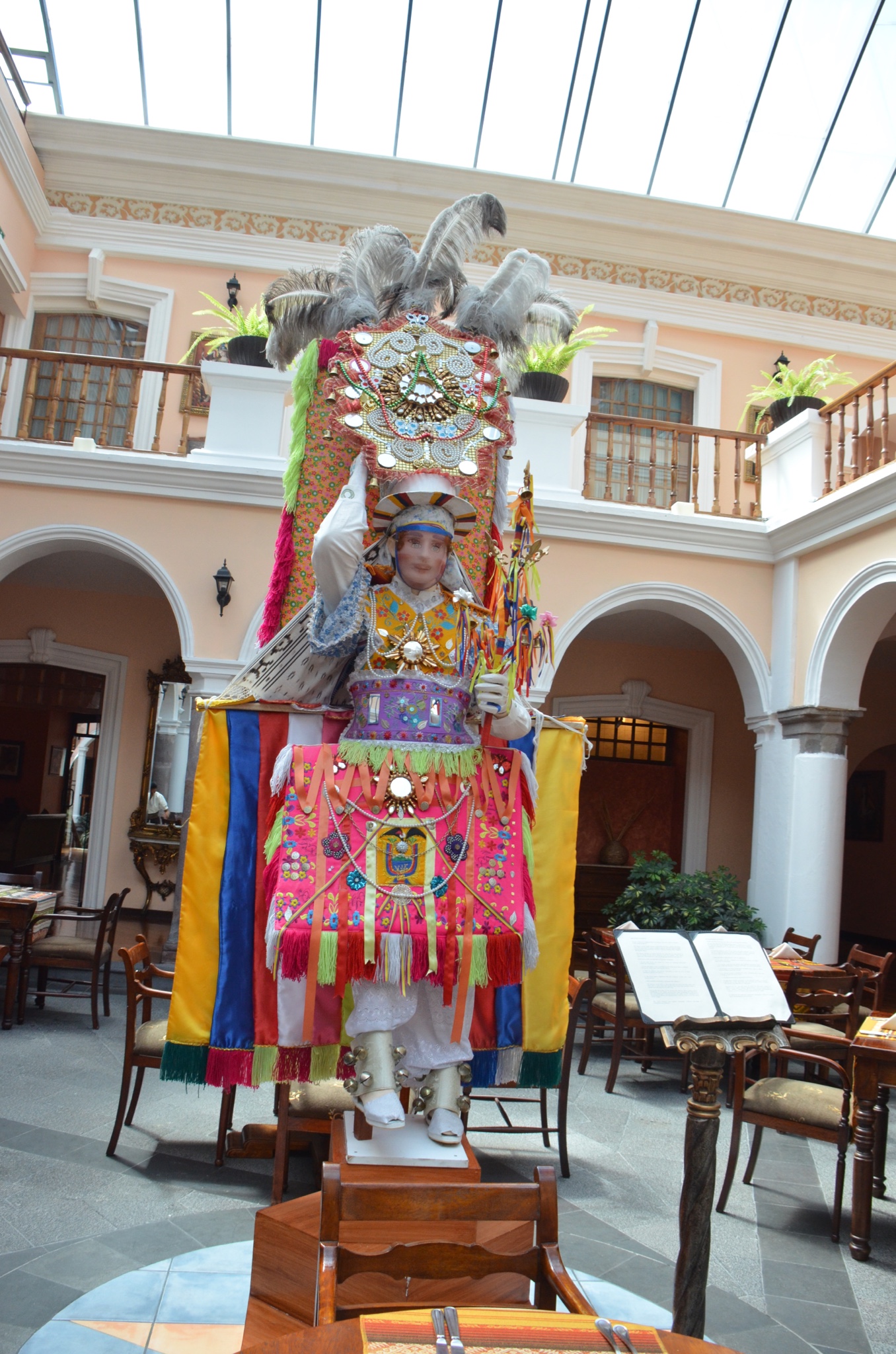
The colorful courtyard where we ate breakfast:
 

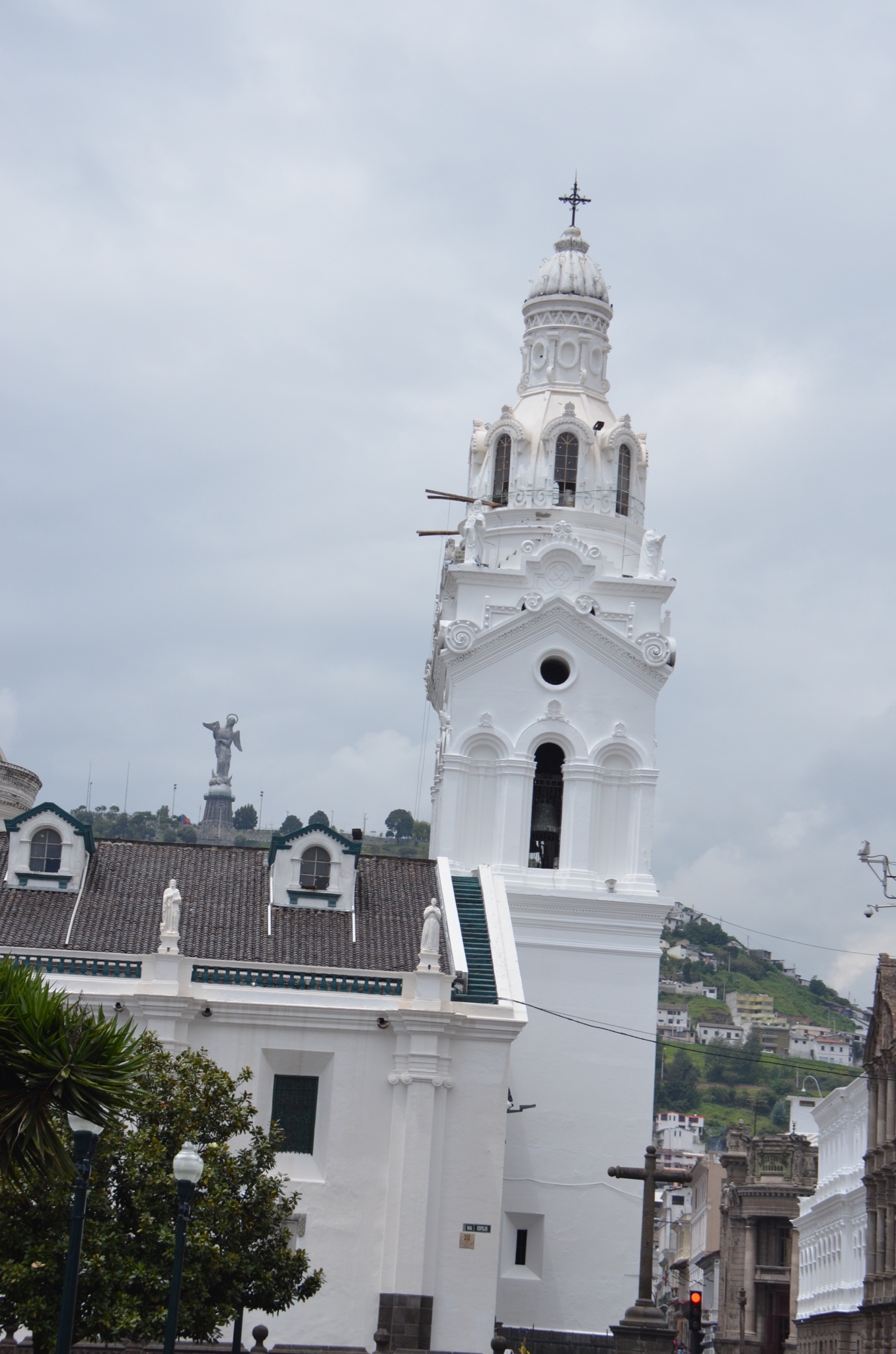
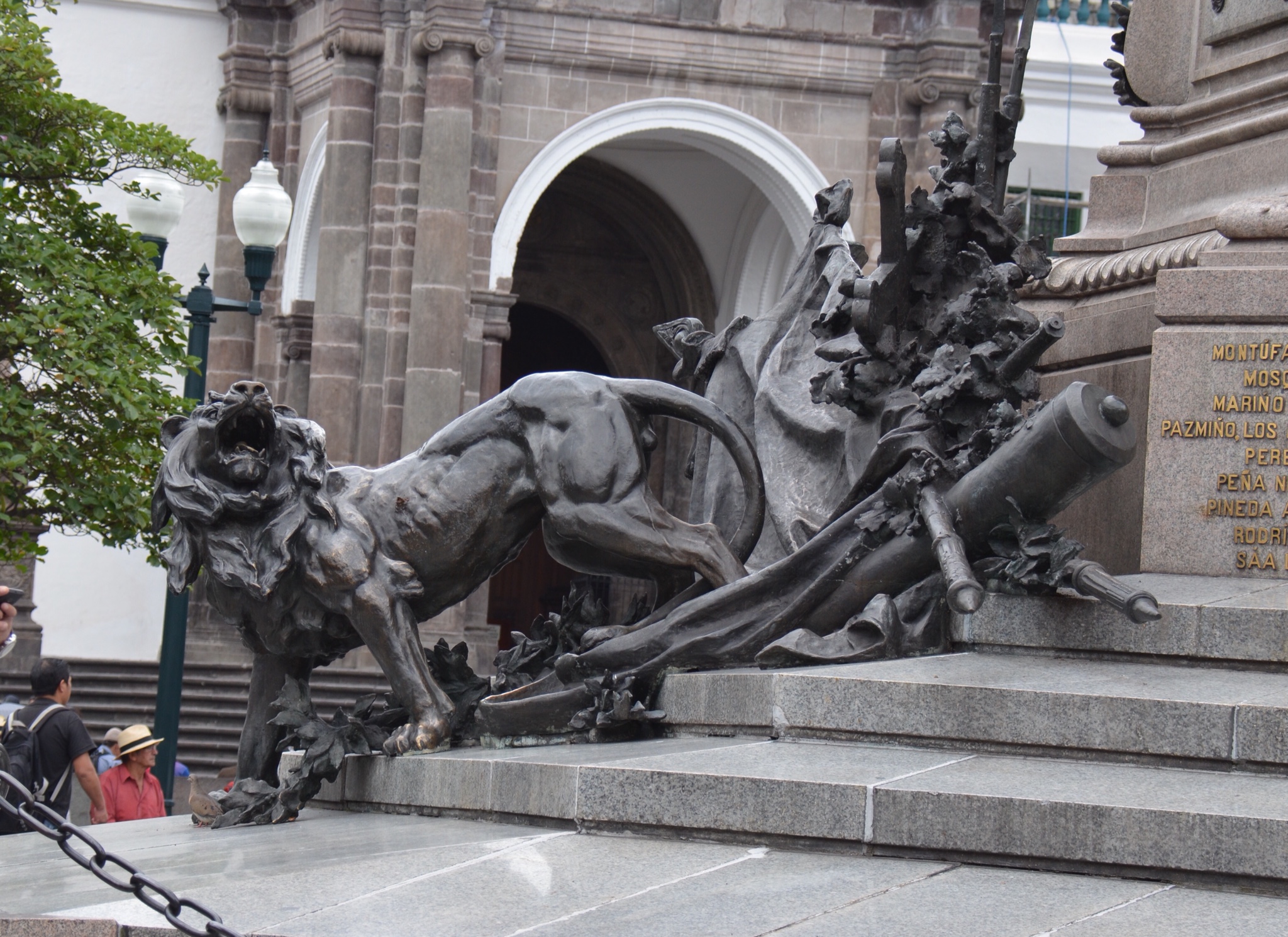
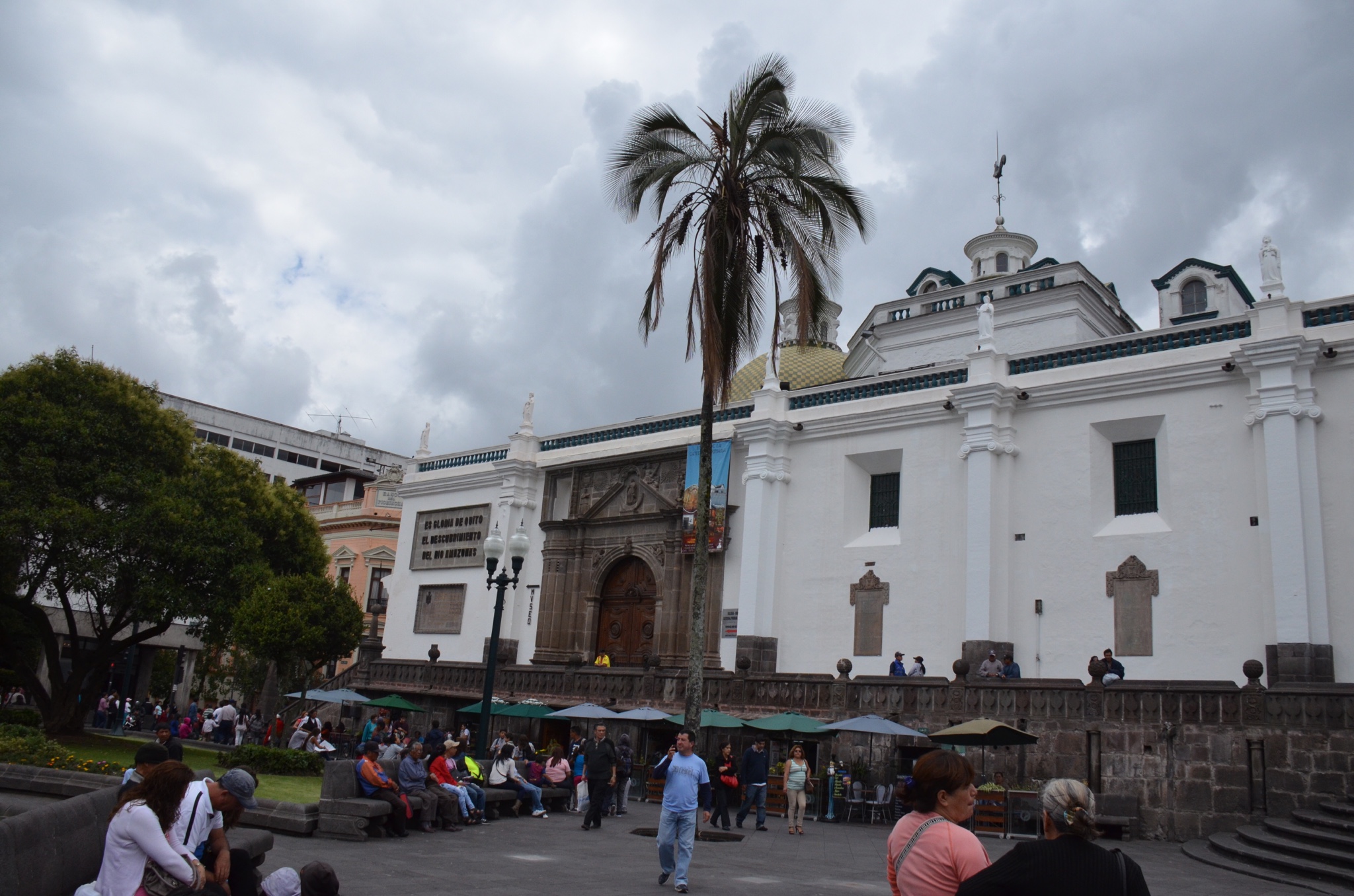
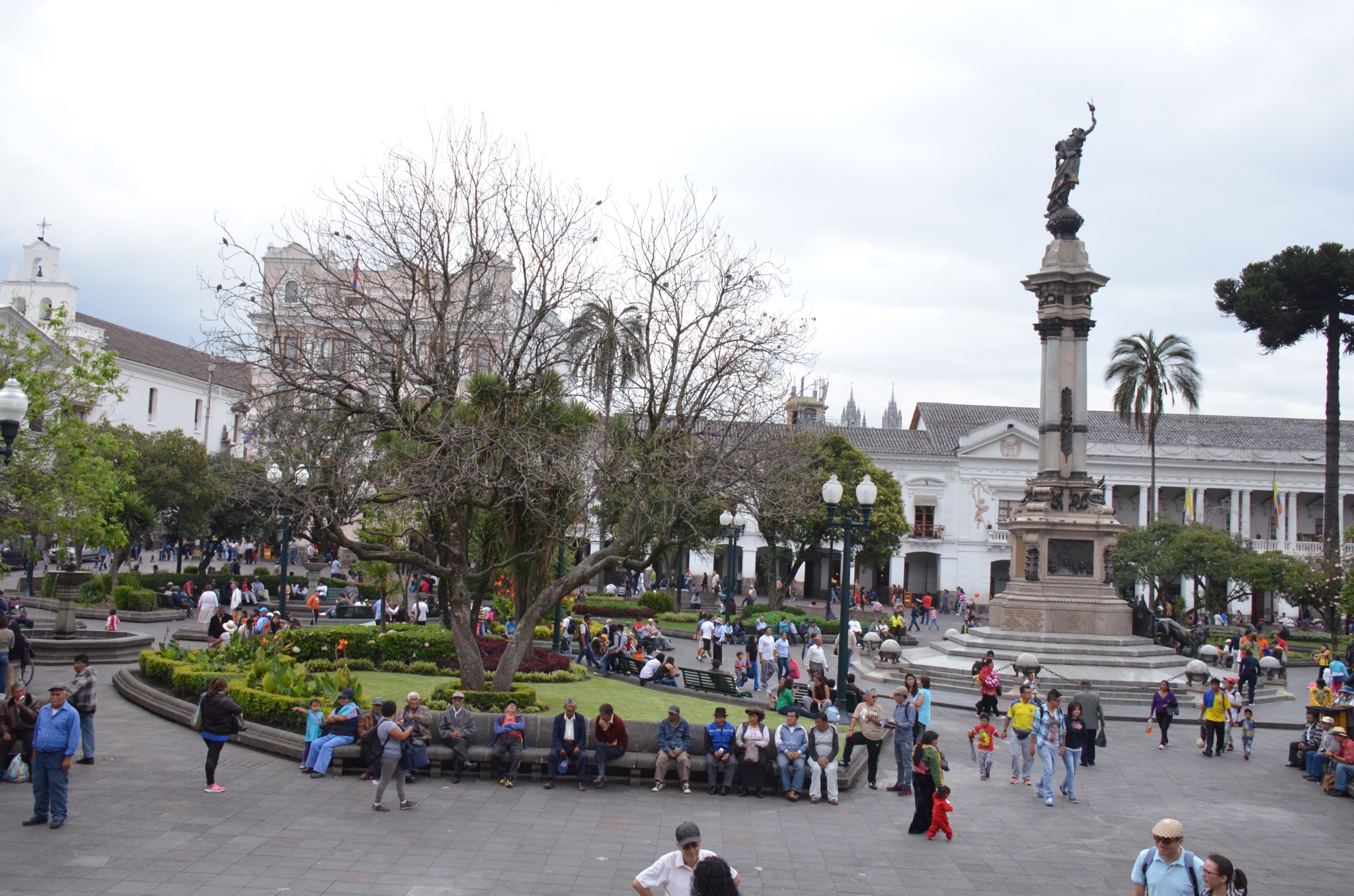
Our hotel is located less than three blocks from the central plaza in Quito and so we wandered down there to see the sights.


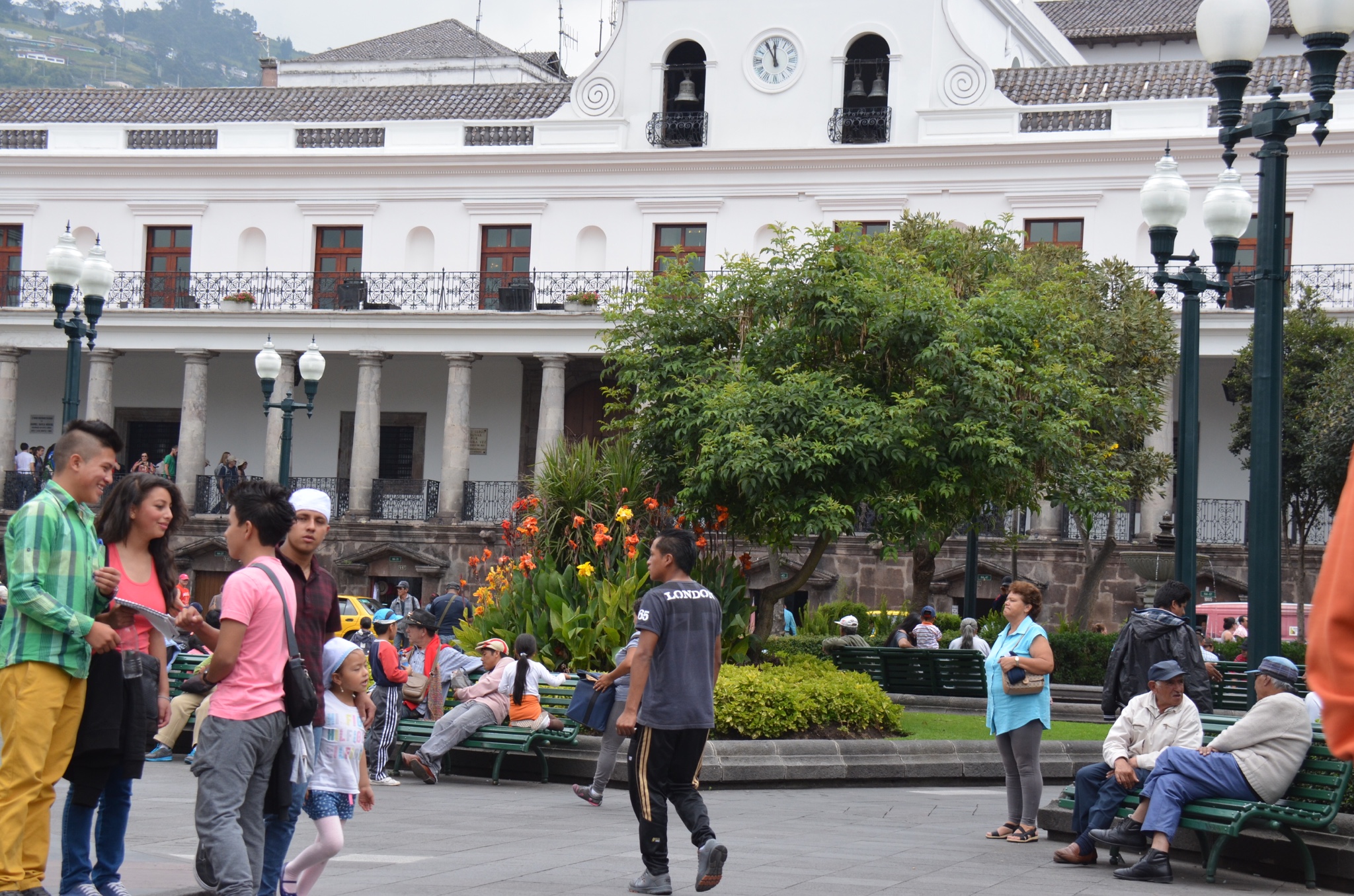
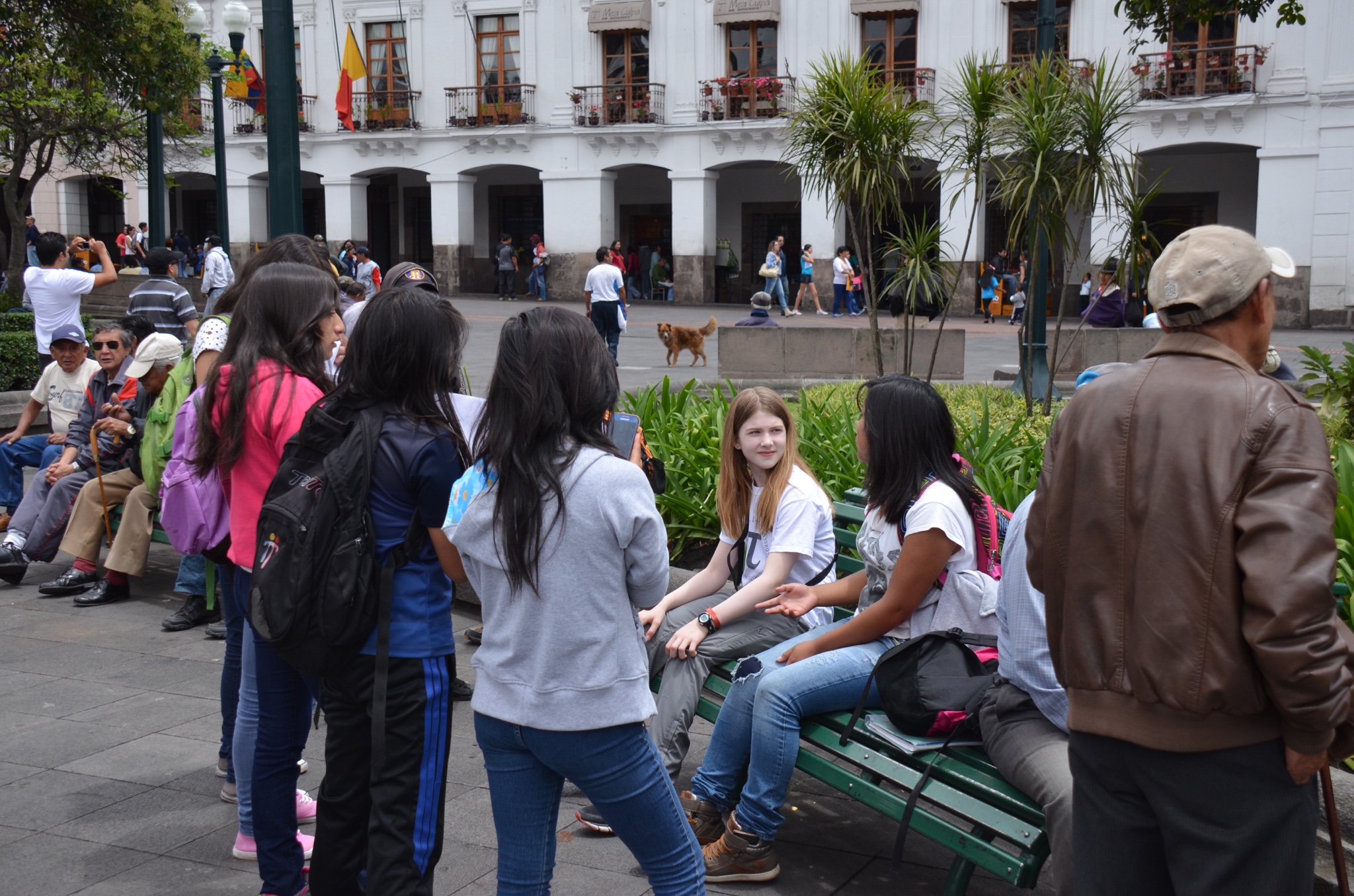
No sooner did we step onto the square than we were accosted by a group of young teenagers. Obviously they had a class assignment and were working in teams. They wanted to interview us in English (sort of). Thankfully they had their questions written out on pieces of paper that they would hold up as they interviewed us. Their command of both written and spoken English was pretty shaky, but I admired their willingness to try to speak. Much of the key to mastering a foreign language is overcoming the fear of trying to speak it. Anyway, they all had their iPhones out recording our answers, and we felt like rock stars. The questions were along the lines of “Do you hate Monday?” (of course!); “Have you ever stolen anything?” (Genene and I were able to say no, and Greg smiled and said nothing. There’s a story there.); “Do you think motorbikes are dangerous?” (Yes, but I like to ride them anyway); and “Are you an adventurous person?” (I’m standing in the middle of a foreign country, so I think so.) It was fun the first time, but as soon as we finished a second group approached with the same questions. Then they wanted to interview us individually.

The loved interviewing Genene and getting their photos made with her:

Holding up their questions on cards:

After about the fourth round, we began to politely wave them off and watched them run away giggling, racing to find more gringos. We continued strolling around the plaza.

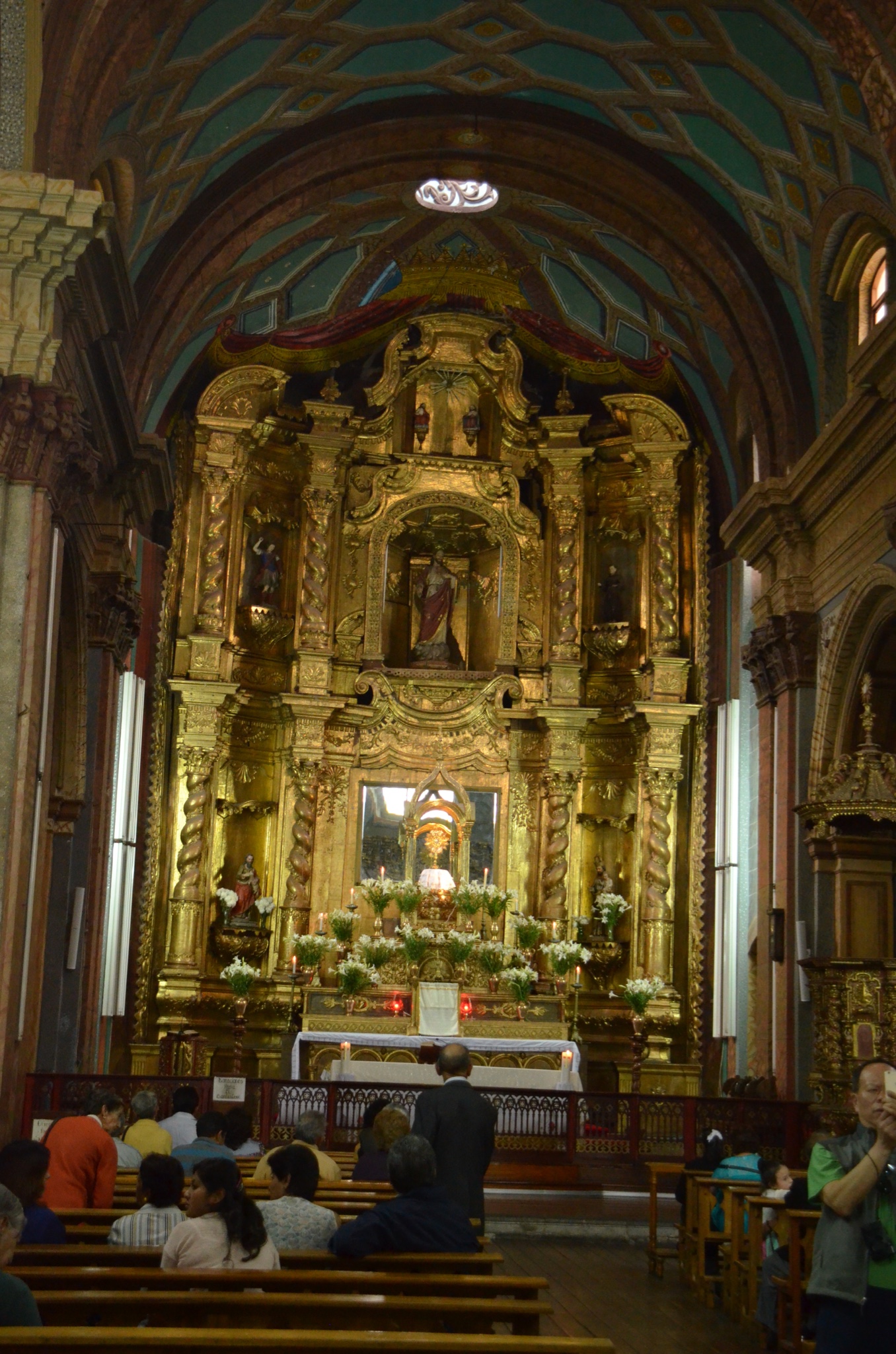
We wandered into a church and lit candles for Genene’s grandfather and for our friend’s husband.


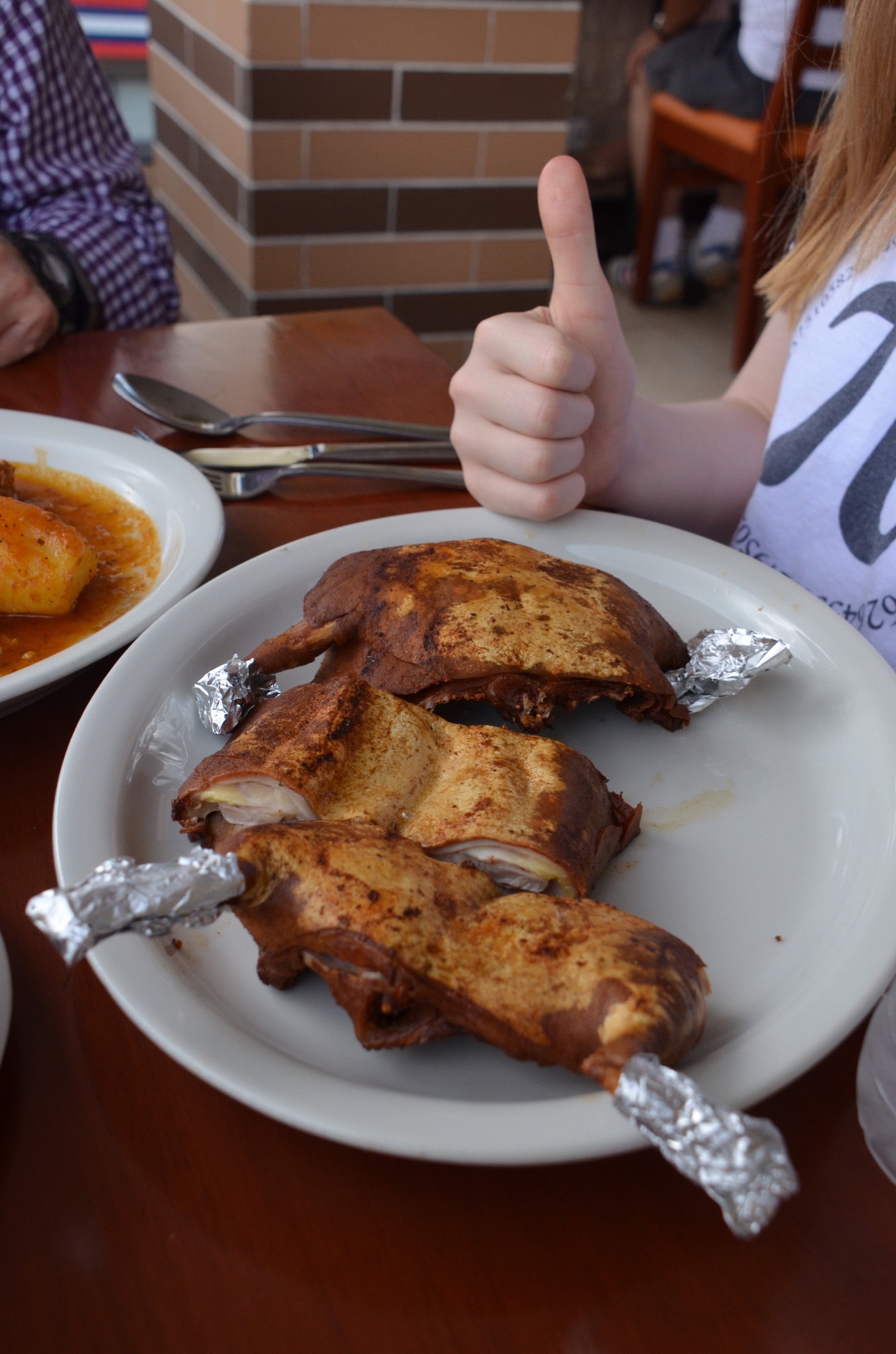
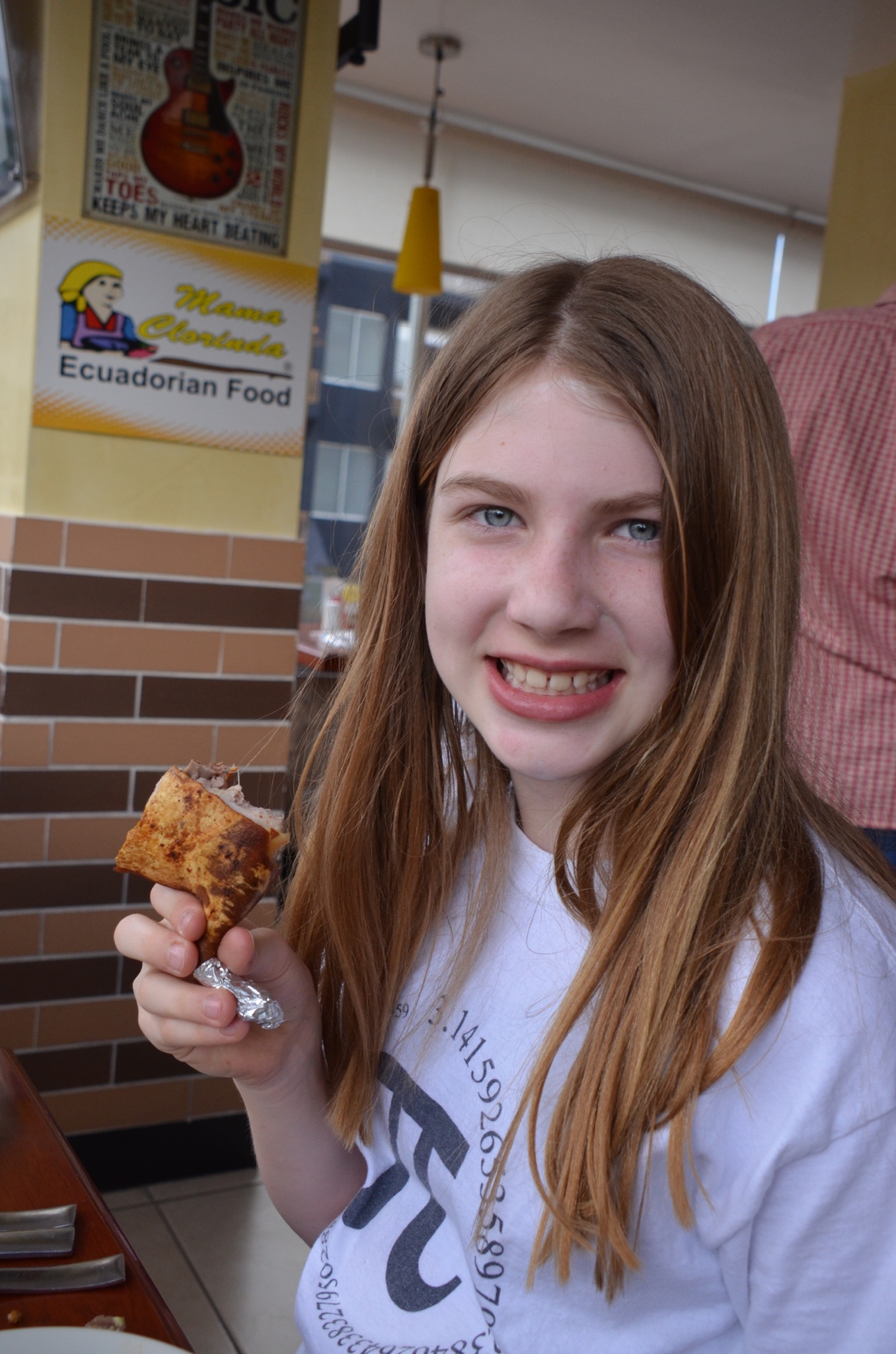
The altitude does have a way of wearing you out quicker and making you hungry. After wandering around the central plaza for a while, we were ready to find lunch. Last summer in Peru, we had a South American delicacy called cuy. You North Americans will call it….guinea pig. We thought it was wonderful. The Ecuadorans claim to make the best cuy in the world, so naturally we wanted to compare. We asked our concierge where the best cuy in Quito is served, and he put us on a taxi to Mama Clorinda’s.

We got great seats on the balcony with terrific views of the plaza below:

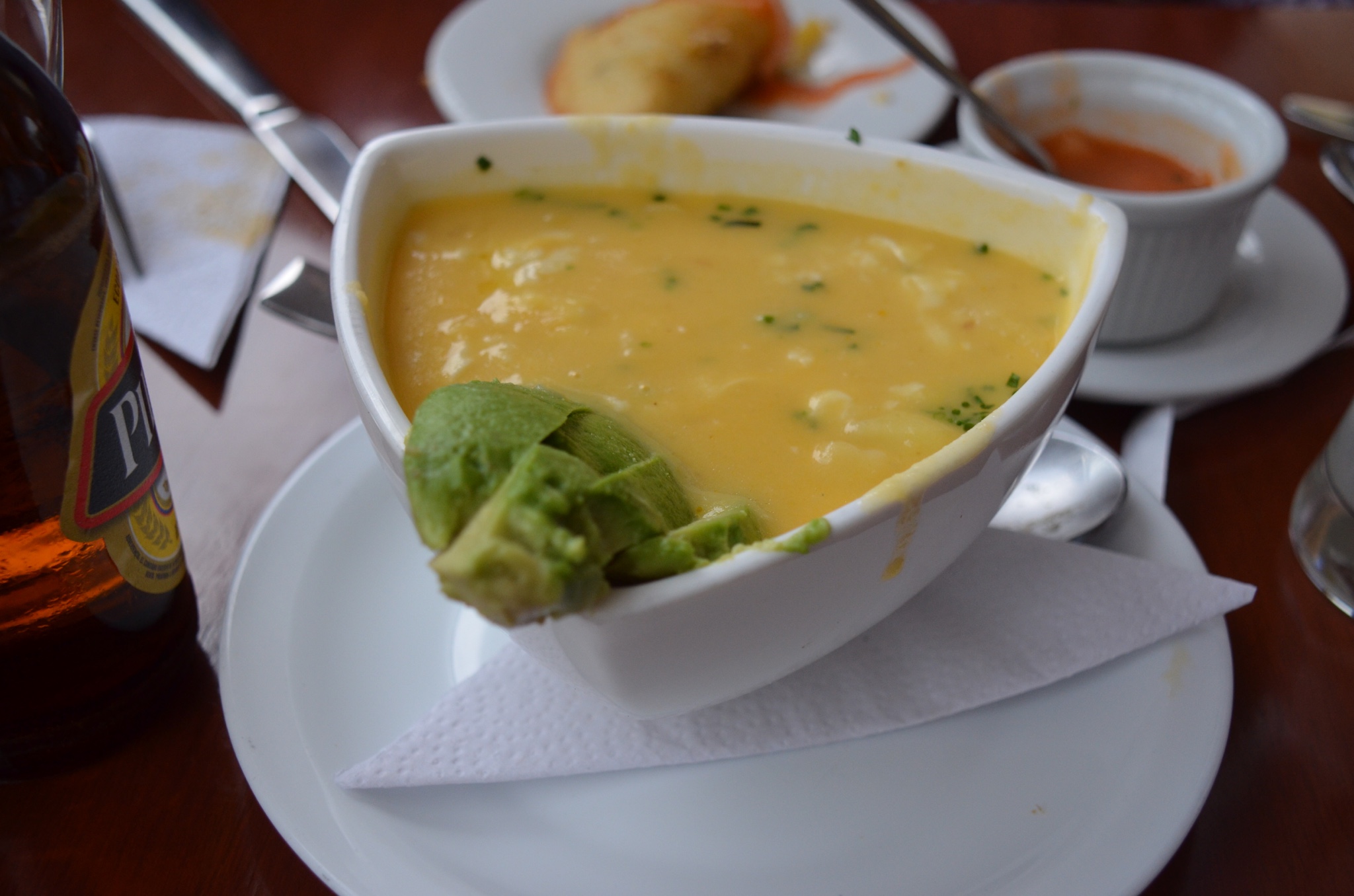
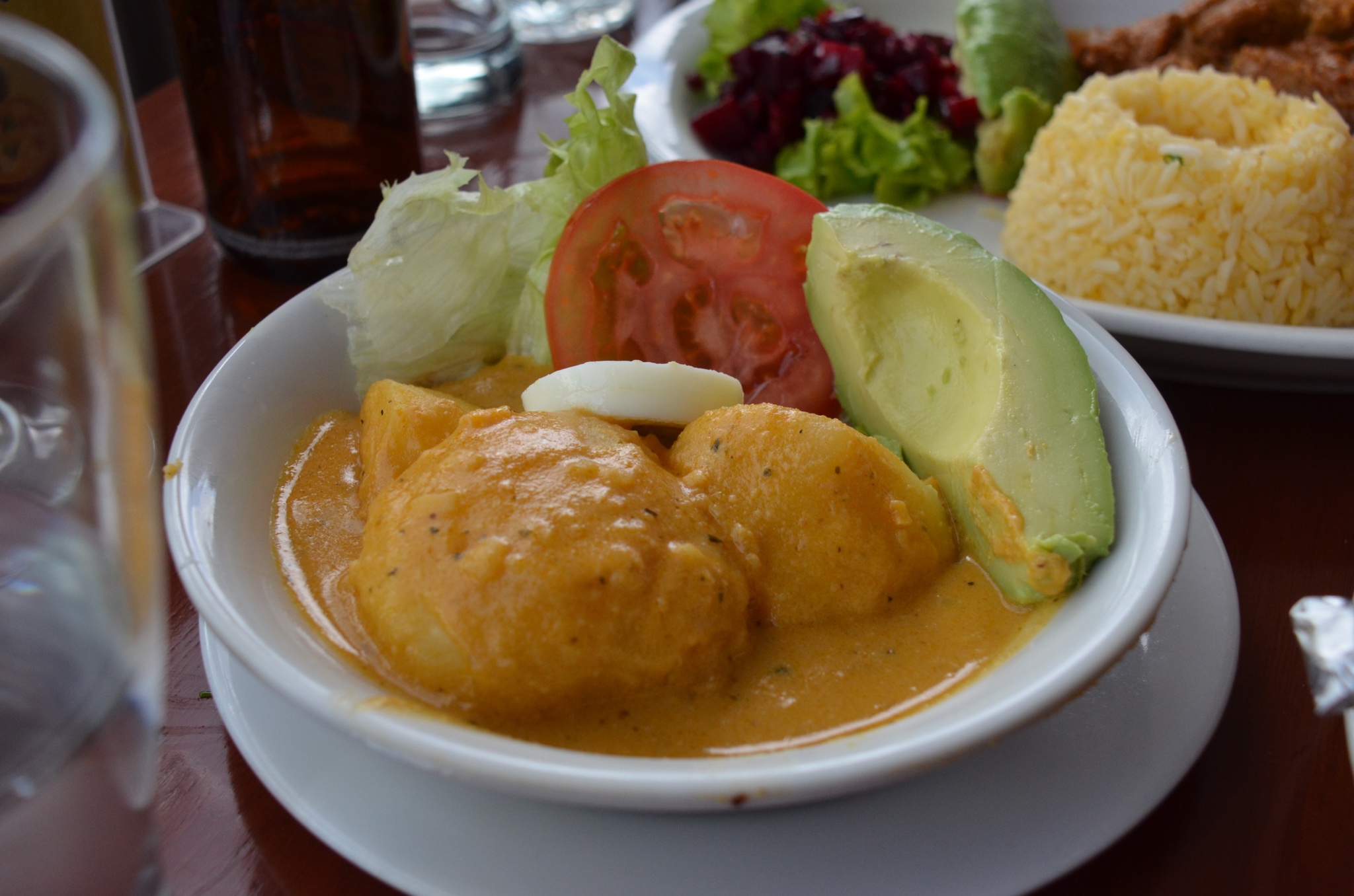
We ate traditional empanadas, a potato soup that was marvelous, and lamb to go with our cuy. It was all delightful, although our family’s decision was unanimous: the Peruvians make better cuy!
Potato soup:
Empanadas:
Lamb:
Cuy! (Second best!)
One of Genene’s best friends has a pet guinea pig, and Genene delights in telling her friend, “I love guinea pigs too. I like mine roasted.”


It was easy to find a cab back to the hotel, and the return trip cost half as much as the trip out. I don’t know if the first guy just gave us the gringo upcharge. Traffic was worse on the way out, so perhaps it was an honest difference. In any event, both ways were cheaper fares than most that I take in Houston, so I am not sweating it. By the way, Ecuador uses the American dollar, so that part is quite simple, although we did notice that one vendor gave us change in their old currency. We will add it to Genene’s coin collection.

I caught this street shot from the cab window on the ride back:

With our bellies full of cuy, Greg and I took a nap. Genene went upstairs to her balcony bedroom and finished reading the only paperback that she brought. She will be sorry! I am proud that she is a voracious reader, but she should have paced herself for those afternoons on the boat. Perhaps there will be some books on the boat.

We walked to dinner tonight. We had a wonderful meal at Theatrum. I always love a tasting menu. Small bites, many courses, happy Lori. I love my red wine, and I think I know the difference between the good stuff and the plonk. I drink both. The problem is that I have a very poor memory for names, so even when I find a good bottle, I cannot often remember the name of it. I picked a Argentinian malbec, and the waiter told me my choice was perfect. I love it when they flatter me like that. I also love it when we are both right. It was a wonderful meal, and we crammed into a van with another group of people from Vancouver who were headed back to the same hotel. We are fat and happy and ready for bed!

Our hotel is very charming and centrally located.

The wifi is STRONG and fast, and Genene is texting away with a friend in Houston. I find it amazing that we can stay connected so well these days, although starting tomorrow it will be a different story. There will be no wifi on the boat. We get up early tomorrow and fly to Guayaquil and then to San Cristobal Island in the Galapagos. We will board an 8-cabin yacht and start motoring from island to island. We will see the animals that inspired Darwin to think about adaptation and evolution. It’s going to be something else. I will keep my blog, but I probably will not be able to post it until I return. I’ll be back!

++++++++++++++++++

For John Wyatt, may he rest in peace…..


Adventures in Peru 2014 Part 16 and FINAL: From Suasi to Lima and Coming Home

Saturday, August 9, 2014

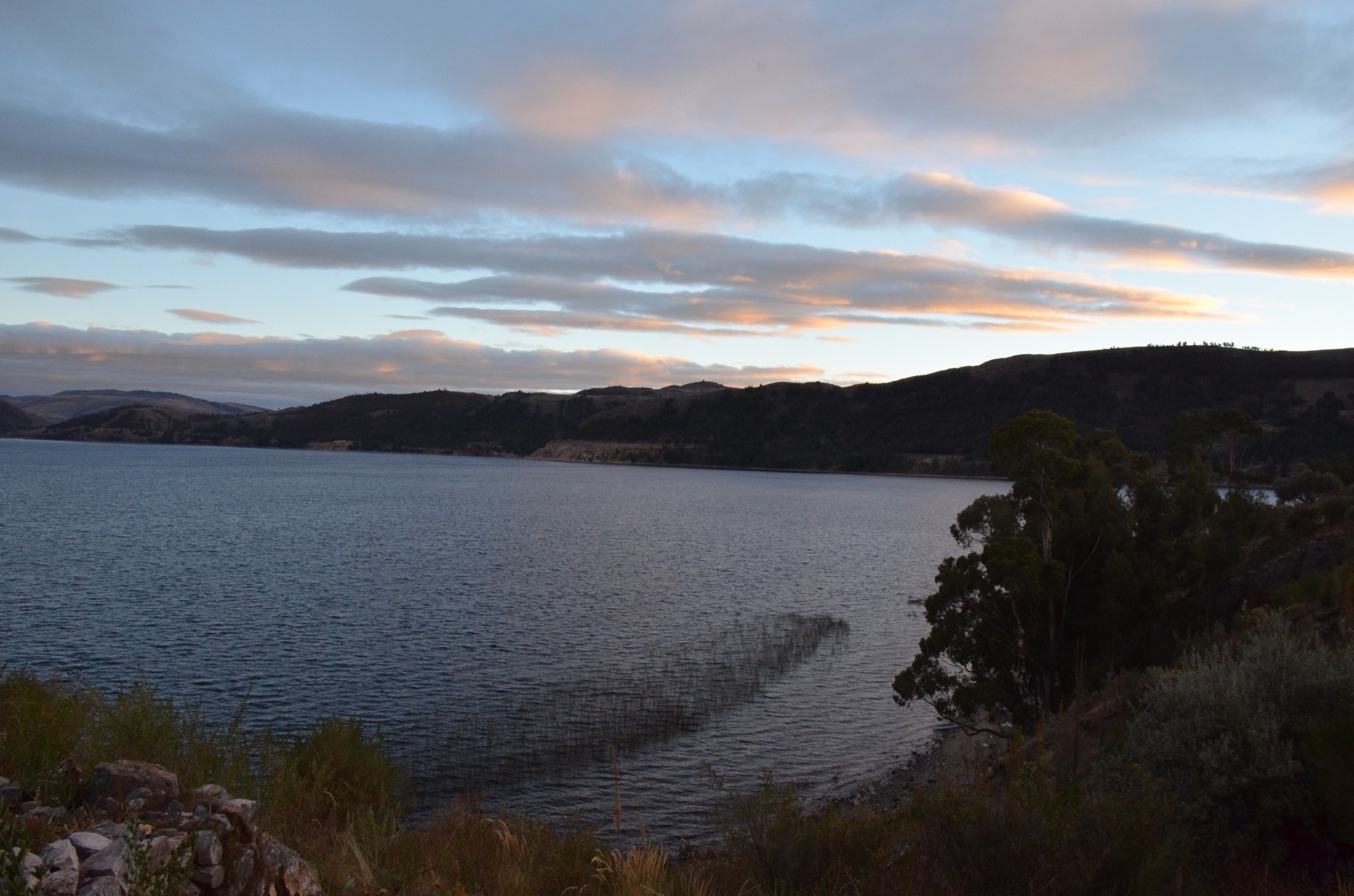
While Genene and Greg slept snugly in their warm beds at Suasi Island in the middle of Lake Titicaca, I went out early chasing the morning light. I am still a rank amateur with my camera, but I am learning that one key to getting a good shot is being willing to wake up early and stay out late. Morning light and evening light can be magical. On this morning, I was rewarded. The morning colors were even prettier than last night’s sunset. I was all alone on the walking path, and it was a good morning to commune with nature.

I was greeted on the path by a chinchilla:

The sunrise filled the sky with pinks and oranges:
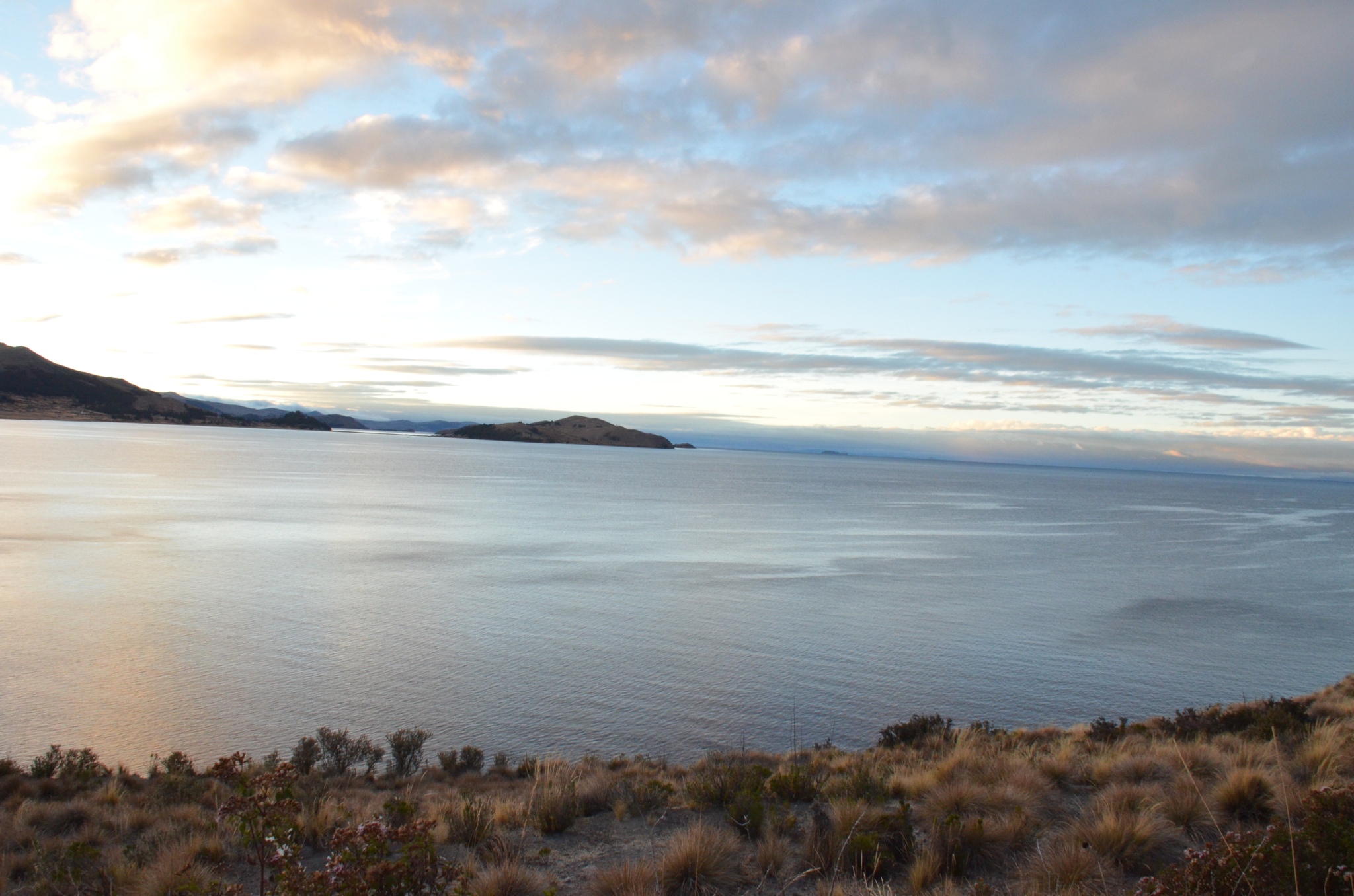
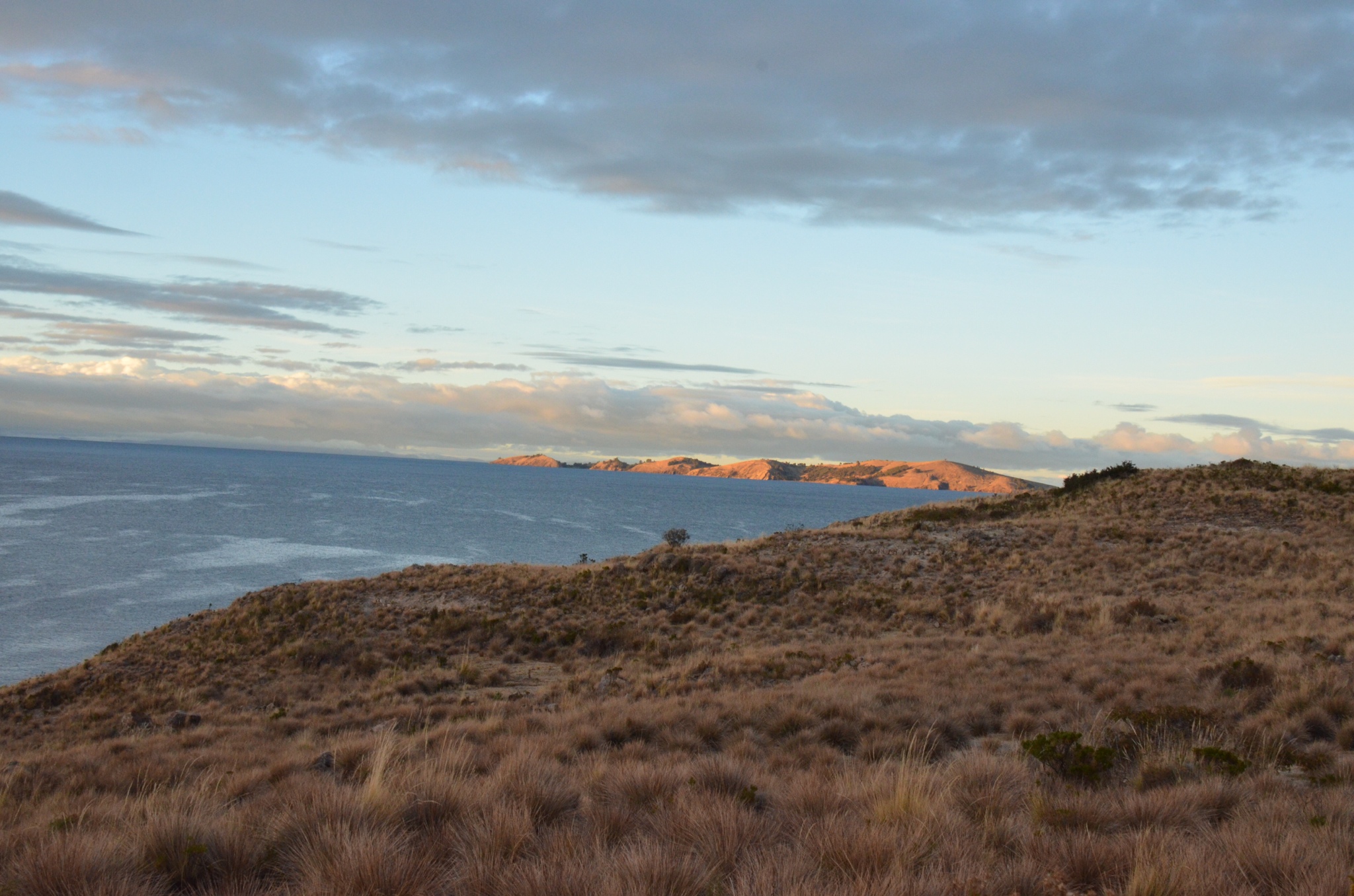
I love the way the sunlight danced on the neighboring islands:
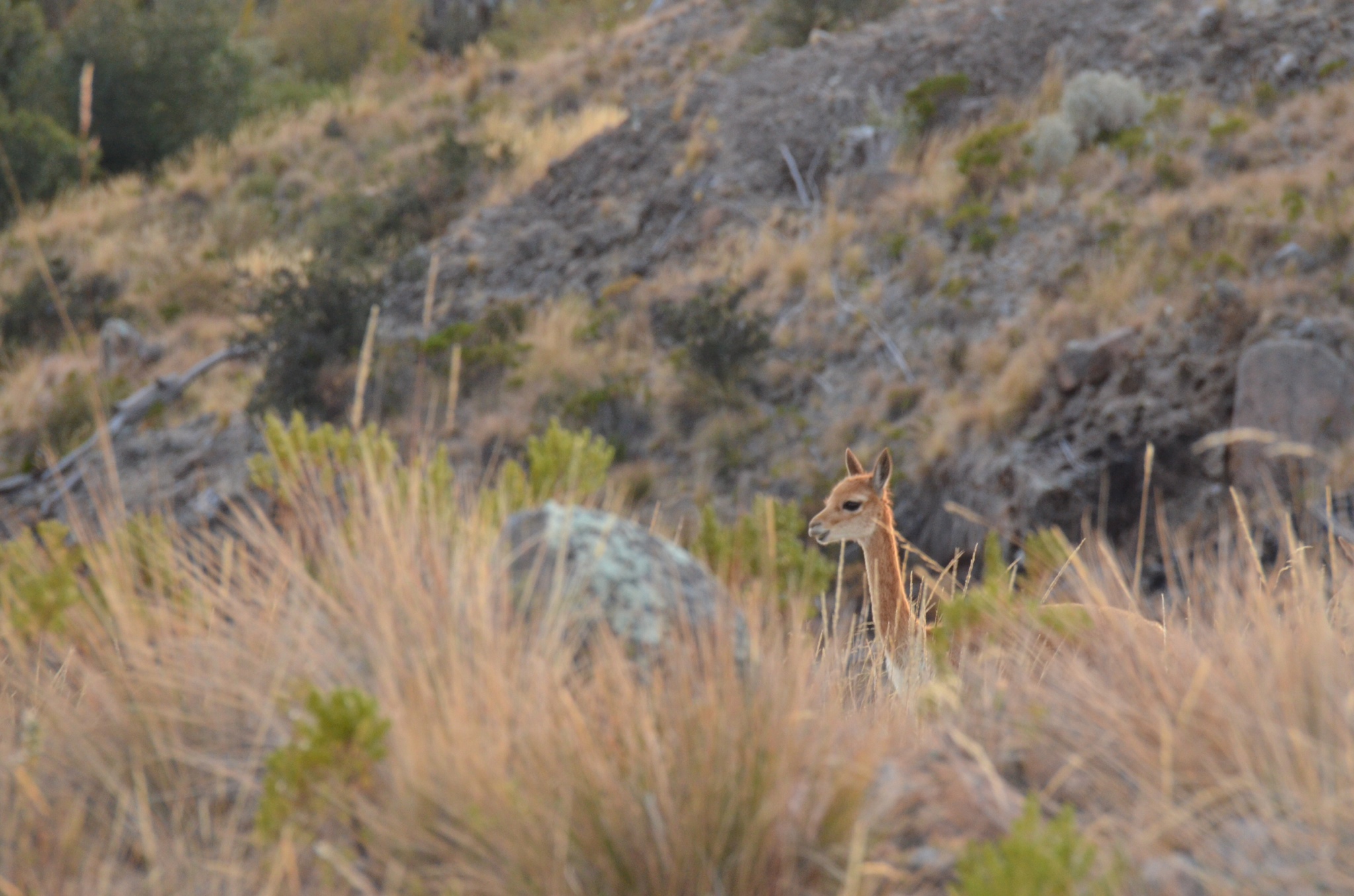
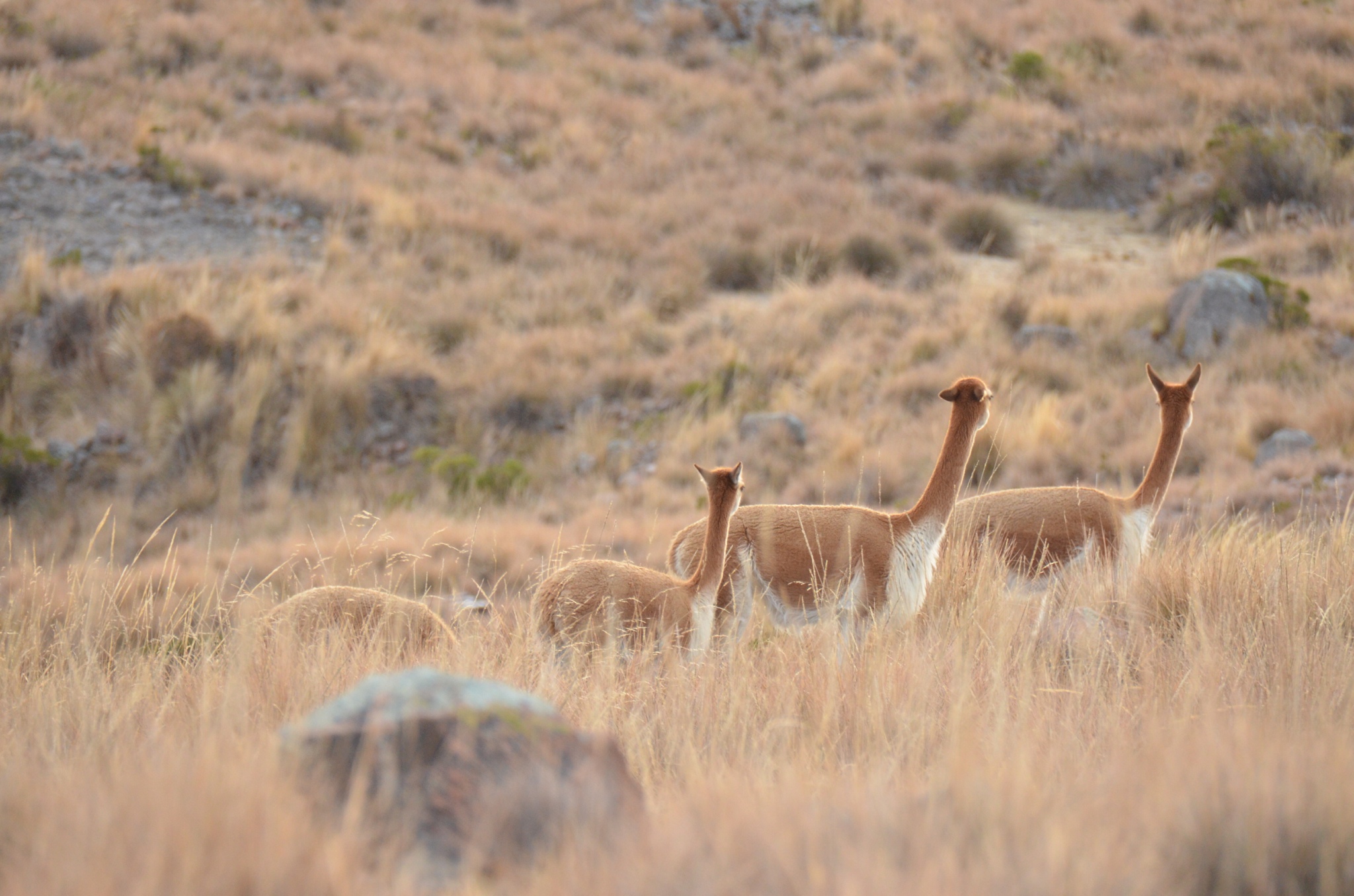
I heard something make a noise that was almost like a whistle. I turned to look and saw the vicuña sticking its head out of the tall grass:
Then I saw two:
And then three:
And finally four! They looked at me.
The looked away.
And they headed out.
It was a treat just for me. Chalk up another point on the plus side of being an insomniac!
I headed up toward the high point of the island, just as we had all done as a group the night before.
The sun continued to rise, casting warm colors on the island and the lake waters.
 
The sleepyheads continue to snore down below:
I am all alone on the path back to the hotel:
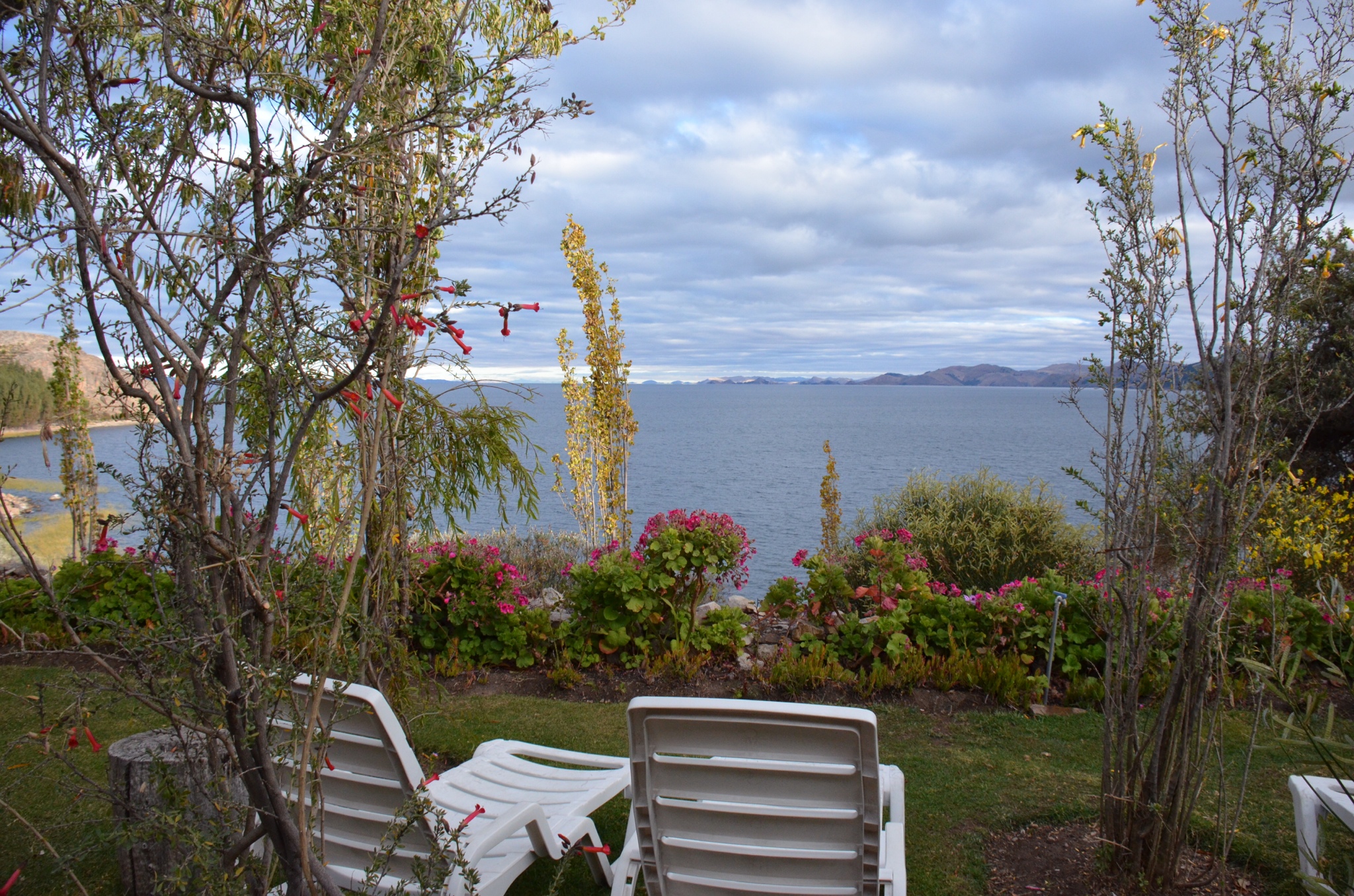
I wish there had been more time to explore the flower gardens…..
and lounge in the chairs….
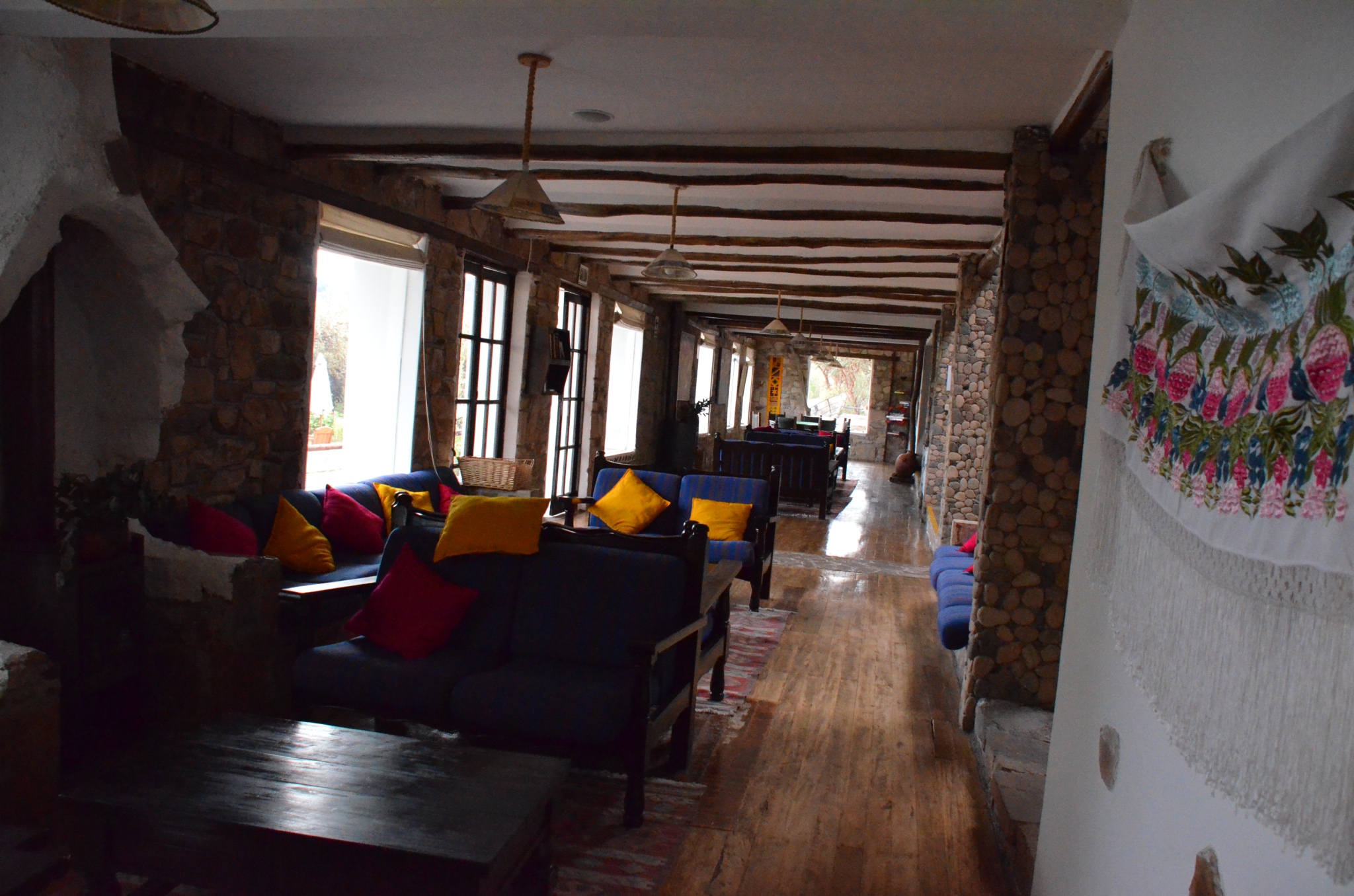
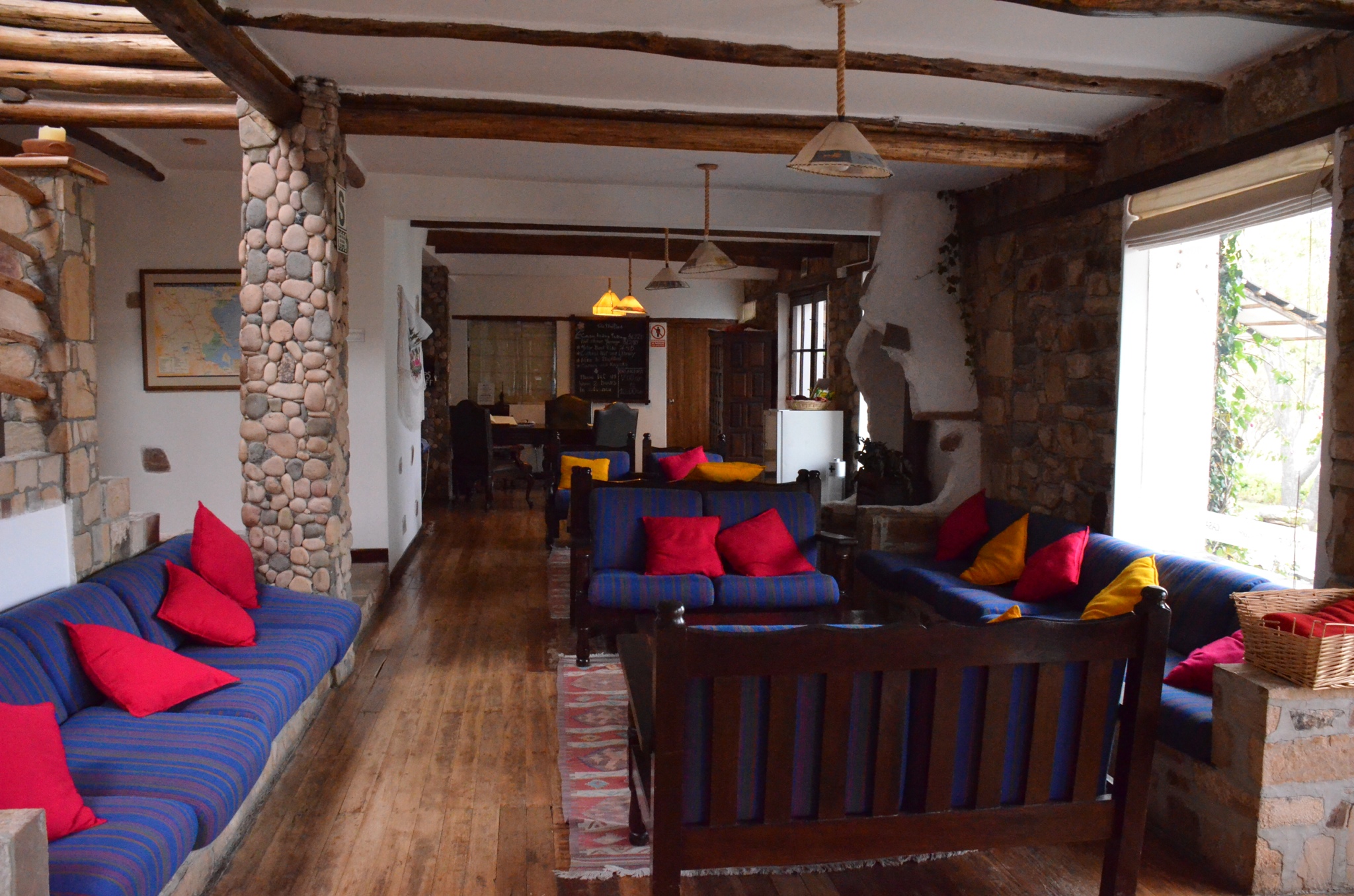
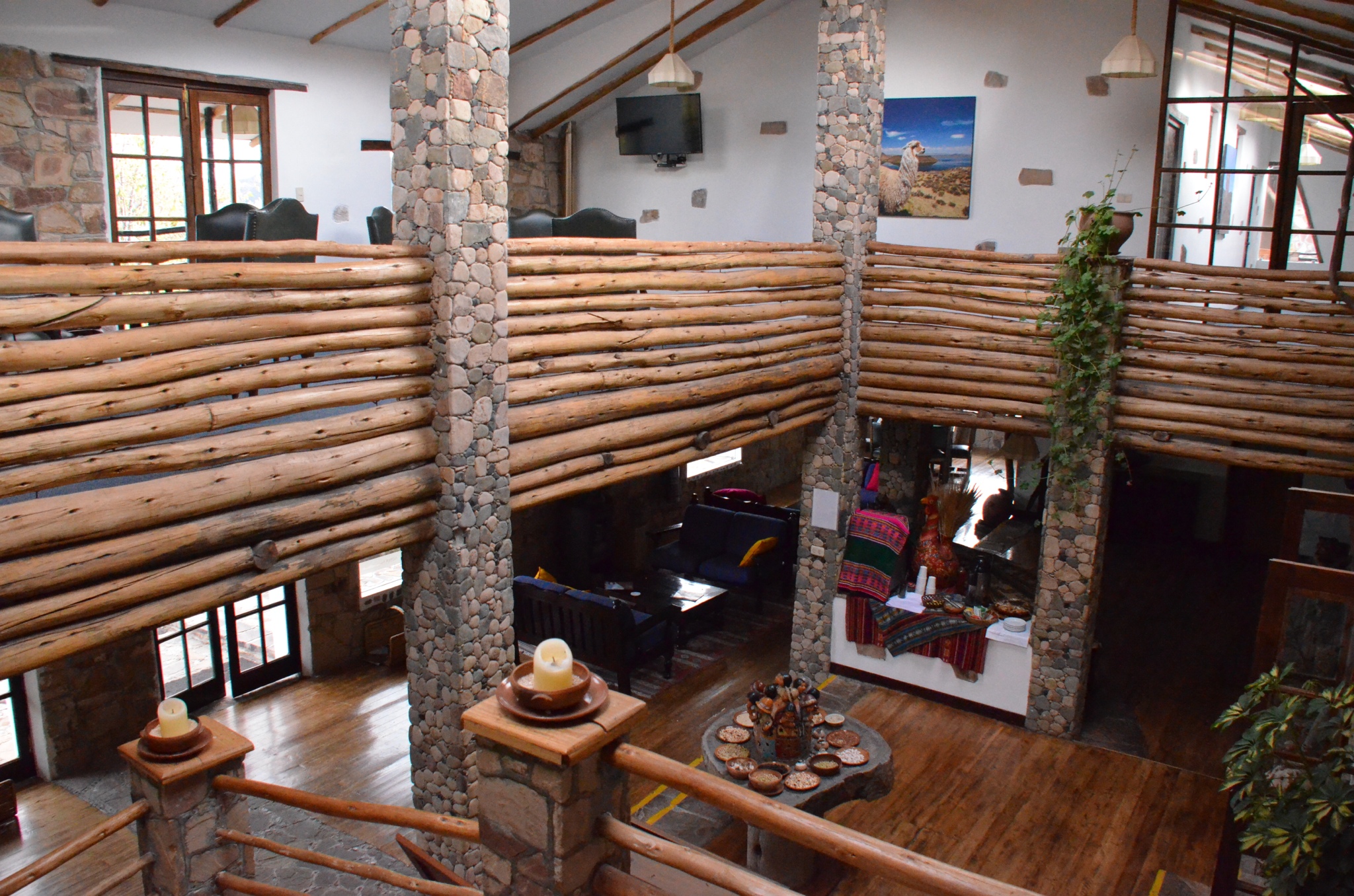
The lobby where we spent a delightful evening telling riddles and jokes with our new friends:
Everyone must have retrieved their phones and iPads from the chargers as last night wore on.
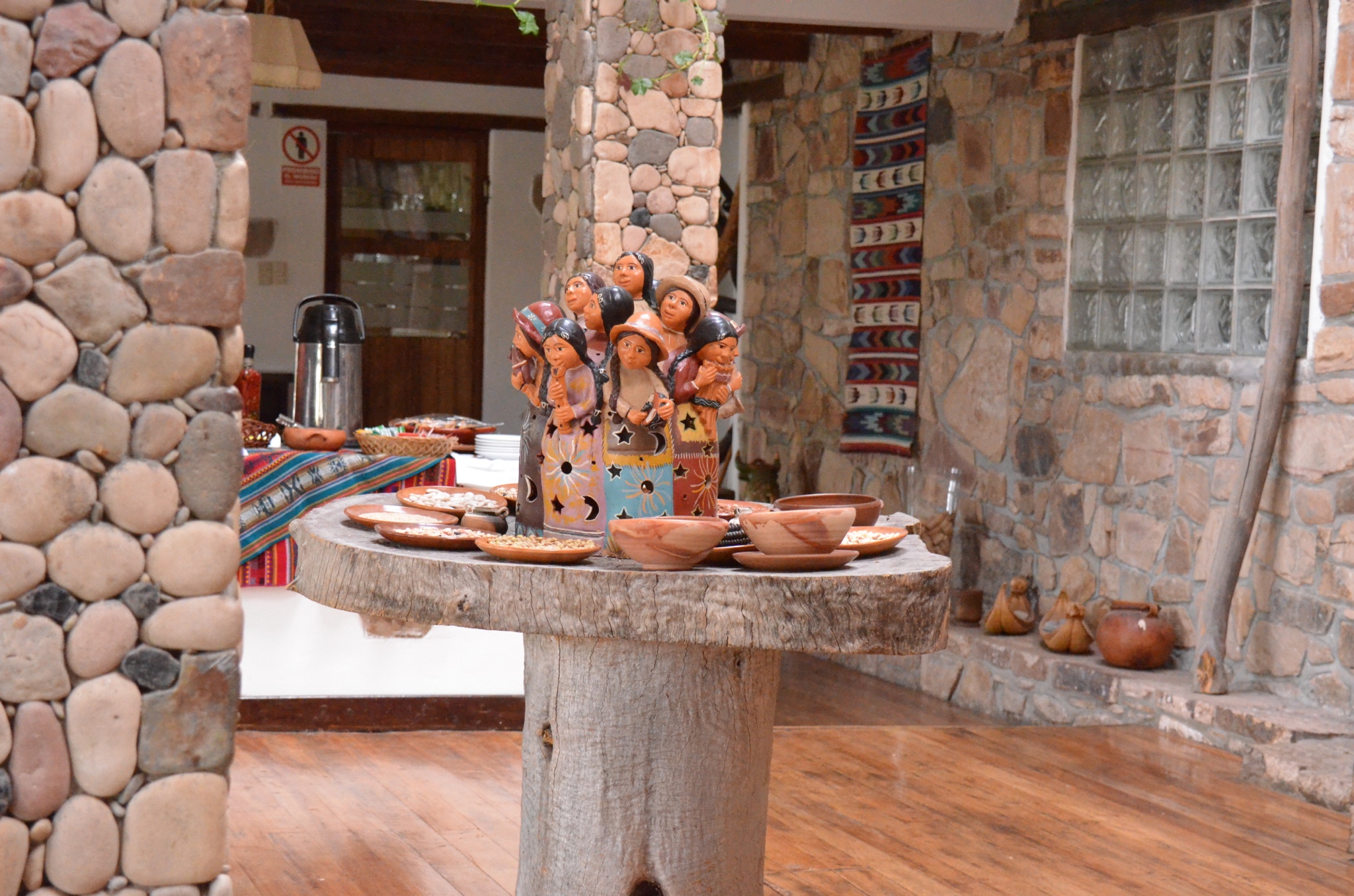
The hotel is beautifully constructed using locally available materials:
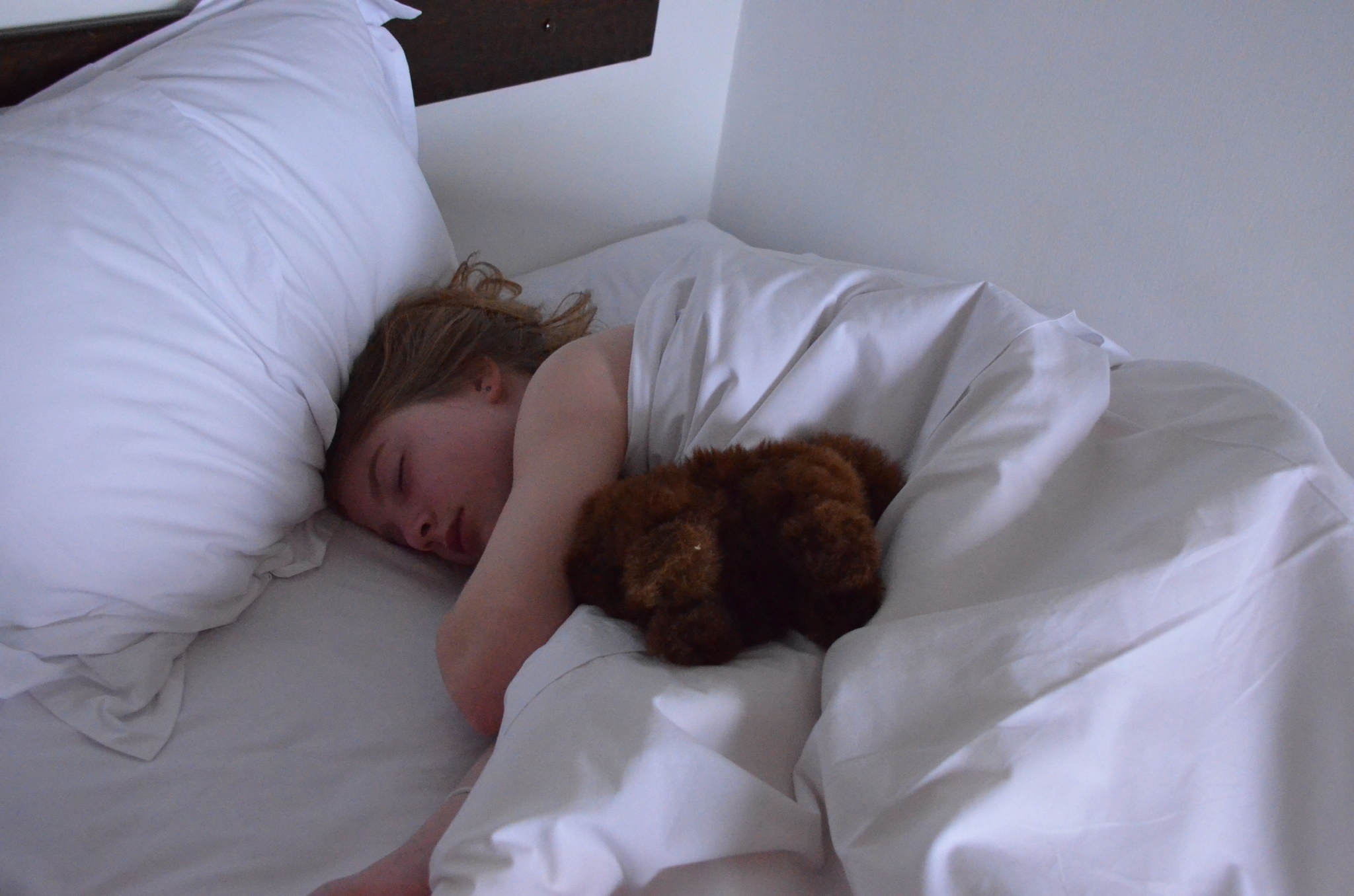
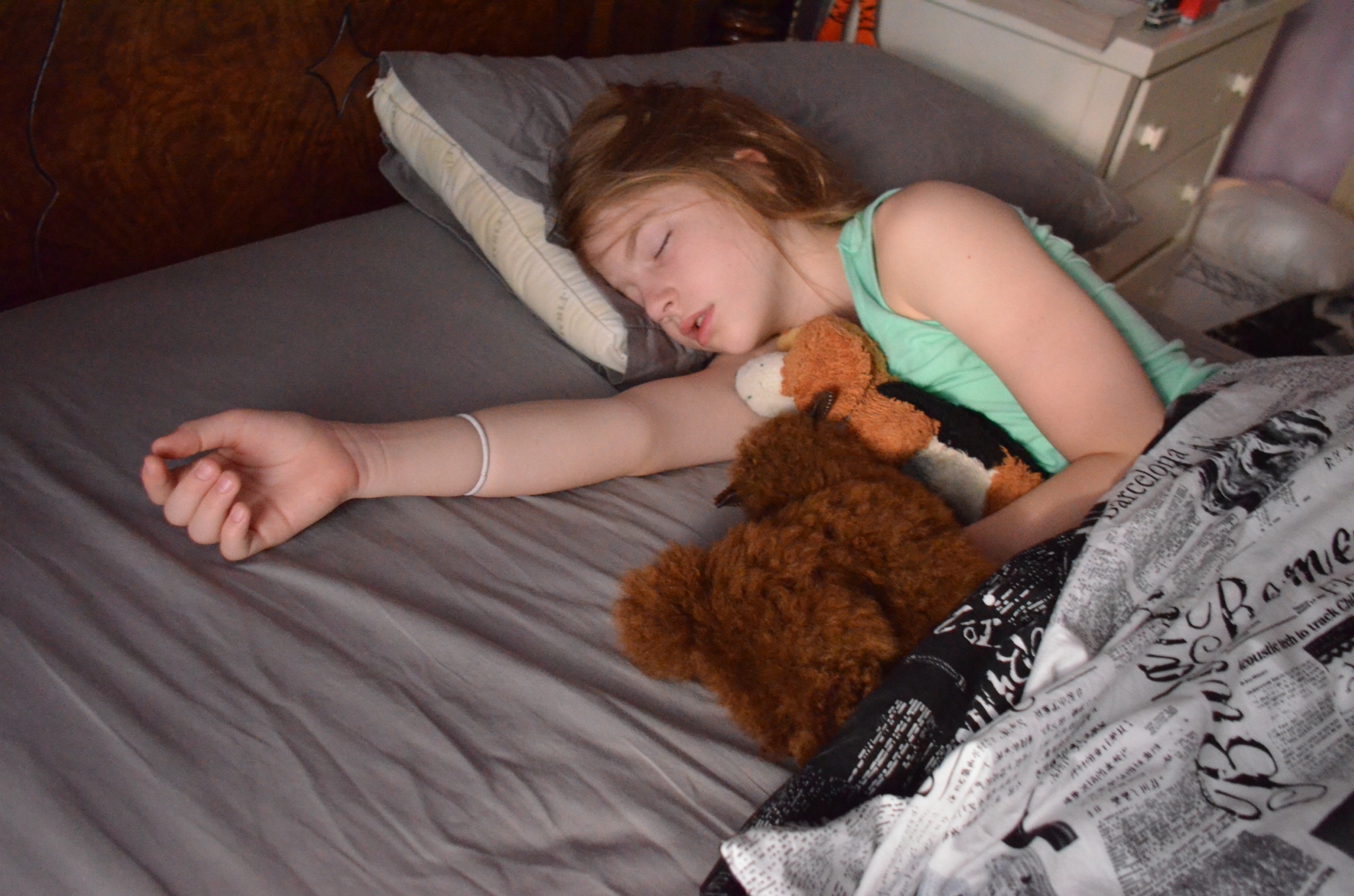
I went back to our room to find my sleeping beauty still snuggled with Andrea the Andean alpaca. (Greg was there too but doesn’t look nearly as pretty while sleeping.):
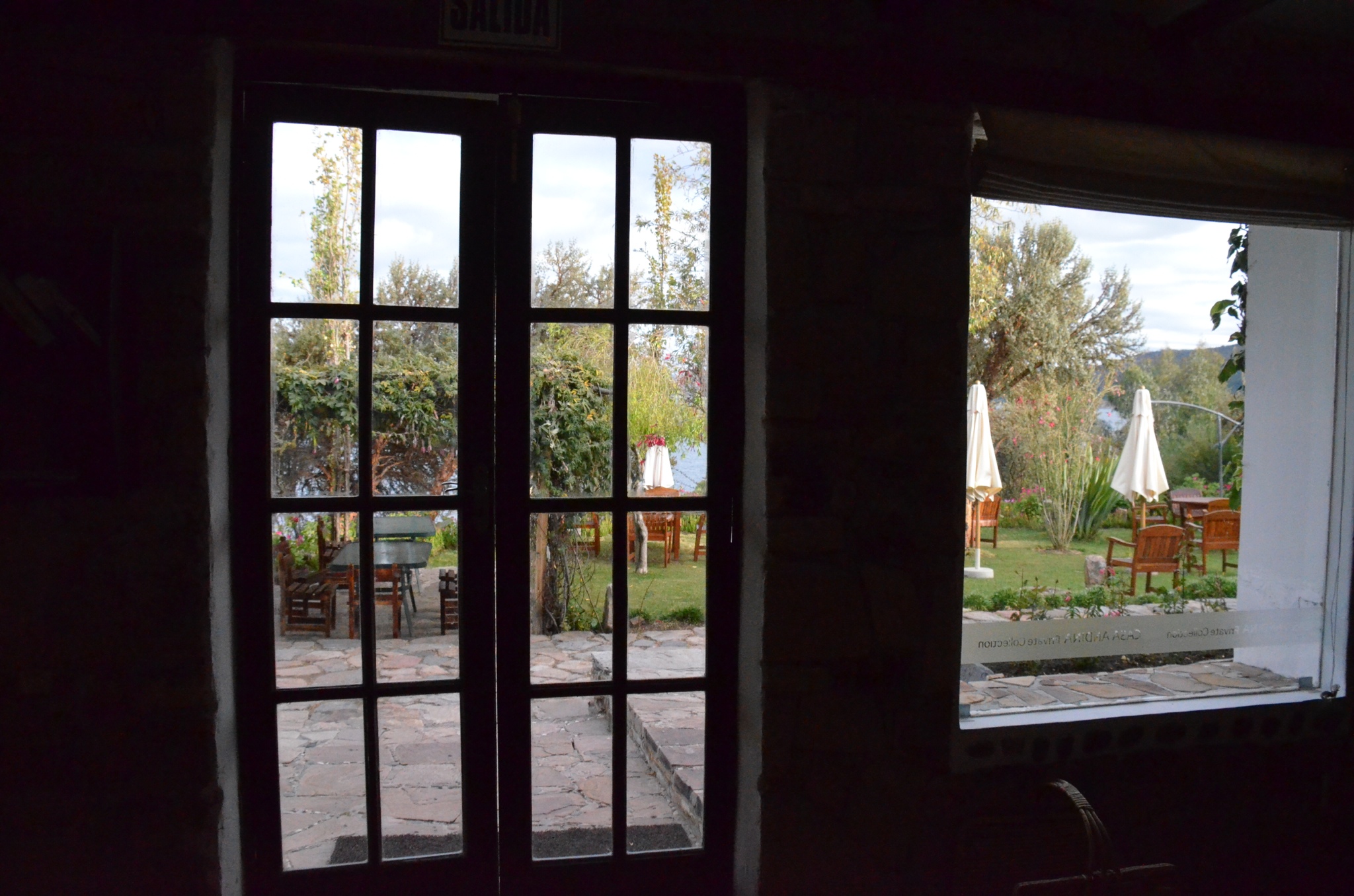
The view from our bedroom window was beautiful. I wish there had been more time to spend here.


Our trip to Suasi Island was truly a whirlwind. We had breakfast at the hotel and were packed and ready to go at 9:00 AM. We traded emails and Facebook contact information with Bob and Cynthia and the kids and wished them well. We also visited with a couple who live in Thailand. We are already thinking of next year’s adventure. Genene wants to knock another continent off her bucket list, and we are thinking that Angkor Wat in Cambodia may be next summer’s destination. The couple from Thailand gave us some tips on a travel agency and a suggested itinerary. By the way, I am quite proud of Genene and jealous of her too. I did not take my first airplane ride until I was on a callback interview my second year of law school. At age 10, Genene has been to four continents and nine countries. She’s quite the traveler!

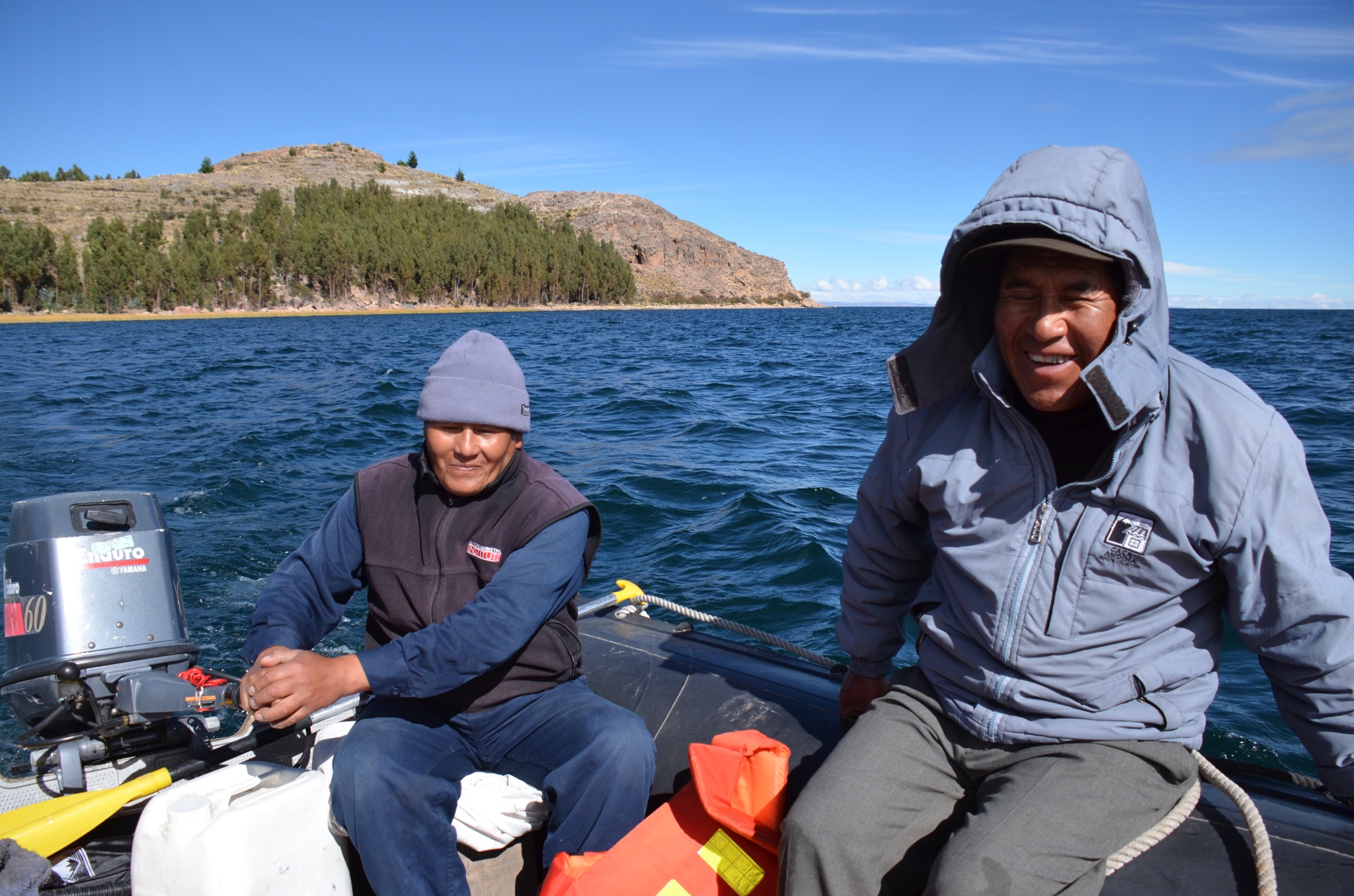
Our tour operator had arranged for us to have private transport off the island and back to the Juliaca airport, but we did not realize exactly what that would entail. The hotel guide told us that our transport had arrived and so walked back down the hill while the staff brought all our gigantic bags via the 4-wheeler. At the water’s edge, one last surprise was waiting: our private transport off the island was a zodiac! Greg was instantly excited and exclaimed, “Far out!” (This is exactly the same expression he used when my water broke with Genene. He is truly an old, reformed hippie.) The zodiac made me smile because I remember having to carry one on our shoulders when we were all in SEAL PT together years ago. I can remember Jack Walston saying, “You better not drop my boat!!” It was about a 15 minute ride across the smooth waters of Lake TIticaca to the mainland.

The bags rode up front while we people took the back:
Greg smiled all the way:
Land Ho!! You can see the pier and above it, our car awaits:
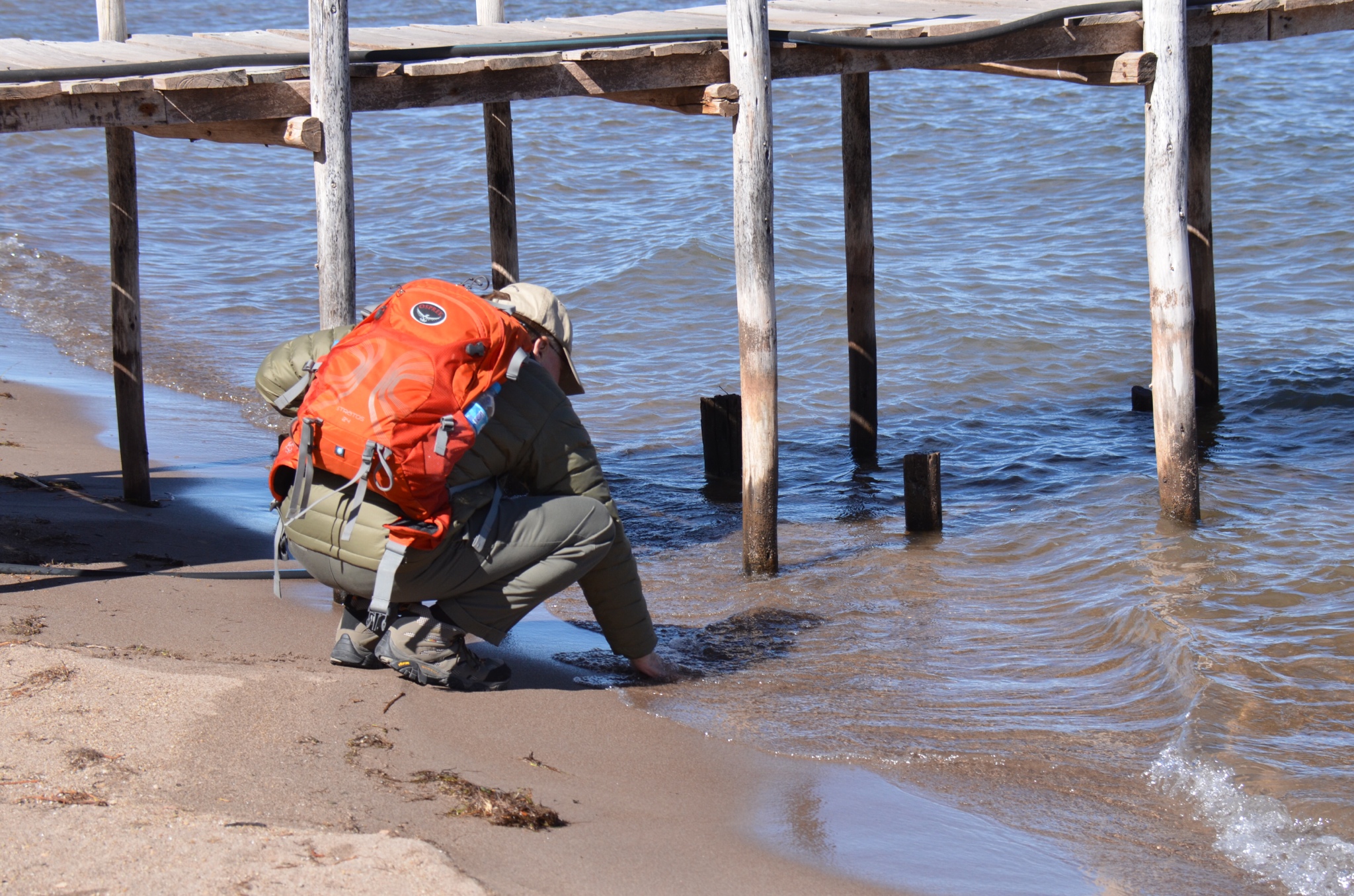
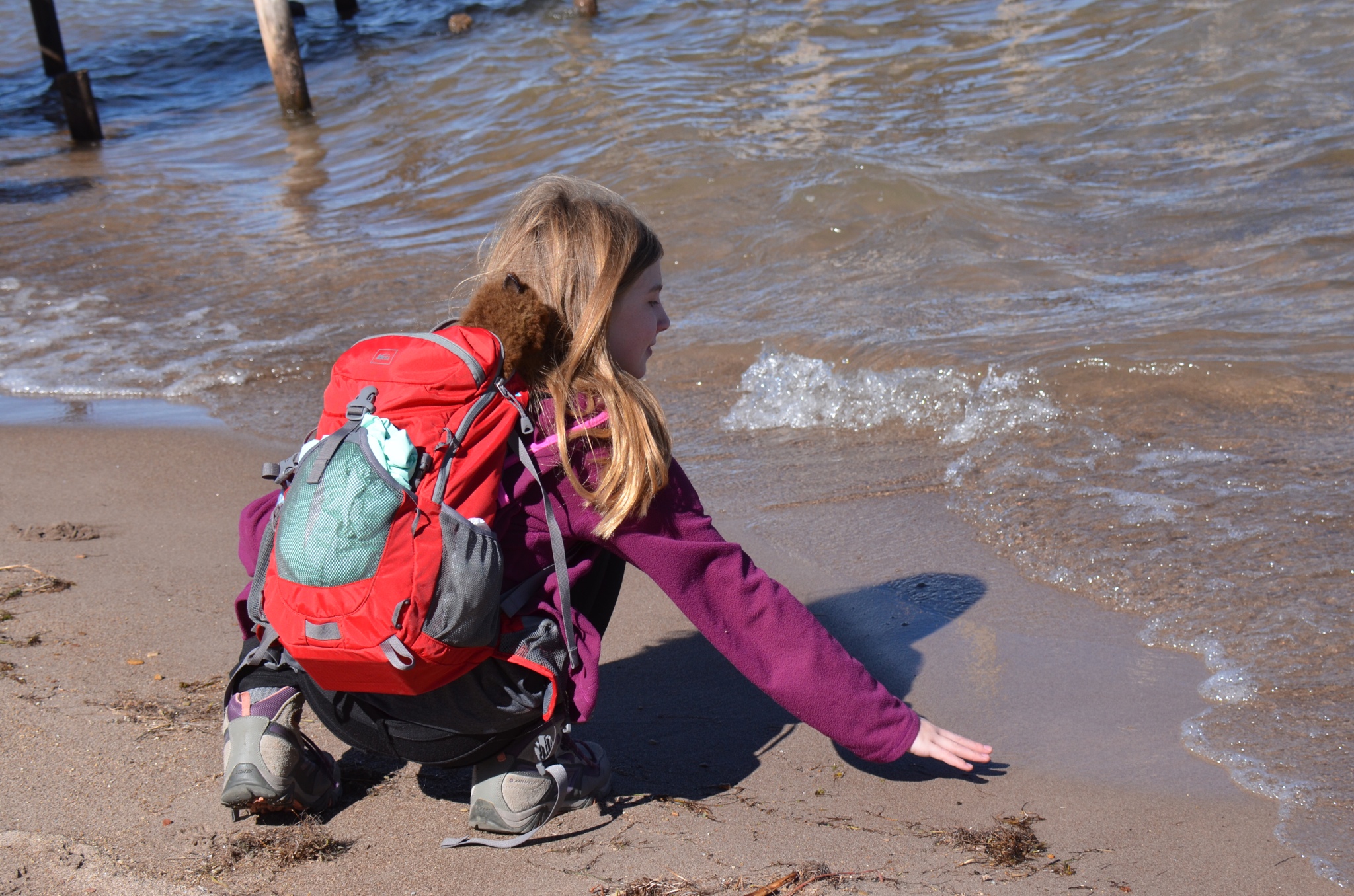
Greg and Genene had to touch the water. It was very cold. How cold was it? My Arkansas friends will understand this reference: it was colder than the Little Missouri at Camp Albert Pike.
The boat pilots and driver manhandled our bags down the pier:

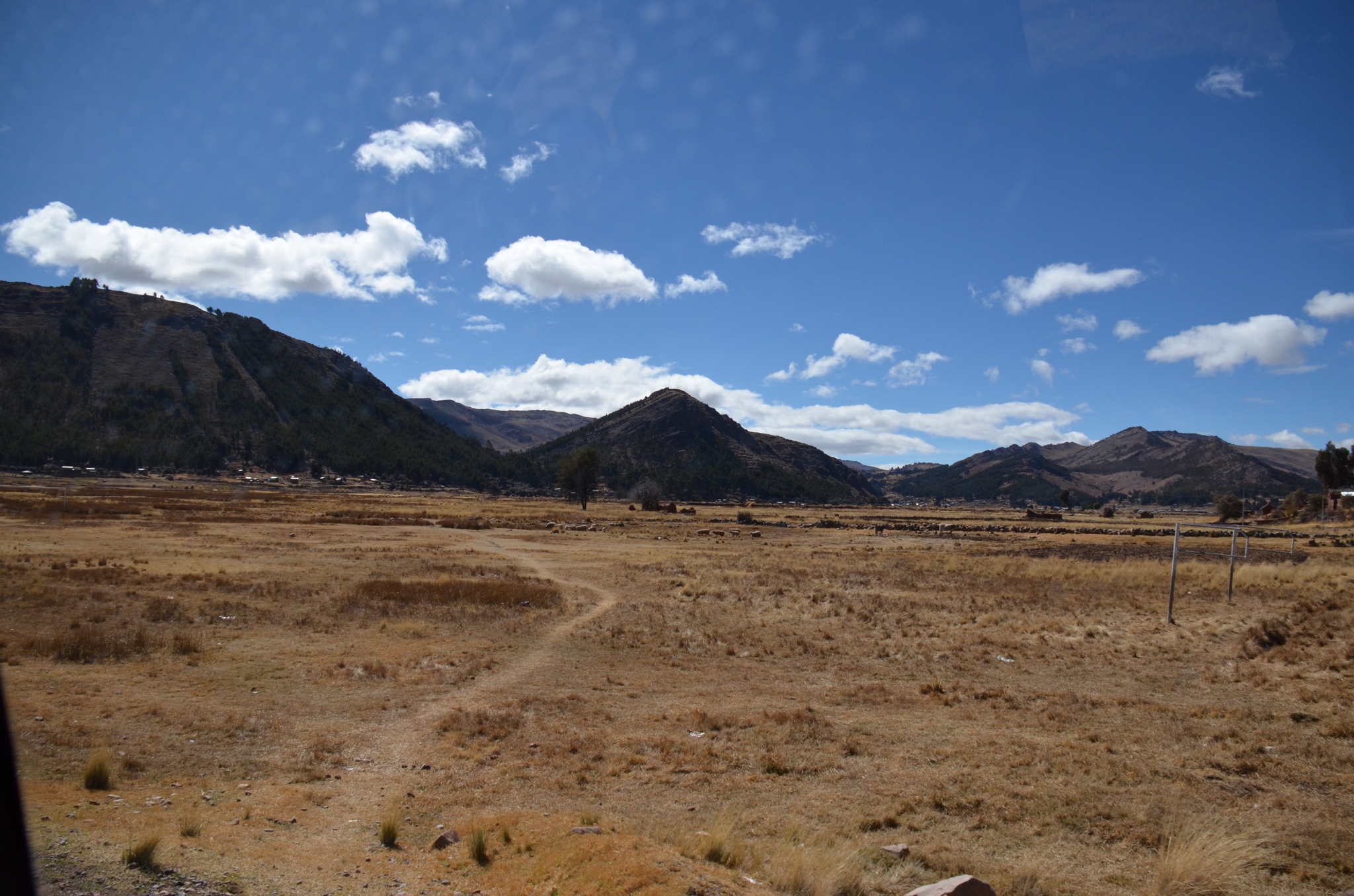
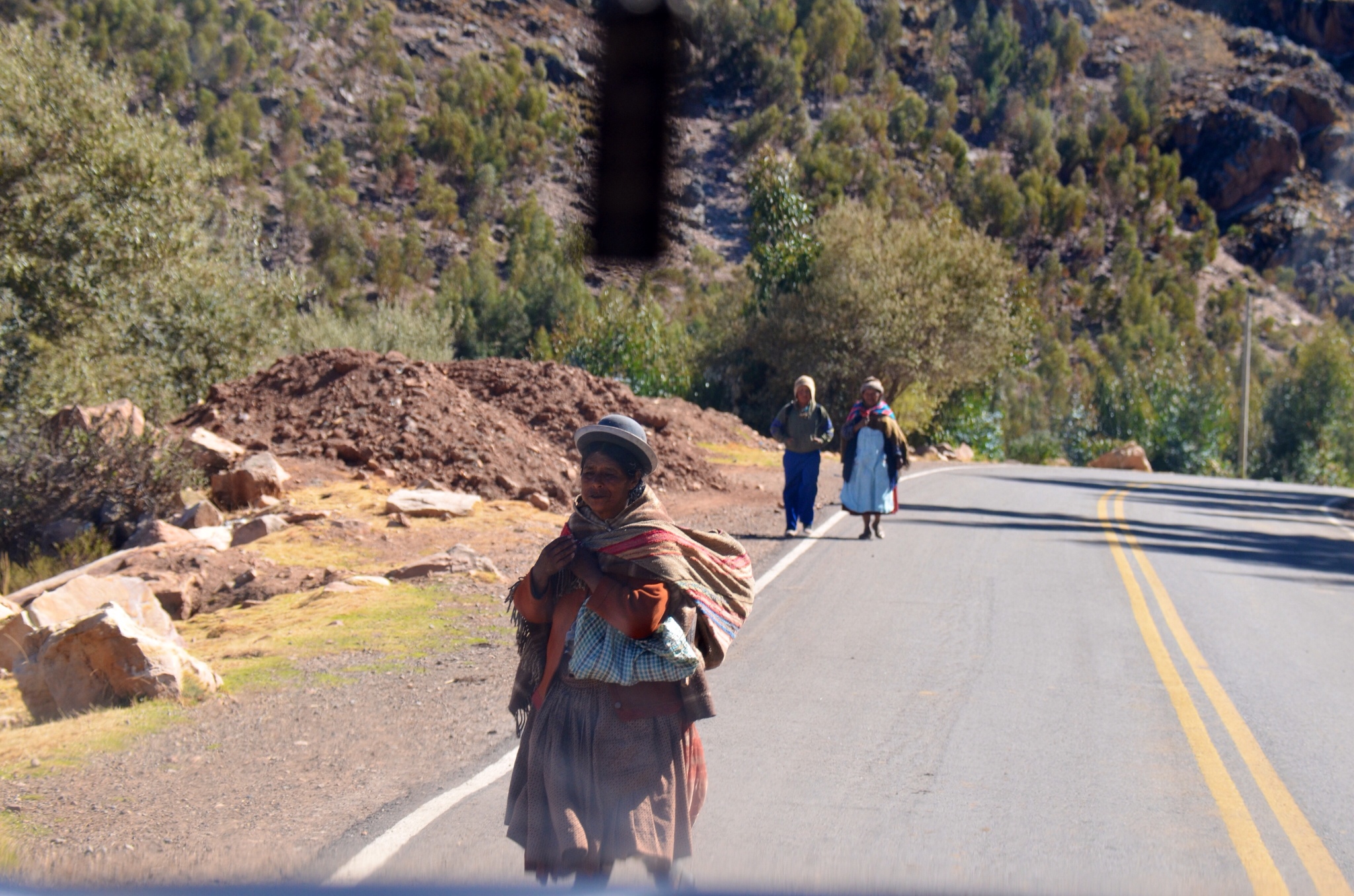
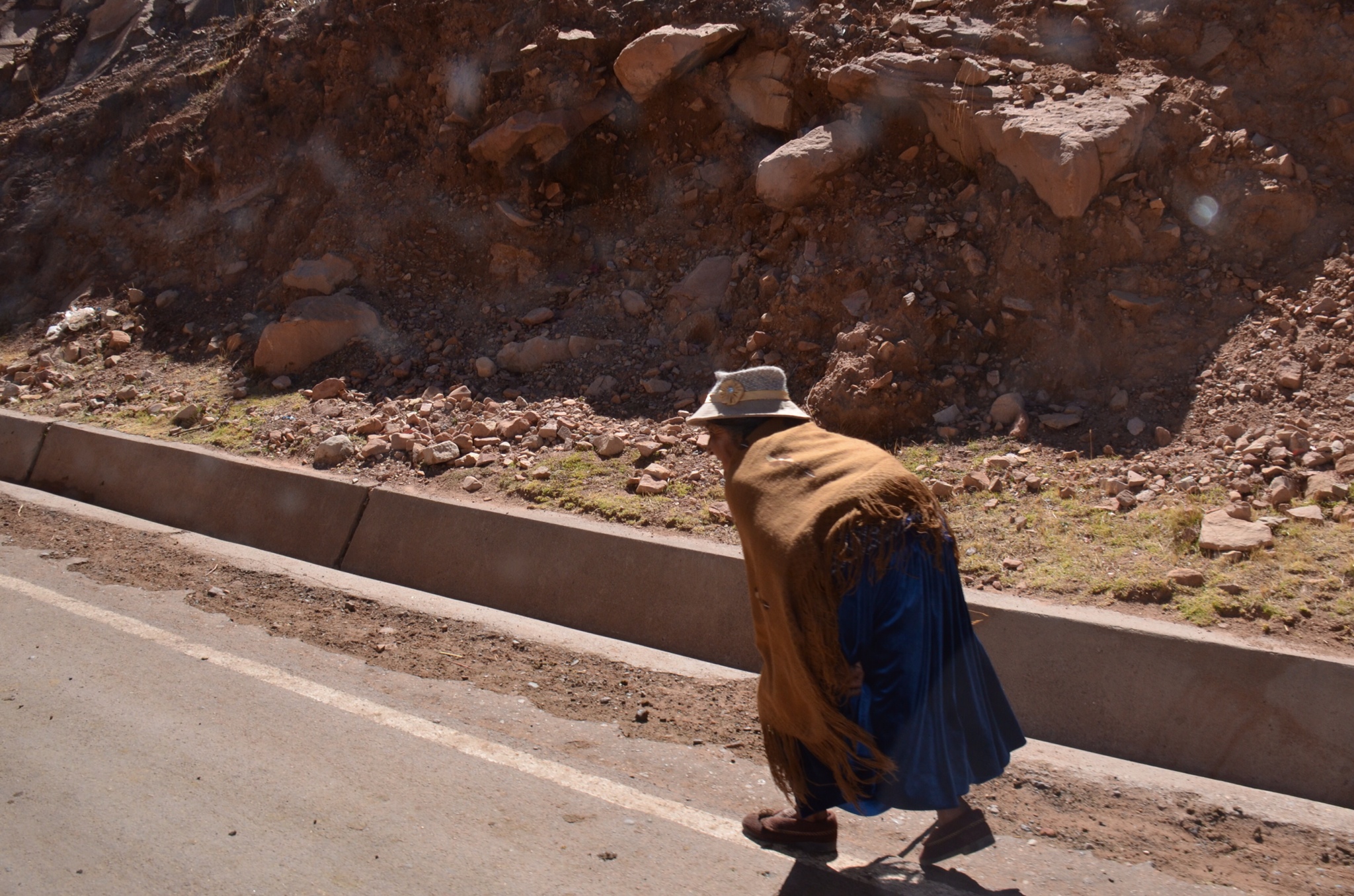
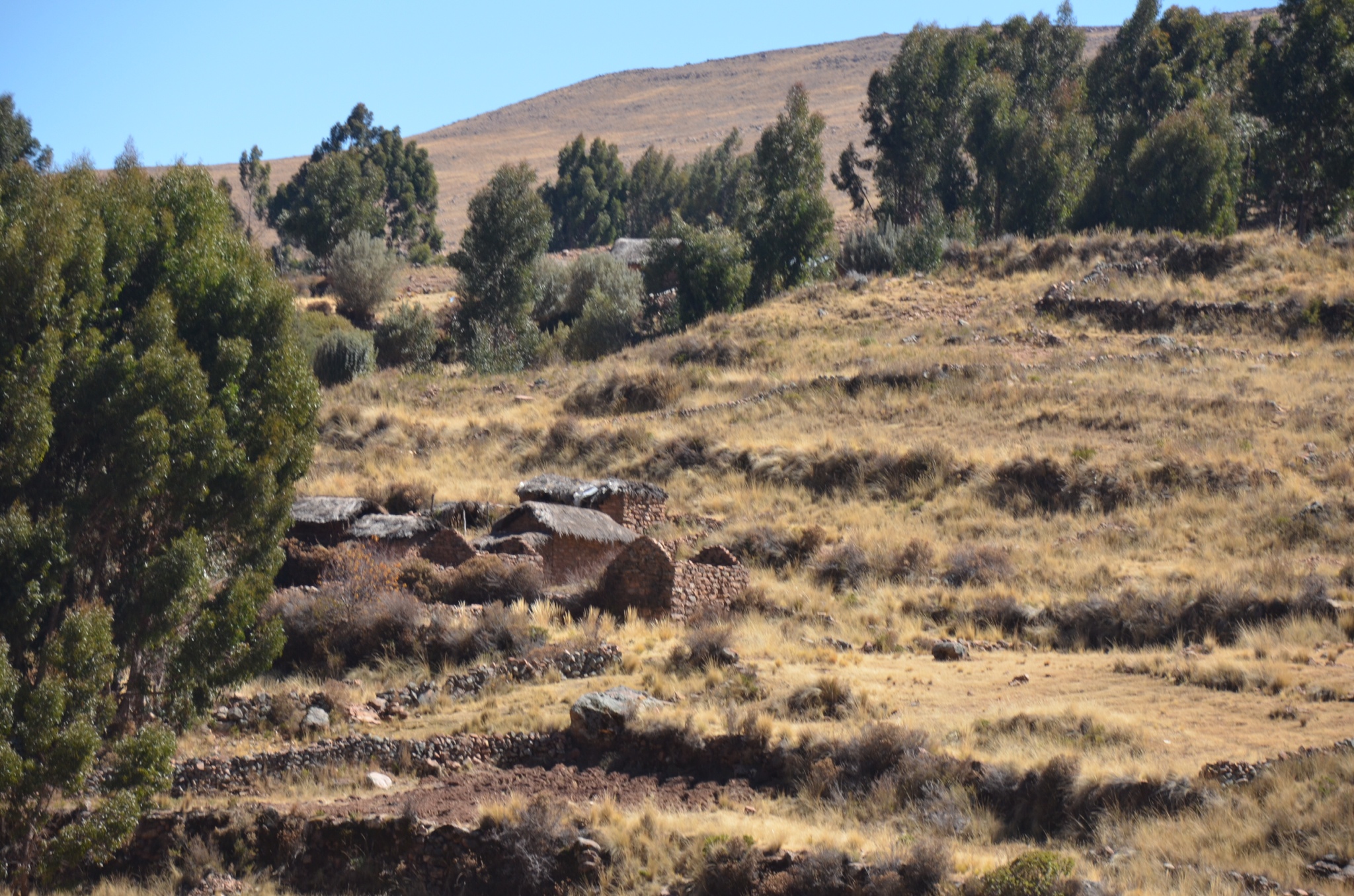
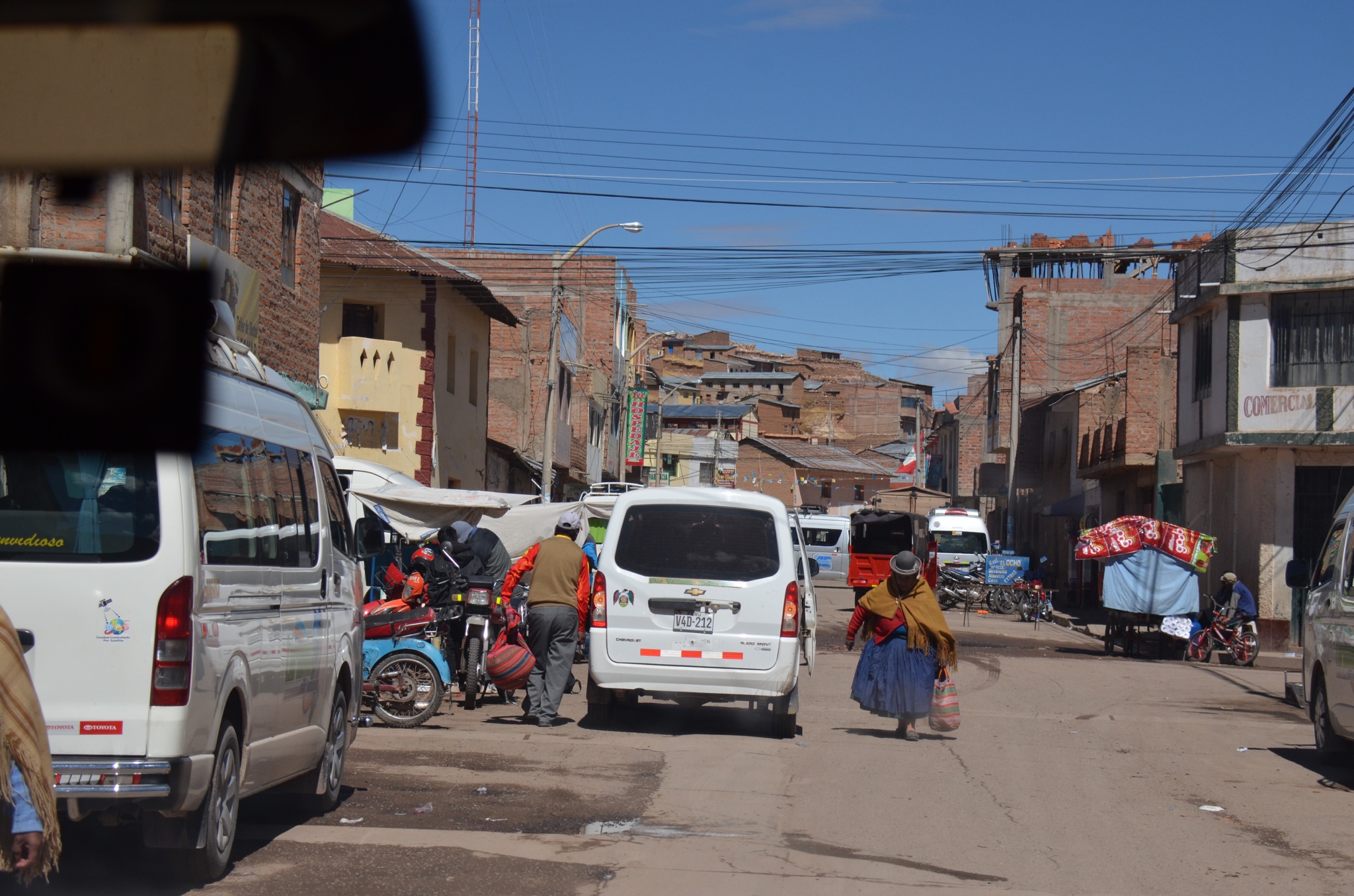
It was a two hour car ride from the shore to Juliaca. We drove through several small villages. I knew this would be our last drive through the countryside of Peru, so I pretended to be a photojournalist and tried to capture the people and scenes.

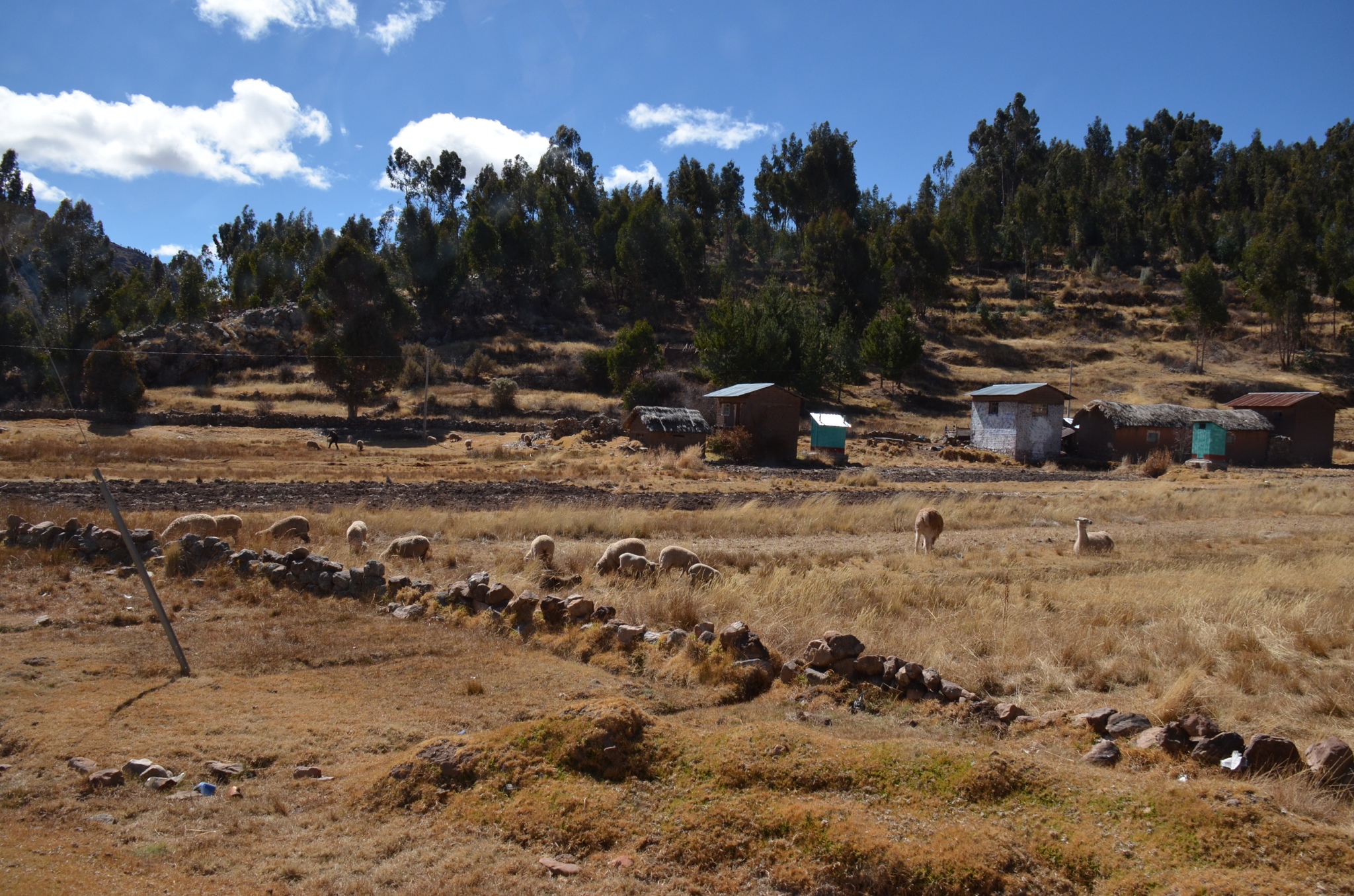
People keep alpaca in their yards:

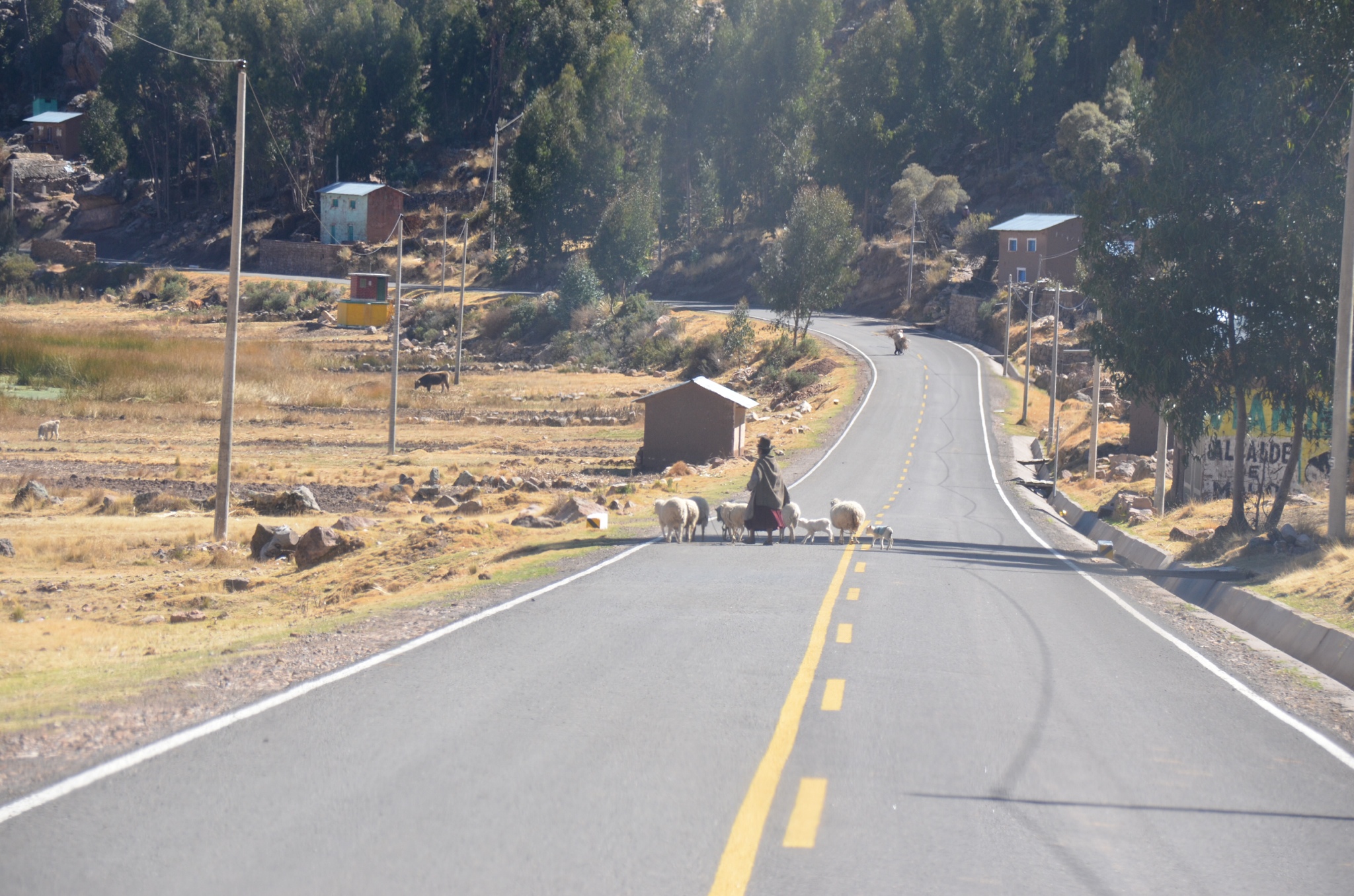
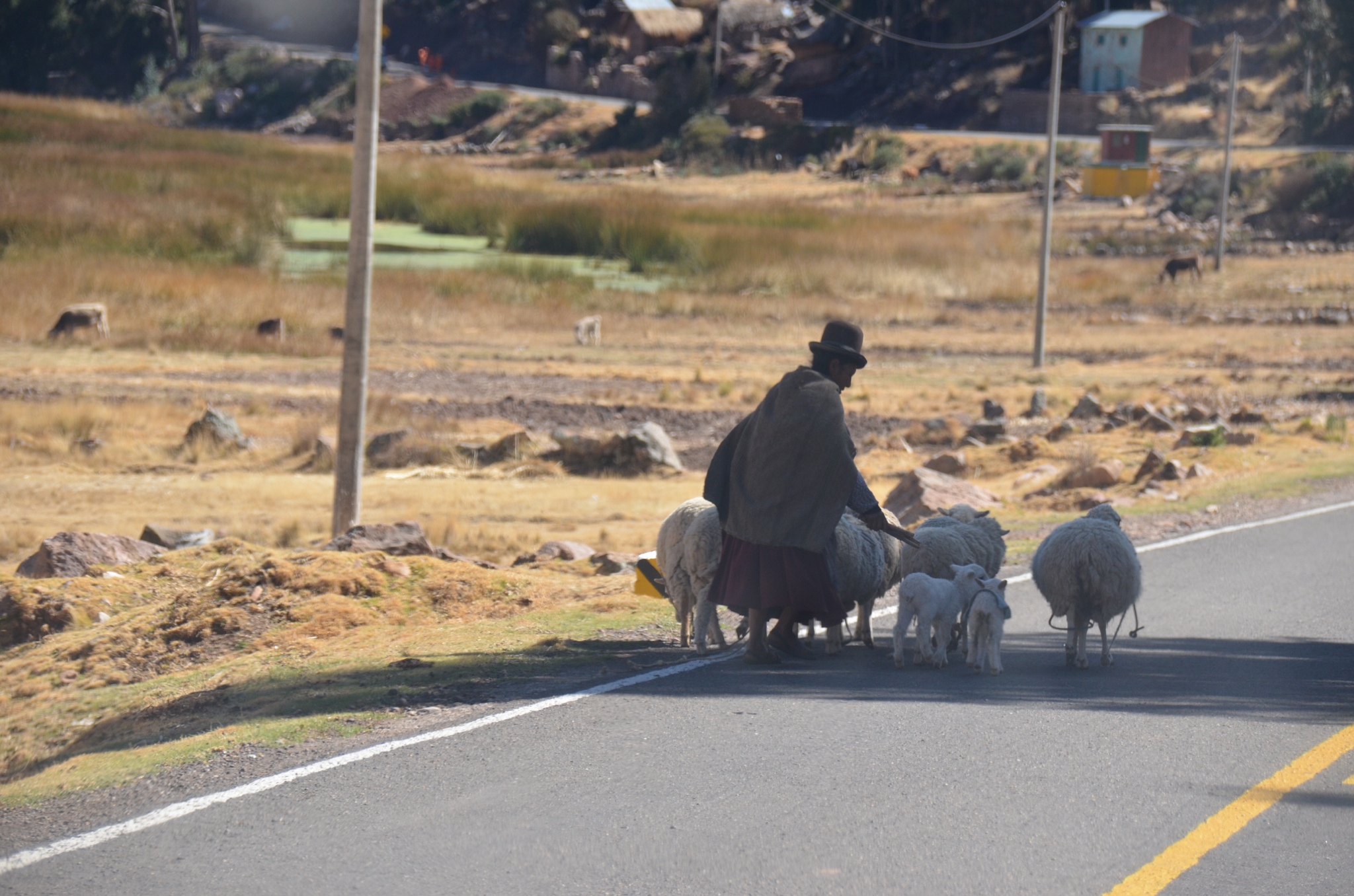
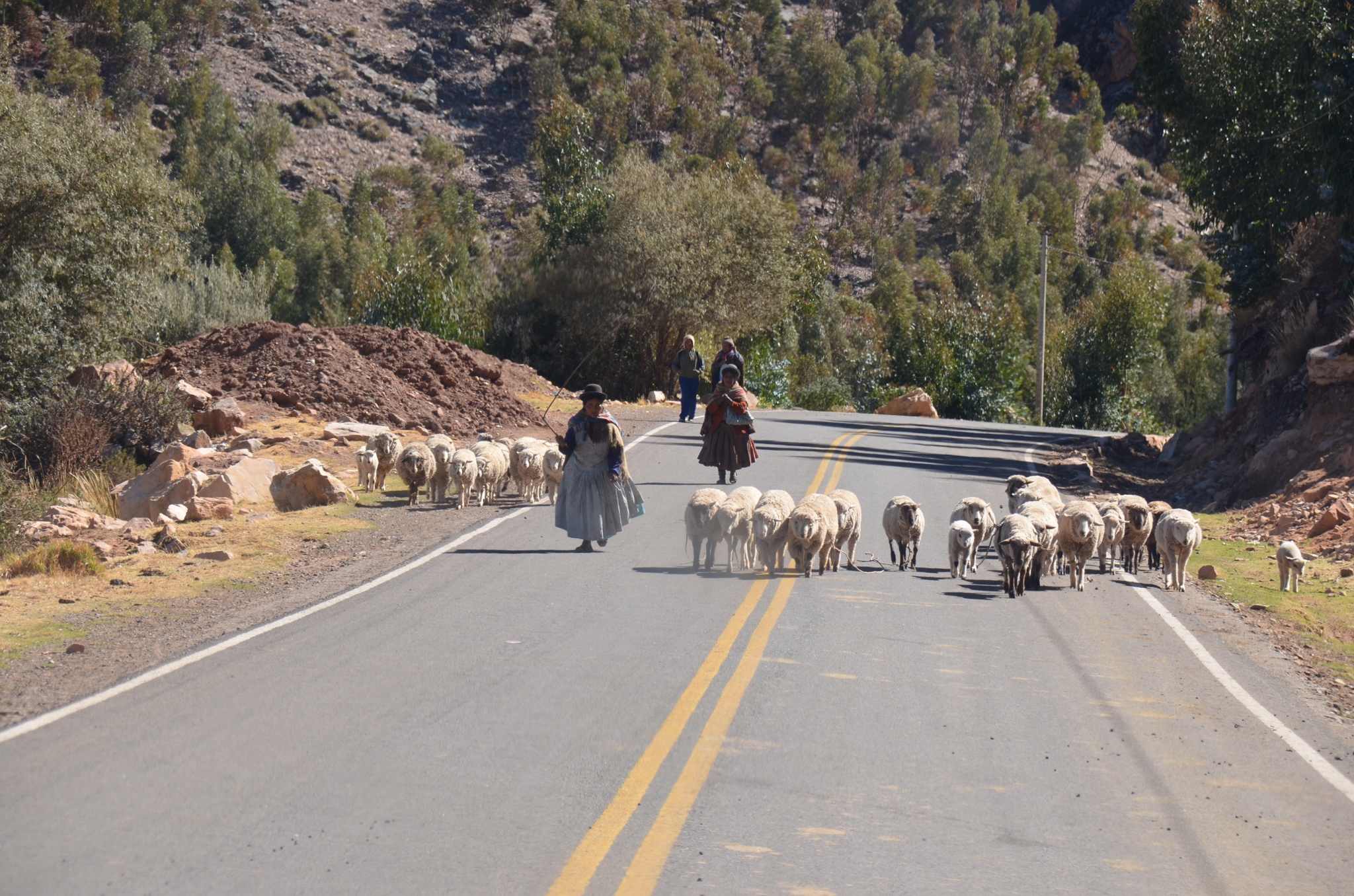
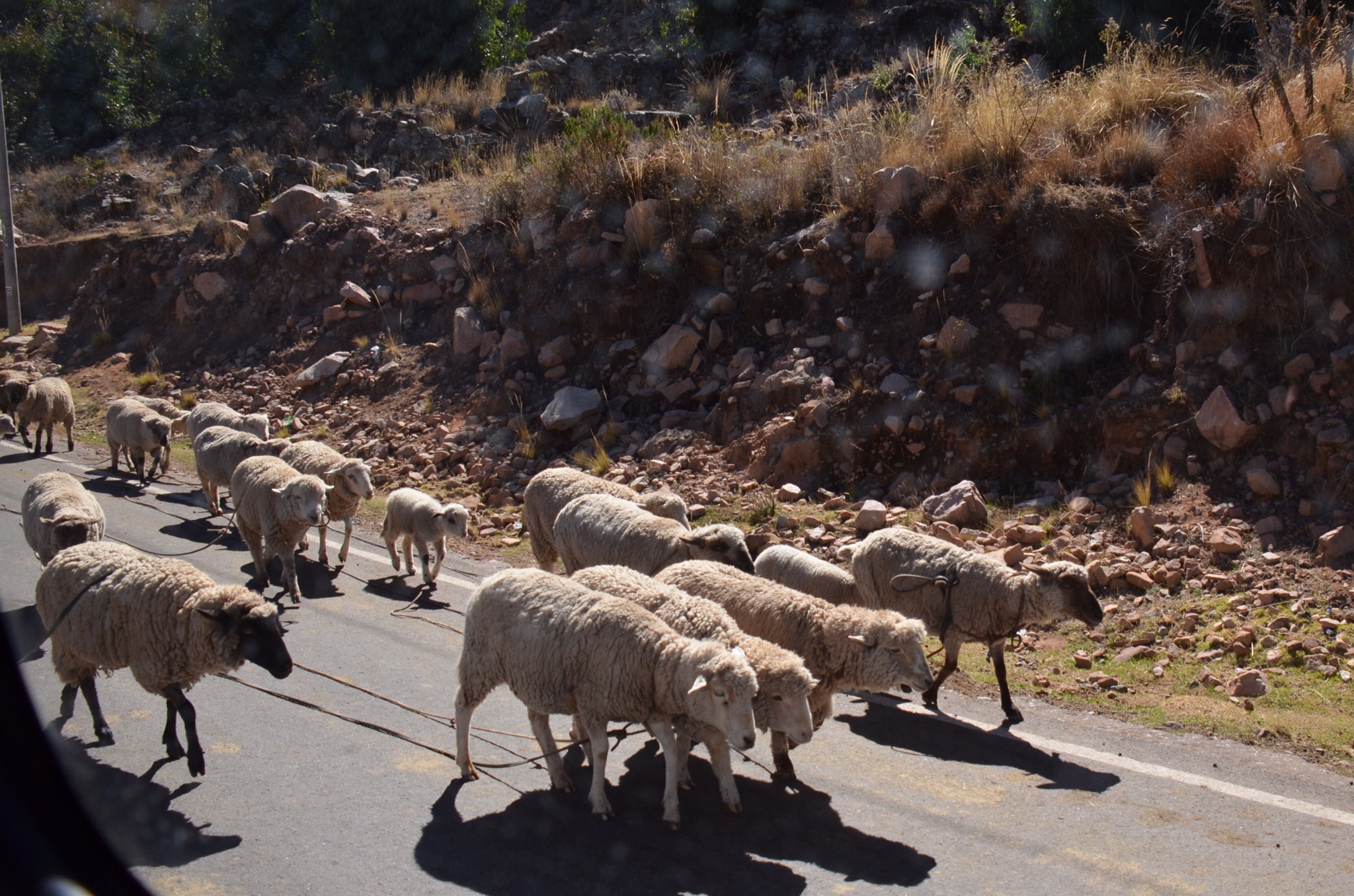
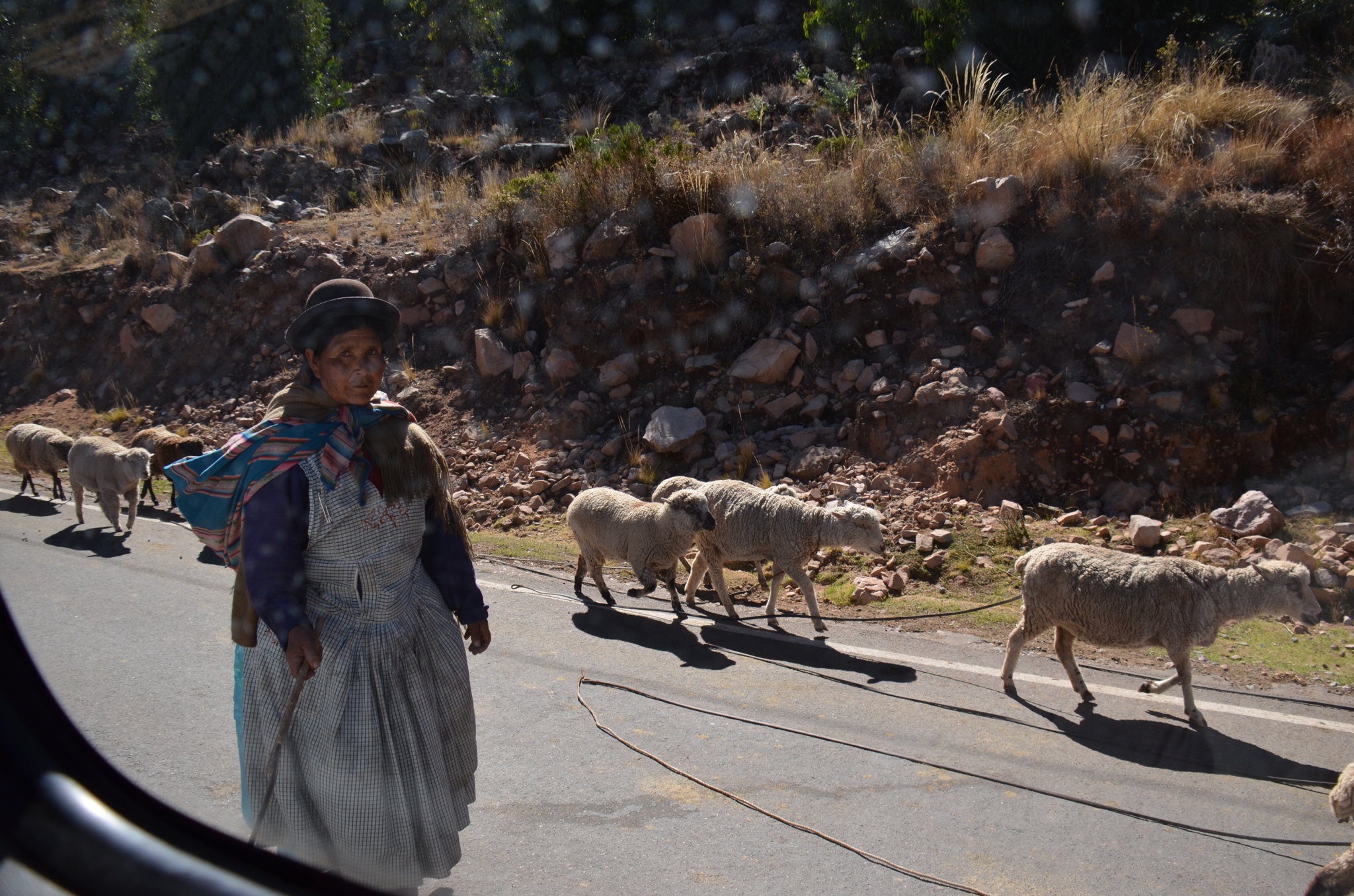
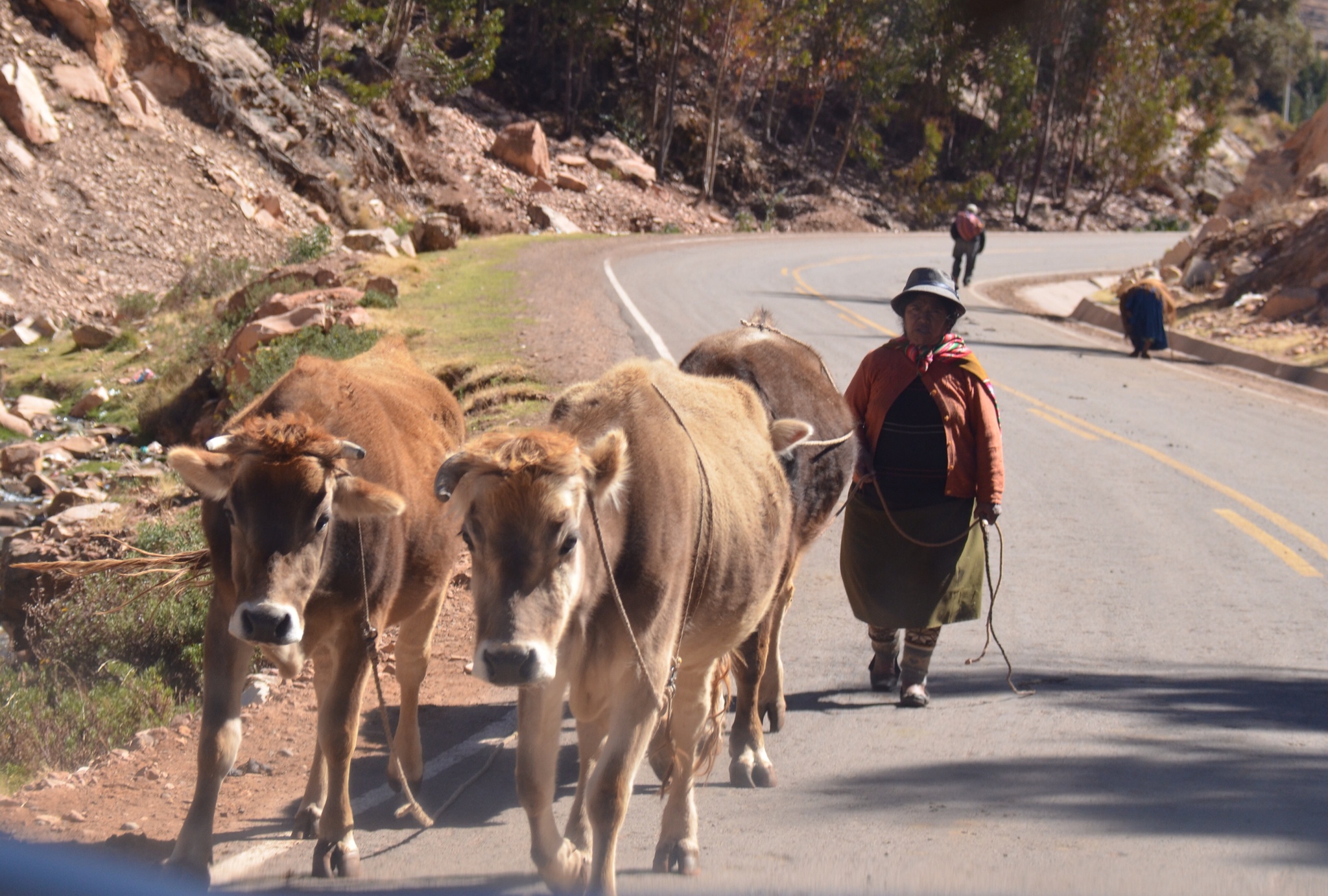
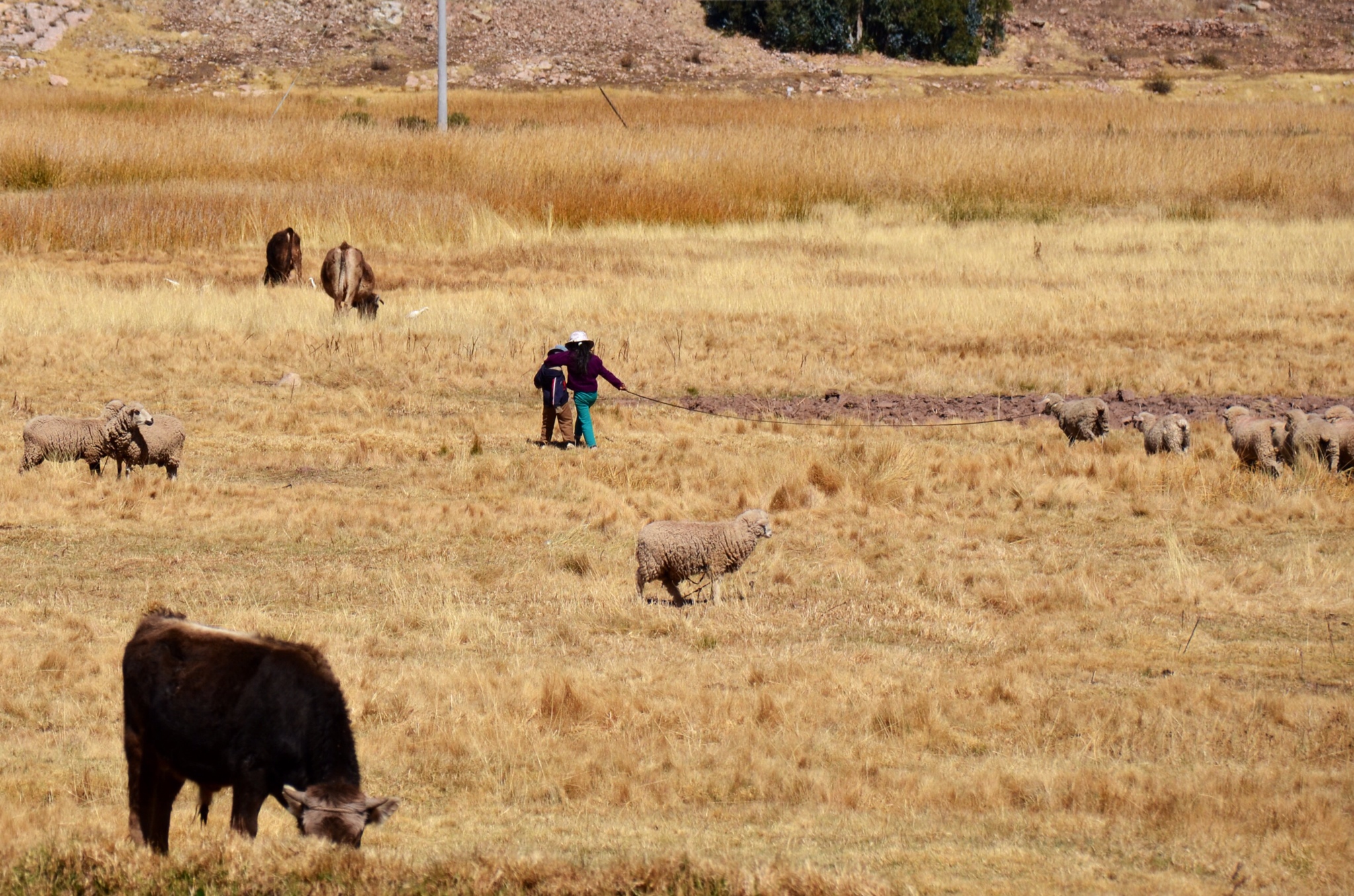
Sheep and cows walked in the road.

Getting ready to fish:
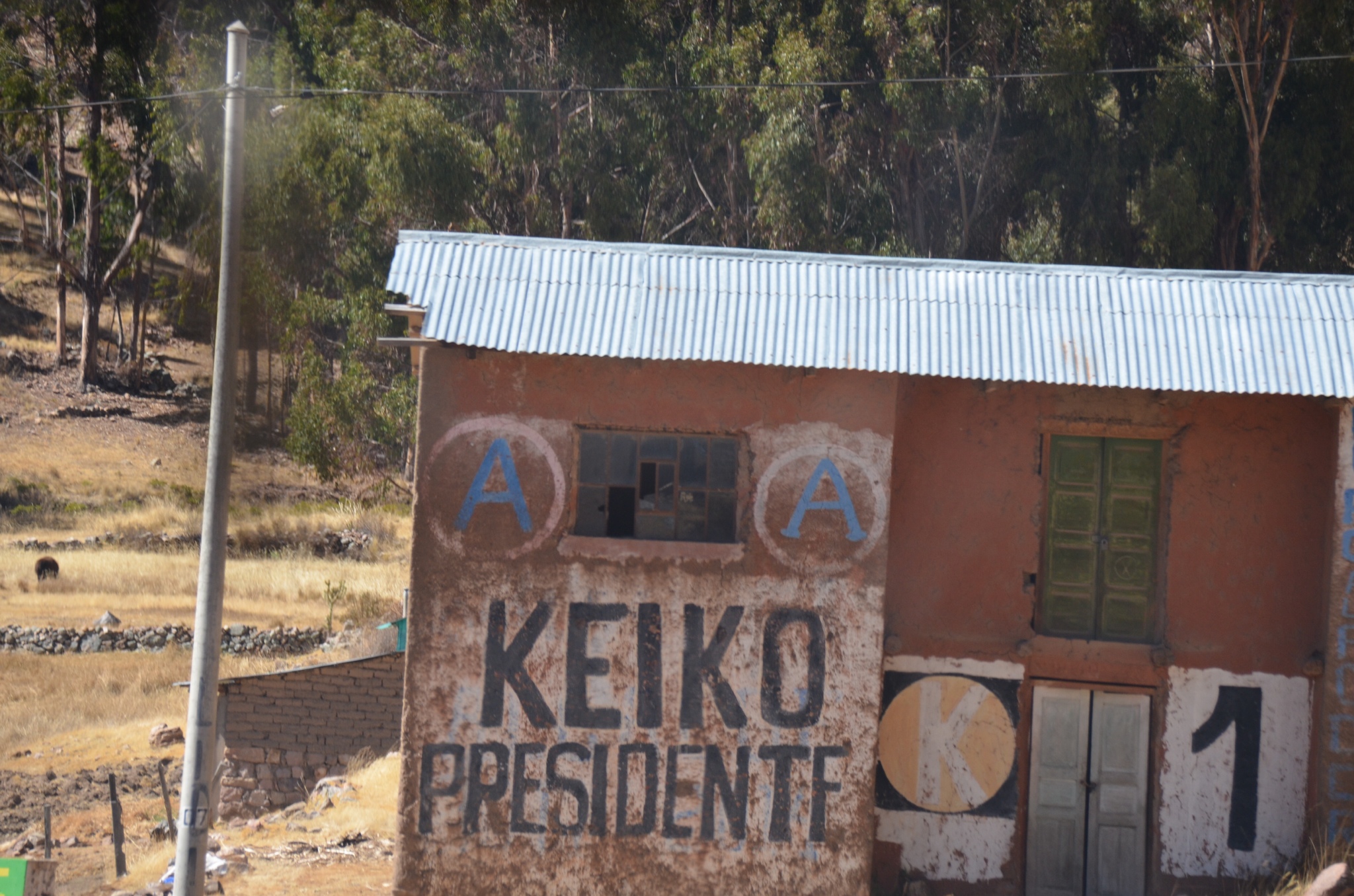
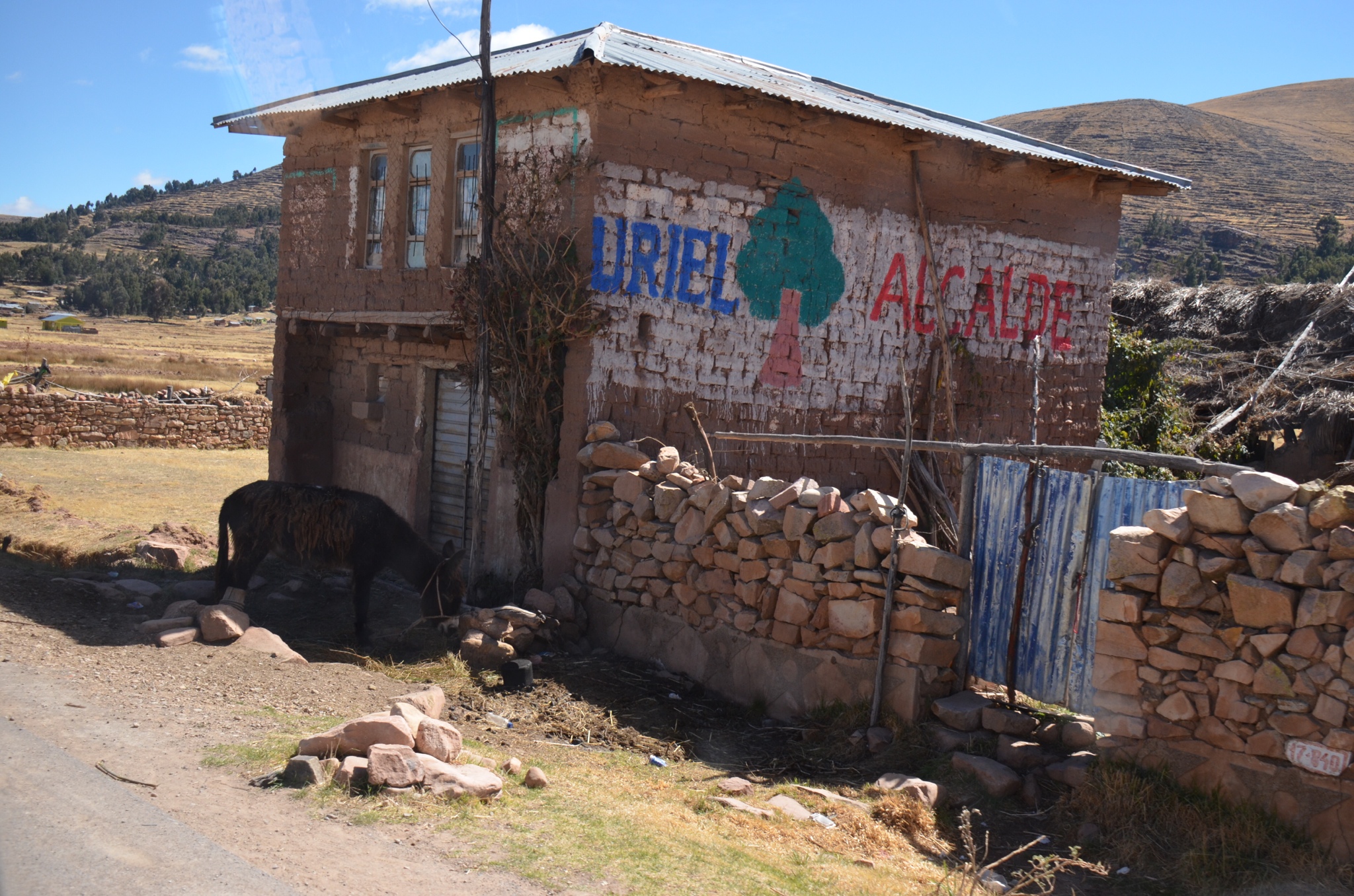
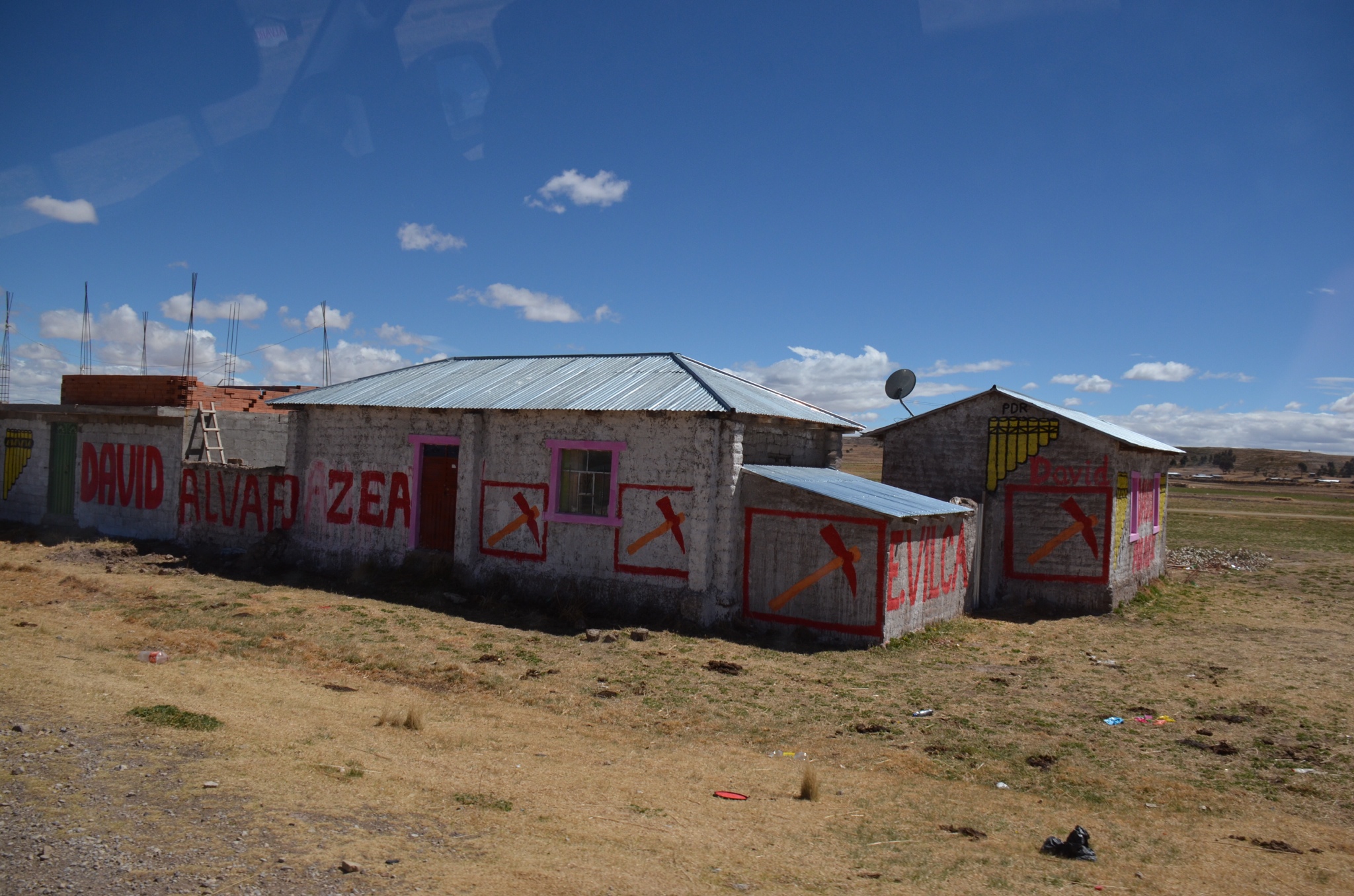
We saw politicians’ advertisements painted on the sides of buildings, walls, any flat surface….
She stared at me. I stared at her.
Everyone is going about their day. The old….
The young….
When I was a kid, vacations were road trips in the good old USA. I was prone to car sickness, and so my parents tried to keep me looking forward and out to the horizon. One of our favorite road games was called, “See It!” The object is to be the first to spot the diamond-shaped yellow highway signs and shout, “See it!” Each sign is worth a point, and if you call one incorrectly, a point is deducted. We have introduced Genene to the game, and she begs to play it any time we are all out on the open road.
See it!
See it!
It is election season in Peru. We were amazed at how many buildings were painted with political messages. “Alcalde” (seen below) means “Mayor.”
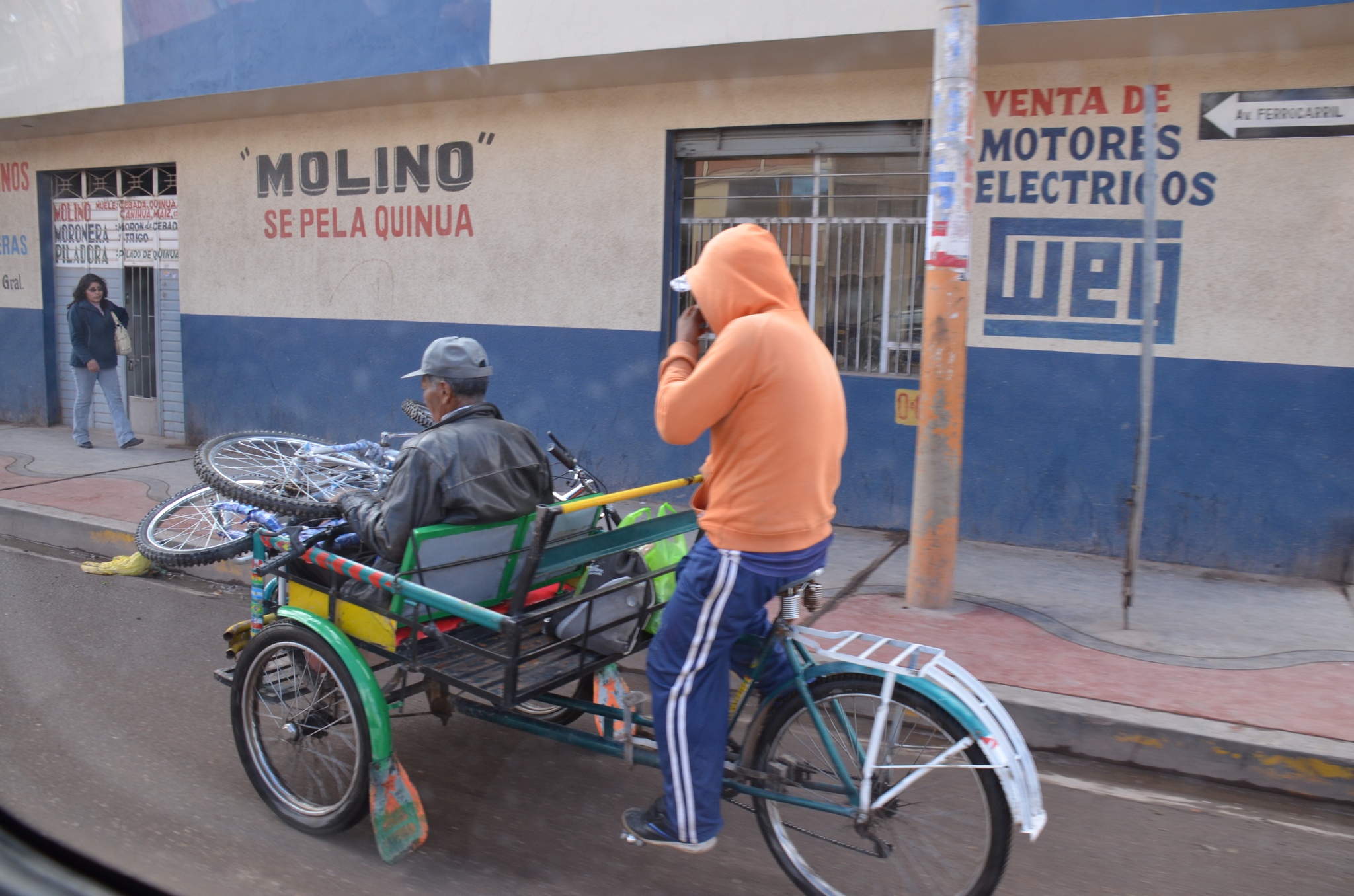
People use all kinds of transportation:
 
“Born to be wild!”
“Looking for adventure! Whatever comes my way!”
Not all the lakes and streams were pristine. Can you see the trash floating in this water? Can you see the people sifting and sorting through it?
It was market day in this village.
 
The people of Peru have cultivated potatoes for hundreds of years. There are 3,000 varieties grown.


Our driver dropped us off at the Juliaca airport with plenty of time to make our flight. The hotel had packed us a hearty boxed lunch, which we enjoyed while waiting for takeoff.


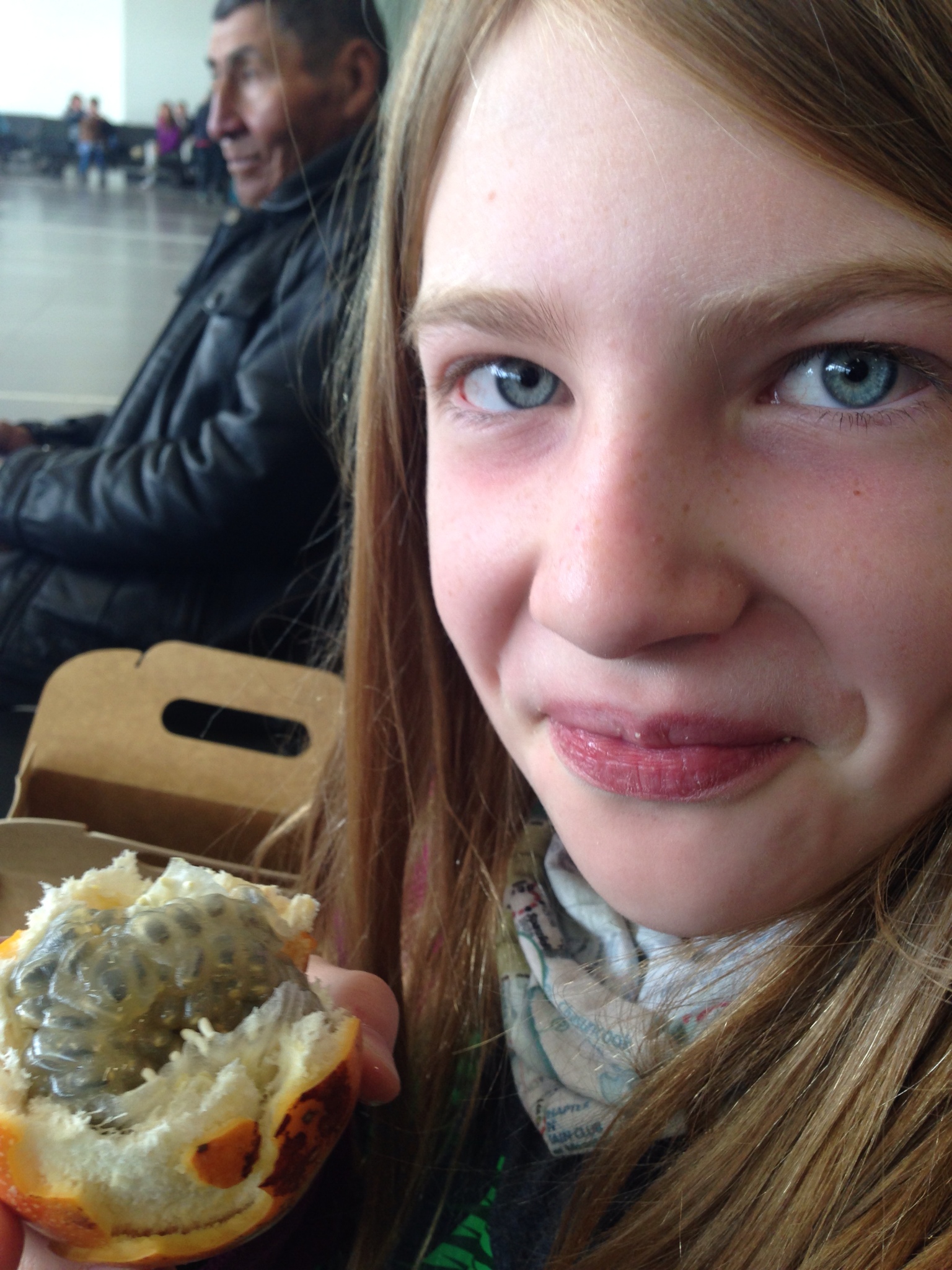
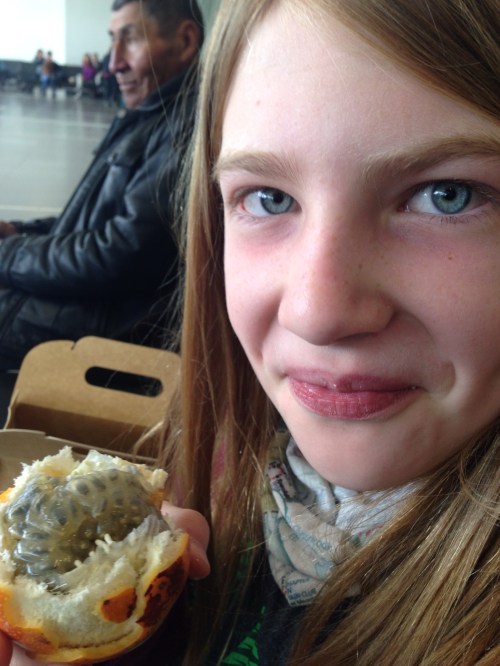
I have tried many drinks that are flavored with passion fruit, but I do not recall ever having tried a passion fruit until now. Each of our box lunches contained one, and we had to ask the guy sitting next to us what it was. It was easy to peel and very sweet and refreshing and wet. The inside reminded me of a pomegranate with all the seeds, but these seeds were edible. I love discovering new things to eat!
 

Greg and Genene had seats together on the plane, while I was sitting a few rows back beside a Belgian family. I struck up friendly conversation with them. They were also ending their trip and going home. They had hiked the Inca Trail and had their fair share of problems. Of their group of nine, every single one of them got sick at some point during the four-day journey, mostly with gastric issues. (I would be angry at the tour operator if I were them.) One of their daughters had to be carried off the trail on the back of a mule and did not complete the journey. The father was glad they had done it and felt some sense of accomplishment, but I am not sure the experience lived up to the billing for him. When we were cooling our heels with Carlos in Cusco, he had told us that in his 10 years of acting as an Inca Trail guide, he had to carry clients out ON HIS BACK more than once. I cannot imagine it. Carlos was not a big man. I feel a little wistful that we missed the trail, but when I hear stories like this, I smile and think of how much I enjoyed that train ride to Machu Picchu!

We got to Lima on time at 3:00 PM. We had an 8 hour layover in Lima and did not want to hang out in the airport. We had called rock star operations director Carla and asked for help, and as usual, she delivered. She had arranged dinner reservations for us in Miraflores, the oceanside neighborhood in Lima. The Enigma representative was waiting for us at the airport in Lima. He helped us store our bags at the Ramada, the same hotel where we began our stay when we arrived. He put us in a cab bound for a restaurant named Cala and advised us to be finished with dinner by 8:00 PM and start heading back.

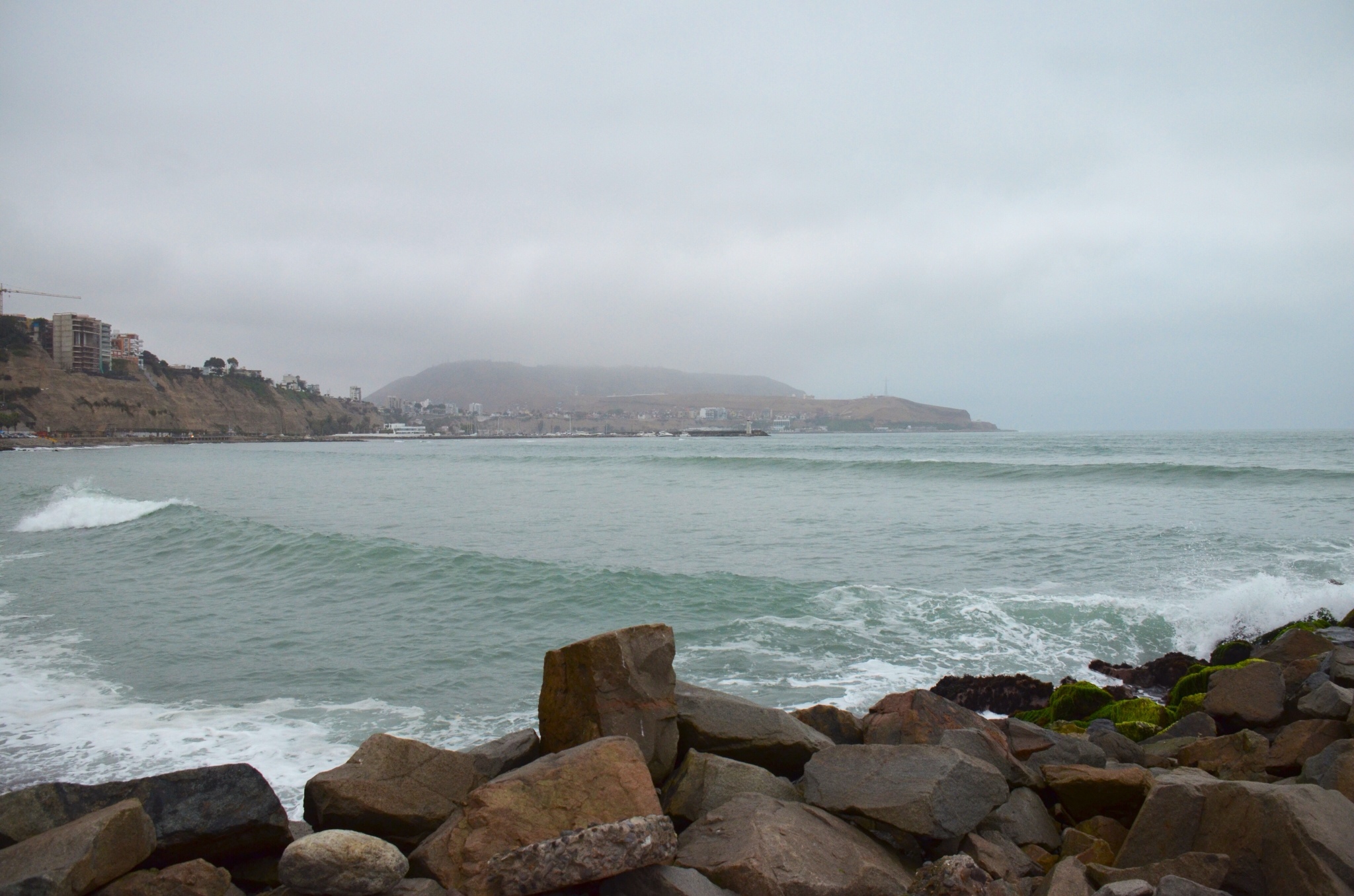
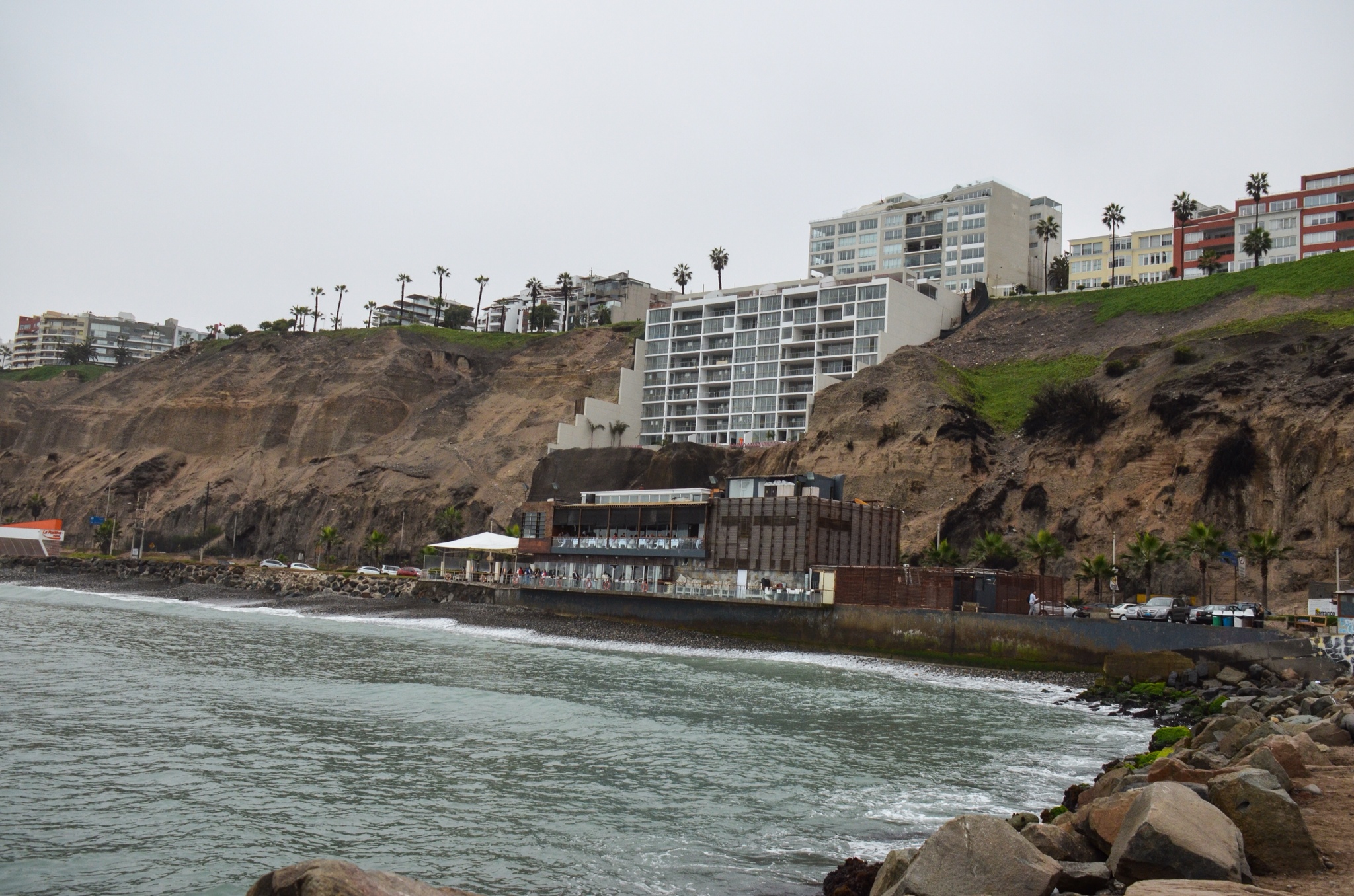
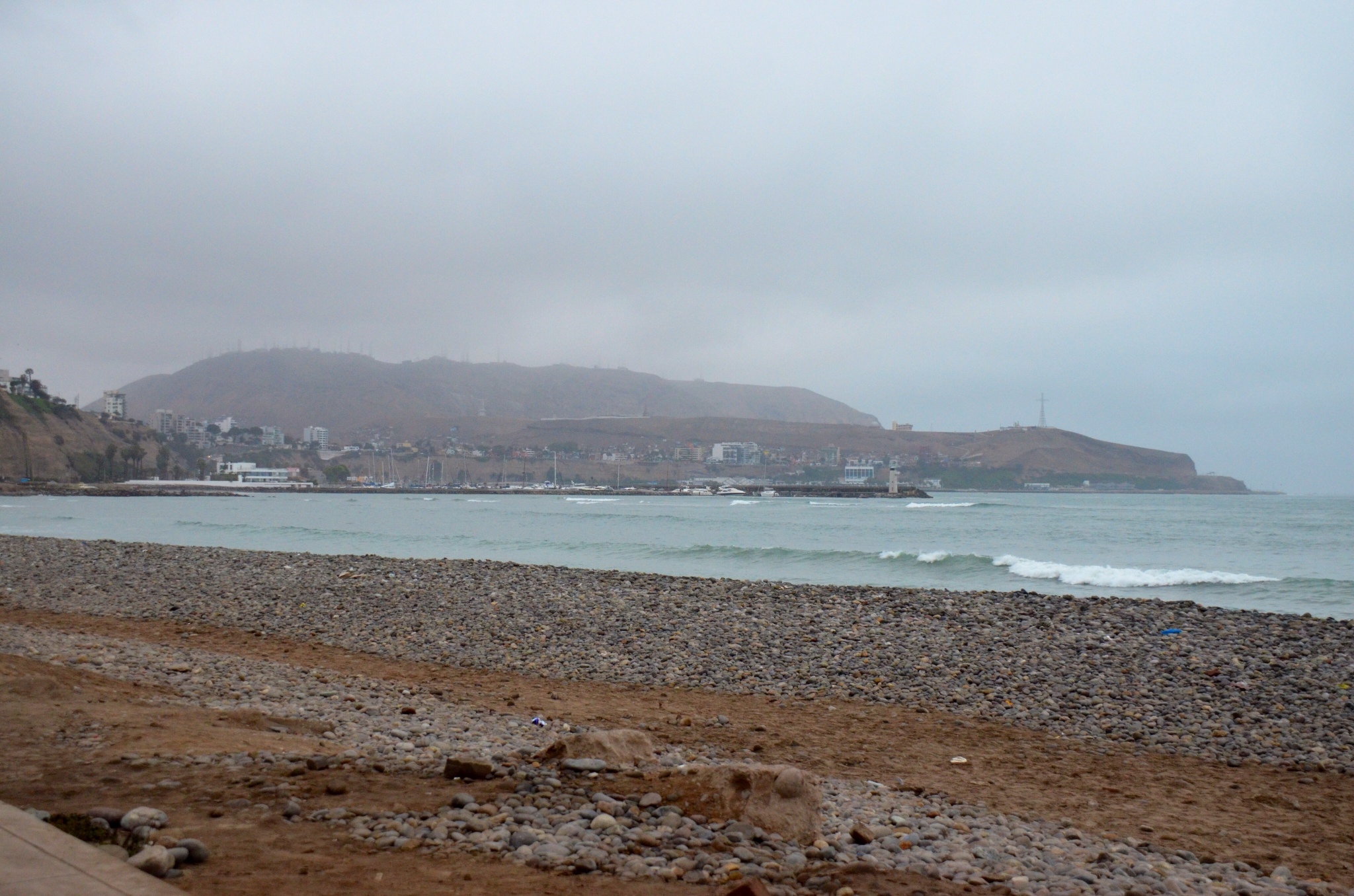
We got to Cala very early and took a walk on the breakwater. The day was gray and cloudy but the temperature was very comfortable.

 
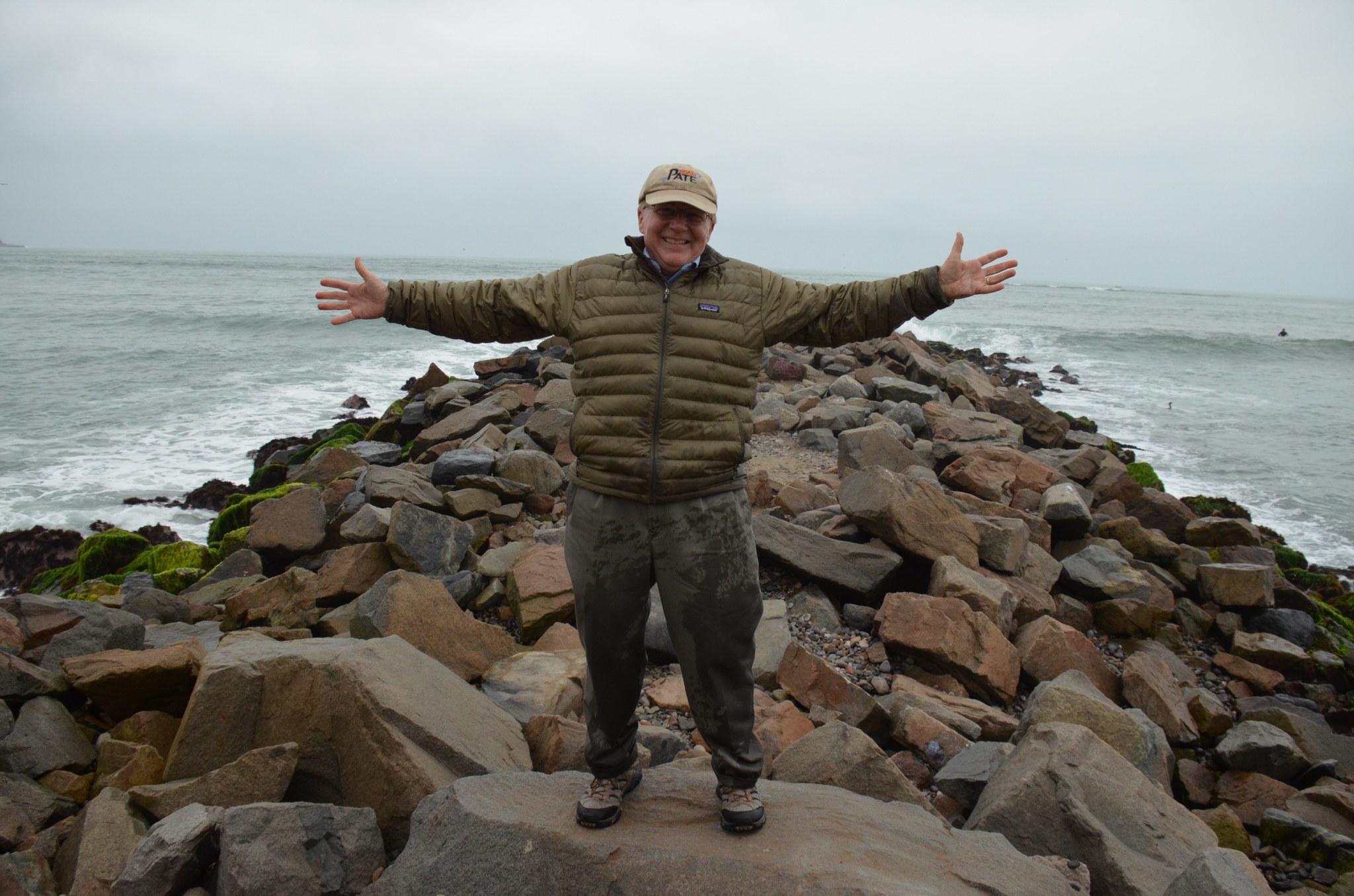
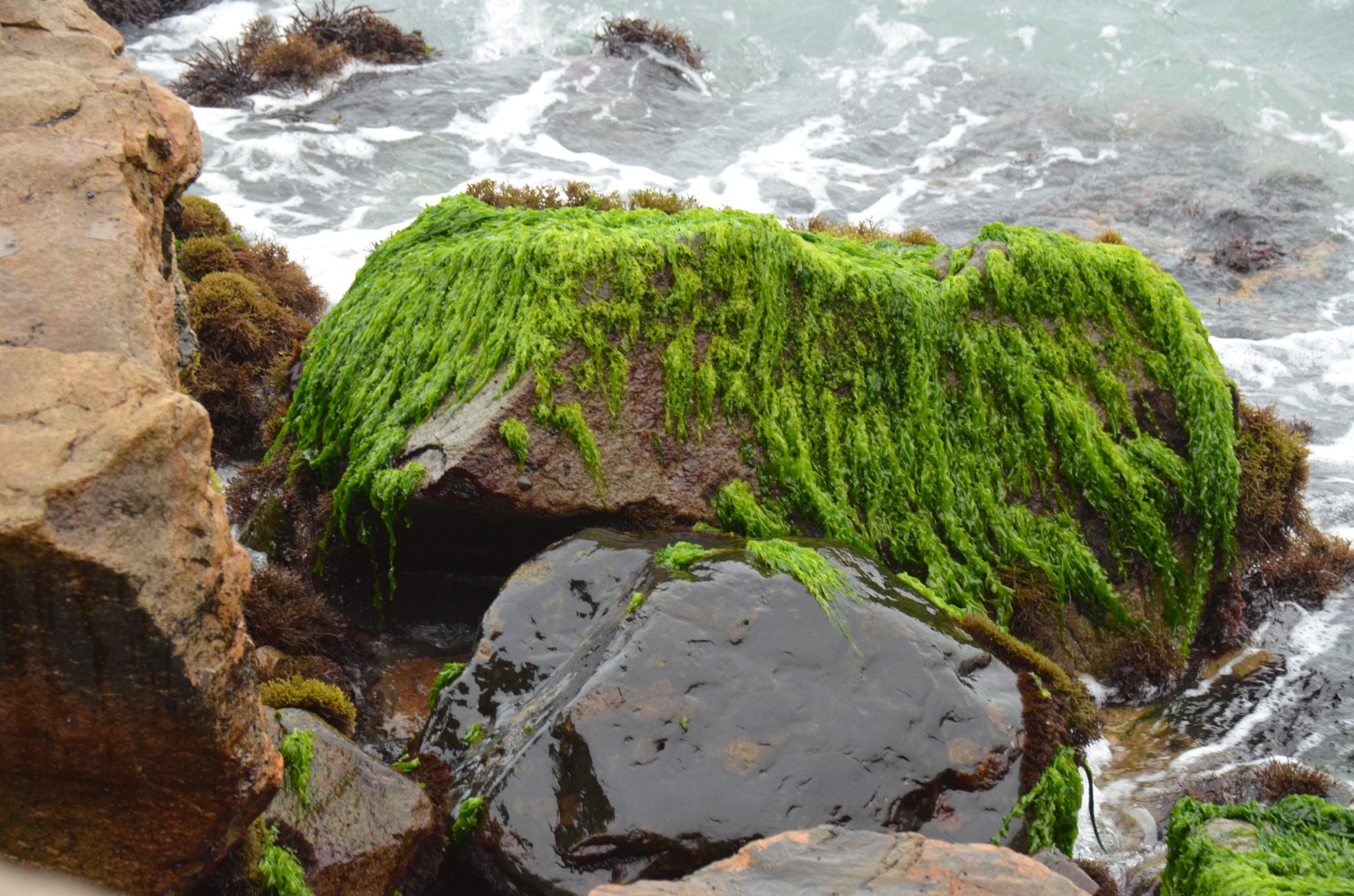
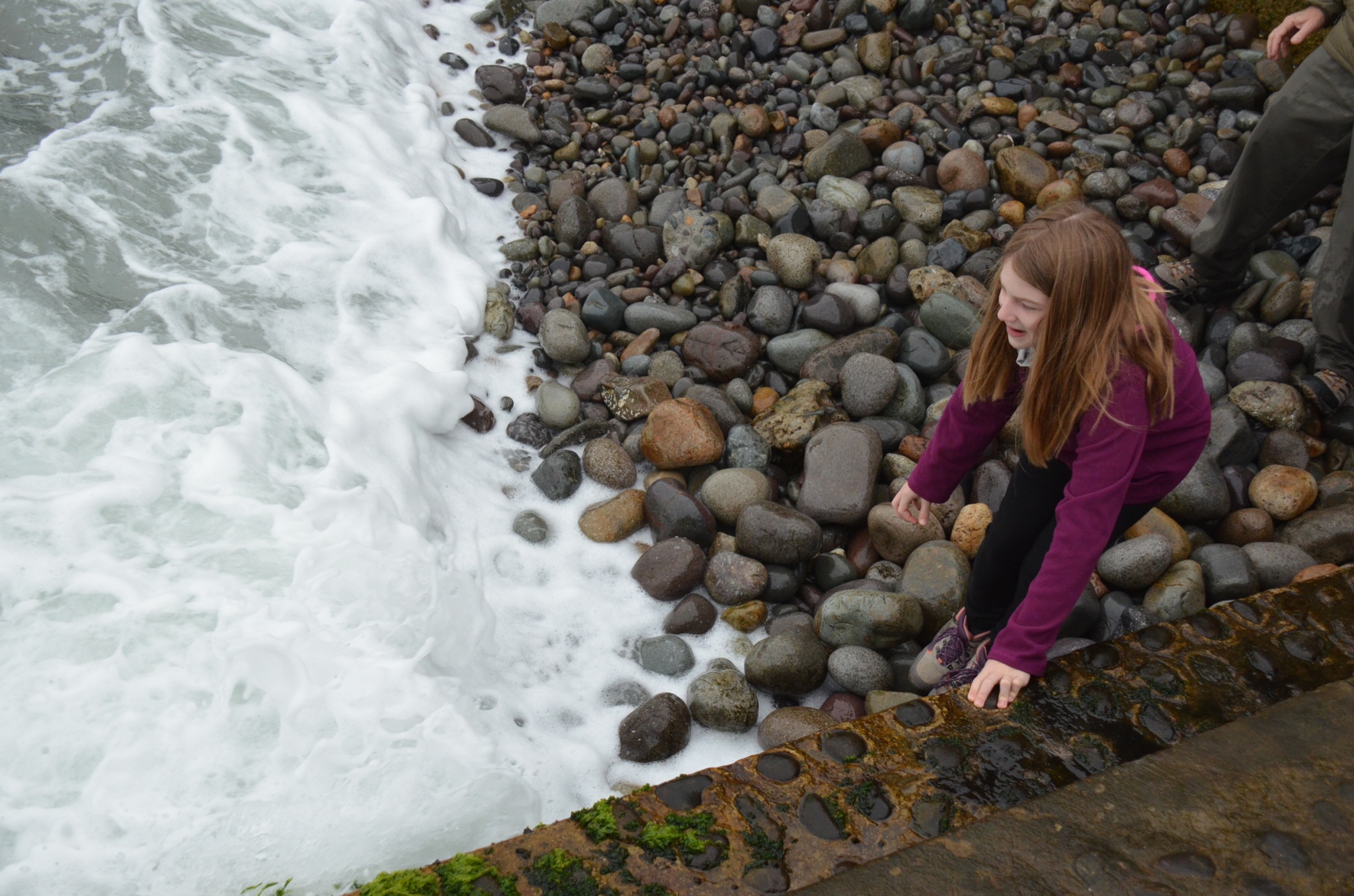
Greg got the brilliant idea that he wanted Genene to “touch the Pacific” since this was her first time to see it. Greg and Genene began to clamber down the breakwater to get to the water. For once I did not nag, even though it was crystal clear to me that this was a dumb idea. I simply watched as those two knuckleheads scrambled down to “touch the Pacific.” They didn’t touch it. It touched them! As soon as they got down to the water’s edge, a huge wave broke over the rocks and soaked Greg.
They quickly rejoined me at the top.
Brilliant, Greg! Now you have to go to dinner and ride the airplane in that!
The view of Cala from the breakwater.


Genene wanted to try again to touch the Pacific, and this time, she went to the shore to get it done.
She got splashed again!
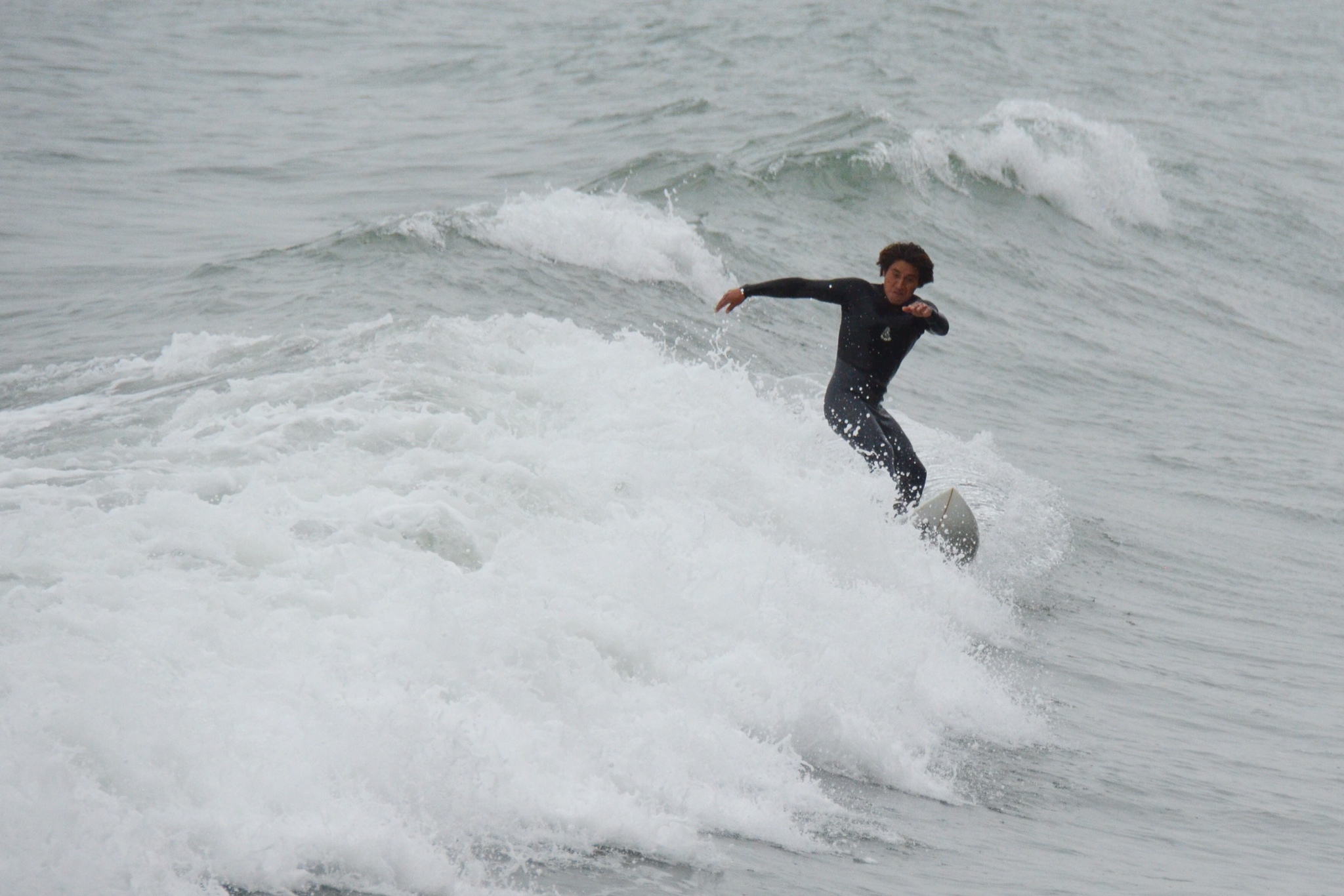
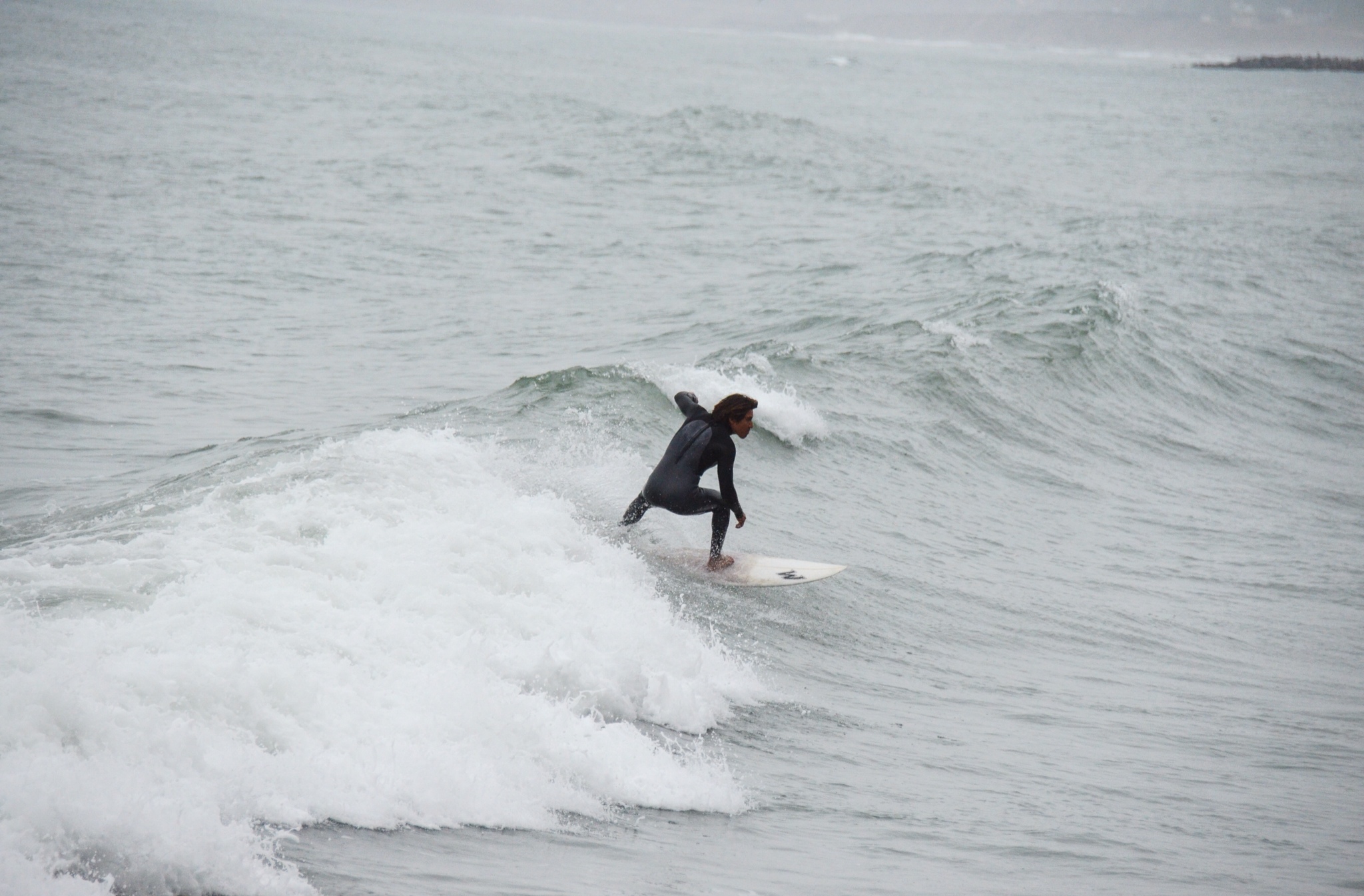
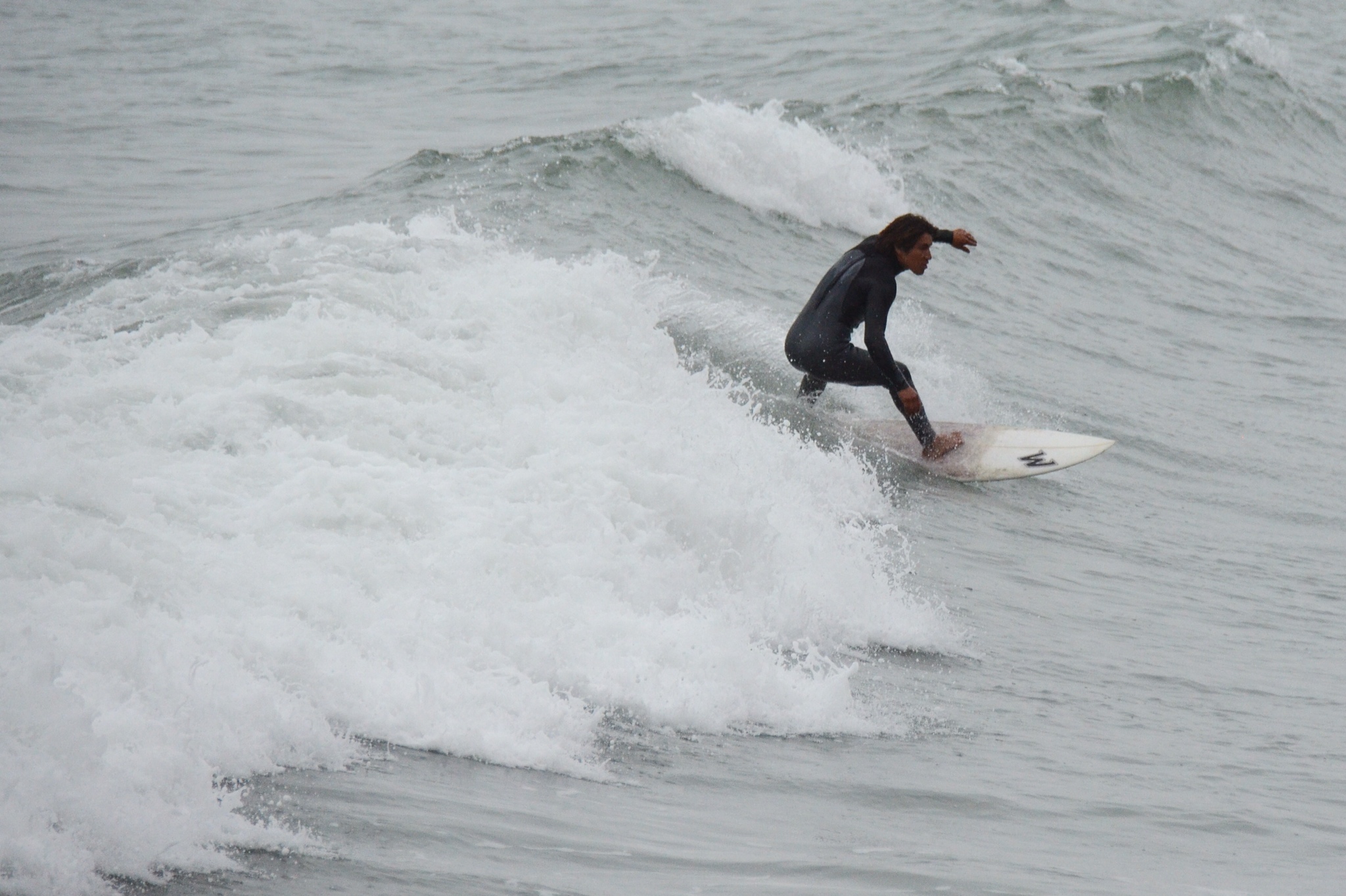
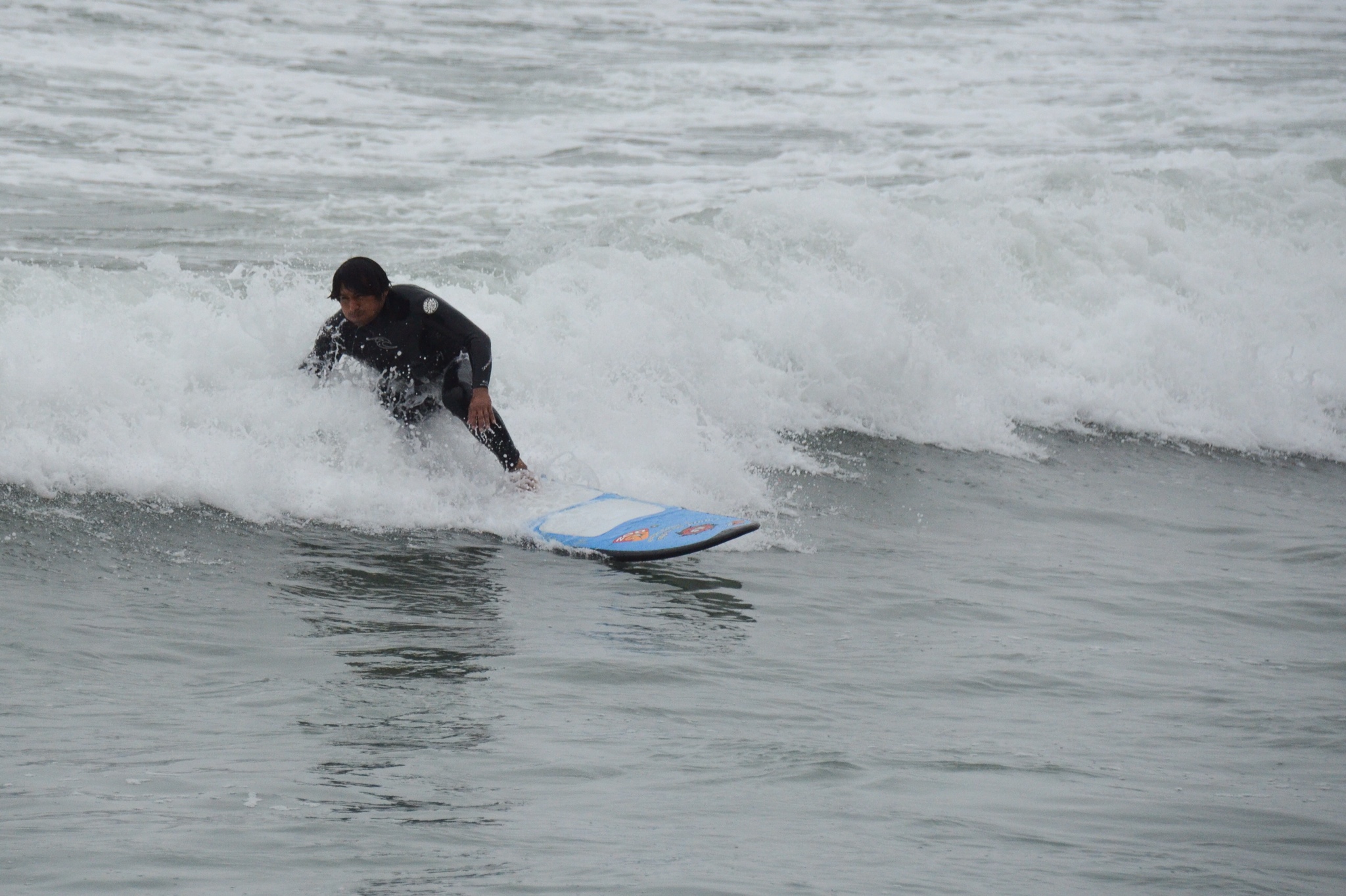
We watched the surfers riding the waves.
“Catch a wave and you’re sittin’ on top of the world!”
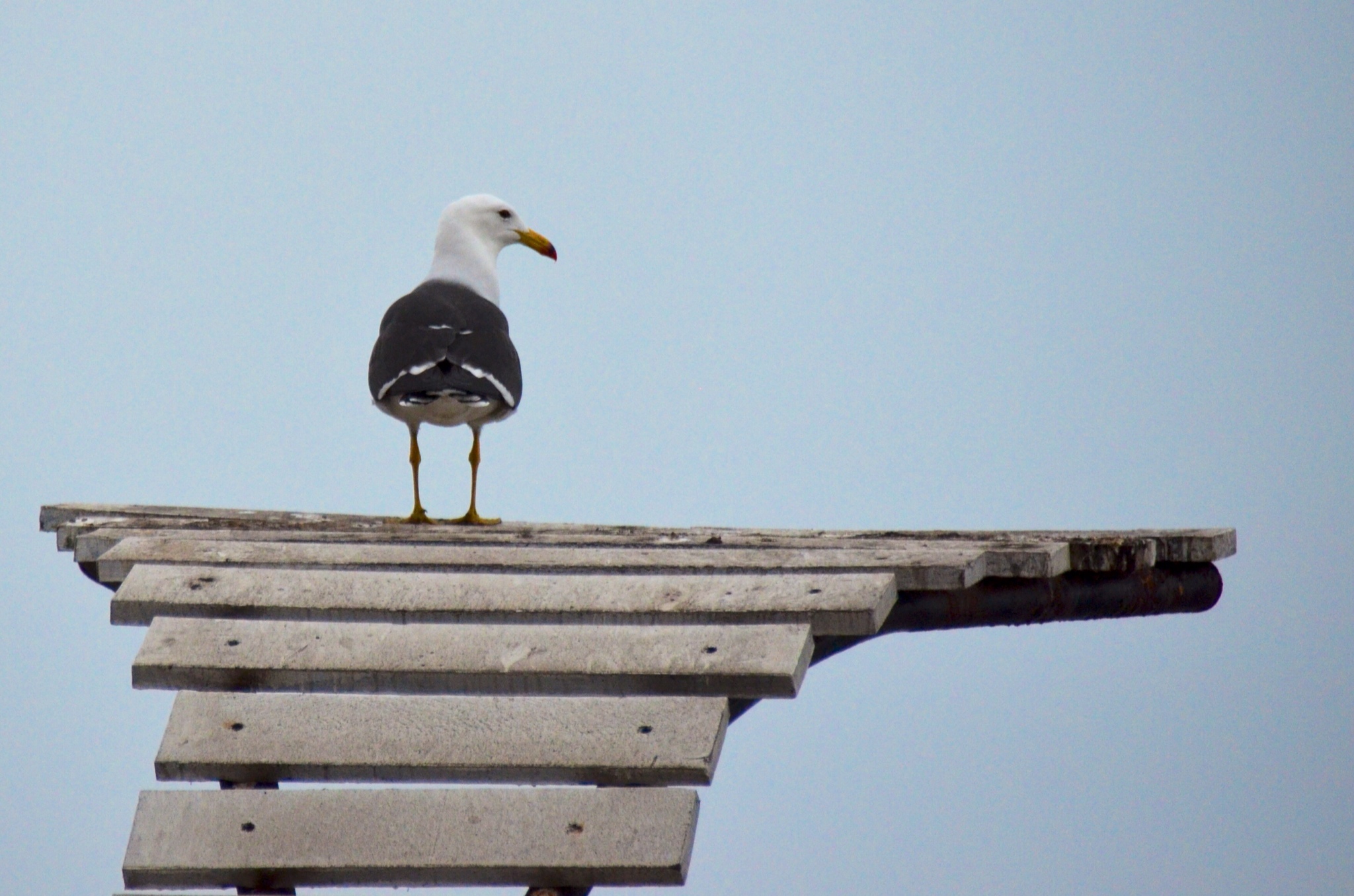
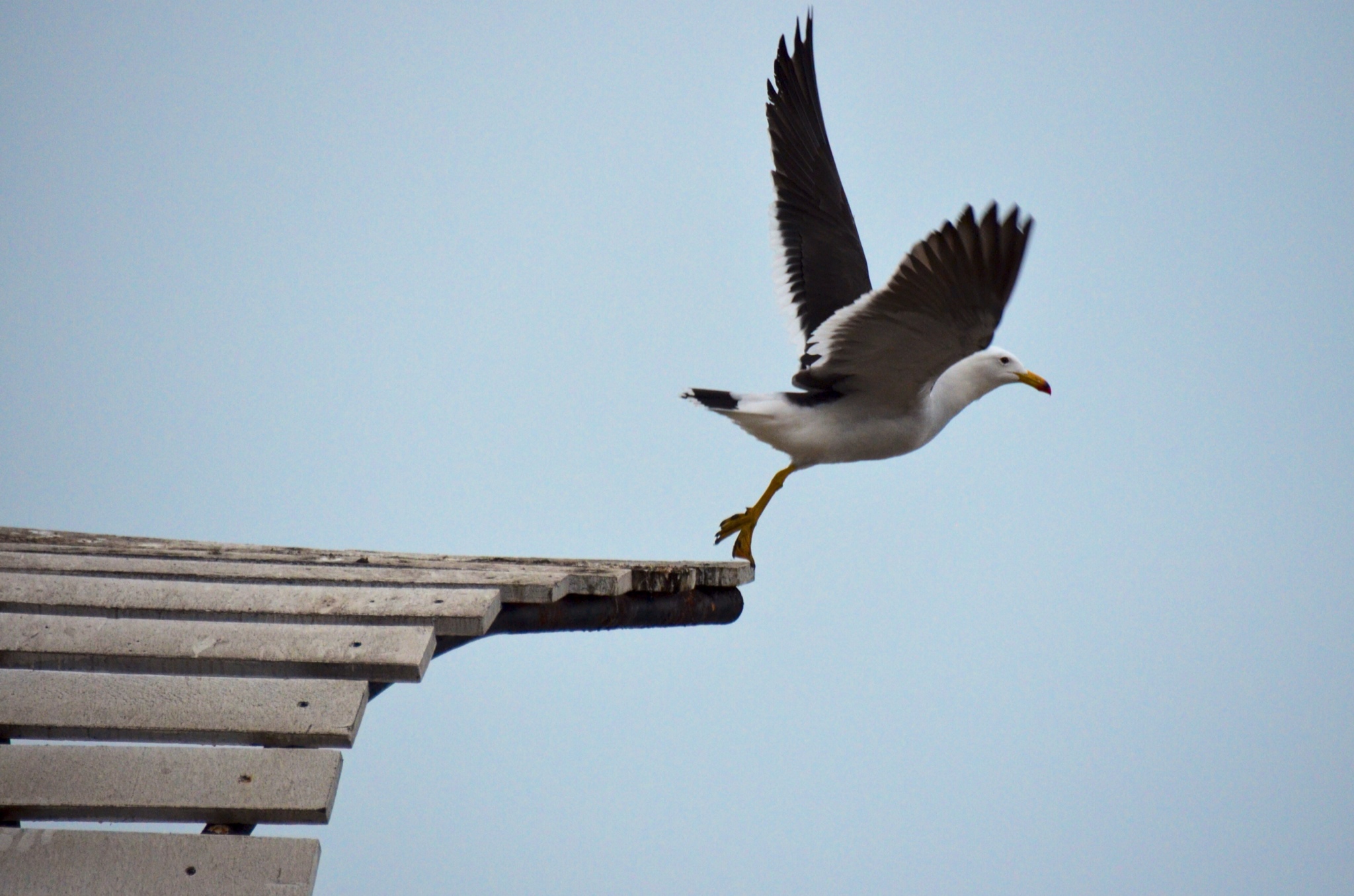
I am still trying to learn to take pictures of birds on the wing.
This fellow sat on the lifeguard stand and scanned the water.
Genene carried Andrea everywhere.
Teenagers doing what teenagers do on the beach:
We are ready to have a classy dinner at a nice restaurant.
Having gotten our fill of the sea air, the sea sand and the sea foam, we headed inside Cala. We really cut a dashing profile. Greg and Genene were sandy and wet, and they were both hauling daypacks loaded with gear. I had my safari camera daypack, which weighs a ton and is about the size of a Fiat. It was hard to tuck all that gear away under our table so that we did not trip other dining patrons.
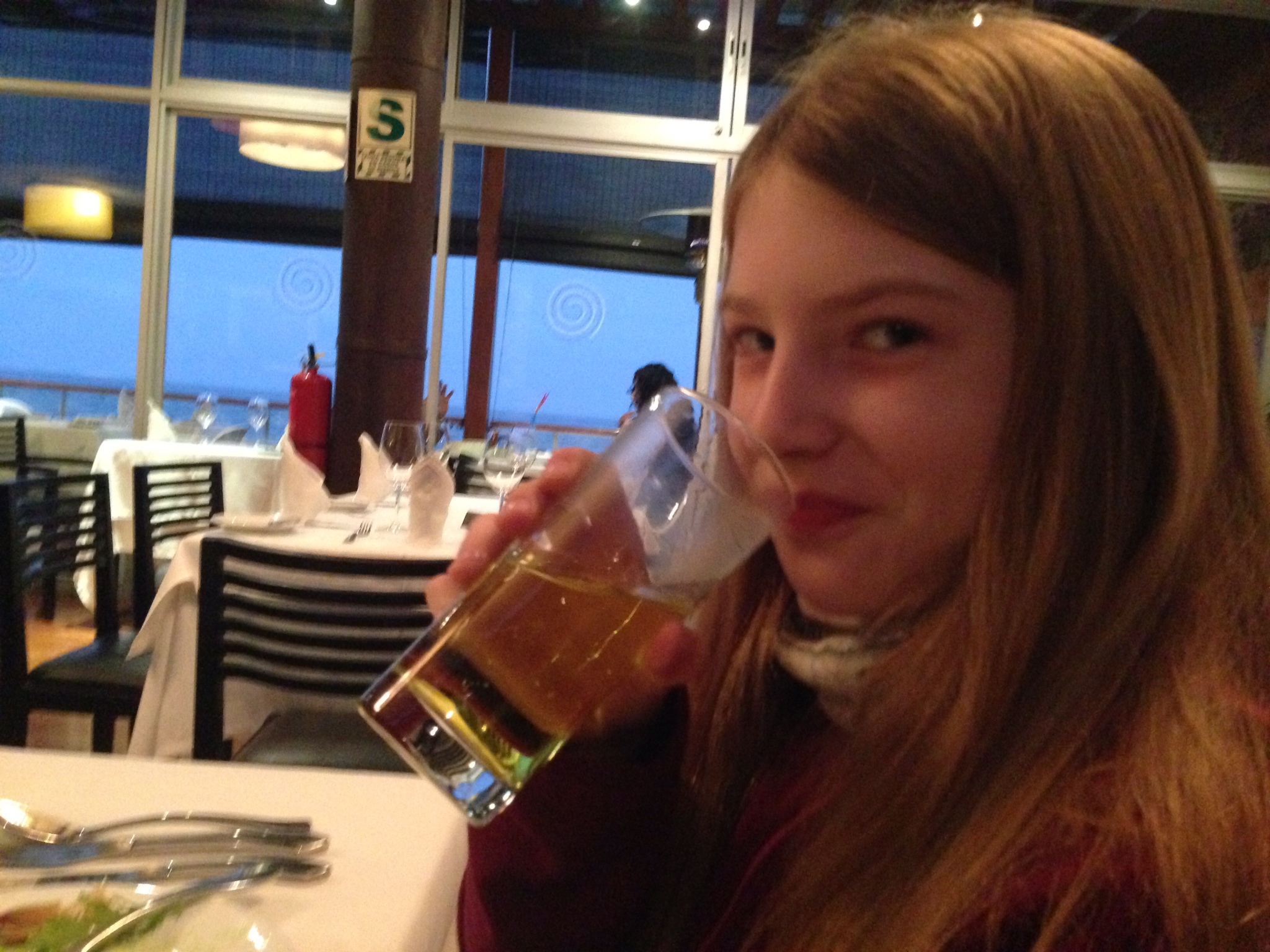
Genene enjoyed an Inca Cola, and we had a great view of the Pacific out the dining room window.
 

Cala is a seafood restaurant. Lima is known for ceviche, and we indulged. I chose a classic recipe with the lime cooked fish. I took the photo with an iPhone, and I am annoyed because it’s blurry. I’m including it anyway because this was the most delicious thing we had.

We also got some seared fish, beautifully prepared.


Greg got some octopus. Everything was fabulous, and it was all fresh from the sea. (My friend Melissa Kilpatrick once had a waiter whose response to any question about the freshness of the seafood was “Oh yes. It slept in the bay last night!”) Greg decided to abandon any notion of moderation on this evening. He even drank a beer. What the heck!

I got a healthy energy drink for dessert.

Our Enigma representative told us that the restaurant would be happy to call us a cab, and they were. However, a little confusion ensued. When we told our cabbie that we wanted to go to the airport, he pawned us off on another cabbie. The second guy charged us 70 soles to take us back to the airport. (Our ride from the airport had cost 55 so we knew we were getting the tourist treatment.) Then the guy tried to claim he did not have proper change and tried to give me back 20 soles change on a 100 sole bill. No sir. We dug around until we found the exact change. No tip for you, man!

We made it through all the security checks and immigration stops with plenty of time to spare. Our flight left at 11:50 PM, and we were tired and ready to settle into our seats. For once, I was the good sleeper. I think I was just relieved. I wasn’t worried about Greg anymore and we were headed HOME. Greg got about 2 hours of sleep on the 6 1/2 hour flight, and Genene got at least 4 hours.

We arrived in Houston at 6:30 AM. Thankfully the line through immigration was short, and we got a very friendly officer for a change. She even noticed that it was Greg’s birthday and wished him a happy day. We are suckers and always answer the questions on the customs forms truthfully. There’s a question about whether you have been in close contact with livestock, and since we rode horses, we had to answer that one “yes.” In the past, that answer has usually gotten us sent to a special room to have our shoes decontaminated, but this year, they waved us through without any of that.

We caught a cab, and the guy nearly had a wreck messing around with his Garmin before we even left the airport. It would have been a little ironic to go around the world, have medical adventures, go ziplining, whitewater rafting, mountain biking, and hiking and then have a car crash on the way home! Anyway, he kept it between the ditches (just barely) and got us to our front doorstep by 7:30 AM.

Genene ran upstairs immediately and found Senior. She brought him downstairs and put him on the kitchen counter beside Andrea, so that Andrea could tell Senior about all that he missed. I spent all day washing clothes and unpacking. I must return to work tomorrow, so the house must be ready.

PARTING THOUGHTS:

I like to wrap up my blog with some parting thoughts. I try to journal everything, but invariably things get left out and I try to slip them in at the end.

I know I have alluded to the coca leaves and coca tea, but I am not sure I have really talked about them. I was a little bit afraid to say too much while I was still in Peru, for fear that some overzealous customs person might read the blog and give me a hard time on re-entering the country (I know that sounds paranoid, but on the other hand, you never know who is watching these days.). Coca leaves in all forms are banned in the United States because coca leaves can be processed into coca paste and then into cocaine. Coca leaves are perfectly legal in Peru and can be found everywhere. Coca tea is served at breakfast in every hotel, and coca leaves sit in baskets on most serving tables so that you can add them to your tea or chew them. The coca leaf is a mild stimulant, much like caffeine. Peruvians swear by the leaves as a remedy for altitude sickness, although our American travel doctors had cautioned us that they could not recommend it. I think the travel doctors are required to spout the party line and cannot recommend anything that is not legal in the states. The people of Peru have been using them for centuries. When Greg first became ill, Carlos stopped in the market in Ollayantaytambo and bought a huge bundle of leaves and eucalyptus oil. He instructed Greg to tuck 20 leaves betweeen his cheek and gum and suck and chew on them for 20 to 30 minutes. The eucalyptus oil was to be rubbed between his hands and sniffed deeply. Of course, neither of those remedies helped Greg, and he could not really work up any ethusiasm for tucking leaves into his gums. I am an old Arkansas girl, and my grandmother dipped snuff all her life, so I was ready to try anything. On the first morning when Greg was really down for the count, I tried the 20-leaves remedy for myself. I was not sick, but as I watched Greg struggle, I knew that I did not want to GET sick and that we could not both afford to be flat on our backs. I tucked that mound of leaves between my cheek and gum and commenced to chewing. It was the only time I felt something akin to a buzz. About 15 minutes after I made my chaw, I felt a bit lightheaded. After that, I confined myself to drinking the tea and chewing a few leaves off and on all day. I never felt any altitude sickness, but I cannot say for sure whether it was the leaves, the medicine the travel doctor gave me, or just good luck.

One thing that became a running gag with me and Genene was the Simon and Garfunkel song “El Condor Pasa.” I kid you not. We heard it every day, and by the third or fourth day, it became a source of amusement. We would listen for it and give each other the ribcage elbow when we heard it played. Greg was not much help in this game, as he is tone deaf. I am reminded of the story about President Ulysses S. Grant, who was also tone deaf. He once told a reporter, “I know only two tunes; one of them is ‘Yankee Doodle,’ and the other isn’t.” Greg could have said that himself. (He is only allowed to sing one song in our house–Happy Birthday.) Genene and I would be snickering in the airport because we would hear the tune, and Greg would wonder what the joke was about. “Hey, Genene, would you rather be a sparrow or a snail?” I began to suspect that this song was really not a Simon and Garfunkel original work and so I did a little research (What did we do before Google?). The tune is actually an old Andean folk song which was turned into an orchestral piece in 1913 by Peruvian composer Daniel Alomía Robles. Paul and Art changed the lyrics and covered it on their 1970 album “Bridge Over Troubled Water,” and now you can hear it every day in the airports, trains and streets of Peru.

The people of Peru are smart and industrious. Even the kid in the papoose on Plaza de Armas is trying to make a buck. Their work days are very long by American standards. There is a long siesta break in midday, but work does not end until 8:00 PM. Tourism is a major industry, and Americans and Canadians are the biggest customers. The Peruvians love our dollars, but they don’t seem to know or care a lot about us. I don’t mean that in a negative way. They just seem blissfully ignorant of Americans. Their world does not completely revolve around our movies and culture, as it seems to do in so many other parts of the world. For instance, when we were in Rome and in Tanzania, we would say we were from Houston, Texas, and the response would be immediate recognition of some sort: “Texas, Yee Haw!’ or “Isn’t that where the space shuttle takes off?” or “Didn’t they shoot Kennedy there?” In Peru, when we mentioned Texas, we often got blank stares or the question, “Is that in the United States?”

The people of Peru take great pride in their Inca heritage. On more than one occasion, Greg tried to make a joke about the aliens assisting with Machu Picchu and was met with firm correction. The Peruvians do not think such jokes are funny. The Inca built these incredible structures, and their descendants are understandably proud of the accomplishment.

We loved the food, although Greg did not get to take full advantage of the wonderful spicy delights. The prices were extremely reasonable by American standards. We just got our credit card bill for our trip so we can see the conversion from soles to dollars. Our dinner at Cala, at which we ate like a king, queen and princess, respectively, cost us about half of what it would have cost in Houston and was just as delicious.

The weather on our journey was so variable. Our guides steered us right when they told us to layer. When the sun was out, it was quite warm, but that could change in a moment. When the sun went behind a mountain or cloud, it could become instantly chilly. Until now, I have never been in a place where the sun can burn you through your clothes. I often wore a long sleeved shirt all day and came home to find my back and shoulders red with sunburn. The Andean sun can be brutal.

For my shutterbug friends, I want to mention my camera gear. I carried my behemoth 50-500mm safari lens all the way to Peru and back and never put it on the camera. The much lighter 18-300mm Nikon lens served me well on the entire adventure. I never took it off the camera, except to pack and stow. The Blackrapid strap is still worth its weight in gold, and I recommend it to anyone who intends to schlep a DSLR camera around all day.

Speaking of photos, this is the last one. Genene is sleeping with Senior AND Andrea now.

I would be remiss if I did not throw one last hearty, enthusiastic shout-out to Enigma Travel http://www.enigmaperu.com/. They went above and beyond in every way. I have already described their heroic efforts elsewhere in this blog, so there is no need to repeat them here. If you are looking for a tour operator in Peru, I recommend them wholeheartedly.
Likewise, I have to give praise to World Nomads travel insurance department https://www.worldnomads.com/. Within 30 minutes of sending them an email about Greg’s health problems, they sent me forms that would be needed if we decided to leave the country early, and they put me in touch with their medical department. Their personnel called immediately and calmly guided us and reassured us that the clinic we were using was competent to treat Greg. I will be forever grateful to them for their assistance and plan to use them in all our future travels.
This trip will always been tinged with the faintest whiff of “what if.” We were all disappointed that the Inca Trail was not in the cards, and I don’t know when or if we will have the chance to try again. There’s a whole world out there, and a lot of places to see. I do not know when we will get back to Peru. That said, did I mention how much I enjoyed the train ride to Machu Picchu?! (Yes, Lori, about 50 times.) The day in Cusco with Carlos and his family was rewarding and something we will always remember fondly. We have a terrific cocktail party story about Greg’s endoscopy and have already been telling it to great hilarity. (It’s funny now!) It would have been great to come through that Sun Gate at sunrise, but we saw plenty of sunrises and sunsets along the way. We all made it home safely, something I will never take quite so easily for granted again. I blog to preserve the memories. I know that few people are interested in what we ate or how big the bathtub was. But for me, these are details that I do not want to lose with the passage of time. I can take a few minutes from my workday to read one of these blogs, and in a moment I am back there, slurping up the sweet juices of the passion fruit or savoring a deliciously roasted guinea pig or zip-lining down a mountainside or listening to Greg gag on the endoscopy tube (now that one, I could forget!).
Peru is a magical, spiritual place. One of the guides told Greg that his health difficulties were the result of the “mountains trying to cleanse him.” As we say, whatever doesn’t kill you makes you stronger. Greg is stronger now. Our family is stronger now. It did not turn out as expected, but it was still a great trip! Take it away, Paul and Art!

“I’d rather be a sparrow than a snail
Yes I would
If I could, I surely would……

I’d rather be a hammer than a nail
Yes I would
If I only could, I surely would…..

Away, I’d rather sail away
Like a swan that’s here and gone
A man gets tied up to the ground
He gives the world its saddest sound, its saddest sound……

I’d rather be a forest than a street
Yes I would
If I could, I surely would….

I’d rather feel the earth beneath my feet
Yes I would
If I only could, I surely would……”
Adventures in Peru 2014 Part 15: Lake Titicaca, the floating Uros Islands, Taquile Island and Suasi Island

Friday, August 8, 2014

Insomnia has its positives and negatives. The negative part is easy to understand and needs no explanation. On the positive side, I get a lot of work done in the middle of the night. I also get to see some spectacular moonrises at 3:30 AM when everyone else is sleeping.


We really did not want to leave Puno. Our hotel room was the nicest one yet. There was a big full bed for Genene and a king for Greg and me. There was a small fireplace in the room and a huge hot tub in the bathroom. It was bliss. However, we had plans to see Lake Titicaca, so we enjoyed the room for the little time we had there.

Greg admires the views of Lake Titicaca and Puno from our window:


Departure time was 7:05 AM, and the boat would pick us up at the hotel’s private pier. The hotel staff carried all our heavy bags and loaded them on the top of the boat. We walked down the pier with our daypacks:

The boat was something like a ferry.


It held 24 passengers inside, and the luggage rode up top. I’m not a very good sailor, and I kept my eye on the horizon at first. I should not have worried. The lake was like glass, and I had no trouble on this day.

Some views from inside the cabin:

A sister boat traveled alongside us:
After we got out into open water, we were allowed to go on the top, four at a time. It was brisk. We took our turn once but were never tempted to go out again.
Traveling light:


We met a very nice family in the seats behind us. Everyone was headed to the same destination, Suasi Island. We struck up a conversation with them and shared sunscreen and candies. Bob and Cynthia and their kids Malia (15) and Jonathan (12) were from California. They have an older daughter who is going to meet them back in Cusco, where there will be a very happy family reunion. Both of the kids were a bit older than Genene, but she soon attached herself to them anyway. Anything to get away from her boring parents! It was good to hear them giggling and comparing notes about school, computer games and other good kid stuff.

Our guide Gilbert explaned that Lake Titicaca is the highest navigable lake in the world at 12,500 feet above sea level. The lake covers 3,340 square miles and at its deepest is 925 feet. It holds about 3 percent of the world’s fresh water. The lake borders with Bolivia. He gave the presentation in English and in Spanish.

Our first stop was at the famous floating Uros Islands. The people of this area have built and lived upon the floating islands made by reeds since pre-Inca times. We got a presentation from the “President” of the island. Every president serves for a year, and both men and women serve as president. The island we visited was probably smaller than a football field. There were several houses, and about 35 people live there.
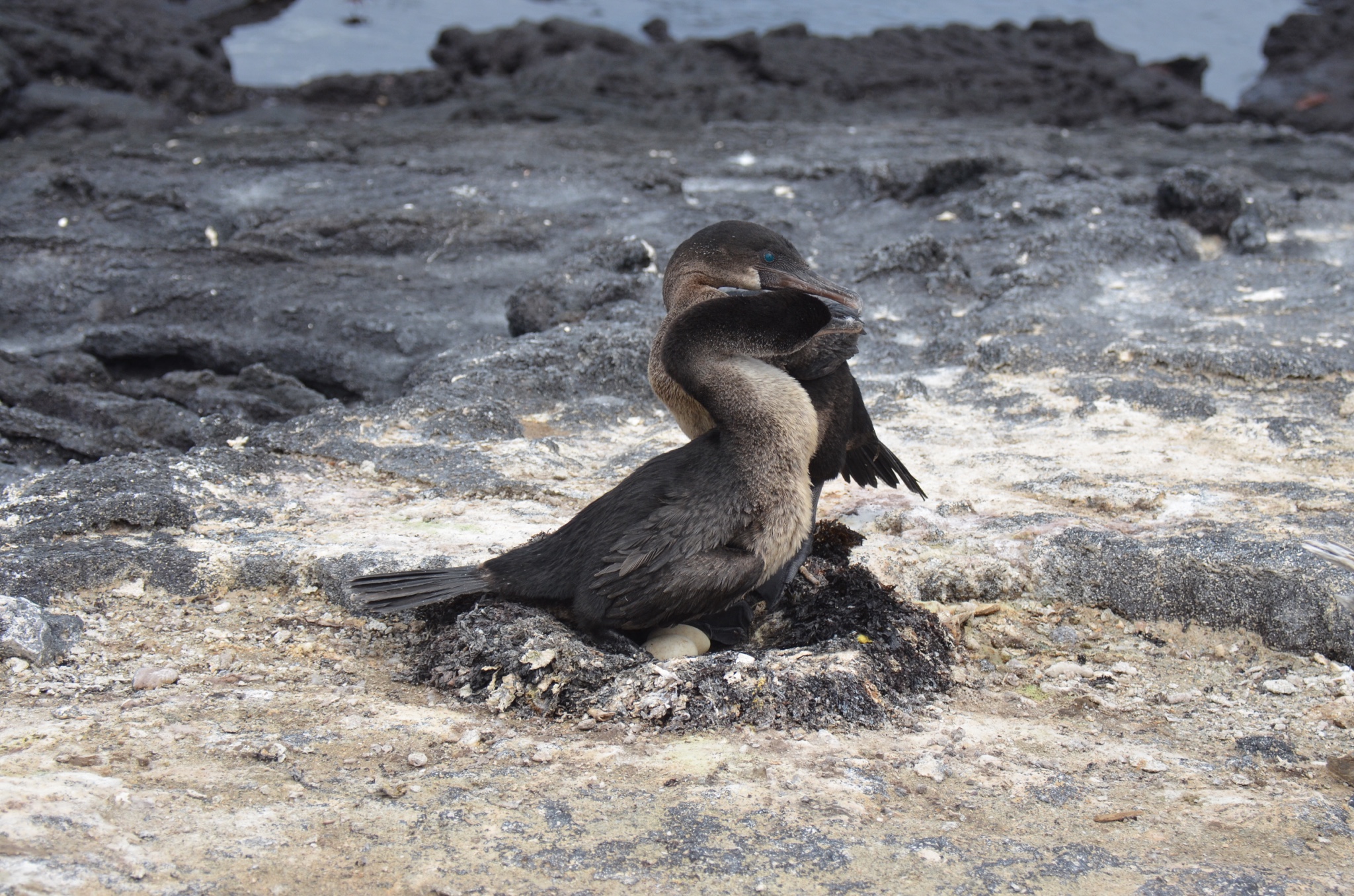
I took a few candid shots of the people as we sat and listened to the presentation:

The people sell and trade fish (as well as souvenirs):


The President explained how the island is built, and Gilbert translated into Spanish and English. The base of the island is a giant sod root ball, which must be acquired from a site 6 miles away. It’s hauled into place by motor boat. The sod ball floats like a cork because it is comprised of 80% roots and organic matter, 10% soil and 10% gases.

The sod must be cut into manageable sizes for the journey: 30 feet long by 15 feet wide by 6 feet thick.

Once in place, the sod segments are tied together with rope. In olden days the rope would have been made from reeds or other organic material. Now it is made from nylon. Because the root is still alive, it will grow and bind back together within six months. Reeds are planted to help bind the root ball together.

On top of the base, reeds are placed, in a criss-cross fashion, three feet thick:
The reeds must be compacted, and the island residents play soccer and other games on the top of the island to tamp down the reeds. The reeds must be replenished every 16 days! The houses on the island are small and can be easily lifted and moved to one side so that the new reeds can be placed under them.

The President dug a small hole with his hands to show us the soft, wet rootball under the reeds:

On the right is a replica of the original pre-Inca hut, which is no longer used. Now the people live in the more square dwelling on the left:
The kitchen is placed on top of a stone, so that they do not set the entire island afire:

At the end of the presentation, the President asked us what else would be “needed” on this island. We shouted out various answers: food? water? money? schools? No, no, no, no. None of these was the correct answer. Finally, one of the men said, “Anchor?” Of course! A man-made floating reed island needs an anchor or it will float away. The President and our guide demonstrated how the island is anchored to the lake floor, and the anchor ropes are weighed down with rocks so that the boats can pass over:


The people speak Aymara (not Quechua). Most are Catholic, although the Seventh Day Adventists coverted at least one island and built a school there. There are between 55 and 70 floating islands. Their numbers are actually on the upswing, mostly due to income potential from tourism. An island will last about 30 years, after which the residents set it on fire and build another in its place.

The white-stalk end of the reed is edible, and we all got a taste. They were very moist and refreshing and about the consistency of celery with a slight cucumber taste.


The reeds are also broken open and used as cold compresses.


They are also used for handwashing.


Best of all, when you are finished, just toss it down on the ground. It’s part of the island.

The president showed the various reed boats that are used for fishing and transportation.


They loved to joke about the one called the “Mercedes Benz.”

The real Mercedes Benz reed boats are made with 2,000 plastic water bottles inside, the ultimate in recycling.

The president showed us his duck gun and success from the morning hunt:


After the demonstration, we were split into groups and taken into different huts. Our hostess immediately began showing us her work, simple tapestries. I found something I liked and asked her the cost. She took her fingernail and scratched the number onto her other hand. I bargained a bit, and it was mine. I’m not sure what I am going to do with all the things I have bought on this trip.

We are inside the hut getting the sales pitch:

Bagging up my purchases:
The view of the hut. I am not sure whether anyone really lives here or this is just the sales showroom:
The doorway is small:


Our guide asked if we wanted to take a ride in one of the reed boats. Of course, everyone did. For the price of 10 soles ($3.50) each, we piled into the reed boat, and an old man sent us gliding along in the reeds and shallow waters of Lake Titicaca, using a long pole for propulsion.

The floating island we just visited:
 
Hey, how come their boat has a nice serpent head and ours doesn’t? I wonder if their ride cost more soles.
Ah ha! A speedboat.
Jonathan, Greg and Genene shared very bad puns and jokes (groaners) along the way.
It’s probably pretty easy to fill your stew pot with duck meat around here:
There are plenty of reeds around for replenishing the islands:
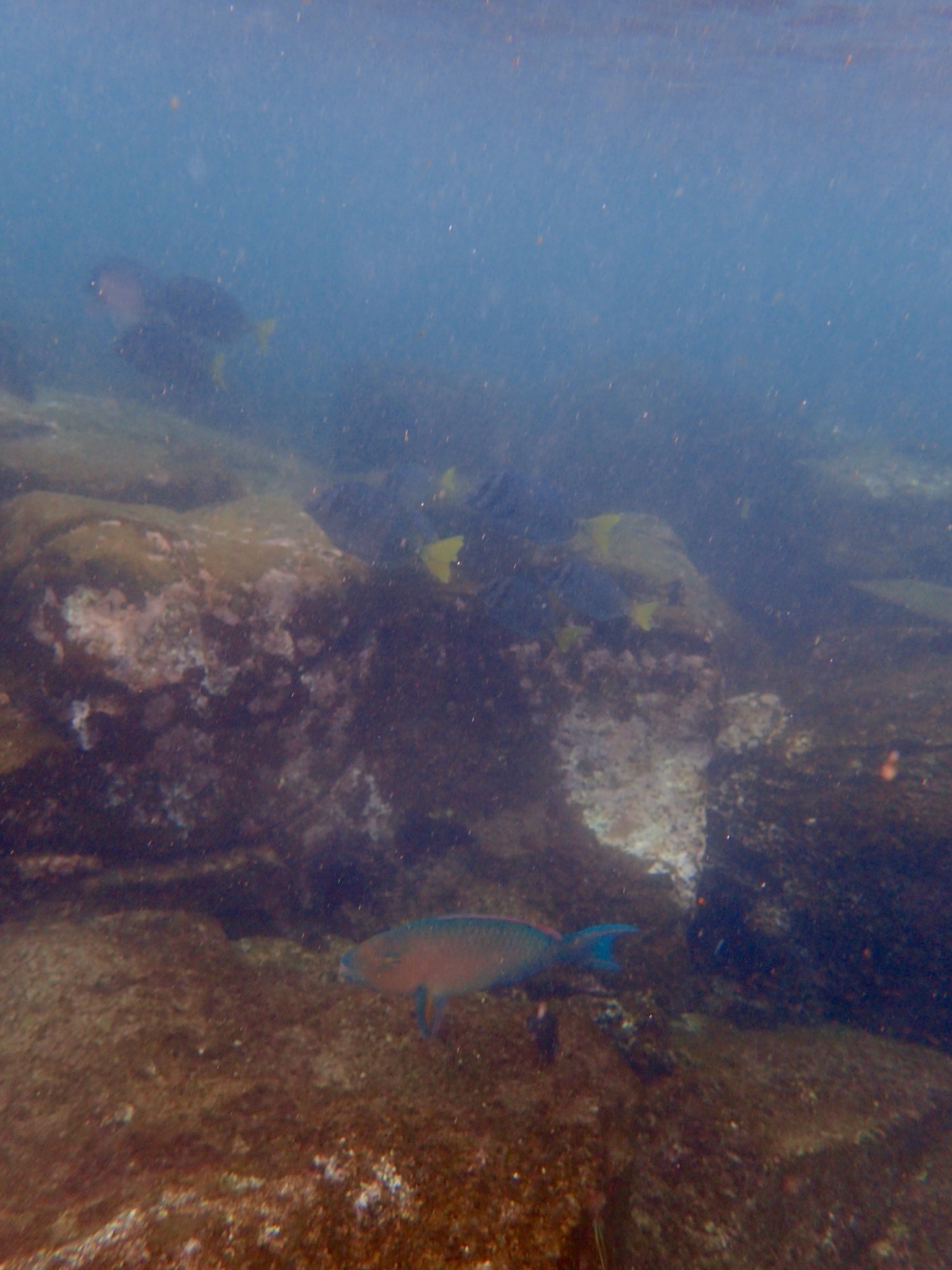
Our reed boat “driver” had an interesting, rugged face:


The ferry met us in the middle of the water and picked us up, and so we were off again.

We motored along for another hour or so until we got to the island of Taquile. The people came down to meet us at the gate and give a traditional greeting:


The people of Taquile Island are known for their textiles. The intricate weaving and knitting is done by both men and women, and they maintain the cooperative lifestyle of their ancestors. The island is still run today by the ancient Inca moral code: “Ama sua, ama llulla, ama qhilla.” (“Don’t be lazy. Don’t steal. Don’t lie.”) Not a bad code for any society.

 
This bag carries the coca leaves, which are traded by the the islanders in greeting:
Trading coca leaves:
Their shoes are made from used tire rubber:


We got a demonstration on their weaving techniques. Married people wear a marriage belt (see below), which attaches two different types of weaving. The hard belt (black and white) is made by the men, while the fine weaving of the softer belt is made by the women. The belt also serves a useful function. The people must carry a lot of heavy items long distances, and the belt serves as a back support. It is cinched low and tight across the lumbar.

The next photo shows a Taquile calendar, which can take three months to make. Gilbert went through the significance of each month of the year: festivals (Catholic and Inca), planting, harvesting, crop rotation, Independence Day (those celebrations last a month). We learned some interesting, random facts about their culture during this presentation. The depth of the fish eggs is used to predict rainfall and plant crops. It is considered to be bad luck for human figures to be placed on the calendars and other weaving, so humans are represented by birds. Couples live together for 3 years before marriage, unless the babies start coming, in which case they get married immediately. Marriage lasts forever. There is no divorce. December is a time of celebration in their culture as in ours. Relatives come home for Christmas celebrations, bringing money from the mainland and gifts for the children.
“Mom, fix my sleeve!”
The pompon on the hats is large and colorful for single men and smaller for married men. It is worn on the right side of the head if looking for a girlfriend and on the left side if taken. On the back means “not interested right now.” A married man’s woolen cap is woven so tightly that water can be carried in it. The leader’s cap has all the colors of the rainbow, like the Inca flag. Married women wear a red shirt.
They demonstrated how they make a kind of soap out of a native plant. When they crush the tree leaves, it looks almost like guacamole. It makes suds just like soap, and it is used to clean wool.
 
Makes me want a bowl of chips and a margarita:
Suds:
Wool is added:
and scrubbed:
Rinse:
Before and after:

They showed us other native plants used in their daily living. Genene particularly loved the smell of the Andean mint, which is rubbed between your hands to release the oils and then sniffed to clear the head and help with sinus problems, altitude sickness, etc.

We got a music show. These men and boys will never make American Idol, but the performance was musical, heartfelt, entertaining and interesting.

They marched this way:
And that way:

They showed us their garden tools. They called this the “Andean tractor.” It looks like a hand plow to me.

This is a sod buster.

My dad would call this one a grubbing hoe.
The implement is tied to the handle with leather:


The ladies continued to weave.

A blanket like this can take up to four years to finish!
I love watching their hands. Look at the fine, intricate detail work that must be done.
Is that a bone she is using to separate the threads?


Of course, they wanted to sell us their wares, which were carefully laid out:


I wanted one of the calendars, but I saw only one, and the price was too high. For once, I paid attention and got lucky. A lady wandered up late and began unwrapping her wares. I went directly to her and found a Taquile calendar. Her price was reasonable, and it was mine! More stuff!

Greg wanted a chullo, the traditional Peruvian wool hat you see with the ear flaps. In the end, he wouldn’t pay the price for it. Probably a wise choice anyway. How often do you get to wear a big woolen cap in Houston?

This lady flashed me a winning smile just before we left:


After the second stop, we had another 90 minutes or so to get to the hotel on the island. I think everyone on the boat except the skipper went to sleep.

Land ho!


We arrived at Suasi Island about 12:45 PM and docked. Suasi Island is a private 106-acre island on Lake Titicaca. There is only one hotel on the island, the Casa Andina Private Collection Hotel. It has only 45 rooms and is designed and built with local materials, such as stone, adobe and tiles. Terraced gardens overlook the lake. It is a beautiful, serene place.

We were met by the hotel guide and told the walk to our hotel would take about 10 minutes, and the trail went straight up the hill. That was a wake-up. They used four-wheelers and trailers to haul all our gear up, so at least our load was light. We were all huffing and puffing.


Lunch was barbeque and buffet. We all had the alpaca, and it was tender and delicious.


After lunch, the kids found the game room and were soon laughing away as they played foosball and pool. Genene needs some pool lessons from her Uncle Alan, who used to be quite the shark in his day. She would not take any advice from us, as usual.

We took a quick rest and then met the guide for a walk to the top of the island for sunset.

The kids strike out ahead:
We passed the alpaca pen. Our guide told us a sad story about how an alpha male alpaca had knocked down a lady tourist and was “sacrificed.” I don’t know the details, but the lady probably had it coming.
All right, Mr. DeMille, I’m ready for my close-up!
We were lucky enough to see vicuñas on our walk. The vicuña is a camelid native to Peru, and they are not domesticated. It is a relative of the llama and is believed to be its wild ancestor. Vicuñas live in the high alpine areas of the Andes. They produce small amounts of extremely fine wool, which is very expensive because the animal can only be shorn every three years, and has to be caught from the wild. When knitted together, the product of the vicuña’s wool is very soft and warm. The Inca valued vicuñas highly for their wool, and it was against the law for anyone but royalty to wear vicuña garments. At one time they were endangered, but conservation efforts have put them on the comeback trail. The vicuña is the national animal of Peru; its emblem is used on the Peruvian coat of arms. When we spotted them, I popped into safari mode and got a shot of this one on the run.
Genene and Jonathan jousted with their walking sticks:
 
Our guide kept apologizing because there was rain falling afar (not on us), and he said there would be “no sunset.” He tried to turn us around before we began the climb to the top, but we were not to be deterred.
The kids went out front:
 
The view from the top was very nice.
It was cold at the top:
Our hotel can be seen at middle right:
A view of our private island:
Probably discussing Minecraft:
Lake Titicaca is vast:
Family portrait:
Our guide was right. It was cloudy so the sunset was not spectacular on this day, though I can imagine that on another day, this vista might rival the Serengeti sunsets. It was still beautiful, and I enjoyed watching the light change minute by minute. It was nice to get out and stretch our legs.

Greg was COLD.
Genene and Jonathan played together all afternoon.
As in Machu Picchu, I found myself taking the pictures of the same vista over and over, because the light changed each minute. My apologies for the photo overload, but I love the clouds and the changing hues of pink, orange, blue:
As the last light faded, we made our way back down the hillside:
The lights in the village on the mainland began to flicker on:
Our hotel beckons:
Last one:

Before dinner, we sat in the main lobby area and shared riddles and jokes with Bob, Cynthia, Malia and Jonathan. One of the great things about traveling is making new friends. Dinner was buffet-style at the hotel. Genene still does not like the quinoa, but we found plenty of things to love on the table anyway.

The hotel is an ecolodge, which means it has a low environmental impact. The hotel was solar powered, and there was no heat in the rooms. There were fireplaces in the common areas. Everyone in the hotel charged their iPhones and electronics at one big charging station in the lobby. There were not-very-bright lights in the rooms, but the solar powered electricity went completely off after a certain hour. We had a candle in our room for light in the middle of the night. It was rustic and charming and cold! We had heavy, fine bed linens, and they tucked a hot water bottle into the bed. It was too cold to sit around in the room but toasty warm in the bed, so after dinner we all climbed under the covers and turned out the lights at 9:00 PM. It had been a long day filled with a lot of travel. Getting to Lake Titicaca and the islands was not easy. However, I am pleased that we included them in our itinerary. I found the people of the Uros floating islands and Taquile Island fascinating, like a living museum. It was worth the effort to visit this beautiful place.

Adventures in Peru 2014 Part 14: Leaving Cusco and Heading to Lake Titicaca

Thursday, August 7, 2014

We are leaving Cusco today. We saw more of it than intended, but we could have easily stayed longer. It is a nice city and a good base of operations to see the Sacred Valley and many archaeological ruins.

Our plane did not leave until 2:30 PM, so there was no need to wake up at the crack of dawn. We slept until 7:00 AM, got up, and started packing. We spent three nights in this hotel, so we had time to spread our gear to kingdom come and back; packing took a while. Also, we had bought some souvenirs, just enough to take each of our bags to the 50 pound limit. We had to keep weighing the bags and taking a little out of one and putting it into another before we got all three under the limit.

Last views from our terrace:

This was our view of the hills of Cusco from the bedroom window:
 

Check-out was at 10:00 AM, so we tucked our bags into storage and went down to Plaza de Armas just to sit on the park benches and relax.

Down the hill we go. Look at the Inca stonework on the left:

Plaza de Armas:
Blanco Cristo sits on the edge of Sacsayhuaman:
The street light posts use the sacred puma motif:
Beauty Contestant No. 1, the Catedral, on the left; Contestant No. 2, Compañía, on the right (those naughty Jesuits!):
Which do you like? Catedral?
Or Compañía?
Catedral?

Compañía?

Catedral?!

Compañía?!

Catedral?!
Compañía?!
Catedral?

Compañía?!

Catedral?
 
Compañía?

Hey look! A Starbucks! We can all agree this doesn’t belong on the plaza.
I’m no Pope, but I point at the Catedral!


Genene creates a bit of a sensation here. The first time we observed it was with Carlos on the day trip to Ollayantaytambo last week. Families want to have their photos taken with Genene. I am not talking about the people who dress in traditional garb and try to get you to pose with them and their lambs or llamas and then ask for money. These are regular Peruvian people in street clothes. It looks like they are on holiday themselves, with cameras dangling from their necks. Many of them politely ask if they can have a photo with Genene. Carlos explained that her blonde hair and blue eyes are what the people find interesting. Anyway, today in Plaza de Armas, Genene was like a rock star. She quit counting at the 13th request for her photo. Entire families would crowd to the bench. They would sit their smallest children down next to Genene. A couple of times we saw people “sneaking” pictures. They would ease around behind the park bench and pretend to put the cathedral in the shot, but you could see the photographer and the subject communicating as if to say, “Get closer to the girl.” Genene said that she did not like it, but I was flattered on her behalf. It also makes me stop and think. I often sneak photos of local people myself. I try to use the telephoto lens and capture them without their knowing. Is it rude? I don’t know, but we experienced a bit of turnabout in the plaza today.

Here’s a stealth picture in progress. The lady sat down on the park bench and her friend is snapping. Greg ended up striking up a conversation with them, so they ceased their ruse and got some posed shots later.
I spent some time walking around the plaza getting candid shots of the people.
This old guy was selling his photographs to people. I am not sure how he did it, but he would take snapshots and then run down the plaza and get printed copies. I like his suit.
We always felt very safe on the streets of Cusco. Police officers were everywhere.
This next sequence of shots is among my favorite from the day. This lady and her little boy are trying to sell little dolls and trinkets on the plaza. There are many people like them in the public areas. As a rule, they were much less aggressive and annoying than, say, the Roma people you find in Rome and Paris, who hound you mercilessly and try to shove things into your hands. A simple “no, gracias” is usually enough to send the Peruvian hawkers away.
She gets out her dolls. “I want to help, Mommy.”
“That one!”
“Got it. Thanks, Mom.”
Helping Mom sell the dolls….
We lingered in the plaza as long as we could, taking in the sights.
We strolled back up the hill to our hotel. Along the way, we stopped to say goodbye to Hatunrumiyoc, the famous “stone of 12 angles.” We had passed it each day on our walks to and from the plaza, and it always drew a crowd. There is usually a volunteer guard posted there who admonishes people not to touch the stone. No one was there today, and we got away with a tiny touch. The original use of the building is unclear, but the common opinion is that the building was the palace of Inca Roca, the sixth Sapa Inca who ruled sometime around 1350. There are many mysteries in this country. There was a major earthquake in Cusco in 1950, and it unearthed Inca walls and ruins that had been covered over by Spanish construction for centuries. The original use of many of these structures is unknown to us now. Cusco is now a UNESCO World Heritage site.
Touching Hatunrumiyoc:

How in heaven’s name did they carve a stone like this and fit it into this wall?

Last looks at the hill we trudged up each day:
Genene and Greg haul it up:
This hill really took it out of us every time we climbed it:


We got back to the hotel and sat in the lobby, waiting for Carla and drinking coca tea. Carla arrived on time and gave us our paperwork for the next part of our journey. Today, we will be traveling to Juliaca via airplane, then to Puno and finally to Lake Titicaca. She gave us our plane tickets and told us that she would be turning us over to a colleague in Juliaca for the remainder of our journey. Carla has become a daily fixture for us. We will miss her calm presence. I still cannot believe that she sat in that endoscopy room with us, translating and taking care of us. She is phenomenal. We took our picture together at the hotel before departing.

The commute to the airport was an easy half hour. Carla took us all the way to the security/boarding area, a luxury we lost in the states after 9/11. There were hugs all around, and she told us that she would call us tomorrow and the next day to make sure we were still doing okay. I will be forever grateful for what she did for us when things went wrong in our journey. That is the true measure of a business or a person. It’s not how we get things done when they are on track and easy: our true colors are demonstrated in how we rise tothe occasion when things go wrong.

The airport in Cusco was clean and bright. We were able to get a light lunch of ham and cheese croissants for all three of us for 18 soles (about $6.31). I dare you to do that in an American airport. While standing in the line for the croissants, I got annoyed with an American lady ahead of me in the line. She was asking 20 questions about how the various croissants were prepared: did they have meat? did they have cheese? I mumbled some ugly words under my breath, “@#$@#$, lady, it’s a croissant. This isn’t fine dining. Just order something!” A young Japanese man just ahead of me in the line starting laughing. I apologized to him for saying ugly things and he quickly replied, “No, it’s okay. I feel the same way.” I forget sometimes that English is spoken and understood by many, many people throughout the world.

It began to rain in Cusco, and the weather had everything backed up. Our flight was delayed by an hour, so we did not get to Juliaca until the late afternoon. Our local guide and driver were waiting for us, and it was easy to get our bags and get on the road.

The drive to Puno took about an hour, and we really feel as if we are at the edge of civilization. Juliaca looked much more “rustic.” The buildings were smaller and built more like shanties.

Our hotel is on the edge of Lake Titicaca. We arrived at night. We are leaving early for Suasi Island, so we will not get much time to enjoy this beautiful place.

A few quick views of the shores of Lake Titicaca, as seen from our hotel:

This hotel room was by far the most spacious and luxurious, as far as the physical features go. (Nothing can compare to Sanctuary Lodge’s service!)
We had a delicious dinner at the hotel and retired back to our room.
Genene jumped in the big bathtub and did not want to get out:
For the price of a few soles in his palm, the bellman came and lit a fire in our room. The place was toasty all night long.

We sail at 7:00 AM tomorrow, so there is not much rest for the weary. Lake Titicaca awaits!

Adventures in Peru 2014 Part 13: Morning at the market and afternoon on horseback

Wednesday, August 6, 2014

We were supposed to start our day with a horseback ride. Carla met us in the lobby at 9:00 AM with some bad news. Our guide was ill. She offered to reschedule the event for afternoon with another guide. That worked for us. It simply meant inverting our plans for the day.

We decided to spend the morning at the souvenir market. We also had an errand to run. The medical clinic had promised to drop off all Greg’s test results at the hotel last week, but that never happened. The clinic was close to the market, so we thought we would drop in and take care of it. After all, who wants to have a second endoscopy?

On a lark, Greg decided to check in the front lobby of the hotel where we had stayed on our unscheduled visit in Cusco last week. Voila! The test results were waiting there for Mr. Gregory Gordon! We were so pleased that it was that easy. It will be interesting to see if our local doctor in Houston is resourceful enough to translate the results into English.

We strolled on to a large enclosed market and wandered from stall to stall. Different proprietors have different styles. Some leave you alone to look. Others start jabbering at you as soon as you get close to their wares and push things into your face. I wonder if that really works on anyone. I find it off-putting and leave quickly when I get that sort of bum’s rush. Genene found some earrings that she wanted, and I found several souvenirs. The trinkets are very reasonably priced, and bargaining is expected. I am not very good at that and always end up with the same annoyed feeling that I get when buying a new car. I usually confine myself to making one counter-offer and then meeting them in the middle.

We ambled back to our hotel loaded with our bags of trinkets and ate leftovers on the terrace outside our room. We all settled in for an afternoon siesta, and I worked a little on my blog.

Our guides met us at the hotel at 2:00 PM and drove us to Sacsayhuaman. We previously visited that site on the first afternoon with Carlos, but the ruins cover many acres, and we were headed for a totally different area today.

Our guide, Grimaldi, rode horses with us, and a young man followed along beside our horses. He carried a small switch and he made noises with his mouth and hands to encourage the horses to move. I was glad that he stayed very close to Genene’s horse the entire journey. Genene has taken riding lessons and sits her mount well, but I was grateful for the “insurance” of having someone nearby in case of trouble.

The horses were Criollo, which is a small horse native to Uruguay, Argentina, Brazil and Paraguay. Our guide told us that the big Peruvian Paso horses, known for their smooth gaits, were worthless in this high mountainous area. He told us that they would “just die here from a heart attack.” The Criollo horses are not much to look at. They are small, even scraggly looking. They are said to be among the best endurance horses in the world, giving the Arabian a run for its money. They are known for their ability to live in harsh conditions and are frugal eaters. I felt a little sorry for my mount because I thought he seemed to small for my ample American self. I should not have worried though. The little horse was as sure-footed as a mountain goat and walked easily up and down steep hills. None of the horses had shoes, but their hooves were sound and strong. We rode with Western tack, and I had a silver saddle horn, which made me feel very Spanish.

We posed before the ride started. Putting our helmets on over our boonie hats and baseball caps only adds to our glamour:

The cowboys discuss their mounts:


We rode some on the road and and on dirt trails:

Genene enjoyed climbing in the rocks:
 
Grimaldi forges ahead:


Our first stop was at the Temple of the Moon. The temple looks like a large hill from one side, and there are caves in it.

It looks like this from the “back side”:

When you go around, you find the temple and caves carved into the rock:

There are altars inside the caves, and cracks in the sides and top allow moonlight to fall inside. At least one of the crevices is aligned so that the moon can be seen during solstice.
There are carvings in the face of the rock. What went on here is a mystery lost in time. It is likely that there were rituals and sacrifices and offerings. Grimaldi told us that people still sneak into the caves at night to make offerings to Pachamama (Mother Earth).

There were also a great number of tunnels and caves around the site. In Quechua, the tunnels are known as “chincanas,” translated as “a place to get lost.” Some people claim that Inca mummies were secreted in the passages. Others claim that the Inca hid their treasures from the Spanish in the underground mazes, and that the treasures are so well hidden that they have never been found. Grimaldi repeated the local claim that the tunnels go all the way down the mountainside into Cusco and were used by Inca to hide treasure and travel secretly. We could go a little ways into each of the tunnels before being engulfed in complete darkness. Grimaldi told us that the Peruvian government has blocked all the tunnel entrances for protection of people. He told us that “several years ago” a group of young people had tried to navigate the tunnel system, never to be seen again. I tried to verify the story on Google and could not confirm whether this actually happened. What I did find was a lot of other similar legends about people being lost in the labyrinth. My favorite one is this one I found on another blog:

“A treasure hunter slipped into the tunnels outside Cusco. In his search for riches, the man became lost and wandered through the maze of tunnels for several days. One morning, about a week after the adventurer had vanished, a priest was conducting mass in the church of Santo Domingo.The priest and his congregation were suddenly astonished to hear sharp rapping on the stone floor of the church. Several worshippers crossed themselves and murmured about the devil’s demons. The priest quieted his congregation and directed that a large stone slab be removed from the ancient floor. The group was astonished to see the treasure hunter come up out of the tunnels carrying a gold bar in each hand.”

Searching for Inca gold:

 
The vistas were stunning. Cusco was laid out below us in all its glory:
Genene followed Grimaldi into the crevices and tunnels without hesitation. I found some of the spaces tight, to my dislike. A couple of years ago, I had a shoulder MRI and discovered that I do not do well in confined spaces. I never balked during this tour, but I was always happy to come back out into the sun.
 
Can you see the serpent carved into the rock wall here?
What is that white spot in the field?
Oh, it’s some hippies. Wonder what they are up to?
 
 
I am not sure how this topic came up, but Grimaldi wanted to tell us a little about the native people of the Amazon rainforest. We are not scheduled to see this area of Peru. Perhaps we will get it done on another trip. Anyway, Grimaldi was trying to tell us about the tribal people. It took a while for us to understand because he pronounced the word tribal as “tribble,” and I kept having visions of the prolifically fertile little furry creatures from the long ago episode of Star Trek. How absurd. I KNEW he couldn’t be talking about that! When we finally understood his meaning, we were able make a little more sense of the story. Grimaldi told us that the tribals like to have many wives, and he leered as he told us how lucky the tribal men were. He asked if we had anything like this in our country, and Greg said, “Yes, we do. We call them Mormons.” I had to mop clean-up on that and tell Grimaldi that not all Mormons practiced polygamy and that in the United States, polygamy was illegal. Grimaldi looked a little wistful. I think perhaps he wishes for the days of old, or maybe he just wants to be a tribble.
We finished our tour of the ruins and got back on our ponies. I was impressed with the scruffy little horses. As we rode through the eucalyptus groves, they picked their way with ease. When the hillsides were steep, they chose to switchback on their own, without any guidance from us. They knew exactly what to do.

I wanted to mention how variable the weather is at all times. When the sun is high in the sky, it can be very warm. In fact, the Andean sun burned me right through my clothes. On several nights, I came home to find my back and shoulders red, when I had worn long sleeves all day. However, as soon as the sun goes behind the clouds or a mountain, it quickly becomes cold. As we rode into the late afternoon, the wind picked up and it was quite brisk.

We finished in the late afternoon and took a last couple of photos with our mounts and guide:

We got back to our hotel in San Blas as the sun was going down. I took a shot from the terrace. I love the warm terracotta colors of the roof and the pots.

We were all a little tired of the Peruvian spice and went the “comfort food” route. Our guide books gave a glowing review to a nearby pizza joint, La Pizza Carlo, and so we walked down the steep hill in search of chow. We found the place, and it was charming. There were only four tables in the restaurant.

We ordered a Hawaiian pizza and watched as the cook cut open the fresh pineapple and loaded all the toppings. The wood burning oven was in the dining room with us, so we could keep warm and watch our meal cook:

We couldn’t take away any leftovers because we travel tomorrow, so we sucked it up and ate every single bite. Sacrifices!

On the way back up the hill to San Blas, we bought some souvenirs from a shop we had gone into several times along the way. There was a little mirror that I had my eye on, and in all our shopping in Cusco, we never saw another one like it so I had to pounce.

We will be sad to leave Cusco but are looking forward to seeing Lake Titicaca. Doesn’t everyone love to say “Lake Titicaca”?


Adventures in Peru 2014 Part 12: A Mountain Bike Ride

Tuesday, August 5, 2014

Our pickup was at 8:00 AM this morning. Carla met us in the lobby with the necessary tickets, introduced us to our guide for the day and wished us well. Our guide was Marco Aurelio (gotta love that; we called him our Roman emperor). Our driver was piloting a very large van, on top of which were five mountain bikes. We would be touring the countryside by car and bike and visiting some archaeological ruins along the way. Our chef, Wilbert, also rode along, as did a bike mechanic, Jonathan. Enigma does an excellent job in providing fully staffed adventures. I had no idea that the three of us would be traveling each day with so many other people to help us.

On the way out of town, we stopped at the same market as the whitewater rafting guides had used. Marco told us that it was a favorite stop of many guides because there was easy parking out front and a bathroom inside. On the drive out, Marco explained the adaptions of the local people to the climate in which they live. He pointed out to Genene that he has high cheekbones and a pouch of fat under his eyes. This helps protect his eyes from the harsh Andean sun. It was interesting to hear him discuss adaptation in terms of human beings. In Genene’s science class this year, they studied the same issue as it relates to animals. Genene loved studying about the cheetah, with its teardrop stain under the eye to help it spot prey in the strong Serengeti sunlight. It is fascinating to see how all of us adapt to our surroundings.

Our first stop on the tour was at the Inca ruins at Tipon.

We immediately saw a large hummingbird, a good omen.


The Inca ruins had been ceremonial place–a huaca (sacred place) for the worship of water. The terraces are fine and elaborate. Many spring-fed aqueducts were built throughout the grounds, and all are still running today. The spring runs from the sacred mountain that looms over the site, Pachatusan (in Quechua this means “cross beam of the universe.”) Waterfalls were nestled in the walls and corners, and channels are cut through the grounds. The whole place sounded like rushing water. Marco explained that the Inca did not really recognize four seasons as we do. Instead they divide the year into two seasons: 1) the rainy season, a time for planting, tending and harvesting the fields; and 2) the dry season, a time for construction. It is still so today in Peru. We are here in the dry season, and all kinds of construction can be observed everywhere. People work on the roads, on their houses, on their animal shelters, etc.

Can you see the water tumbling at the corners of the walls?
 

The woman in the terraced fields gives you perspective on how large this place is:

The aqueducts are uncovered in certain areas so that we can see how the water flows:

We climbed back into the van and headed out.

These are the kinds of hairpin turns we navigated all the time:


Our second stop Oropesa, a village devoted to the making of “pan chuta” breads found only in this area.

We went into a family compound through this door:


The inside looked like this. Notice the eucalyptus wood stacked up all around. It gives the bread a nice flavor:


We stopped near the oven and got a demonstration on how the bread is made.

We saw the wood burning oven:


The bread is put into this warm room to rise:


My mom has a mixer that looks about like this, just a little smaller:

The equipment was not quite state of the art:
 

We bought loaves from this lady:


The bread was very fine, sweet and delicious. We tried two different kinds. One was a wheat bread, only with the consistency of cake. The other loaf was more yellow, and I think a perhaps corn flour was used. Each family marks its loaves with a particular pattern of raisins, olives, slashes or other distinctive feature, so that their customers know whether they are getting the real deal. The bread is a point of family and community pride, and contests for best bread are held each year. Competition is fierce.

Breads are also specially designed for events:

Loaves are stacked up for sale:

Genene said that she wanted to have a birthday party and serve nothing but this cake. It was a geat mid-morning treat.

Marco explained that the people of this village can be seen on the streets of Cusco, selling their bread. They wear this particular uniform and hat so that purchasers may know that they are from Oropesa:

According to Marco, the people of Oropesa are “mixta,” a mix of Spanish and Inca. They bake a mean loaf of bread!


After this stop, we drove a little ways and parked on a dirt road and unloaded the bikes. Marco was our guide, and Jonathan rode along in case there were mechanical issues on the bike. The van shadowed us as well. We rode on dirt roads and on tarmac. We encountered people moving their cattle and sheep from place to place and had to stop our bikes until the livestock could pass. Everyone on the road wished us a good day and a good journey. Greg was wearing a GoPro, and if we ever figure out how to download it, I will do a supplemental home movie blog.

Greg is feeling much better by now. I’m glad that Carla “didn’t cancel nothing.”


We rode our bikes around the edge of Huarcarpay Lagoon, where we saw people fishing and many birds on the wing. There were reeds at the lake’s edge, and the sound of the wind in them rushed like running water. The total ride was less than an hour and was fairly easy, although there were a few small hills and the occasional strong wind.

We stopped at a couple of points along the way to watch the bird life:

We saw people fishing:
More fishing below. At one point on the road, we saw a young boy wearing nothing but a shirt and underwear. I think that was his “fishing attire.”
Sculling on the lagoon:
We got to our “camp” at around noon and took a short break. You can see the camp from across the lagoon in this shot:


While the chef fixed lunch, we rode in the car up to the archaeological complex of Piquillaqta (little city), a pre-Inca trade center. Marco explained that there was a strong, highly organized civilization before the Inca. These people, called the Huari, had controlled the area between 500 and 1000 AD, many centuries before the Inca showed up. They built much of the road networks and aqueducts that the Inca would later use, though the Inca and their descendents do not like to admit it. The Huari controlled the area and all the goods supplied. From this centrally located village, they could control the flow of goods from the Amazon, the coast, and the mountains. The site is spread over about 116 acres.

The floors and walls were made of mud and stacked stone and were covered with plaster. They would have gleamed white in the Andean sun.
Marco explained that this is the fruit of the molle pepper tree. We had several dishes that were flavored with this tasty spice. Greg was not supposed to indulge, but sometimes he did so anyway.
The Huari were an advanced civilization, but the Incas ran them over and not much is known about the Huari culture. Depending on who you ask, Piquillaqta translates as “little city” (a name the Incas would have given to minimize the Huari accomplishments) or “place of the flea.”
Can you see the horizontal lines in the side of the mountain? These are old, non-functional aqueducts:


By the time our short tour was over, lunch was ready. Our chef today was a genius. He made a special meal for Greg, with less oil and spice. Genene and I got the full complement of spice and grease, for which we were appreciative. There was a beautiful salad, with fresh tomatoes and avocadoes. There was a tender cooked chicken with spicy sauce, quinoa salad with carrots and raisins, potatoes and eggplant, and pasta salad with broccoli. It was all to die for. For dessert, Genene was thrilled to have the tres leches cake.

I annoy Genene again by getting her photo outside the toilet tent. Moms can be so aggravating:
Yikes. More rolls than a bakery here:
Greg won’t smile if he is posing for a photo, but I managed to catch him giggling with Genene:
My world traveler, with a map for a do-rag:


We felt like beached whales after that lunch. The staff rushed to pack our camp site, and we got back into the car and headed back to Cusco. I wanted to try the chicharrón, fried pork skins found in one of the villages outside of Cusco. We had passed by on the way out of town.

Marco got us a small sack full from a street vendor:

I enjoyed the snack but was surprised that Greg did not. Genene was asleep and missed the chance to savor the crispy skin, which was akin to a potato chip.

We got back to our hotel at 4:00 PM, washed up and rested.

Here’s the view from our terrace at the hotel:

Can you read the quote on our wall? It’s something akin to carpe diem, I think:

After our afternoon rest, we strolled down past Plaza de Armas in search of dinner. I took a few night shots along the way.

Everyone told us that this guy, situated outside a shop near our hotel, was “good luck.” We could have used him earlier in the trip!

The Catedral in the Plaza de Armas was built on top of an Inca palace using blocks removed from Sacsayhuaman:


Almost every night we heard fireworks in Cusco. There always seems to be a party going on.


Marco had recommended that we try some Chinese food. He told us that Peruvian people love to eat and love spicy things, and like in any place, even the ethnic food takes on the flavors of the area. He told us that the Chinese food would have a Peruvian twist. He recommended La China, and we had a wonderful meal there, although I cannot say that I noticed any particular local twist. It was simply excellent Chinese food. I had a salmon baked on a plank with ginger and garlic. I also had two mixed drinks called La China Hypnotica. Genene had a chicha morada, a drink that Marco recommended “for energy.” It was sugary, purple and delicious. Greg had a glass noodle dish with squid rings and vegetables. He claims it was not spicy. Genene had shrimp and noodles.

We waddled back to Plaza de Armas and headed up the hill toward “home.”
This is Iglesia de la Compañía, built by the Jesuits in 1573. It sits just across the plaza from the Catedral. It was also built atop an Inca ruin. It rivals the Catedral in beauty and prominence in the plaza, which was intentional on the part of the Jesuits. The archbishop of Cusco did not like this competitor to the Catedral and asked Pope Paul III to arbitrate the squabble. Of course, the pope sided with the Catedral, but by the time the decision reached Cusco, Igelsia de la Compañía was almost finished, and so it stands today.
You can see Greg and Genene at the Catedral here:
Can you see how the street goes sharply up, up, up to San Blas?
We stopped often on the steps, huffing and puffing our way:
Back to our hotel, carting the leftovers (because you know we are not going to waste any food!):

It was a great day filled with exploration and adventure. It was good to have Greg back in the bike saddle and feeling good again. Genene, as always, was a trooper and ran us all into the ground. I don’t know what was in those China Hypnotica, but I was feeling no pain for the rest of the evening!